An Air Cushion Patrol Seaplane Was Once In The Works With The U.S. And Japan美国和日本曾计划联合研制一种气垫巡逻水上飞机。
Grumman and Shin Meiwa worked together to propose an aircraft that combined aspects of a jet-powered flying-boat with an air cushion vehicle.
新闻视频
Updated Jun 18, 2021 4:46 AM EDT
A 70-ton jet-powered maritime patrol aircraft that could operate from runways peppered with bomb craters, unprepared airstrips, scrub, water, or even ice? The Grumman/Shin Meiwa ASR-544-4 proposal could have provided Japan, as well as other operators, with a remarkably versatile, high-performance submarine-hunter. Sadly, perhaps, this Cold War project never made it beyond the drawing board, but it was a radical concept that warrants further examination.
The joint American/Japanese program was based around the potential of a novel concept that had been developed by Bell Aerosystems, the Air Cushion Landing System, or ACLS, which was apparently first tested on a Lake LA-4 light amphibious aircraft.
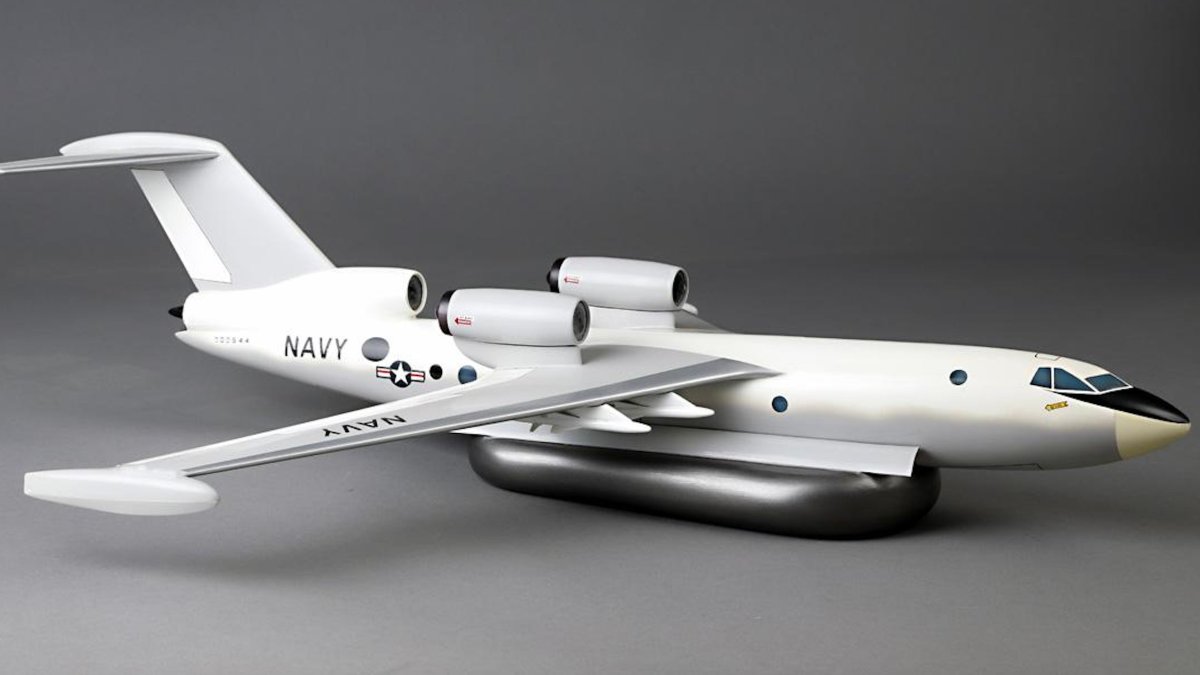
A desktop model of the Grumman/Shin Meiwa ASR-544-4 in U.S. Navy markings., John Aldaz Collection via Twitter
In the late 1960s and early 1970s, there were a number of experiments to fit aircraft with the rubber-raft-like ACLS gear, which promised to make possible operations from almost any surface. In this way, an aircraft fitted with ACLS could be truly amphibious without the requirement for wheeled landing gear, skis, floats, or even a boat-like hull.
The ACLS employed an inflatable bag under the aircraft that effectively transformed it into an air cushion vehicle once on the ground (or water). This was inflated using compressed air, released through thousands of nozzles on the inside of the rubber skirt, creating a layer of air that the aircraft literally floated upon. Integral ‘pillows’ were deployed to slow the aircraft down when landing, acting as brakes. When the aircraft was parked or floating on water, an internal bladder sealed off the nozzles.
To test the idea for military applications, the U.S. Air Force and Canada’s Department of Industry, Trade and Commerce teamed up with Bell to adapt a de Havilland Canada DHC-5 Buffalo twin-turboprop short takeoff and landing transport with ACLS. Two additional turboprop engines were fitted to provide compressed air to inflate the ACLS. Known as the XC-8A and nicknamed the “Puffalo,” the modified air-cushion Buffalo first took off using ACLS in March 1975. It’s unclear , however, if it ever landed with a fully inflated system. Overall, though, it seems the main concern with the project was the service life of the aircraft’s rubber airbag, which proved prone to wear and tear on harder surfaces.
The XC-8A “Puffalo” taxies on its ACLS gear., Bell
Meanwhile, the ACLS was being eyed by Grumman and Shin Meiwa as a way of greatly improving the versatility of their planned maritime patrol aircraft. In the ASR-544-4 proposal of 1973, the aircraft would likely have been used mainly from the sea, but it was expected to be able to tackle other surfaces too, including improved and unimproved runways.
With an elegant 104-foot high-mounted swept wing and a swept T-tail, the ASR-544-4 was broadly reminiscent of the Martin P6M Seamaster jet-powered flying-boat prototype of the 1950s. The engine installation was unusual, with a pair of turbofans mounted above the wings, close to the wing root, and a third engine buried in the tail. The exhausts of the two over-wing engines could be deflected 15 degrees downward to improve takeoff performance.
The 111-foot fuselage had space for a crew of 10, together with their workstations, a rest area, bunk, galley, and lavatory. Mission equipment was planned to include radar in the nose, magnetic anomaly detector in the wingtip floats for finding submerged submarines, plus internal sonobuoys. Two separate lower-fuselage weapons bays would have carried up to eight torpedoes, while four underwing stations were also provided for anti-ship missiles.
John Aldaz Collection via Twitter
Finally, the ACLS below the fuselage would have been 44 feet long and 24 feet wide, with a maximum depth of 6.7 feet, and would have retracted fully into the fuselage when not in use. The air needed to inflate the cushion would have come from two “common power packages,” located in the rear fuselage, these same engines also providing bleed air for the boundary-layer control system, which streamed gases over the upper surfaces of the wing for improved takeoff and landing performance. Takeoff from calm water with a headwind was expected to be achieved in 21 seconds, the aircraft lifting into the air after a distance of 1,700 feet.
An underside view of the ASR-544-4 reveals the inflated ACLS and the fuselage weapons bays fore and aft., John Aldaz Collection via Twitter
Performance-wise, the ASR-544-4 would have had a mission radius of 1,400 nautical miles and a maximum stores load of over 12,000 pounds. The planned top speed was an impressive Mach 0.9, which would have allowed it to take up its position on station far quicker than its propeller-driven counterparts.
A three-view drawing and specification for the ASR-544-4., Grumman
Schematic cutaway view of the Grumman/Shin Meiwa design., Grumman
It’s unclear if there was a specific requirement that the ASR-544-4 was aimed at, but the design was expected to be ready for service in 1980, which would have provided the Japan Maritime Self-Defense Force (JMSDF) with a more capable successor to the four-turboprop Shin Meiwa PS-1 and US-1, anti-submarine and search and rescue amphibians, respectively, which entered service in the early 1970s. Interestingly, while the US-1 was a true amphibian, with a boat hull, floats, and wheeled landing gear, the PS-1 was a flying boat that could only alight on water. These aircraft also had a separate engine to provide power for the boundary-layer control system, similar to what was planned for the ASR-544-4.
With a long history of amphibian and flying boat manufacture and service, it seems likely Japan was looking closely at more advanced aircraft in this class by the 1970s. Had the ASR-544-4 been chosen for production, it could perhaps have replaced the land-based SP-2H and P-2J Neptune as well as the earlier flying-boats. Instead, the Neptunes were eventually replaced from the early 1980s by P-3C Orions , a more conventional four-turboprop patroller.
Meanwhile, the JMSDF has continued to operate both land-based fixed-wing patrol aircraft and amphibians, the most recent in the latter category being the impressive four-turboprop ShinMaywa US-2, a handful of which are in service. The impressive ability of the US-2 to take off from short stretches of water is something that The War Zone has looked at in the past . As for the P-3, after upgrade, the surviving JMSDF fleet is now being slowly replaced by indigenous, four-jet Kawasaki P-1 maritime patrollers.
Kawasaki P-1., Japanese Ministry of Defense
However, it’s hard to see that the U.S. Navy, which had already turned its back on patrol amphibians by the late 1960s, would have found a role for the ASR-544-4, although it would have offered a compelling performance advantage, at least in terms of speed and runway independence, compared to the P-3.
While the promised performance and unique operating attributes of the ASR-544-4 are undeniable, it would likely have been expensive to procure and operate. Furthermore, with five turbine engines of two different types, maintenance may have been a challenge. Today, Russia is the only military operator of a jet-powered amphibian of any kind, the Beriev Be-200 , with the first example delivered to the navy last year. Intended primarily for search and rescue, this aircraft is broadly similar in size and configuration to the ASR-544-4, but of course uses a more conventional boat-like hull plus wheeled undercarriage, rather than air cushion landing gear.
The first Be-200ES amphibian for the Russian Navy., United Aircraft Corporation
Keeping the ASR-544-4 serviceable would have been further complicated by its lack of landing gear, likely making some kind of beaching gear (as used on the PS-1) essential whenever it was on land for prolonged periods, with the ACLS uninflated. Even the process of the crew entering and disembarking would have been somewhat tricky, not to mention refueling and rearming the aircraft.
Ultimately, the ACLS did not find any applications that were enticing enough to put it into testing and production, although it continued to be revisited in the United States and elsewhere into the 1990s. Today, the concept is being offered as a means of operating airships from various different surfaces.
A Soviet concept from the 1980s that added ACLS-like landing gear to the Antonov An-14 utility transport:
Interestingly, the ACLS could also provide a solution to the ongoing challenge of creating an amphibious version of the MC-130J Commando II multi-mission combat transport, an idea that the U.S. military is now looking at again closely . There have been previous studies of C-130s using air cushion landing gear and it’s just possible that the same concept might once again find its niche.
An ACLS-equipped C-130 concept., LOCKHEED
In the meantime, the design of the ASR-544-4 stands testament to a bold approach to rethinking the problem of creating a truly amphibious aircraft.
Hat-tip to Caesar for alerting us to this project. Follow them on Twitter here .
Contact the author: thomas@thedrive.com
Comments couldn’t be loaded. Please refresh the page.
更新于美国东部时间2021年6月18日凌晨4:46
一架70吨重的喷气式海上巡逻机,能够在布满弹坑、简易跑道、灌木丛、水域甚至冰面上起降?格鲁曼/新明和ASR-544-4方案本可以为日本以及其他国家提供一种用途广泛、性能卓越的反潜战飞机。可惜的是,这个冷战时期的项目最终未能走出图纸阶段,但它所提出的激进概念值得进一步研究。
这项美日联合计划基于贝尔航空系统公司开发的一种新概念——气垫着陆系统(ACLS)的潜力,该系统显然首先在 Lake LA-4 轻型两栖飞机上进行了测试。
格鲁曼/新明和ASR-544-4型飞机的桌面模型,涂装为美国海军标志。图片来自John Aldaz收藏,经由Twitter发布。
20世纪60年代末和70年代初,人们进行了一系列试验,试图为飞机配备类似橡皮筏的ACLS装置,这种装置有望使飞机几乎可以在任何水面上起降。这样一来,配备ACLS的飞机就可以真正实现两栖作战,而无需轮式起落架、滑雪板、浮筒,甚至不需要类似船体的船体。
ACLS系统在飞机下方安装了一个充气气囊,使其在着陆(或水面)后有效地变成气垫船。该气囊利用压缩空气充气,压缩空气通过橡胶裙边内侧的数千个喷嘴释放,形成一层气垫,飞机便能漂浮在其上。着陆时,内置的“气枕”会展开以减缓飞机速度,起到刹车的作用。当飞机停放或漂浮在水面上时,内部气囊会密封喷嘴。
为了测试该理念在军事应用方面的潜力,美国空军和加拿大工业、贸易和商业部与贝尔公司合作,对一架德哈维兰加拿大DHC-5“水牛”双涡轮螺旋桨短距起降运输机进行了改装,加装了ACLS系统。飞机上额外加装了两台涡轮螺旋桨发动机,用于提供压缩空气以给ACLS系统充气。这架改装后的“水牛”飞机被命名为XC-8A,绰号“水牛”,于1975年3月首次使用ACLS系统起飞。然而,目前尚不清楚它是否曾在系统完全充气的情况下着陆。总的来说,该项目的主要关注点似乎是飞机橡胶气囊的使用寿命,因为在较硬的表面上,橡胶气囊很容易磨损。
XC-8A“水牛”飞机依靠其ACLS起落架滑行。
与此同时,格鲁曼公司和新明和公司正将ACLS视为大幅提升其计划中的海上巡逻机多用途性的途径。在1973年提出的ASR-544-4方案中,该飞机可能主要用于海上作战,但也预计能够适应其他地形,包括改良型和未改良型跑道。
ASR-544-4 拥有优雅的 104 英尺高位后掠翼和后掠 T 型尾翼,其外形与 20 世纪 50 年代的马丁 P6M 海霸王喷气式水上飞机原型机颇为相似。其发动机安装方式也十分独特:两台涡扇发动机安装在机翼上方靠近翼根的位置,第三台发动机则隐藏在尾部。两台翼上发动机的排气管可以向下偏转 15 度,以提升起飞性能。
这架111英尺长的机身可容纳10名机组人员,并设有工作站、休息区、卧铺、厨房和盥洗室。任务设备计划包括机头雷达、翼尖浮筒上的磁异常探测器(用于探测水下潜艇)以及内部声呐浮标。机身下部两个独立的武器舱最多可携带八枚鱼雷,机翼下方还设有四个反舰导弹挂架。
约翰·阿尔达兹 (John Aldaz) 系列推特
最后,机身下方的ACLS(主动着陆系统)长44英尺,宽24英尺,最大深度为6.7英尺,不使用时可完全收回机身内。为气垫充气的空气来自位于机身后部的两个“通用动力组件”,这两个组件也为边界层控制系统提供引气,该系统将气体流过机翼上表面,以改善起降性能。预计在逆风条件下从平静水面起飞仅需21秒,飞机在飞行1700英尺后即可升空。
从ASR-544-4的底部视角可以看到充气的ACLS系统以及机身前后部的武器舱。(图片来自John Aldaz Collection,经推特发布)
性能方面,ASR-544-4 的任务半径可达 1400 海里,最大载荷超过 12000 磅。其计划最高速度可达惊人的 0.9 马赫,这将使其比同类螺旋桨飞机更快地抵达预定位置。
格鲁曼公司ASR-544-4的三视图和规格说明
格鲁曼/新明和设计的示意性剖视图。
目前尚不清楚ASR-544-4的设计目标是否有具体要求,但该机型预计于1980年投入使用,届时日本海上自卫队(JMSDF)将拥有比四涡轮螺旋桨的“新明和”PS-1和US-1更强大的后继机型。PS-1和US-1分别是反潜和搜救两栖飞机,于20世纪70年代初服役。值得注意的是,US-1是真正的两栖飞机,拥有船体、浮筒和轮式起落架,而PS-1则是一架只能在水面起降的水上飞机。此外,这些飞机还配备了一台独立的发动机,用于为边界层控制系统提供动力,这与ASR-544-4的设计方案类似。
日本在水陆两用飞机和水上飞机的制造和服务方面有着悠久的历史,因此,到了20世纪70年代,日本很可能已经开始密切关注这一领域更先进的飞机。如果ASR-544-4最终被选中投入生产,它或许可以取代陆基SP-2H和P-2J“海王星”以及早期的水上飞机。然而,从20世纪80年代初开始,“海王星”最终被更为传统的四涡轮螺旋桨巡逻机P-3C“猎户座”所取代。
与此同时,日本海上自卫队继续装备陆基固定翼巡逻机和水陆两栖飞机,其中最新的水陆两栖飞机是性能卓越的四涡轮螺旋桨飞机新明和US-2,目前仍有少量服役。US-2在短距离水面上的出色起飞能力,此前《战区》栏目曾对此进行过报道。至于P-3,经过升级改造后,现存的日本海上自卫队P-3机队正逐步被国产的四喷气式川崎P-1海上巡逻机所取代。
川崎P-1,日本防卫省
然而,很难想象美国海军会在 20 世纪 60 年代末放弃巡逻两栖飞机的情况下,为 ASR-544-4 找到一个用武之地,尽管与 P-3 相比,它在速度和跑道独立性方面具有明显的性能优势。
ASR-544-4 的性能和独特的操作特性毋庸置疑,但其采购和运营成本可能相当高昂。此外,由于它配备了两种不同类型的五台涡轮发动机,维护保养也可能是一项挑战。目前,俄罗斯是唯一拥有喷气式水陆两用飞机的国家,其机型为别里耶夫 Be-200,首架 Be-200 已于去年交付海军。Be-200 主要用于搜救任务,其尺寸和结构与 ASR-544-4 大致相似,但 Be-200 采用的是更传统的船型船体和轮式起落架,而非气垫起落架。
俄罗斯海军首架Be-200ES水陆两用飞机,联合飞机制造公司
由于ASR-544-4没有起落架,保持其适航状态变得更加复杂。因此,当飞机长时间停在陆地上且主动着陆系统(ACLS)未充气时,很可能需要某种类似PS-1使用的沙滩起落架。即使是机组人员上下飞机的过程也会相当棘手,更不用说加油和重新装弹了。
最终,ACLS未能找到足够吸引人的应用场景,因此未能投入测试和生产,尽管在20世纪90年代,美国和其他地区仍在不断对其进行研究。如今,该概念被提出作为一种从各种不同表面操作飞艇的方法。
这是苏联在 20 世纪 80 年代提出的一个概念,为安东诺夫 An-14 多用途运输机加装了类似 ACLS 的起落架:
有趣的是,ACLS或许还能为MC-130J“突击队员II”多用途战斗运输机的两栖版本研发提供解决方案,而美军目前正在重新密切关注这一方案。此前已有关于C-130运输机采用气垫起落架的研究,或许这一概念会再次找到用武之地。
配备ACLS系统的C-130概念机,洛克希德·马丁公司
与此同时,ASR-544-4 的设计证明了在重新思考如何制造真正的两栖飞机这一问题上采取了一种大胆的方法。
感谢凯撒让我们了解到这个项目。点击此处关注他们的推特账号。
联系作者:thomas@thedrive.com
评论加载失败,请刷新页面。