Vietnam’s economic growth races ahead of Thailand’s putting it on track to overtake its net GDP by 2029越南经济增长速度超过泰国,有望在2029年实现净GDP超过泰国。
Thailand’s economic lead is under pressure as Vietnam surges 9.95% in Q3 while Thai growth stays below 2%. Vietnam has 31m more people, a younger… Read More ›
新闻视频
October 5, 2026 at 1:34 pm
in Economy , Living , Media , Politics , Thailand
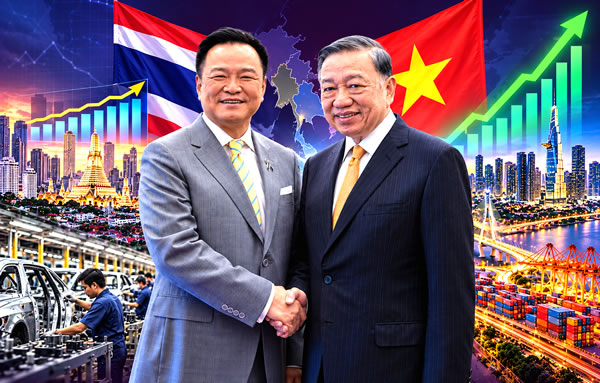
Vietnam is racing towards a historic economic reversal with Thailand after growth surged 9.95% in the third quarter. The kingdom remains richer and marginally larger, but its economy is expanding below 2%. Vietnam already has 31 million more people, a younger workforce and surging industrial investment. Now, IMF projections suggest it could overtake Thailand in total GDP by 2028–29. The transformation marks a dramatic reversal from a generation ago, when Thailand held an overwhelming economic lead. Yet the contest is not over. Thailand retains deeper industrial networks, stronger infrastructure and a substantial advantage in income per person. However, Vietnam’s rapid growth, foreign investment and expanding manufacturing base are closing the gap at extraordinary speed.
Vietnam’s 9.95% growth puts Thailand’s economic lead in danger. With 31m more people and surging investment, Vietnam could become the larger economy by 2028–29. ( Source: Matichon )
Thailand’s once-commanding economic lead over Vietnam is disappearing at remarkable speed. Vietnam’s economy surged 9.95% in the third quarter of 2026. Thailand, by contrast, remains stuck below 2% growth. The neighbouring economies are now moving at radically different speeds.
Vietnam is expanding roughly four to five times faster than Thailand. Notably, its economy is already almost 90% of Thailand’s size. It also has 31 million more people and a younger population. At the same time, factories, infrastructure and foreign investment are expanding rapidly.
Thailand remains richer per person and retains formidable industrial strengths. However, it has become a persistent slow-growth economy. The kingdom also faces rapid ageing, weaker productivity growth and population decline. Vietnam faces its own pressures, including inflation and a record trade deficit.
Vietnam races forward as growth accelerates and the kingdom’s economic advantage rapidly narrows
Even so, the economic gap is closing quickly. Vietnam could overtake Thailand in total economic output around 2028–29. Thailand’s lead in GDP per person should survive considerably longer. Yet even that advantage is gradually narrowing.
Vietnam’s National Statistics Office reported 9.95% year-on-year GDP growth from July through September. That was its strongest quarterly performance since the COVID-19 pandemic. More importantly, growth accelerated throughout the year. Vietnam expanded 8.15% during the first quarter.
Thereafter, second-quarter growth accelerated to 8.81%. By the third quarter, it had reached 9.95%. Consequently, Vietnam’s economy expanded 9.01% during the first nine months of 2026. Thailand is operating in an entirely different economic environment.
The IMF’s July update projected Thai growth of approximately 1.9% during 2026. Accordingly, Vietnam is presently growing several times faster than Thailand’s projected annual rate. The difference is substantial between the two neighbouring industrial economies. It also follows years of stronger Vietnamese growth.
Thailand expanded approximately 2% during 2025, while Vietnam grew about 8%. As a result, the economic balance between the countries is changing rapidly. Thailand remains the larger economy today. Its remaining margin, though, has become surprisingly small.
Thailand’s $62 billion GDP lead shrinks as Vietnam closes in after decades of faster economic growth
World Bank figures put Thailand’s nominal GDP at approximately $577 billion during 2025. Vietnam stood at approximately $514.7 billion. Thus, Thailand’s advantage was only about $62 billion. Vietnam had already reached almost 90% of Thailand’s economic size.
That position would have appeared extraordinary several decades ago. Thailand industrialised earlier and built one of Southeast Asia’s strongest manufacturing economies. Vietnam started from a substantially lower base. Since then, however, the distance between the countries has steadily disappeared.
The latest figures suggest that process is accelerating. Significantly, Vietnam’s third-quarter expansion was broad rather than concentrated. Industry and construction grew 12.50%, while services expanded 9.54%. Exports of goods and services increased 23.27%.
More strikingly, gross capital formation surged 21.39%. Vietnam is therefore adding investment alongside rapid current growth. Industrial production also accelerated sharply. It increased 16.7% year-on-year during September.
On the trade front, merchandise exports jumped 39.1% that month. September exports consequently reached $59.48 billion. Imports grew even faster, surging 45.8% to $58.21 billion. Despite that increase, Vietnam recorded a $1.27 billion September merchandise surplus.
Vietnam’s investment and industrial surge broadens as exports jump and September trade stays in surplus
The wider nine-month figures were less comfortable. Exports increased 24.5% to $434.3 billion between January and September. Conversely, imports surged 36.7% to $453.72 billion. Vietnam consequently recorded a $19.42 billion trade deficit.
It was the highest deficit on record for the period. In effect, Vietnam’s rapid expansion is creating enormous demand for imported goods and industrial inputs. Energy prices have added another burden. Crude oil import volumes actually fell 13.5%.
Their value, however, increased 14.4%. Separately, refined fuel imports increased 11.5% by volume. Their value surged by 79.3%. Higher energy costs are therefore feeding directly into Vietnam’s import bill.
Inflation has risen as well. Vietnam’s consumer price index increased 5.08% year-on-year during September. Clearly, its rapid expansion carries mounting economic pressures. Investment, nevertheless, continues to rise strongly.
Total investment increased 16.7% during the first nine months. In parallel, the Vietnamese government accelerated infrastructure spending. Foreign capital is arriving simultaneously. Disbursed foreign direct investment reached $21.07 billion between January and September.
That was the highest level for the period in five years. Taken together, public investment, domestic capital and foreign money are expanding quickly. That combination is adding productive capacity at considerable speed.
Record trade deficit and rising inflation expose pressures even as investment and foreign capital surge
New factories require machinery, suppliers, logistics and workers. In turn, expanding industrial clusters generate demand for engineering and specialist services. Infrastructure spending supports that expansion. Vietnam is therefore building additional capacity while recording some of Asia’s fastest growth.
The Asian Development Bank has already raised its Vietnamese forecast. It increased its 2026 projection from 7.2% to 7.8%. The bank cited manufacturing, domestic consumption and sustained foreign direct investment. Even that upgraded forecast trails Vietnam’s nine-month performance.
Vietnam expanded 9.01% between January and September. Beyond that, Hanoi is pursuing full-year growth exceeding 10%. Even 9.95% third-quarter growth therefore falls below the government’s annual ambition. The target shows the pace Vietnam is seeking.
Thailand presents a dramatically different picture. The kingdom is not in recession, while its industrial economy remains substantial. Rather, Thailand is a sophisticated economy struggling to generate strong overall growth. Its established economic strengths remain considerable.
Thailand has a major automotive industry. In addition, it retains substantial electronics, petrochemical and food-processing sectors. Tourism remains another major source of income. Well-developed industrial supply chains have also been built over several decades.
Vietnam builds industrial capacity at speed while Thailand struggles to turn mature strengths into growth
On another front, Thailand possesses mature physical infrastructure. Its financial markets are considerably more developed than Vietnam’s. Manufacturing still represents approximately one-quarter of Thai GDP. The sector also employs more than six million people.
Thailand therefore remains an important Asian manufacturing centre. The World Bank identifies opportunities in several newer industries. These include electric vehicles, batteries and solar equipment. Energy-efficient appliances and advanced green manufacturing provide additional potential.
Recently, electronics exports have benefited from the global artificial intelligence investment cycle. Private investment has also improved in machinery, equipment and data centres. Those strengths, however, have not generated rapid national growth. Thailand has instead remained close to 2%.
The IMF estimated Thai growth at approximately 2.1% during 2025. Its July update then projected only 1.9% during 2026. Manufacturing and services also softened during August. Thailand increasingly combines sophisticated economic infrastructure with stubbornly weak headline growth.
Investment exposes another major contrast. The IMF estimates Thai gross domestic investment at approximately 20.6% of GDP during 2026. Private investment represents around 16.4%. Vietnam, meanwhile, is accumulating capital at a far faster rate.
Thailand retains deep industrial strengths but weak growth and investment leave it trailing Vietnam
Its gross capital formation increased 21.39% year-on-year during the third quarter. Across nine months, total investment increased 16.7%. Meanwhile, realised foreign direct investment exceeded $21 billion. Vietnam is adding factories and infrastructure while expanding at near double-digit rates.
Thailand experienced similar industrial expansion during its earlier high-growth decades. Today, however, it operates from a much more mature economic base. Vietnam still has substantial scope for industrial catch-up. Its lower starting point also permits faster percentage growth.
Demographics add another powerful difference. Vietnam has approximately 103 million people, against Thailand’s 71.6 million. Vietnam therefore has roughly 31.4 million additional people. Its population is about 44% larger.
Crucially, Vietnam’s population is also younger. That provides a larger labour pool for manufacturing and modern services. It also creates a much larger potential consumer market. For multinational manufacturers, Vietnam offers a deeper workforce.
Thailand faces the reverse demographic trend. Its population has already entered decline. IMF-based projections suggest further falls of around 0.1–0.2% annually later this decade. Vietnam’s population is still projected to expand around 0.5% annually.
Vietnam’s faster capital growth and younger population widen its investment and demographic advantages
As a consequence, the demographic gap will continue widening. Thailand is also ageing rapidly. Its working population must therefore support an increasing elderly population. Vietnam retains a younger workforce during its present industrial expansion.
The World Bank identifies ageing as a major Thai structural challenge. Likewise, it points to weak productivity growth. High household debt creates another constraint. Constrained SME dynamism adds further pressure, while fiscal demands are increasing.
Thailand must therefore generate more output from a workforce that is no longer expanding. Vietnam does not yet face that constraint equally. Its larger population provides additional workers and consumers. Population size alone, however, does not determine prosperity.
Thailand remains significantly richer per person. Indeed, this is its strongest remaining advantage in the comparison. World Bank figures put Thai GDP per capita at $8,057 during 2025. Vietnam stood at only $5,066.
Current IMF-based estimates put Thailand at approximately $8,105 during 2026. Vietnam stands at $5,115. Vietnamese GDP per person therefore remains only about 63% of Thailand’s level. Closing that gap will take considerably longer.
Existing projections illustrate the difference. For 2027, Thailand reaches approximately $8,170 per person, against Vietnam’s $5,372. A year later, Thailand rises to $8,392. Vietnam reaches approximately $5,698.
Thailand’s ageing population and weak productivity contrast with Vietnam’s younger expanding workforce
By 2029, Thailand stands at around $8,730. Vietnam reaches $6,010. The difference remains substantial by 2030. Thailand reaches $9,092 per person, while Vietnam reaches approximately $6,323.
By 2031, Thailand reaches $9,498. Vietnam stands at approximately $6,652. Vietnam therefore does not catch Thailand during the existing IMF forecast period. Still, the direction remains towards convergence.
If Vietnamese nominal GDP per person later grows 6–7% annually, the gap steadily narrows. That assumes Thai nominal growth per person of approximately 3–4%. On those assumptions, convergence could occur during the 2040s.
Under stronger Vietnamese growth, the crossover could arrive during the late 2030s. Such long-range estimates carry considerable uncertainty. Exchange rates, inflation, productivity and demographics could shift the dates. The total GDP crossover is much closer.
Earlier IMF estimates put Thailand’s 2026 nominal GDP at approximately $580 billion. Vietnam was projected at approximately $527 billion. Thailand therefore retained an advantage of about $53 billion. That margin then narrowed dramatically.
Thailand keeps income lead per person but Vietnam continues narrowing the gap with faster growth
For 2027, Thailand was placed at approximately $584 billion. Vietnam reached approximately $557 billion. The gap therefore fell to only $27 billion. By 2028, it had almost vanished.
Thailand was projected at approximately $599 billion that year. Vietnam reached approximately $595 billion. Only $4 billion separated them. Then, during 2029, Vietnam moved ahead.
Its economy reached a projected $631 billion. Thailand stood at approximately $623 billion. Vietnam therefore became around $8 billion larger. Subsequently, the projected difference widened further.
Vietnam reached approximately $668 billion by 2030. Thailand stood at about $648 billion. By 2031, Vietnam reached approximately $705 billion. Thailand stood at $675 billion.
Those projections placed Vietnam’s crossover around 2029. Importantly, they preceded Vietnam’s latest acceleration. The country has now expanded 9.01% during the first nine months of 2026. Third-quarter growth alone reached 9.95%.
Accordingly, a crossover during 2028 has become plausible if stronger growth persists. Nominal GDP comparisons, however, are heavily influenced by exchange rates. A stronger baht would increase Thailand’s GDP when measured in dollars.
Vietnam closes the total GDP gap rapidly as IMF projections show Thailand’s lead disappearing by 2029
Conversely, dong depreciation would reduce Vietnam’s dollar GDP. Currency movements could therefore shift the crossover by a year or more. They would not, however, erase the underlying real-growth difference.
Vietnam’s industrial position is also benefiting from changes across Asian manufacturing. International companies have increasingly diversified production beyond China. Vietnam occupies a strong position within that shift.
For one thing, it offers a large workforce and relatively low labour costs. Infrastructure is also expanding rapidly. Geographically, Vietnam sits directly beside China’s enormous industrial supply chains.
That location offers manufacturers another advantage. Companies can diversify production while remaining close to Chinese suppliers. Vietnam also offers extensive links to international markets. Foreign investment figures demonstrate the resulting capital flows.
More than $21 billion in FDI was realised during the first nine months. Alongside that, manufacturing and export capacity continue expanding. The Vietnamese model, however, contains important weaknesses.
Vietnam must increase domestic value added within foreign-owned manufacturing. Imported components reduce the local economic contribution. Foreign companies can also remit profits overseas. Large foreign factories therefore do not automatically create equivalent Vietnamese household income.
Currency shifts could alter crossover timing while Vietnam gains from manufacturing diversification
As part of this challenge, Vietnam needs stronger local suppliers and higher-value production. Technology and components will become increasingly important. Thailand faces a related challenge. It approaches that task from a more developed industrial position.
Thailand already possesses deep automotive and electronics supply chains. It also has decades of manufacturing expertise. Nevertheless, Vietnam is adding industrial capacity much faster. Its capital formation is expanding rapidly, while foreign investment remains strong.
Political structures provide another sharp contrast. Vietnam remains an authoritarian one-party state controlled by the Communist Party. Political opposition is severely restricted. Independent political organisation also faces extensive controls.
International rights organisations report significant restrictions on expression and association. Thailand operates a fundamentally different political system. It has competitive elections and substantially greater political pluralism. Yet Thailand has repeatedly experienced severe political disruption.
Its modern history includes coups and judicial interventions. Political parties have also been dissolved. Additionally, prime ministers and governing coalitions have changed repeatedly. Responsibility for long-term economic policy has consequently shifted frequently.
Vietnam seeks more local value from foreign factories as instability complicates Thailand’s outlook
Vietnam’s one-party structure provides much greater political continuity. Infrastructure and industrial strategies can continue under the same political framework. Major investment programmes can also run across many years.
That continuity does not remove Vietnam’s economic risks. Nor does it guarantee successful investment. Nonetheless, the countries operate under markedly different political and policy environments.
Vietnam combines political continuity with increasingly market-oriented economic development. It also combines export growth with heavy infrastructure spending. Manufacturing investment remains strong. Foreign direct investment provides another large source of capital.
At the same time, Vietnam’s younger workforce supports further industrial expansion. Its larger population also expands the potential domestic market. Thailand still retains major advantages accumulated across decades.
Thai citizens remain considerably richer per person. The country’s infrastructure is mature, while its financial system is deeper. Its industrial networks also remain extensive. Yet those advantages increasingly coexist with weak national growth.
Vietnam remains poorer, but it is adding output several times faster. Its population is 44% larger. Its workforce is younger. Industrial production is expanding rapidly, while investment is rising at double-digit rates.
Vietnam’s political continuity backs long-term investment while Thailand retains deeper strengths
Meanwhile, foreign capital continues entering Vietnam. Infrastructure spending is also accelerating. Its consumer market is considerably larger in terms of population. Thailand faces a much less favourable demographic position.
Its population is shrinking and its workforce is ageing. At the same time, productivity growth remains weak. Household debt creates another economic constraint. Investment has also failed to match Vietnam’s rapid capital accumulation.
The comparison therefore looks dramatically different from only a generation ago. Thailand once held an enormous economic advantage over Vietnam. Vietnam was considerably poorer and substantially smaller economically.
Thailand, meanwhile, became one of Southeast Asia’s leading industrial success stories. That gap has now narrowed dramatically. Vietnam’s economy is already almost 90% as large as Thailand’s.
More importantly, the remaining difference could disappear within two or three years. Existing IMF projections place the crossover around 2029. Those projections, however, came before Vietnam’s latest acceleration.
As things stand, 2028 is now within the plausible range. Thailand should remain richer per person for considerably longer. That distinction is critical to the comparison.
Thailand’s demographic and growth pressures mount as Vietnam closes a lead built over several decades
Vietnam becoming the larger economy would not immediately make Vietnamese citizens richer than Thais. Instead, its much larger population allows total output to overtake Thailand earlier. Even so, Vietnam is narrowing the per-capita gap.
That second crossover will take far longer. Current assumptions point towards the late 2030s or 2040s. The absolute GDP contest, however, is already entering its final years.
Vietnam’s latest 9.95% growth figure has made that increasingly visible. Thailand remains ahead today, but its margin is becoming thin. Vietnam has the larger population and younger workforce.
Above all, it currently has much faster economic growth. Its industrial production is surging, while capital formation is rising sharply. Foreign investment remains strong.
Thailand retains higher income per person. It also retains sophisticated infrastructure and established industrial clusters built across decades. But Thailand is expanding at less than 2%.
Vietnam is presently expanding at close to 10%. That is the central economic contrast between the neighbours. One country remains richer and marginally larger.
The other is adding output several times faster. Thailand’s old economic lead is consequently shrinking. The numbers now put a timeframe on that change.
Vietnam’s larger population and faster growth put Thailand’s remaining total GDP lead on a short timetable
Vietnam could become the larger economy around 2028–29. Thailand’s advantage in income per person should continue for another decade or longer. Even that gap, however, is no longer static.
For decades, Thailand could look north at a substantially poorer Vietnamese economy. That economic landscape has changed. Vietnam is now almost Thailand’s size despite remaining much poorer per person.
Moreover, its 103 million population gives it far greater economic scale. Its younger workforce gives manufacturers a deeper labour pool. Rapid investment is simultaneously creating additional industrial capacity.
Thailand still possesses substantial economic assets. Its 71.6 million population, however, is ageing and beginning to contract. Growth remains weak, while the economic distance between both countries keeps shrinking.
Vietnam’s record is not without serious pressure. Inflation has climbed above 5%. Its nine-month trade deficit has reached $19.42 billion. Energy costs have also surged.
In addition, imports are expanding considerably faster than exports. Yet Vietnam’s economy still grew 9.01% during the first nine months. Thailand remains around a 1.9% projected annual growth rate.
Vietnam nears the economic crossover as Thailand’s industrial strengths fail to deliver comparable growth
The difference is reshaping the economic balance of mainland Southeast Asia. The final crossover has not happened yet. On existing projections, however, it is close.
Thailand retains a $500 billion-plus economy, sophisticated infrastructure and decades of industrial investment. Vietnam still trails substantially in income per person. Nonetheless, the old gap in total economic output is rapidly disappearing.
Vietnam’s third-quarter figures have accelerated that process. Industry and construction are growing at double-digit rates. Capital formation is expanding above 20%. Industrial production is also rising strongly.
Meanwhile, exports and imports are surging as Vietnam absorbs investment, fuel and industrial inputs. More than $21 billion of foreign investment has already been realised.
Thailand’s economy offers no comparable headline growth. Instead, it remains near 2% despite its mature industrial base. The kingdom therefore faces a striking regional reversal.
Thailand entered this comparison far ahead. Vietnam entered it poorer, less developed and recovering from decades of economic isolation. Yet the remaining GDP gap has narrowed to tens of billions.
By 2028, existing projections reduce that difference to almost nothing. By 2029, they put Vietnam ahead. Crucially, those calculations preceded Vietnam’s latest 9.95% quarterly growth.
Thailand keeps key advantages but Vietnam’s faster growth makes the question of overtaking immediate
Thailand therefore retains important advantages, but no longer an overwhelming economic lead. The kingdom remains richer per head and more developed across several sectors.
Vietnam, however, possesses greater population scale, faster growth and stronger demographic momentum. The economic arithmetic has consequently become increasingly difficult for Thailand.
An economy growing near 2% cannot indefinitely preserve a narrow output lead over one expanding several times faster. Currency movements may alter the precise crossover date.
Vietnam’s inflation and trade deficit may also slow its advance. Likewise, stronger Thai investment and productivity could change the growth differential.
The figures currently available, however, show a rapidly narrowing gap. Thailand remains ahead in total GDP today. Vietnam is closing fast.
The question is therefore shifting from whether Vietnam can approach Thailand’s economic size. It already has. Instead, the immediate question is when Vietnam passes it.
Vietnam could pass Thailand by 2028–29 while the kingdom keeps a substantial lead in income per person
On existing projections, the answer is around 2028–29. The per-capita contest remains much further away. Thailand’s roughly $8,000 income per person remains well above Vietnam’s roughly $5,000.
Still, Vietnam continues closing ground through faster growth. Thailand therefore retains a substantial income advantage. Its old regional economic cushion, however, has largely disappeared.
A generation ago, the economic distance between Thailand and Vietnam was enormous. Today, Vietnam is almost 90% of Thailand’s size.
Within two or three years, it could be larger.
Thailand’s once-commanding economic lead over Vietnam is no longer measured in generations or decades.
Increasingly, it is measured in years.
Vietnam is taking Thailand’s quality tourists in huge numbers while Bangkok flails about with crackdowns
Thailand’s once mighty tourism industry is failing but now faces further damage from overvalued baht
Economists baffled by extraordinary and damaging rise of the baht in 2025 hitting tourism and exports
Top Thai banker launches blistering attack on present state of the economy calling for more inclusion
Top economist warns of a stronger baht as the US economy weakens. Tourism and exports face a severe hit
Rate cut anticipated as outgoing Bank of Thailand governor attends last Monetary Policy Committee
Finance Ministry & central bank move to boost credit by shifting non-performing debt into asset firms
Business leaders and bankers urge the government to push through the US Thai tariff deal at all costs
Game changer US Thai trade deal approved at special cabinet meeting as 19% tariff rate warmly welcomed
Win for Thailand. 19% U.S. tariff deal just announced. Rate lower and more competitive than predicted
Last minute tweaks in Bangkok as deal is finalised with U.S. However, Thailand may not match Vietnam
Joseph Anthony is an expat from Ireland who has lived in Thailand for the last decade. He has worked extensively in the media including editorial positions in Ireland and Thailand. He is focused on economic and business stories in Thailand as well as the expat lifestyle.
All posts by Joseph O' Connor
49 year old Myanmar man dies in landslide incident off Sukhumvit Rd in Bangkok on Thursday evening October 1, 2026 Fatal Sukhumvit 71 landslide buries Myanmar worker
Former top judge advocates collecting evidence for a Constitutional Court case to strike down the Senate October 1, 2026 All 200 Senate seats could be at stake as former
Body of full term baby found in freezer in central Bangkok. 21 year old says the infant was born dead at a hotel October 1, 2026 Bangkok hotel horror as police find a full-term baby
Government takes a stronger hand as Thai Airways crisis at Suvarnabhumi Airport worsened Wednesday September 30, 2026 Government anger closes in on Thai Airways as 8,000
Pattani midnight attack sees masked gunmen bomb a store and gut a truck causing havoc and disruption September 30, 2026 Fresh Deep South violence hits Pattani as armed men
Flooding crisis another black eye for Thai governance as Prime Minister Anutin faces rising criticism September 30, 2026 Flood fury closes in on PM Anutin as Bangkok battles
Mixed messages from Thai government on a US Thai trade deal despite Commerce Minister’s optimism September 29, 2026 Thailand’s US trade deal hits a hiatus as Suphajee
USS George HW Bush heading for Phuket for 6 days R&R. Docks October 5 with over five thousand sailors September 29, 2026 Phuket braces for 5,120 US personnel as USS George
Thai Airways CEO apologises for ongoing flooding crisis issues with defective carts and delayed flights September 29, 2026 Defective baggage equipment and staff shortages hammer
Foreign tourist arrivals already down 3.65% with fears the flooding crisis may impact the Chinese market September 29, 2026 Thailand’s tourism engine sputters into high season
Anutin rejects appeal against deportation made by French man Kevin Dimino despite wife’s submission September 28, 2026 French zoo owner Kevin Dimino faces deportation after
32 year old Ranger killed in one shot incident in Narathiwat on Sunday evening as he took up position September 28, 2026 One gunshot kills Ranger Sukran Lateh, 32, as his
Tourism minister directs acute airport baggage crisis caused by workers who failed to turn up for shifts September 28, 2026 Tourism Minister Surasak rushes to Suvarnabhumi as the
Prime Minister Anutin wades into flood hit areas to be met with a mixed reaction including seething anger September 28, 2026 Bangkok flood victims confront Prime Minister Anutin
Nene Royal after conquering the showbiz world this week returns home to Phuket to her granny’s embrace September 27, 2026 Thailand’s Nene Royal returns to Phuket after
Bangkok airports open and flights running but there are delays and baggage issues at Suvarnabhumi September 27, 2026 Flood chaos hits Suvarnabhumi as passengers wait six
Bangkok flooding eases as front moves to Myanmar but Governor warns city needs 2-3 days to recover September 27, 2026 The Thai capital races to drain vast floodwater after
Tuk Tuk driver in Phuket assaulted by Middle Eastern looking tourist who failed to pay his fare to a hotel October 2, 2026
Naturalised citizenship scrutinised as PM scraps Israeli’s Thai status over ongoing home passport use October 1, 2026
Business leaders pile pressure on Thai Airways over vital air cargo artery for the kingdom’s exports to the world October 1, 2026
Department of Business Development (DBD) contacts 43 foreign embassies on nominee shareholder firms September 30, 2026
British mother from Croydon in a Cambodian hellhole prison facing up to 20 years after drug mule dupe September 30, 2026
Serving Election Commissioner again voicing his concerns about the probe into the 2024 Senate poll September 30, 2026
Thai Airways admits it got it wrong as Suvarnabhumi Airport public areas are swamped by a baggage flood September 30, 2026
Turkish arsonist arrested. His Thai girlfriend hired him to destroy evidence at her former workplace September 29, 2026
Race against time and water flows as PM Anutin works round the clock tackling flooding emergency September 29, 2026
Thailand moves carefully with AI regulation as US tech warns over key provisions hindering investment September 29, 2026
Military operations are expanded at Suvarnabhumi Airport as crisis is still not brought under control September 28, 2026
PM’s relief as Constitutional Court upholds February 8th General Election despite a barcode warning September 28, 2026
Royal Thai Army deployed to Suvarnabhumi Airport after baggage chaos gets the better of exhausted staff September 28, 2026
Love triangle horror in Chumphon sees all three dead after government officer goes on a killing rampage September 27, 2026
NIDA opinion poll shows rising apathy among the Thai public as Prime Minister Anutin’s base crashes September 27, 2026
Flooding tragedy in Samut Prakan near Bangkok. Two die from electrocution after family car is submerged September 27, 2026
Crucial ballot decision of Constitutional Court on Monday could upend government and Thai politics September 27, 2026
American arrested in Pattaya after a joint agency raid found an illicit narcotics factory in his suburban home September 26, 2026
Warning in Thailand over fake cough syrup bottles. Police smash counterfeit medicine empire in 4 raids September 26, 2026
Spanish chef (32) who murdered and dismembered a Colombian surgeon on Koh Phangan loses appeal September 26, 2026
Dizziness, headaches in a Pattaya locale after a cannabis farm fire at a residence on Friday morning guts the property September 25, 2026
33 year old sets fire to Honda Scooby in Udon Thani after mother refused to buy him a more powerful ride September 25, 2026
© 2026 Thai Examiner. All rights reserved.
2026年10月5日下午1点34分
经济、生活、媒体、政治、泰国
越南第三季度经济增长高达9.95%,正朝着与泰国发生历史性的经济逆转迈进。泰国虽然依然比越南富裕,国土面积也略大,但其经济增长率低于2%。越南人口比泰国多3100万,劳动力更加年轻,工业投资也在蓬勃发展。国际货币基金组织(IMF)预测,越南的GDP总量可能在2028-2029年超过泰国。这一转变与上一代人时期泰国遥遥领先的局面截然不同。然而,竞争远未结束。泰国仍然拥有更深厚的产业网络、更强大的基础设施和显著的人均收入优势。但是,越南的快速增长、外商投资和不断扩大的制造业基础正在以惊人的速度缩小差距。
越南9.95%的经济增长对泰国的经济领先地位构成威胁。越南人口比泰国多3100万,投资也大幅增长,到2028-2029年,越南的经济规模可能超过泰国。(来源:Matichon)
泰国曾经对越南的显著经济领先优势正在以惊人的速度消失。越南经济在2026年第三季度增长了9.95%,而泰国的经济增速却仍然低于2%。这两个邻国的经济发展速度如今已截然不同。
越南的经济扩张速度大约是泰国的四到五倍。值得注意的是,越南的经济规模已经接近泰国的90%。越南的人口比泰国多3100万,而且人口结构更加年轻。与此同时,越南的工厂、基础设施和外商投资都在快速增长。
泰国人均收入依然较高,工业实力也十分雄厚。然而,其经济增长持续低迷。泰国还面临着人口快速老龄化、生产力增长乏力以及人口下降等问题。越南也面临着自身的压力,包括通货膨胀和创纪录的贸易逆差。
随着经济增长加速,越南奋力向前,沙特阿拉伯的经济优势迅速缩小。
即便如此,两国经济差距正在迅速缩小。越南的经济总量可能在2028-2029年左右超过泰国。泰国的人均GDP领先优势应该会持续更长时间。然而,即使是这一优势也在逐渐缩小。
越南国家统计局公布的数据显示,7月至9月越南国内生产总值(GDP)同比增长9.95%,这是自新冠疫情爆发以来最强劲的季度表现。更重要的是,全年增速都在加快。越南第一季度GDP增长8.15%。
此后,第二季度增速加快至8.81%。到第三季度,增速达到9.95%。因此,越南经济在2026年前九个月增长了9.01%。泰国则处于完全不同的经济环境中。
国际货币基金组织7月份的最新预测显示,泰国2026年的经济增长率约为1.9%。相比之下,越南目前的经济增长速度是泰国预计年增长率的数倍。这两个相邻的工业化经济体之间的差距相当显著。此外,越南近年来经济增长势头也更为强劲。
2025年泰国经济增长约2%,越南增长约8%。因此,两国之间的经济平衡正在迅速变化。泰国目前仍然是更大的经济体,但其剩余优势已变得出人意料地小。
随着越南在经历了数十年的更快经济增长后逐渐缩小与泰国的差距,泰国620亿美元的GDP领先优势正在缩小,越南正在迎头赶上。
世界银行预测,到2025年,泰国的名义GDP约为5770亿美元,而越南约为5147亿美元。因此,泰国的优势仅约为620亿美元。越南的经济规模届时已接近泰国的90%。
几十年前,这种观点会显得非常不同寻常。泰国工业化进程较早,并建立了东南亚最强大的制造业经济体之一。越南的起步基础则要落后得多。然而,自那时以来,两国之间的差距已逐渐缩小。
最新数据显示,这一进程正在加速。值得注意的是,越南第三季度的经济扩张是广泛性的,而非集中性的。工业和建筑业增长了12.50%,服务业增长了9.54%。货物和服务出口增长了23.27%。
更引人注目的是,资本形成总额激增21.39%。因此,越南在当前经济快速增长的同时,也在增加投资。工业生产也大幅加速,9月份同比增长16.7%。
贸易方面,9月份商品出口额增长39.1%,达到594.8亿美元。进口额增长更快,飙升45.8%,达到582.1亿美元。尽管进口额有所增长,越南9月份仍录得12.7亿美元的商品贸易顺差。
越南投资和工业的蓬勃发展带动了出口的大幅增长,9月份贸易额继续保持顺差。
前九个月的整体数据则不那么乐观。1月至9月,越南出口额增长24.5%,达到4343亿美元。相反,进口额飙升36.7%,达到4537.2亿美元。因此,越南录得194.2亿美元的贸易逆差。
这是同期有史以来最高的贸易逆差。事实上,越南经济的快速扩张造成了对进口商品和工业投入品的巨大需求。能源价格上涨又加剧了这一负担。原油进口量实际下降了13.5%。
然而,它们的价值却增长了14.4%。此外,精炼燃料进口量增长了11.5%,价值却飙升了79.3%。因此,能源成本上涨直接推高了越南的进口支出。
通货膨胀也随之上升。越南9月份消费者物价指数同比上涨5.08%。显然,经济的快速扩张带来了日益增长的压力。尽管如此,投资依然保持强劲增长。
今年前九个月,总投资增长了16.7%。与此同时,越南政府加快了基础设施建设支出。外资也随之涌入。1月至9月,实际到位外商直接投资额达210.7亿美元。
这是五年来同期最高水平。公共投资、国内资本和外资总体上都在快速增长。这种组合正以相当快的速度增加生产能力。
尽管投资和外国资本激增,但创纪录的贸易逆差和不断上涨的通货膨胀暴露出诸多压力。
新建工厂需要机械设备、供应商、物流和工人。反过来,不断扩张的产业集群又会产生对工程和专业服务的需求。基础设施建设支出为这种扩张提供了支持。因此,越南在保持亚洲最快经济增长速度的同时,也在不断提升产能。
亚洲开发银行已上调了对越南经济增长的预测,将2026年的预测值从7.2%上调至7.8%。该行指出,制造业、国内消费和持续的外国直接投资是推动经济增长的主要因素。即便如此,这一上调后的预测值仍低于越南前九个月的实际经济增长。
越南1月至9月经济增长9.01%。此外,河内方面正力争全年增长超过10%。因此,即使第三季度增长9.95%,也低于政府的年度目标。这一目标体现了越南所追求的增长速度。
泰国的情况则截然不同。泰国并未陷入衰退,其工业经济依然雄厚。相反,泰国是一个高度发达的经济体,正努力实现强劲的整体增长。其既有的经济优势依然十分显著。
泰国拥有庞大的汽车工业。此外,其电子、石化和食品加工业也相当发达。旅游业仍然是泰国重要的收入来源。几十年来,泰国也建立了完善的工业供应链。
越南快速提升工业产能,而泰国则难以将成熟优势转化为经济增长。
另一方面,泰国拥有成熟的基础设施。其金融市场比越南发达得多。制造业仍然约占泰国国内生产总值的四分之一,该行业也雇佣了超过600万人。
因此,泰国仍然是亚洲重要的制造业中心。世界银行指出,泰国在多个新兴产业领域拥有发展机遇,包括电动汽车、电池和太阳能设备。节能家电和先进的绿色制造技术也蕴藏着巨大的潜力。
近年来,电子产品出口受益于全球人工智能投资周期。私人投资在机械设备和数据中心领域也有所增长。然而,这些优势并未带来快速的国民经济增长。泰国的经济增速仍然维持在2%左右。
国际货币基金组织(IMF)此前预测泰国2025年经济增长率约为2.1%。但其7月份的最新预测显示,2026年泰国经济增长率仅为1.9%。8月份,制造业和服务业也出现疲软。泰国日益呈现出经济基础设施完善但经济增长却持续低迷的局面。
投资揭示了另一个显著的差异。国际货币基金组织估计,到2026年,泰国国内总投资约占GDP的20.6%,其中私人投资约占16.4%。与此同时,越南的资本积累速度远超泰国。
泰国仍拥有雄厚的工业实力,但增长乏力、投资不足,使其落后于越南。
第三季度,越南资本形成总额同比增长21.39%。前九个月,总投资增长16.7%。同时,实际外商直接投资超过210亿美元。越南正在以接近两位数的速度扩张,并不断增加工厂和基础设施。
泰国在其早期高速增长的几十年里也经历了类似的工业扩张。然而,如今泰国的经济基础要成熟得多。越南的工业发展仍有很大的追赶空间。其较低的起点也使其能够实现更快的百分比增长。
人口结构是另一个显著的差异。越南人口约1.03亿,而泰国人口约7160万。因此,越南比泰国多出约3140万人口,人口总数比泰国多出约44%。
至关重要的是,越南的人口结构也更加年轻。这为制造业和现代服务业提供了更庞大的劳动力储备,同时也创造了更大的潜在消费市场。对于跨国制造商而言,越南拥有更充足的劳动力资源。
泰国面临着相反的人口趋势。其人口已经开始下降。根据国际货币基金组织的预测,本十年后期泰国人口还将以每年约0.1%至0.2%的速度进一步下降。而越南的人口预计仍将以每年约0.5%的速度增长。
越南更快的资本增长速度和更年轻的人口结构扩大了其投资和人口优势。
因此,人口结构差距将继续扩大。泰国的人口老龄化速度也很快,其劳动人口必须供养日益增长的老年人口。越南在目前的工业扩张时期则保持了较年轻的劳动力。
世界银行指出,人口老龄化是泰国面临的一项重大结构性挑战。同时,它也指出泰国生产率增长乏力。高额的家庭债务构成另一项制约因素。中小企业活力不足进一步加剧了这一压力,而财政需求却在不断增加。
因此,泰国必须利用不再增长的劳动力来创造更多产出。越南目前尚未面临同样的制约。其庞大的人口提供了更多的劳动力和消费者。然而,人口规模本身并不能决定繁荣程度。
泰国人均收入仍然显著高于越南。事实上,这是泰国在比较中最大的优势。世界银行预测,到2025年,泰国人均GDP将达到8057美元,而越南仅为5066美元。
根据国际货币基金组织目前的预测,到2026年,泰国的人均GDP约为8105美元,而越南为5115美元。因此,越南的人均GDP仅为泰国的约63%。要缩小这一差距,还需要相当长的时间。
现有预测数据表明了这一差异。预计到2027年,泰国人均生活成本将达到约8170美元,而越南则为5372美元。一年后,泰国人均生活成本将升至8392美元,越南则约为5698美元。
泰国人口老龄化和生产力低下与越南年轻且不断壮大的劳动力形成鲜明对比。
到2029年,泰国人均生活成本约为8730美元,越南人均生活成本约为6010美元。到2030年,这一差距仍然很大。泰国人均生活成本将达到9092美元,而越南人均生活成本约为6323美元。
到2031年,泰国的全球平均收入将达到9498美元,越南约为6652美元。因此,在国际货币基金组织(IMF)目前的预测期内,越南无法赶上泰国。尽管如此,两国的发展方向仍然是趋同的。
如果越南人均名义GDP未来每年增长6%至7%,两国差距将稳步缩小。这假设泰国人均名义GDP增长率约为3%至4%。基于这些假设,两国经济趋同可能在2040年代实现。
如果越南经济增长强劲,经济突破可能在2030年代末期到来。但这种长期预测存在相当大的不确定性。汇率、通货膨胀、生产率和人口结构等因素都可能导致这一日期发生变化。而越南GDP突破则要早得多。
国际货币基金组织早前估计,泰国2026年的名义GDP约为5800亿美元,越南约为5270亿美元。因此,泰国一度领先约530亿美元。但此后,这一优势急剧缩小。
泰国人均收入仍然领先,但越南的增长速度更快,差距正在不断缩小。
预计到2027年,泰国的经济规模约为5840亿美元,越南约为5570亿美元,两国经济规模差距将缩小至仅270亿美元。到2028年,这一差距几乎消失。
当年泰国的经济规模预计约为5990亿美元,越南约为5950亿美元,两者仅相差40亿美元。然而,到了2029年,越南超越了泰国,位居榜首。
越南经济规模预计达到6310亿美元,而泰国约为6230亿美元。因此,越南的经济规模比泰国大了约80亿美元。随后,两国经济规模的差距进一步扩大。
到2030年,越南的经济规模将达到约6680亿美元,泰国约为6480亿美元。到2031年,越南的经济规模将达到约7050亿美元,泰国约为6750亿美元。
这些预测将越南的经济转型期定在2029年左右。值得注意的是,这些预测早于越南最近的经济加速增长。截至2026年前九个月,越南经济增速已达9.01%。仅第三季度增速就达到了9.95%。
因此,如果经济持续走强,2028年出现交叉点并非不可能。然而,名义GDP的比较受汇率影响很大。泰铢走强将推高以美元计价的泰国GDP。
随着国际货币基金组织预测泰国领先优势将在2029年消失,越南正迅速缩小与全球GDP的差距。
反之,越南盾贬值会降低越南以美元计价的GDP。因此,汇率波动可能会使汇率交叉点推迟一年或更长时间。然而,汇率波动并不会消除实际增长方面的根本差异。
越南的工业地位也受益于亚洲制造业的整体变革。国际公司已日益将生产重心转移到中国以外的地区。越南在这一转变中占据了有利地位。
首先,越南拥有庞大的劳动力队伍和相对较低的劳动力成本。基础设施也在快速扩张。从地理位置上看,越南紧邻中国庞大的工业供应链。
这一地理位置为制造商提供了另一项优势。企业既可以实现生产多元化,又能与中国供应商保持紧密联系。越南还拥有广泛的国际市场渠道。外国投资数据也印证了由此带来的资本流动。
前九个月,越南吸引外商直接投资超过210亿美元。与此同时,制造业和出口能力持续扩张。然而,越南模式也存在一些重大缺陷。
越南必须提高外资制造业的国内附加值。进口零部件会降低越南对当地经济的贡献。此外,外国公司还可以将利润汇回海外。因此,大型外国工厂并不会自动创造等值的越南家庭收入。
汇率波动可能会改变越境时机,而越南则受益于制造业多元化。
面对这一挑战,越南需要更强大的本地供应商和更高附加值的产品。技术和零部件将变得日益重要。泰国也面临着类似的挑战,但它从更发达的工业地位出发来应对这一挑战。
泰国已拥有深厚的汽车和电子产品供应链,以及数十年的制造业经验。然而,越南的工业产能增长速度更快,资本形成迅速扩张,外商投资也保持强劲势头。
政治结构则呈现出另一鲜明的对比。越南仍然是一个由共产党控制的威权一党制国家。政治反对派受到严格限制。独立的政治组织也面临广泛的控制。
国际人权组织报告称,泰国的言论和结社自由受到严重限制。泰国的政治制度与此截然不同。泰国实行竞争性选举,政治多元化程度也高得多。然而,泰国却屡次经历严重的政治动荡。
其近代史包括政变和司法干预。政党也曾多次解散。此外,总理和执政联盟也频繁更迭。因此,长期经济政策的责任也随之频繁转移。
由于局势不稳,泰国前景复杂,越南寻求从外国工厂获得更多本地价值。
越南的一党制结构提供了更大的政治连续性。基础设施和产业战略可以在同一政治框架下继续推进。重大投资项目也可以持续多年。
这种延续性并不能消除越南的经济风险,也不能保证投资成功。然而,两国所处的政治和政策环境截然不同。
越南在政治上保持稳定,同时经济发展也日益市场化。此外,越南在出口增长的同时,也大力投资基础设施建设。制造业投资依然强劲。外国直接投资是越南另一重要的资金来源。
与此同时,越南年轻的劳动力支撑着工业的进一步扩张。其庞大的人口也扩大了国内市场的潜在规模。泰国仍然保留着数十年来积累的主要优势。
泰国公民的人均财富仍然相当可观。该国的基础设施成熟,金融体系也更为完善,产业网络也十分发达。然而,这些优势却与疲软的国民经济增长并存。
越南虽然仍然贫穷,但其产出增长速度却是其他国家的数倍。越南人口比其他国家多44%。其劳动力更加年轻。工业生产正在快速扩张,投资也以两位数的速度增长。
越南的政治稳定性为长期投资提供了保障,而泰国则拥有更深厚的实力。
与此同时,外资持续涌入越南,基础设施建设支出也在加速增长。越南的消费市场人口规模远大于泰国。相比之下,泰国的人口结构则远逊于越南。
越南人口正在减少,劳动力正在老龄化。与此同时,生产率增长依然疲软。家庭债务也构成另一项经济发展制约因素。投资也未能跟上越南快速的资本积累。
因此,如今的对比与仅仅一代人之前相比已截然不同。泰国曾经在经济上对越南拥有巨大的优势。当时的越南经济规模小得多,也贫穷得多。
与此同时,泰国已成为东南亚工业发展最成功的国家之一。如今,两国之间的差距已大幅缩小。越南的经济规模已接近泰国的90%。
更重要的是,剩余的差距可能在两三年内消失。国际货币基金组织目前的预测认为,这一转变将在2029年左右发生。然而,这些预测是在越南最近一次经济加速增长之前做出的。
就目前情况来看,2028年已在合理范围内。泰国的人均富裕程度应该会在相当长的一段时间内保持较高水平。这一区别对于比较至关重要。
随着越南缩小与泰国数十年来建立的差距,泰国的人口结构和增长压力日益增大。
越南经济规模扩大并不意味着越南公民会立即比泰国人更富裕。相反,越南庞大的人口基数使其总产出能够更快地超越泰国。即便如此,越南的人均收入差距仍在缩小。
第二次转折点需要更长时间才能到来。目前的预测指向2030年代末或2040年代。然而,绝对GDP之争已经进入尾声。
越南最新的9.95%的增长数据更加凸显了这一点。泰国目前仍领先,但优势正在缩小。越南拥有更庞大的人口和更年轻的劳动力。
最重要的是,它目前经济增长速度更快。其工业生产蓬勃发展,资本形成也大幅增长。外国投资依然强劲。
泰国人均收入较高,也拥有数十年来发展起来的完善基础设施和成熟的产业集群。但泰国的经济增速却不足2%。
越南目前的经济增长率接近10%。这是两国之间最显著的经济对比。一个国家更加富裕,国土面积也略大一些。
另一个国家的产出增长速度是其他国家的数倍。泰国以往的经济领先优势也因此逐渐缩小。目前的数据显示,这种变化将持续一段时间。
越南人口众多,经济增长速度更快,这使得泰国在GDP总量上的领先优势在短期内难以撼动。
越南经济规模可能在2028-2029年左右超越泰国。泰国的人均收入优势预计还会持续十年甚至更久。然而,即便如此,这一差距也并非一成不变。
几十年来,泰国可以仰望北方经济远逊于自己的越南。但如今,这种经济格局已然改变。越南的经济规模如今几乎与泰国相当,尽管其人均收入仍然远低于泰国。
此外,其1.03亿人口使其经济规模更大。其年轻的劳动力为制造商提供了更充足的劳动力储备。快速的投资同时也在创造额外的工业产能。
泰国仍然拥有可观的经济资源。然而,其7160万人口正在老龄化并开始萎缩。经济增长依然疲软,而两国之间的经济差距也在不断缩小。
越南的经济形势并非一帆风顺。通货膨胀率已超过5%。过去九个月的贸易逆差高达194.2亿美元。能源成本也大幅上涨。
此外,进口增速远超出口。尽管如此,越南经济在今年前九个月仍增长了9.01%。泰国预计年增长率约为1.9%。
随着泰国工业优势未能带来同等增长,越南经济正接近转折点。
这种差异正在重塑东南亚大陆的经济格局。最终的转变尚未发生,但根据现有预测,这一天已近在眼前。
泰国拥有超过5000亿美元的经济规模、完善的基础设施和数十年的工业投资。越南的人均收入仍然远低于泰国。然而,两国经济总量的差距正在迅速缩小。
越南第三季度的数据加速了这一进程。工业和建筑业正以两位数的速度增长。资本形成增速超过20%。工业生产也呈现强劲增长。
与此同时,随着越南吸收投资、燃料和工业投入,进出口额激增。目前已实现超过210亿美元的外国投资。
泰国经济并未出现与之相提并论的总体增长。尽管其工业基础成熟,但经济增长率仍徘徊在2%左右。因此,泰国正面临着区域经济格局的显著逆转。
泰国在此次比较中遥遥领先。越南则相对贫穷、发展水平较低,且正从数十年的经济孤立中复苏。然而,两国GDP的差距已缩小至数百亿美元。
到2028年,现有预测将把这一差距缩小到几乎为零。到2029年,越南将领先。至关重要的是,这些预测是在越南最近9.95%的季度增长率公布之前做出的。
泰国仍保持着关键优势,但越南更快的增长使得超越泰国的问题迫在眉睫。
因此,泰国仍然保留着重要的优势,但不再拥有压倒性的经济领先地位。泰国的人均收入仍然较高,并且在多个领域也更加发达。
然而,越南拥有更大的人口规模、更快的经济增长速度和更强的人口增长势头。因此,泰国的经济形势变得越来越严峻。
经济增长率接近2%的经济体不可能永远保持对增速高出数倍的经济体的微弱产出领先优势。汇率波动可能会改变确切的交叉日期。
越南的通货膨胀和贸易逆差也可能减缓其增长速度。同样,泰国投资和生产力的增强也可能改变增长差距。
然而,目前可获得的数据显示,差距正在迅速缩小。泰国目前的GDP总量仍然领先,越南正在快速追赶。
因此,问题不再是越南能否接近泰国的经济规模(它已经接近了),而是越南何时才能超越泰国。
越南有望在2028-2029年超越泰国,但泰国在人均收入方面仍保持显著领先优势。
根据现有预测,答案大约在2028-2029年。但人均收入的差距仍需时日才能缩小。泰国的人均收入约为8000美元,远高于越南的约5000美元。
尽管如此,越南凭借更快的经济增长仍在不断缩小差距。因此,泰国仍然保持着显著的收入优势。然而,其原有的区域经济缓冲作用已基本消失。
一代人之前,泰国和越南之间的经济差距巨大。如今,越南的国土面积几乎达到了泰国的90%。
两三年内,它可能会变得更大。
泰国曾经对越南拥有压倒性的经济领先优势,但这种优势不再以几代人或几十年来衡量。
越来越多地,它是以年为单位来衡量的。
越南正大量吸引泰国的优质游客,而曼谷却在打击非法游客的行动中束手无策。
泰国曾经强大的旅游业正在衰落,如今又面临泰铢高估带来的进一步打击。
经济学家对泰铢在2025年出现异常且破坏性的上涨感到困惑,认为这将重创旅游业和出口。
泰国顶级银行家猛烈抨击当前经济状况,呼吁加强包容性经济。
顶级经济学家警告称,随着美国经济疲软,泰铢可能走强。旅游业和出口将面临严重冲击。
泰国央行即将卸任的行长出席最后一次货币政策委员会会议,市场预期将下调利率。
财政部和央行采取措施,通过将不良债务转移到资产公司来提振信贷。
商界领袖和银行家敦促政府不惜一切代价推进美泰关税协议。
具有里程碑意义的美泰贸易协议在内阁特别会议上获得批准,19%的关税税率受到热烈欢迎
对泰国有利。美国刚刚宣布了一项19%的关税协议。税率低于预期,更具竞争力。
在与美国最终敲定协议之际,曼谷方面进行了最后的调整。然而,泰国可能无法与越南匹敌。
约瑟夫·安东尼是一位来自爱尔兰的侨民,过去十年一直居住在泰国。他曾在爱尔兰和泰国的媒体行业担任过编辑职务,拥有丰富的媒体从业经验。他主要关注泰国的经济和商业新闻,以及侨民的生活方式。
约瑟夫·奥康纳的所有帖子
2026年10月1日星期四晚间,一名49岁的缅甸男子在曼谷素坤逸路附近发生的山体滑坡事故中丧生。这起致命的山体滑坡发生在素坤逸路71巷,掩埋了这名缅甸工人。
前最高法院法官主张收集证据,准备向宪法法院提起诉讼,推翻参议院。2026年10月1日,参议院全部200个席位都可能面临改选。
曼谷市中心一家酒店的冰柜里发现一具足月婴儿的尸体。一名21岁的女子称,这名婴儿于2026年10月1日在酒店出生时已死亡。曼谷酒店惊魂:警方发现一具足月婴儿尸体
2026年9月30日星期三,泰国航空公司素万那普机场危机恶化,政府采取更强硬措施。随着8000名乘客被困机场,政府对泰国航空公司的愤怒情绪日益高涨。
2026年9月30日,帕塔尼午夜发生袭击事件,蒙面枪手炸毁一家商店并烧毁一辆卡车,造成混乱和骚乱。南部深区暴力事件再次袭击帕塔尼,武装人员……
洪灾危机再添泰国政府耻辱,总理阿努廷面临日益高涨的批评声浪 2026年9月30日 洪灾肆虐,曼谷遭受重创,总理阿努廷岌岌可危
尽管商务部长苏帕吉持乐观态度,但泰国政府就美泰贸易协议发出的信息仍然混乱。2026年9月29日,由于苏帕吉的言论,泰美贸易协议陷入停滞。
“乔治·H·W·布什”号航空母舰即将前往普吉岛进行为期6天的休整。该舰将于10月5日靠岸,届时将有超过5000名水兵抵达。2026年9月29日,普吉岛准备迎接5120名美国人员,届时“乔治·H·W·布什”号将抵达普吉岛。
泰国航空首席执行官就持续不断的行李搬运车故障和航班延误问题致歉(2026年9月29日) 行李搬运设备故障和人手短缺严重影响了泰国航空的运营。
外国游客到访量已下降3.65%,人们担心洪灾危机可能影响中国市场(2026年9月29日) 泰国旅游业在旺季来临之际步履蹒跚
尽管妻子提交了上诉,但阿努廷驳回了法国男子凯文·迪米诺针对其驱逐出境的上诉 2026年9月28日 法国动物园老板凯文·迪米诺面临被驱逐出境
2026年9月28日星期日晚,32岁的护林员苏克兰·拉特在纳拉提瓦府执勤时遭枪击身亡。
旅游部长指示处理因工人未按时上班而导致的机场行李危机 2026年9月28日 旅游部长素拉萨赶赴素万那普机场
2026年9月28日,阿努廷总理亲临洪灾地区,遭遇民众褒贬不一的反应,其中不乏愤怒之声。曼谷洪灾灾民与阿努廷总理对峙。
泰国女星妮妮·罗亚尔 (Nene Royal) 本周在演艺圈大获成功后,于2026年9月27日返回普吉岛,与祖母团聚。
曼谷机场已开放并恢复航班,但素万那普机场出现延误和行李问题(2026年9月27日)。洪水袭击素万那普机场,乘客等待六小时。
随着锋面移向缅甸,曼谷洪水有所缓解,但曼谷市长警告称,该市需要2-3天才能恢复正常。2026年9月27日,泰国首都曼谷正全力排水。
2026年10月2日,普吉岛一名嘟嘟车司机因未支付前往酒店的车费而被一名看起来像中东人的游客殴打。
2026年10月1日,总理因以色列人持续使用本国护照而取消其泰国公民身份,入籍公民身份受到审查。
2026年10月1日,商界领袖就泰国航空至关重要的航空货运通道向泰国航空公司施压,该通道对泰国出口到世界各地至关重要。
商业发展部 (DBD) 于 2026 年 9 月 30 日就代理股东公司事宜联系了 43 个外国大使馆。
2026年9月30日,一名来自克罗伊登的英国母亲因欺骗他人充当毒品运输者而被关押在柬埔寨人间炼狱般的监狱中,面临最高20年的监禁。
现任选举专员再次表达了他对2024年参议院选举调查的担忧(2026年9月30日)
泰国航空公司承认失误,素万那普机场公共区域被行李淹没 2026年9月30日
土耳其纵火犯被捕。他的泰国女友雇佣他销毁其前工作场所的证据。2026年9月29日
与时间赛跑,与洪水赛跑,阿努廷总理夜以继日地应对洪灾紧急情况 2026年9月29日
泰国谨慎推进人工智能监管,美国科技公司警告称关键条款可能阻碍投资 2026年9月29日
2026年9月28日,由于危机仍未得到控制,素万那普机场的军事行动范围扩大。
尽管有条形码警告,宪法法院仍维持2月8日大选的合法性,总理松了一口气 2026年9月28日
2026年9月28日,行李混乱导致疲惫不堪的机场工作人员不堪重负,泰国皇家陆军被派往素万那普机场。
2026年9月27日,春蓬府发生一起三角恋恐怖事件,一名政府官员突然发狂,三人全部遇害。
2026年9月27日,泰国国家发展研究所(NIDA)民意调查显示,随着总理阿努廷的基地坠毁,泰国公众的冷漠情绪日益加剧。
2026年9月27日,曼谷附近北榄府发生洪水悲剧,一辆汽车被淹,两人触电身亡。
宪法法院周一的关键投票裁决或将颠覆泰国政府和政治格局 2026年9月27日
2026年9月26日,一名美国公民在芭堤雅被捕,此前联合执法机构突袭了他的郊区住宅,在其住所内发现了一个非法制毒窝点。
泰国警方发出警告,警惕假冒止咳糖浆。2026年9月26日,警方在四次突击行动中捣毁了一个假药帝国。
2026年9月26日,在帕岸岛谋杀并肢解哥伦比亚外科医生的32岁西班牙厨师上诉被驳回。
2026年9月25日星期五上午,芭堤雅一处民宅发生大麻种植场火灾,房屋被烧毁,当地居民出现头晕、头痛等症状。
2026年9月25日,一名33岁男子因母亲拒绝给他买一辆动力更强的车,在乌隆他尼纵火焚烧了自己的本田史酷比汽车。
© 2026 Thai Examiner。版权所有。