The P-3 Orion Airborne Early Warning Aircraft Has Flown Its Last MissionP-3“猎户座”空中预警机已完成最后一次任务
U.S. Customs and Border Protection was the only operator of P-3 AEW aircraft with their radar domes on top, using them to hunt drug smugglers.
新闻视频
By Joseph Trevithick
Published Oct 5, 2026 1:39 PM EDT
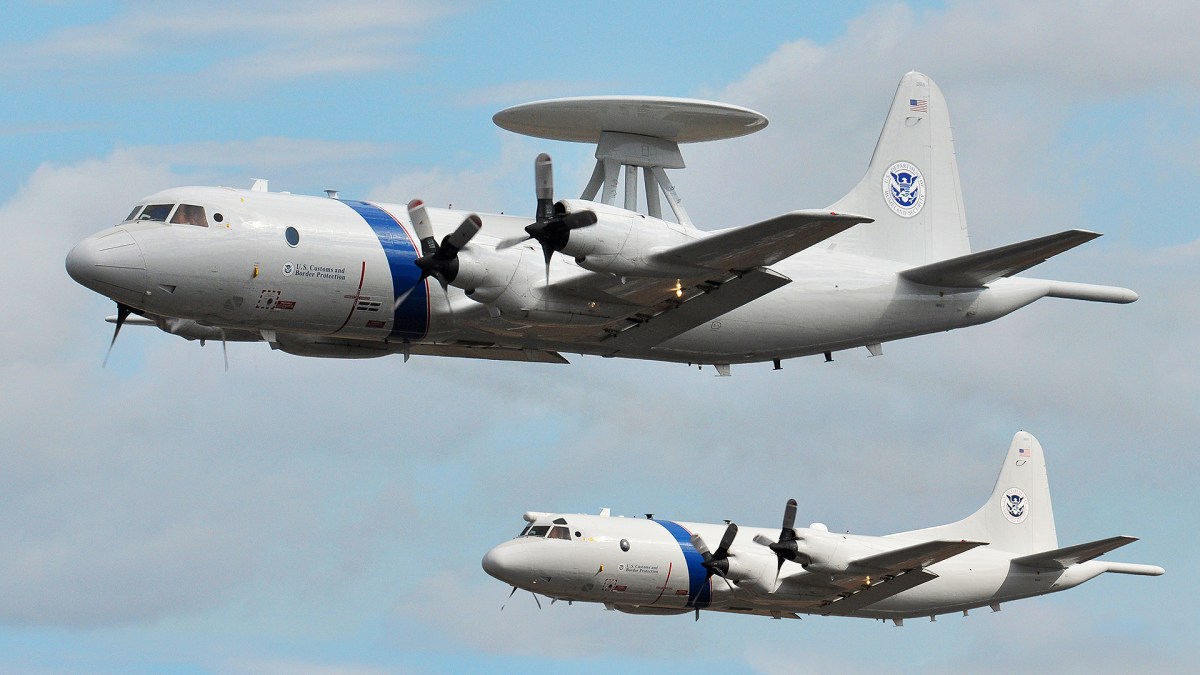
A CBP P-3 AEW (in front) flies together with a P-3 LRT (behind). CBP/Carlos A. Rivera
U.S. Customs and Border Protection (CBP) has retired the last of its P-3 Airborne Early Warning (AEW) aircraft. The AEW version is instantly recognizable from the saucer-like radar dome on top, as seen on other AEW types like the E-2 Hawkeye and the E-3 Sentry . CBP was the only operator of this variant of the P-3 Orion and is said to have been the only law enforcement agency to fly any kind of dedicated AEW plane. The retirement of these aircraft comes at a time when American AEW assets, in general, are under heavy strain by demands globally .
CBP officially retired its final P-3 AEW on September 30, 2026, after a final flight from National Air Security Operations Center Jacksonville (NASOC Jacksonville), in Jacksonville, Florida. CBP has also flown Long Range Tracker (LRT) variants of the P-3 , configured for more traditional maritime surveillance missions. The current plans for the LRT aircraft, and whether their sunset may also be on the horizon, are not immediately clear, and TWZ has reached out for more information. Orions of all types have been steadily disappearing from service with the U.S. military and elsewhere across the U.S. government as the aging aircraft become more difficult to operate and maintain.
End of the Road: AMO’s Iconic P-3 Dome Takes Its Final Flight! On September 30, 2026, the distinct silhouette of a four-engine turboprop carrying its massive rotating radar dome touched down for the final time at the National Air Security Operations Center in Jacksonville. Our… pic.twitter.com/doT9TZYJzD — CBP AMO (@CBPAMO) October 1, 2026
End of the Road: AMO’s Iconic P-3 Dome Takes Its Final Flight! On September 30, 2026, the distinct silhouette of a four-engine turboprop carrying its massive rotating radar dome touched down for the final time at the National Air Security Operations Center in Jacksonville. Our… pic.twitter.com/doT9TZYJzD
“Our Jacksonville-based P-3 AEW fleet has served as a cornerstone of America’s outer-layer border security,” according to a brief announcement from CBP about the retirement on social media. “Its crews flew far beyond our borders, providing wide-area surveillance across the Caribbean, Gulf of America [Gulf of Mexico], and the transit zones of Central and South America, helping detect and track threats before they could reach the United States.”
By all indications, including official CBP sources, the P-3 AEW fleet consisted of eight aircraft at its peak. There is a confusingly worded 2014 CBP press release that mentions an “11th and final Lockheed Martin P-3 Airborne Early Warning (AEW) aircraft overhaul,” but that figure looks to also include three of the six LRT versions. The same release says that CBP only had 14 P-3s of all types at that time.
What was then known as the U.S. Customs Service (USCS) first began operating the P-3 AEW version in the late 1980s. The aircraft were converted from second-hand maritime patrol variants of the Orion. The first example had started life as a P-3B for the Royal Australian Air Force (RAAF). Ex-U.S. Navy P-3s were also converted.
A picture of a P-3 AEW in USCS service circa the late 1980s. CBP
The initial three P-3 AEWs were equipped with the AN/APS-138 radar. The same radar was used on early E-2C Hawkeye airborne early warning and control aircraft operated by the U.S. Navy, as well as several other armed forces internationally.
“The Customs Service had previously borrowed U.S. Navy E-2Cs to meet its antinarcotics surveillance requirements, but required an aircraft with longer range and on-station time,” according to a 2006 report from Forecast International . “In June 1989, the U.S. General Accounting Office issued a report on the drug interdiction P-3B AEW aircraft. The findings indicated that the radar performance was as specified, but the P-3B (when compared to the E-2C) was less costly to operate per square mile of area covered because of the higher cruising speed and longer endurance. The P-3B had at least twice the in-flight endurance of the E-2C.”
Starting in the 1990s, USCS began the process of acquiring additional P-3 AEWs with newer AN/APS-145 radars, as also used on later model E-2Cs. The original AEW Orions were eventually refitted with APS-145s, as well. It’s worth noting here that the U.S. Coast Guard separately moved to acquire an AEW version of the C-130H, designated the EC-130V , in the 1990s, which used the AN/APS-125 radar, also used on older E-2s. Budget cuts led to the end of that program. The EC-130V that had been built was redesignated as an NC-130H and subsequently used for test purposes.
A US Navy E-2C Hawkeye. USN
The NC-130H test aircraft with its radar dome still on top. US Military
The P-3 AEWs were also equipped with a sensor turret containing electro-optical and infrared (EO/IR) video cameras, allowing the aircraft to more closely investigate targets spotted on radar. CBP regularly conducted P-3 operations that paired AEWs with LRT variants to provide an even broader array of sensor capabilities on missions. The LRTs have EO/IR sensor turrets, as well as AN/APG-66 and SeaVue radars . The pulse-doppler AN/APG-66 is primarily designed for spotting and tracking aerial targets, and was originally used on early variants of the F-16 fighter . SeaVue is a multi-function type with surface search and synthetic aperture radar (SAR) imagery modes. Images produced via SAR are highly detailed maps of the surface below, and can be captured day or night, and regardless of any cloud cover, smoke, or dust.
Beyond radars and other sensors, the P-3 AEWs also had a robust communications suite consisting of VHF and UHF radios, as well as satellite communications links by the end of their career. CBP’s entire P-3 fleet, including the AEWs and LRTs, has received various updates over the years, including new ‘glass cockpits’ starting in the early 2000s.
Though primarily employed in support of counter-narcotics interdiction operations, the airborne radar and command and control capabilities were also applied to other missions, including disaster relief and humanitarian assistance efforts at home and abroad. As an example, CBP’s P-3 AEWs helped with air traffic coordination , as well as provided other support, during relief efforts in Texas in the wake of Hurricane Harvey in 2017.
At the same time, CBP’s entire P-3 fleet, including both the AEW and LRT versions, has only been getting increasingly older and difficult to sustain. The P-3B variant first entered U.S. Navy service in the 1960s. CBP did put its P-3s through a Service Life Extension Program overhaul in the 2010s, which included “new wings and tail for each aircraft and completely strips down the aircraft to its bare metal for an inspection,” according to a 2014 press release .
A P-3 AEW seen during a test flight as part of the SLEP overhaul. The aircraft notably lacks its radar dome. CBP
As mentioned, the P-3 family has been in steadily dwindling service in the United States, overall, in recent years. The U.S. Navy has completely retired the Orion as a maritime patrol platform , and the service has also fully divested its more specialized EP-3 intelligence-gathering variants . The Navy had retained a small number of P-3s for research and development and test and evaluation activities, but growing sustainment challenges have been prompting the retirement of those planes , as well. The last NP-3C assigned to the Navy’s Scientific Development Squadron One (VXS-1), the “Warlocks,” was also retired last month . VXS-1 previously operated a ‘domed’ NP-3D, similar to CBP’s P-3 AEWs, as well. The National Oceanic and Atmospheric Administration (NOAA) is also in the process of replacing its pair of P-3s, configured as civilian hurricane hunter aircraft , with new C-130J Hercules-based platforms . The shrinking U.S. Orion operator base can only have a knock-on impact on CBP P-3 operations.
A key question now is how CBP will fill any gaps left by the retirement of the final AEW version. The agency does continue to operate a mix of other crewed fixed-wing aircraft with mixtures of radars and other sensors, as well as MQ-9 drones , but none of these platforms are equipped with a sensor like the AN/APS-145. CBP also has a network of tethered aerostats with radars at fixed sites around the Caribbean. As an aside, General Atomics, together with Saab, is now working on an AEW configuration for the MQ-9B drone , but there are no known U.S. orders for that capability at the time of writing. That platform will not offer the same level of flexibility and look-down capability as modern crewed AEW aircraft, either. Look-down AEW capability is only growing in importance today amid expanding and evoling drone threats , including to the U.S. homeland .
Another look at one of CBP’s now-retired P-3 AEWs. CBP
High demand for AEW support, in general, means that the U.S. military regularly steps to provide additional coverage with U.S. Navy E-2s and U.S. Air Force E-3s to aid in U.S. counter-drug operations around Latin America. Newer E-2D Advanced Hawkeyes notably have far more powerful radars than the E-2C or the P-3 AEW, with added surface search and track capability, too. At the same time, as mentioned at the start, those assets are in heavy demand, especially in light of the conflict with Iran . On top of that, the Air Force’s E-3 fleet is facing serious sustainment challenges itself, with replacement E-7 Wedgetail aircraft still years away from being delivered.
The Air Force, in particular, is also aiming to eventually push most, if not all, air moving-target indicator (AMTI) tasks currently performed by aircraft like the E-3 and E-7 into space. The service is heavily investing to accelerate the fielding of those capabilities , which could eventually offer revolutionary constant, persistent coverage globally. The first of those satellites are still not expected to reach an early operational state until 2028. It is possible that CBP could get access to a tailored data feed from this system when it does become operational. It still does not obviate the need to have crewed or uncrewed aircraft capable of more closely investigating tracks of interest using EO/IR cameras and other sensors.
Whatever the future might now hold, CBP’s unique time as the operator of the P-3 AEW aircraft has come to an end.
Contact the author: joe@twz.com
Comments couldn’t be loaded. Please refresh the page.
作者:约瑟夫·特雷维西克
发布于美国东部时间2026年10月5日下午1:39
一架美国海关与边境保护局(CBP)的P-3 AEW预警机(前)与一架P-3 LRT巡逻机(后)一同飞行。CBP/卡洛斯·A·里维拉
美国海关与边境保护局(CBP)已退役其最后一架P-3空中预警机(AEW)。这种AEW机型最显著的特征是顶部碟状的雷达罩,与其他AEW机型(如E-2“鹰眼”和E-3“哨兵”)的雷达罩类似。CBP是该型号P-3“猎户座”的唯一运营商,据称也是唯一使用专用AEW飞机的执法机构。这些飞机的退役正值美国AEW资产整体因全球需求而承受巨大压力之际。
美国海关与边境保护局(CBP)于2026年9月30日正式退役了其最后一架P-3预警机,该机从位于佛罗里达州杰克逊维尔的国家航空安全行动中心(NASOC Jacksonville)完成了最后一次飞行。CBP还曾使用过P-3的远程跟踪者(LRT)型号,该型号主要用于传统的海上监视任务。目前LRT飞机的未来计划尚不明确,它们是否也即将退役,TWZ已联系相关部门以获取更多信息。随着老旧飞机操作和维护难度的增加,各种型号的猎户座预警机已陆续从美国军方和美国政府其他部门退役。
旅程的终点:AMO标志性的P-3圆顶雷达完成最后一次飞行!2026年9月30日,一架搭载着巨大旋转雷达圆顶的四引擎涡轮螺旋桨飞机,其独特的轮廓在杰克逊维尔的国家航空安全行动中心进行了最后一次着陆。我们的…… pic.twitter.com/doT9TZYJzD — CBP AMO (@CBPAMO) 2026年10月1日
旅程的终点:AMO标志性的P-3雷达罩完成最后一次飞行!2026年9月30日,一架四引擎涡轮螺旋桨飞机,其独特的轮廓,载着巨大的旋转雷达罩,最后一次降落在杰克逊维尔的国家航空安全行动中心。我们的…… pic.twitter.com/doT9TZYJzD
美国海关与边境保护局(CBP)在社交媒体上发布简短公告,宣布其驻扎在杰克逊维尔的P-3预警机机队退役。公告称:“该机队一直是美国外围边境安全的重要支柱。其机组人员的飞行范围远超美国国界,对加勒比海、美洲湾(墨西哥湾)以及中美洲和南美洲的过境区域进行大范围监视,帮助美国在威胁进入美国之前发现并追踪它们。”
根据包括美国海关与边境保护局(CBP)官方消息来源在内的所有迹象,P-3空中预警机机队鼎盛时期仅有八架。CBP在2014年发布的一份措辞含糊的新闻稿中提到“第11架也是最后一架洛克希德·马丁P-3空中预警机(AEW)的全面检修”,但这个数字似乎也包含了六架LRT型中的三架。同一份新闻稿还指出,当时CBP所有型号的P-3飞机加起来也只有14架。
当时的美国海关总署(USCS)于20世纪80年代末开始使用P-3预警机。这些飞机是由二手的猎户座海上巡逻机改装而来。第一架P-3预警机最初是澳大利亚皇家空军(RAAF)的P-3B。美国海军的P-3也曾被改装。
一张摄于20世纪80年代末的美国海关与边境保护局(CBP)P-3预警机的照片。
最初的三架P-3预警机都配备了AN/APS-138雷达。美国海军早期使用的E-2C“鹰眼”空中预警和控制飞机以及其他一些国家的军队也使用了同样的雷达。
据Forecast International 2006年的一份报告显示,“美国海关此前曾借用美国海军的E-2C预警机来满足其缉毒监视需求,但需要航程更远、续航时间更长的飞机。”报告还指出,“1989年6月,美国总审计署发布了一份关于P-3B缉毒预警机的报告。报告指出,P-3B的雷达性能符合规格,但由于其巡航速度更快、续航时间更长,因此与E-2C相比,P-3B每平方英里覆盖区域的运营成本更低。P-3B的飞行续航时间至少是E-2C的两倍。”
自20世纪90年代起,美国海岸警卫队开始采购更多配备新型AN/APS-145雷达的P-3预警机,该雷达也用于后期型号的E-2C预警机。最初的P-3“猎户座”预警机最终也改装了APS-145雷达。值得一提的是,美国海岸警卫队在20世纪90年代还曾计划采购C-130H的预警机版本,即EC-130V,该机型使用AN/APS-125雷达,该雷达也用于较老的E-2预警机。由于预算削减,该项目最终终止。已建造的EC-130V被重新命名为NC-130H,随后用于测试用途。
美国海军E-2C“鹰眼”预警机。
NC-130H 测试飞机,雷达罩仍安装在机身上。美国军方
P-3预警机还配备了包含光电/红外(EO/IR)摄像机的传感器转塔,使飞机能够更仔细地侦察雷达探测到的目标。美国海关与边境保护局(CBP)经常执行P-3预警机与远程侦察机(LRT)的联合行动,以在任务中提供更广泛的传感器能力。远程侦察机配备了光电/红外传感器转塔以及AN/APG-66和SeaVue雷达。脉冲多普勒AN/APG-66雷达主要用于发现和跟踪空中目标,最初用于早期型号的F-16战斗机。SeaVue雷达是一种多功能雷达,具有水面搜索和合成孔径雷达(SAR)成像模式。SAR生成的图像是下方地表的高精度地图,可以昼夜拍摄,不受云层、烟雾或灰尘的影响。
除了雷达和其他传感器外,P-3预警机在其服役末期还配备了强大的通信系统,包括甚高频(VHF)和超高频(UHF)无线电台,以及卫星通信链路。美国海关与边境保护局(CBP)的整个P-3机队,包括预警机和远程侦察机(LRT),多年来都进行了多次升级,包括从21世纪初开始安装的新型“玻璃座舱”。
虽然主要用于支持禁毒行动,但机载雷达和指挥控制能力也应用于其他任务,包括国内外的灾害救援和人道主义援助工作。例如,2017年哈维飓风过后,美国海关与边境保护局的P-3预警机在德克萨斯州的救援工作中协助进行了空中交通协调,并提供了其他支持。
与此同时,美国海关与边境保护局(CBP)的整个P-3机队,包括预警机(AEW)和远程侦察机(LRT)版本,机龄日益老旧,维护难度也越来越大。P-3B型于20世纪60年代首次在美国海军服役。CBP在2010年代对其P-3飞机进行了延寿计划(SLPP)大修,根据2014年的一份新闻稿,该计划包括“为每架飞机更换新的机翼和尾翼,并将飞机完全拆解至裸金属进行检查”。
一架P-3 AEW预警机在SLEP升级改造的试飞过程中被拍到。值得注意的是,这架飞机缺少雷达罩。
如前所述,近年来,P-3系列飞机在美国的服役数量总体呈持续下降趋势。美国海军已完全退役了“猎户座”海上巡逻机,并彻底淘汰了其更专业的EP-3情报收集型飞机。海军保留了少量P-3用于研发和测试评估活动,但日益严峻的维护挑战也促使这些飞机陆续退役。上个月,海军第一科学发展中队(VXS-1,代号“术士”)的最后一架NP-3C也退役了。VXS-1此前还装备过一架类似美国海关与边境保护局(CBP)P-3预警机的“圆顶”NP-3D。美国国家海洋和大气管理局(NOAA)也正在用基于C-130J“大力神”运输机的新型平台替换其两架P-3巡逻机(这两架P-3巡逻机改装为民用飓风侦察机)。美国“猎户座”巡逻机用户数量的减少势必会对美国海关与边境保护局(CBP)的P-3巡逻机行动产生连锁反应。
现在的关键问题是,美国海关与边境保护局(CBP)将如何填补最终版预警机退役后留下的空白。该机构目前仍在运营其他配备雷达和其他传感器的有人驾驶固定翼飞机以及MQ-9无人机,但这些平台均未配备类似AN/APS-145的传感器。CBP还在加勒比海地区拥有一个系留气球网络,其固定站点配备有雷达。此外,通用原子公司与萨博公司正在合作研发MQ-9B无人机的预警机配置,但截至撰写本文时,尚未有美国订购该配置的无人机。该平台也无法提供与现代有人驾驶预警机相同的灵活性和下视能力。随着无人机威胁的不断扩大和演变,包括对美国本土的威胁,下视预警能力的重要性日益凸显。
再来看看美国海关与边境保护局(CBP)一架现已退役的P-3预警机。
总体而言,对预警机支援的高需求意味着美军经常动用海军的E-2和空军的E-3预警机,为美国在拉丁美洲的禁毒行动提供额外的空中掩护。值得注意的是,新型的E-2D“先进鹰眼”预警机配备了比E-2C或P-3预警机强大得多的雷达,并且还具备更强的地面搜索和跟踪能力。同时,正如文章开头所述,这些装备的需求量很大,尤其是在与伊朗的冲突背景下。此外,空军的E-3机队自身也面临着严峻的维护挑战,因为替代机型E-7“楔尾”预警机的交付仍需数年时间。
空军尤其致力于最终将目前由E-3和E-7等飞机执行的大部分(如果不是全部)空中移动目标指示(AMTI)任务转移到太空。空军正在大力投资以加速这些能力的部署,这些能力最终可能提供革命性的全球持续覆盖。首批此类卫星预计要到2028年才能达到早期运行状态。届时,美国海关与边境保护局(CBP)有可能获得该系统提供的定制数据流。但这仍然不能取代配备有人或无人飞机的必要性,这些飞机能够利用光电/红外摄像机和其他传感器对目标进行更精确的探测。
无论未来如何,美国海关与边境保护局作为 P-3 预警机运营商的独特时期已经结束。
联系作者:joe@twz.com
评论加载失败,请刷新页面。