Thailand’s tilt toward China tests treaty alliance with US泰国向中国靠拢的趋势考验着与美国的条约联盟。
Thailand’s drift toward China over the past decade is turning the longstanding alliance with the U.S. into something of a paper tiger, some analysts argue.
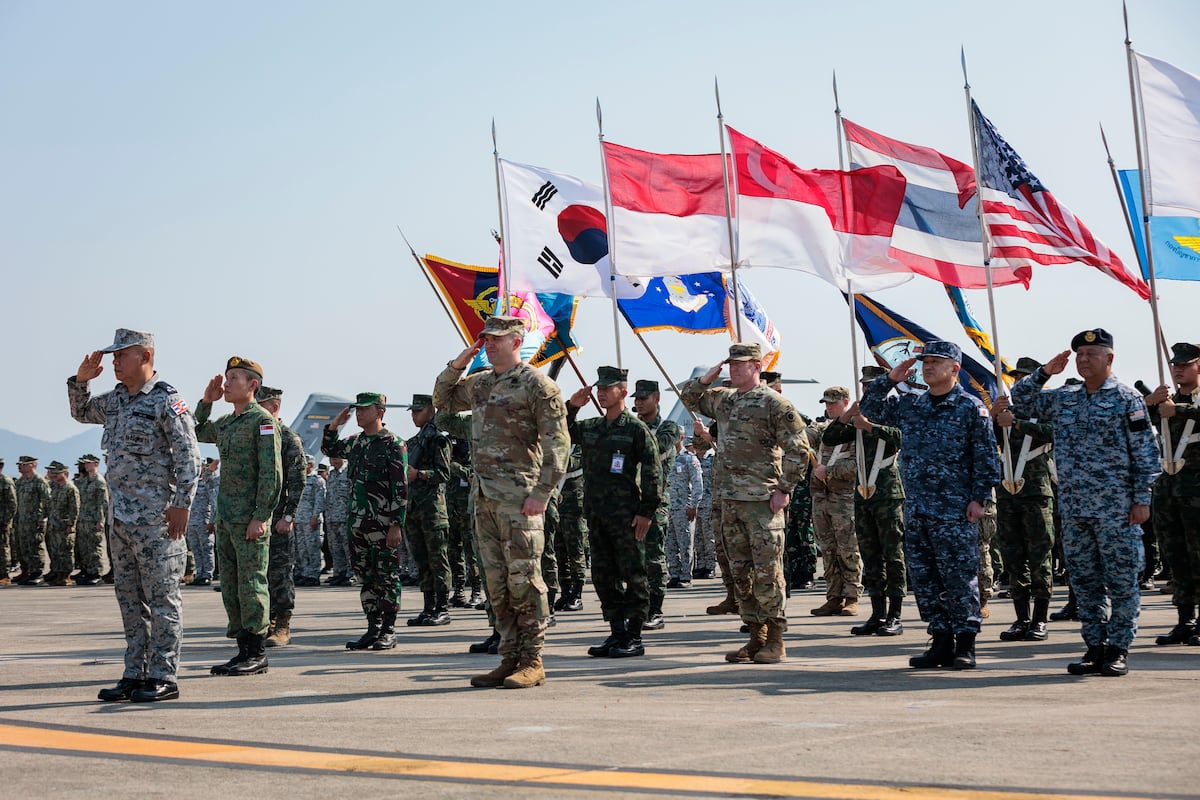
BANGKOK — On paper, the U.S. security alliance with Thailand is one of the strongest in Asia, dating back seven decades and backed up by military exercises each year with thousands of troops from both countries and many others.
Thailand’s drift toward China over the past decade, though, is turning the alliance into more of a paper tiger, some analysts say, with military and strategic consequences for the United States across the region.
“Thailand’s increasing ties to China accelerates the trend of the U.S. losing strategic influence in Southeast Asia,” Emma Chanlett-Avery, director of political-security affairs at the Asia Society Policy Institute in Washington, told Military Times.
“Despite Thailand’s status as a treaty ally of the U.S., Bangkok’s center of gravity has long been leaning toward the PRC,” she said, referring to the People’s Republic of China.
Bending toward Beijing
In 1833, Thailand, then Siam, became the first country in Asia to sign a treaty of amity and commerce with the United States, setting up diplomatic and economic ties. Over a century later, as the Cold War was heating up, Thailand was one of only three Asian countries brought into the Manila Pact of 1954 with the United States; it declared that an attack on any member was a threat to all.
Thailand went on to become a key staging ground for U.S. operations during the Vietnam War and was named a major non-NATO ally of the United States in 2003.
Since 1982, Thailand has also been co-hosting the annual Cobra Gold exercises with the United States. Chanlett-Avery called them the largest multilateral military exercises in the world.
However, she and others say Thailand has been leaning ever closer to China, its main trading partner, for some time.
Historically, the United States has been the largest arms supplier to Thailand. But after a 2014 military coup that toppled Thailand’s democratically elected government, Washington pulled back sharply, leaving Beijing to step in.
According to Australia’s Lowy Institute, China sold Thailand nearly $400 million worth of arms between 2016 and 2022, about twice as much as the United States. The Chinese hardware ran the gamut from surface-to-air missiles to radars and tanks. Thailand is also working with China on delivery of its first submarine.
While the United States still holds more — and more sophisticated — military exercises with Thailand than does China, China has been catching up, according to the Lowy Institute.
Chanlett-Avery said Thailand’s growing military ties with China mean the United States can no longer count on the access it once could for its own military.
“With the intensified strategic competition between the U.S. and China, Thailand has leaned heavily toward Beijing, solidifying the U.S. conviction that Thailand would not allow U.S. access to its bases in the event of a conflict in the Taiwan Straits,” she said.
A risk of decoupling
Zach Cooper, a senior fellow at the American Enterprise Institute, said the two allies are now at high risk of a “decoupling,” where they would no longer see their interests as well aligned.
He said that could lead to even fewer U.S. arms deals with Thailand, cutbacks in joint-training exercises, and less access to Thai bases including U-Tapao, a naval airfield on the Gulf of Thailand.
“What’s so critical about U-Tapao is the U.S. just doesn’t have a lot of operating locations in the Southeast Asian region, and so … the logistical aspects of maintaining a global military presence are quite challenging,” Cooper told Military Times.
While the United States could probably count on other countries in the region, he added, such as Singapore, Thailand is farther north than most of them.
“That has some benefits from a logistical perspective, especially as the U.S. is transitioning, say, between the Middle East and Asia or trying to operate a little bit farther north in Southeast Asia,” he said.
In a 2024 report on the missiles arms race in the Asia-Pacific, the International Institute for Strategic Studies said Thailand’s tilt toward China hobbles U.S. missile basing options as well.
The IISS report says Thailand “would be highly unlikely to approve the deployment of U.S. missiles” for countering what it calls the growing ballistic- and cruise-missile threat from both China and North Korea.
Cooper said Bangkok’s tilt may also restrain Washington’s defense cooperation with Thailand by limiting the military intelligence and technology it is willing to share and sell.
“It’s really going to make American intelligence officials a bit nervous that so many Thai leaders see their interests as more aligned with China going forward than with the United States. So, in that context, I think it would be hard to have the degree of confidence necessary to really share some of those more sensitive details,” he said.
There could be cases, he added, where the U.S. may be reluctant to hold some military exercises with Thailand in range of Chinese radars for fear of giving away certain U.S. capabilities.
Cooper said Thailand’s foiled bid for U.S. F-35 jets is a case in point.
In 2023, the United States denied Thailand’s request to buy up to eight of the Lockheed Martin F-35s, one of the world’s most advanced fighter aircraft. At the time, a Thai air force official told local media that Thailand’s relationship with China probably played a part.
Losing interest and influence
As Thailand has been turning toward China, though, the analysts say the United States has also been turning away from Southeast Asia, the mainland especially.
When the United States announced its “Pivot to Asia” in 2011, Cooper said, South and Southeast Asia loomed large in its strategic plans. But the focus is now shifting more to the east, he said, especially to the so-called first island chain, which roughly skirts China’s seaboard from Japan to Taiwan and on to the Philippines.
Cooper said the shift is reflected in the U.S. government’s latest National Security Strategy, which lays out each new administration’s security priorities.
“It’s a much more limited set of objectives, in my view, and one in which mainland Southeast Asia just plays a smaller role than I think it used to in U.S. thinking,” he said.
“And I think where this is leading is not a complete pullback but a sort of partial pullback from parts of South and Southeast Asia.”
Chanlett-Avery said Washington is elevating “minilateral” and trilateral security pacts with Australia, India, Japan and South Korea, for example, that mostly leave Southeast Asia out, the Philippines being the main exception.
The United States has been ramping up military ties with the sprawling archipelago to counter China’s increasingly aggressive forays into the South China Sea and around Taiwan.
But that still leaves its leverage not only in Thailand, but the region, on the wane, Chanlett-Avery added.
“With security concerns taking center stage, combined with the dismantlement of USAID, the two allies have grown apart,” she said. “The unfortunate byproduct of this dynamic is that U.S. influence has tanked, not only in Thailand but in Southeast Asia more broadly.”
曼谷——从纸面上看,美国与泰国的安全联盟是亚洲最强大的联盟之一,已有七十年的历史,每年都有来自两国和其他许多国家的数千名士兵参加军事演习。
不过,一些分析人士表示,过去十年泰国向中国靠拢的趋势,正使美泰联盟沦为纸老虎,这对美国在该地区造成了军事和战略上的影响。
“泰国与中国日益密切的关系加速了美国在东南亚失去战略影响力的趋势,”华盛顿亚洲协会政策研究所政治安全事务主任艾玛·钱莱特-艾弗里告诉《军事时报》。
“尽管泰国是美国的条约盟友,但曼谷的重心长期以来一直倾向于中华人民共和国,”她说道。
向北京倾斜
1833年,泰国(当时称为暹罗)成为亚洲第一个与美国签署友好通商条约的国家,建立了外交和经济联系。一个多世纪后,随着冷战的加剧,泰国成为仅有的三个加入1954年《马尼拉条约》的亚洲国家之一;该条约宣称,对任何一个成员国的攻击都将对所有成员国构成威胁。
泰国后来成为美国在越南战争期间开展行动的重要集结地,并于 2003 年被指定为美国的主要非北约盟友。
自1982年以来,泰国一直与美国共同主办一年一度的“金色眼镜蛇”联合军演。钱莱特-艾弗里称其为世界上最大的多边军事演习。
然而,她和其他人表示,泰国一段时间以来一直在向其主要贸易伙伴中国靠拢。
历史上,美国一直是泰国最大的武器供应国。但在2014年推翻泰国民选政府的军事政变后,华盛顿大幅减少了对泰国的武器供应,北京取而代之。
据澳大利亚洛伊研究所的数据,2016年至2022年间,中国向泰国出售了价值近4亿美元的武器,约为美国的两倍。这些中国武器涵盖范围广泛,从地对空导弹到雷达和坦克应有尽有。泰国目前也在与中国合作,接收其首艘潜艇。
据洛伊研究所称,虽然美国与泰国举行的军事演习数量更多、技术更先进,但中国一直在迎头赶上。
Chanlett-Avery表示,泰国与中国日益密切的军事联系意味着美国不能再像以前那样指望自己的军队能够获得准入。
“随着中美战略竞争加剧,泰国严重倾向于北京,这更加坚定了美国的信念,即一旦台海发生冲突,泰国不会允许美国使用其军事基地。”她说道。
脱钩风险
美国企业研究所高级研究员扎克·库珀表示,这两个盟友现在面临着“脱钩”的高风险,届时他们将不再认为彼此的利益高度一致。
他表示,这可能导致美国与泰国的军火交易进一步减少,联合训练演习缩减,以及美国更难进入包括位于泰国湾的海军机场乌塔堡在内的泰国基地。
库珀告诉《军事时报》:“乌塔帕奥行动的关键在于,美国在东南亚地区的行动地点并不多,因此……维持全球军事存在的后勤方面面临着相当大的挑战。”
他补充说,虽然美国或许可以指望该地区的其他国家,例如新加坡,但泰国比它们中的大多数都更靠北。
他说:“从后勤角度来看,这有一些好处,尤其是在美国从中东向亚洲过渡,或者试图在东南亚更北的地方开展行动的时候。”
国际战略研究所2024年发布的关于亚太地区导弹军备竞赛的报告中指出,泰国向中国的倾向也削弱了美国的导弹部署选择。
国际战略研究所的报告称,泰国“极不可能批准部署美国导弹”来应对其所谓的来自中国和朝鲜日益增长的弹道导弹和巡航导弹威胁。
库珀表示,曼谷的倾向也可能限制华盛顿与泰国的防务合作,因为这会限制华盛顿愿意分享和出售的军事情报和技术。
他说:“这么多泰国领导人认为,他们未来的利益更倾向于与中国而非美国保持一致,这确实会让美国情报官员感到不安。因此,在这种情况下,我认为很难建立起足够的信任,从而真正分享一些更敏感的细节。”
他补充说,可能会出现这样的情况:美国可能不愿在中国雷达探测范围内与泰国举行一些军事演习,以免泄露美国的某些能力。
库珀表示,泰国竞购美国F-35战机失败就是一个典型的例子。
2023年,美国拒绝了泰国购买至多8架洛克希德·马丁公司F-35战斗机的请求,F-35是世界上最先进的战斗机之一。当时,一位泰国空军官员告诉当地媒体,泰国与中国的关系可能是造成这一结果的原因之一。
失去兴趣和影响力
分析人士表示,随着泰国转向中国,美国也逐渐疏远了东南亚,尤其是中国大陆。
库珀表示,2011年美国宣布“重返亚洲”战略时,南亚和东南亚在其战略规划中占据重要地位。但他指出,如今美国的战略重心正更多地转向东方,尤其是所谓的“第一岛链”,这条岛链大致沿着中国海岸线,从日本延伸至台湾,再到菲律宾。
库珀表示,这种转变反映在美国政府最新的《国家安全战略》中,该战略列出了每一届新政府的安全优先事项。
“在我看来,这是一套更为有限的目标,而且东南亚大陆在美国的战略构想中所扮演的角色也比以前要小得多,”他说。
“我认为这最终不会导致全面撤退,而是导致从南亚和东南亚部分地区进行某种程度的撤退。”
Chanlett-Avery 表示,华盛顿正在提升与澳大利亚、印度、日本和韩国等国的“小型多边”和三边安全条约的地位,这些条约大多将东南亚排除在外,菲律宾是主要的例外。
为了对抗中国在南海和台湾周边日益咄咄逼人的行动,美国一直在加强与这个幅员辽阔的群岛的军事联系。
Chanlett-Avery补充说,但这仍然导致其不仅在泰国,而且在整个地区的影响力都在减弱。
“随着安全问题成为关注焦点,再加上美国国际开发署的解散,这两个盟友的关系日益疏远,”她说道。“这种动态带来的不幸后果是,美国的影响力大幅下降,不仅在泰国,而且在整个东南亚地区也是如此。”