Pentagon update on National Defense Strategy cites progress, omits key threats五角大楼发布国家国防战略更新报告,列举取得的进展,却忽略了关键威胁。
The report to Congress notes accomplishments but masks depleted arsenals, strategic distractions, and a quiet retreat from European defense.
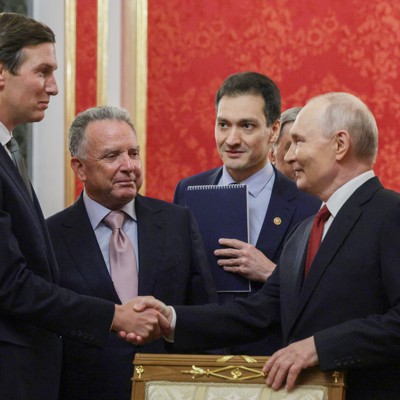
In this pool photograph distributed by the Russian state agency Sputnik, Russia's President Vladimir Putin (R) welcomes U.S. special envoy Steve Witkoff and U.S. President Donald Trump's son-in-law Jared Kushner prior to their talks in Moscow on September 5, 2026. Gavriil GRIGOROV / POOL / AFP via Getty Images
The report to Congress notes accomplishments but masks depleted arsenals, strategic distractions, and a quiet retreat from European defense.
The Pentagon’s latest report about its implementation of the National Defense Strategy notes progress on accelerating weapons production, cutting red tape, and persuading European governments to boost defense spending—but is light on problems such as Russia’s increasing aggression in Europe and the high cost of U.S. wars in the Middle East.
The report to Congress, dated Sept. 22 but pushed out on Defense Department social media on Tuesday, argues that the Trump administration has made “significant progress implementing the 2026 National Defense Strategy’s guidance” in several areas. It cites a historically large budget request that includes funding for undersea forces, long-range air forces, long-range ground fires, and satellites for communication and intelligence; and $53 billion to accelerate the development of munitions.
The report arrives one day before Defense Secretary Pete Hegseth’s scheduled “State of the Force” address at Marine Corps Base Quantico in Virginia. He is likely to talk about some of the update’s key themes, according to one person familiar with the matter.
The update cites progress made in the Golden Dome for America, or GDA, effort to build a continental defense against drones and missiles. “DoW has already conducted our first live-fire event , during which we successfully demonstrated key aspects of GDA command-and-control (C2) as well as integration of other key capabilities,” it says.
The update says the Pentagon has worked with the Federal Aviation Administration and the Federal Communications Commission to ease the development and testing of counter-drone defenses. “We have created a first-of-its-kind process for the rapid coordination and safe incorporation of next generation C-UAS technology” into the National Airspace System, it says.
The update touts the administration’s effort to persuade European allies to spend more on their militaries and contribute more to plans for the continent’s defense. At least one alliance defense leader—Paweł Ksawery Zalewski, secretary of state at Poland’s Ministry of National Defence—has said the NATO 3.0 concept should not be misunderstood as a harbinger of a U.S. retreat from the alliance. “Polish armed forces and American armed forces have never been so close and so good and so deep as today,” Zalewski told a U.S. audience last week.
But the report glosses over conditions that have worsened since the National Defense Strategy was published in January—in part, because of President Trump’s decision to start a war on Iran.
For instance, while the NDS holds as a goal the replenishment of the U.S. arsenal, the new report doesn’t mention that Operation Epic Fury and other Middle East operations have set back that goal by “'months and years,” as a report from the Center for Strategic and International Studies put it in May. Nor does the report mention the NDS’ warning against “endless wars, regime change, and nation building”—the latter two being among the many justifications given by the Trump administration for its war on Iran.
It skips the fact that the NDS said regional allies should deter Iran and that it said further military action to prevent an Iranian nuclear weapon would be unnecessary in the wake of June 2025’s “Midnight Hammer” bombing.
Instead, the update asserts that the Defense Department “anticipated that such a need [for strikes against Iran’s nuclear program] might be forthcoming.”
But perhaps the report’s most significant omission, which it shares with the NDS itself, concerns Russian actions: hybrid and kinetic action against NATO members, military assistance to Iran , and intensifying the war on Ukraine.
Instead, the update notes that the United States reduced the number of manned brigade combat teams in Europe from “five to three, returning us to the level of BCTs in Europe in 2021.”
Max Bergmann and Otto Svendsen, writing for the Heinrich Böll Foundation on Sept. 24, say that “a potential U.S. force posture reduction in Europe will leave the continent vulnerable to further Russian aggression.”
NEXT STORY: After 40 days of combat, Navy destroyer returns home
这张由俄罗斯国家通讯社“卫星通讯社”发布的合影显示,2026年9月5日,俄罗斯总统弗拉基米尔·普京(右)在莫斯科会见美国特使史蒂夫·威特科夫和美国总统唐纳德·特朗普的女婿贾里德·库什纳,随后举行会谈。图片来源:Gavriil GRIGOROV / POOL / AFP via Getty Images
提交给国会的报告列举了取得的成就,但掩盖了武器库的枯竭、战略上的干扰以及悄然从欧洲防务中撤退的事实。
五角大楼最新发布的关于其执行《国防战略》的报告指出,在加快武器生产、减少繁文缛节以及说服欧洲各国政府增加国防开支方面取得了进展,但对于俄罗斯在欧洲日益增长的侵略性和美国在中东战争的高昂成本等问题却着墨不多。
这份提交给国会的报告日期为9月22日,但直到周二才通过国防部社交媒体发布。报告指出,特朗普政府在多个领域“落实2026年国防战略指导方针方面取得了显著进展”。报告列举了一项历史性的巨额预算申请,其中包括为水下部队、远程空军、远程地面火力以及通信和情报卫星提供资金;此外,还拨款530亿美元用于加速弹药研发。
这份报告在国防部长皮特·赫格塞斯计划于弗吉尼亚州匡蒂科海军陆战队基地发表“部队状况”演讲的前一天发布。据一位知情人士透露,他很可能会谈到这份更新报告中的一些关键内容。
此次更新报告指出,美国“金穹顶”(Golden Dome for America,简称GDA)项目在构建针对无人机和导弹的大陆防御体系方面取得了进展。报告称:“美国国防部已经进行了首次实弹演练,成功展示了GDA指挥控制(C2)的关键方面以及其他关键能力的整合。”
最新消息称,五角大楼已与联邦航空管理局和联邦通信委员会合作,简化反无人机防御系统的研发和测试流程。“我们创建了一个史无前例的流程,用于快速协调并将下一代反无人机系统技术安全地整合到国家空域系统中,”消息称。
此次更新强调了美国政府努力说服欧洲盟国增加军费开支,并为欧洲大陆的防务计划做出更大贡献。至少有一位联盟防务领导人——波兰国防部国务秘书帕维尔·克萨韦里·扎列夫斯基——表示,不应将北约3.0概念误解为美国退出北约的先兆。“波兰军队和美国军队的关系从未像今天这样密切、友好和深入,”扎列夫斯基上周对美国听众说道。
但该报告忽略了自1月份《国防战略》发布以来情况已经恶化的事实——部分原因是特朗普总统决定对伊朗发动战争。
例如,尽管《国家安全战略》(NDS)将补充美国武器库作为一项目标,但这份新报告并未提及“史诗狂怒行动”和其他中东军事行动已使这一目标“推迟了数月甚至数年”,正如战略与国际研究中心(CSIS)5月份的一份报告所指出的那样。该报告也未提及《国家安全战略》对“无休止的战争、政权更迭和国家重建”的警告——后两项正是特朗普政府为对伊朗发动战争所提出的众多理由之一。
它忽略了《国家安全战略》中指出地区盟友应该威慑伊朗,并且指出在 2025 年 6 月“午夜铁锤”轰炸之后,采取进一步军事行动阻止伊朗拥有核武器是没有必要的。
相反,更新声明称,国防部“预料到可能会出现(对伊朗核计划进行打击的)这种需求”。
但这份报告或许最大的疏漏,也是《国家安全战略》本身所遗漏的,是俄罗斯的行动:对北约成员国的混合和动能行动、对伊朗的军事援助以及加剧对乌克兰的战争。
相反,更新报告指出,美国已将驻欧洲的有人旅级战斗队数量从“5个减少到3个,使我们恢复到2021年驻欧洲旅级战斗队的水平”。
马克斯·伯格曼和奥托·斯文森于 9 月 24 日在海因里希·伯尔基金会撰文称,“美国在欧洲的潜在兵力缩减将使欧洲大陆容易受到俄罗斯的进一步侵略。”
下一篇报道:经过40天的战斗,海军驱逐舰返回母港