Army awards more than $4 billion in counterdrone contracts, putting the Pentagon’s new drone marketplace to the test美国陆军授予超过40亿美元的反无人机合同,对五角大楼新的无人机市场进行考验。
The Defense Department launched drones.mil earlier this year following an Army-led effort.
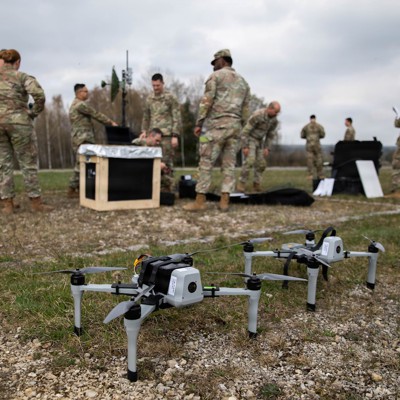
Soldiers with 2d Squadron, 2d Cavalry Regiment, build a ground control station for electronic warfare at Vilseck, Germany, April 15, 2026. U.S. Army / Sgt. Addison Shinn
The Defense Department launched drones.mil earlier this year following an Army-led effort.
Military drone and counterdrone demand is booming amid a rush to spend funds before the end of the fiscal year—but the Pentagon’s drone marketplace is making it a little easier, defense officials said.
“These contracts are available to everybody. And so what we've seen across the department is a surge of end-of-year requests for procurement,” Brig. Gen. Matthew Ross, who leads the Pentagon’s Joint Interagency Task Force 401 , told reporters Tuesday. “End-of-year spending is nothing new inside of the department, but when you have an available contract vehicle, it makes it really easy to execute. And so, we've seen that from across the services.”
The Army issued 10 indefinite delivery, indefinite quantity contracts Tuesday with a total ceiling of $4.15 billion for counterdrone tech including command and control systems, sensors, and systems that can disable or destroy unmanned aerial drones.
Seven companies received $500 million awards: Allen Control Systems, Digital Force Technologies, DroneShield, L3Harris WESCAM, Napatree Technology, RADA Technologies, and SRC.
Echodyne and PVP Advanced EO Systems received $250 million contracts, and SmartShooter received a $150 million contract. Only about $50 million was obligated at the time of award, the Army said.
But there’s room for more—-up to $7 billion.
"As of today we have awarded over $5 billion, which includes previous contracts with [ Aerovironment ] and CACI , these 10 new IDIQs and others that we expect to sign before the end of next month. The $7 billion ceiling is in full effect today, and additional contracts will be pursued to get us to that point," Col. Tony Lindh, JIATF-401’s lead for rapid acquisitions, told reporters.
The new enterprise contracts reflect a new way of doing business for the Army, providing buyers more flexibility over time.
“These platforms are software-defined, hardware-enabled systems…so we have to be able to partner with industry and then hold them accountable over time,” said Ross, JIATF 401’s director.
The Army’s unmanned aerial systems marketplace has done about $800 million in transactions since it opened earlier this year, and the expectation is for counterdrone demand to follow a similar path—especially with allies and partners, said Brent Ingraham, who leads Army acquisitions.
“About 10 days ago, Australia successfully procured, in this case, it was a UAS off the drones.mil marketplace ,” Ingraham told reporters. “We still have to use the [foreign military sales] process as we go through this marketplace. But…we've automated the tools on the back end.”
That means it now takes days from request to purchase instead of months or longer when an ally or partner nation wants to buy a system the U.S. has.
“When they see the U.S. military buying certain products, they're all in,” Ingraham said. “And so this is a way to share those technologies, share what we're doing,” and help smaller businesses “scale.”
NEXT STORY: Treat operational feedback as a strategic resource, new paper argues
2026年4月15日,在德国维尔塞克,美国陆军第2骑兵团第2中队的士兵正在搭建电子战地面控制站。(美国陆军/中士艾迪生·辛恩摄)
今年早些时候,在陆军的牵头下,国防部推出了 drones.mil 系统。
国防官员表示,由于财政年度结束前急于花掉资金,军用无人机和反无人机的需求正在激增——但五角大楼的无人机市场让这一切变得稍微容易了一些。
“这些合同对所有人开放。因此,我们看到整个部门年底采购申请激增,”五角大楼联合跨部门特遣部队401负责人马修·罗斯准将周二告诉记者。“年底支出在国防部内部并不新鲜,但当有可用的合同机制时,执行起来就非常容易。因此,我们在各军种都看到了这种情况。”
周二,陆军签发了 10 份不定期交付、不定期数量的合同,总金额上限为 41.5 亿美元,用于采购反无人机技术,包括指挥控制系统、传感器以及能够使无人机失效或摧毁的系统。
七家公司获得 5 亿美元的奖励:Allen Control Systems、Digital Force Technologies、DroneShield、L3Harris WESCAM、Napatree Technology、RADA Technologies 和 SRC。
Echodyne和PVP Advanced EO Systems公司分别获得了价值2.5亿美元的合同,SmartShooter公司获得了价值1.5亿美元的合同。陆军方面表示,合同授予时仅拨付了约5000万美元。
但还有更多空间——高达 70 亿美元。
“截至今日,我们已授予超过50亿美元的合同,其中包括之前与[Aerovironment]和CACI签订的合同,这10份新的无限期交付/无限期数量合同(IDIQ)以及我们预计在下月底前签署的其他合同。70亿美元的上限今日起全面生效,我们将继续争取更多合同以达到这一目标,”联合跨部门特遣部队401快速采购负责人托尼·林德上校告诉记者。
新的企业合同体现了陆军新的经营方式,为买家提供了更大的灵活性,使其能够随着时间的推移而更加灵活。
“这些平台是软件定义、硬件支持的系统……所以我们必须能够与行业合作,然后随着时间的推移让他们承担责任,”JIATF 401 的主管罗斯说。
陆军无人机系统市场自今年年初开放以来,交易额已达约 8 亿美元。陆军采购负责人布伦特·英格拉姆表示,预计反无人机需求也将遵循类似的路径,尤其是在盟友和合作伙伴方面。
“大约10天前,澳大利亚成功采购了一架无人机系统,这架无人机来自drones.mil市场,”英格拉姆告诉记者。“我们仍然需要通过(对外军售)流程来完成这个市场交易。但是……我们已经实现了后端工具的自动化。”
这意味着,现在盟友或伙伴国家想要购买美国拥有的系统时,从提出请求到购买只需几天时间,而不是几个月或更长时间。
“当他们看到美国军方采购某些产品时,他们就都想跟进,”英格拉姆说。“所以这是一种分享这些技术、分享我们正在做的事情的方式,”并帮助小型企业“扩大规模”。
下一篇报道:新论文认为,应将运营反馈视为战略资源