Navy, Shield AI pour big bucks into X-BAT drone development海军和Shield AI公司斥巨资研发X-BAT无人机
Altogether, Shield AI and the US Navy are investing a combined $400 million into the X-BAT drone.
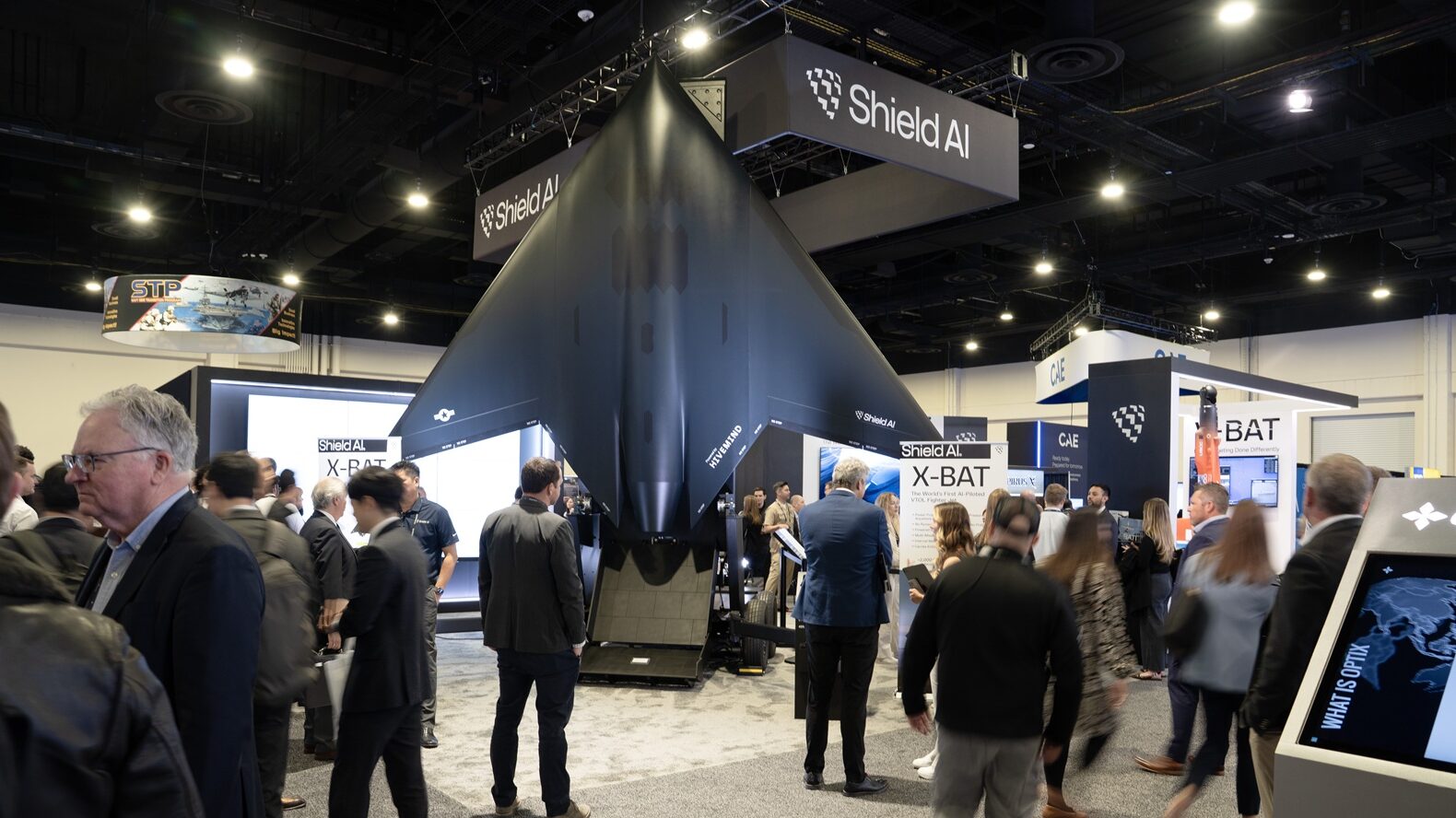
Shield AI's X-BAT is an AI-piloted VTOL fighter jet. (Daniel Woolfolk / Breaking Defense)
WASHINGTON — Artificial intelligence startup Shield AI and the Navy are putting another $300 million into the company’s X-BAT vertical takeoff and landing (VTOL) drone , the firm announced today.
The Navy has signed off on a $150 million modification to an existing Other Transaction agreement for the X-BAT program under the Pentagon’s Defense Exportability Features program, and Shield AI has agreed to match that funding with $150 million of its own capital, according to the firm.
The investment builds upon another $100 million in government and private funding announced. In August , the Navy’s Portfolio Acquisition Executive (Aviation) Rapid Capability Cell and the Defense Innovation Unit (DIU) awarded $50 million in funding for the X-BAT program as part of the Runway Independent Maritime Expeditionary Strike (RIMES) effort, which seeks a drone capable of conducting long-range strikes with minimal infrastructure. Shield AI also coupled $50 million in private capital to match government funding for that initiative.
Altogether, Shield AI and the US Navy are investing a combined $400 million in the X-BAT drone, which is slated for flight testing later this year.
“We are testing early and often while working on the aircraft, mission systems, ship suitability and production in parallel,” Armor Harris, senior vice president of aircraft at Shield AI, said in a statement. “That approach helps us identify and resolve issues earlier, reduce development risk and move more quickly toward flight testing.”
After unveiling X-BAT last year, Shield AI announced last month that the Seattle area would serve as the production site for the aircraft while testing would occur at the Newton City-County Airport in Kansas.
The firm said that it has employed 500 engineers at Shield AI and other “key suppliers” to construct a test aircraft and has already completed engine light-off and thrust-vectoring nozzle integration. The aircraft — which Shield AI markets as the “world’s first AI-piloted VTOL fighter jet” — measures in at 26 feet long with a 39 foot wingspan and a range of more than 2,000 nautical miles, according to the company.
Why Bigger Fences Aren’t Enough in the Age of Drones
Traditional thinking about how to protect facilities must adapt to new threats such as drones or downstream attacks.
The effort comes as the Navy has sought an unmanned aerial system (UAS) capable of launching from ships without large flight decks — like Arleigh Burke-class destroyers — to conduct long-range strikes.
The DIU published a solicitation in February for the RIMES program, which claimed that naval surface combatants are “constrained in their ability to support long-range strikes over extended combat operations due to reliance on single-use missile systems, with limited magazine depth and limited at-sea munition replenishment capability.”
As a result, the notice said the Navy wants a drone that can launch from “expeditionary locations with minimal infrastructure, or from ships without large flight decks,” and have a one-way range of at least 1,400 nautical miles with 1,000-pound munitions.
JJ Cummings, Shield AI’s head of mission solutions for the US Navy, touted the aircraft’s design for the Navy operations.
“Its runway-independent design and small deck footprint can increase sortie generation and extend long-range air combat power from CVNs, LHAs, LHDs and ESBs,” Cummings said in a statement. “Just as important, we are designing it for safe, high-tempo manned-unmanned flight deck operations and integration with the missions and capabilities of the carrier air wing, so X-BAT can add combat power without compromising existing operations.”
Breaking Defense Video
Unpacking Boeing’s F/A-XX win, plus a report from wartime Ukraine
How Hegseth envisions a new Autonomous Warfare Command
What Europe’s military air fleets will look like in 30 years
Riyadh gets closer to F-35s, Damascus presses sovereignty and an expert take on Iran
Drone-hunting on the border, plus turmoil at an Air Force think tank
The future of European airpower might be unmanned
The big news out of AFA, plus a guided tour of the show floor
Why the ‘right to repair’ matters to the Pentagon
What the Pentagon is testing along the US-Mexico border
Chairman Caine talks cislunar ops, plus a window into next-gen airlift
Shield AI公司的X-BAT是一款由人工智能驾驶的垂直起降战斗机。(Daniel Woolfolk / Breaking Defense)
华盛顿——人工智能初创公司 Shield AI 和美国海军今天宣布,将再向该公司的 X-BAT 垂直起降 (VTOL) 无人机投入 3 亿美元。
据该公司称,海军已批准对五角大楼国防出口能力特征计划下的 X-BAT 项目的现有其他交易协议进行 1.5 亿美元的修改,而 Shield AI 已同意用其自有资金 1.5 亿美元来匹配这笔资金。
这项投资建立在此前宣布的1亿美元政府和私人资金之上。今年8月,海军航空装备采购执行办公室快速能力小组和国防创新部门(DIU)为X-BAT项目拨款5000万美元,该项目是“跑道独立海上远征打击”(RIMES)计划的一部分,旨在研发一种能够在极少基础设施的情况下执行远程打击任务的无人机。Shield AI公司也投入了5000万美元的私人资本,与政府拨款共同支持该计划。
Shield AI 和美国海军总共投资 4 亿美元用于 X-BAT 无人机,该无人机计划于今年晚些时候进行飞行测试。
“我们在进行飞机、任务系统、舰船适用性和生产工作的同时,也在进行早期且频繁的测试,”Shield AI公司飞机高级副总裁阿莫尔·哈里斯在一份声明中表示。“这种方法有助于我们更早地发现和解决问题,降低开发风险,并更快地进入飞行测试阶段。”
继去年推出 X-BAT 之后,Shield AI 上个月宣布,西雅图地区将作为该飞机的生产基地,而测试将在堪萨斯州牛顿市县机场进行。
该公司表示,已在Shield AI和其他“关键供应商”雇佣了500名工程师来建造测试飞机,并已完成发动机点火和推力矢量喷管集成。据该公司称,这架被Shield AI宣传为“世界首架人工智能驾驶垂直起降战斗机”的飞机长26英尺(约8米),翼展39英尺(约12米),航程超过2000海里(约3200公里)。
为什么在无人机时代,更高的围栏还不够?
传统的设施保护理念必须适应无人机或下游攻击等新威胁。
海军一直在寻求一种能够从没有大型飞行甲板的舰艇(如阿利·伯克级驱逐舰)上起飞的无人机系统(UAS),以进行远程打击。
国防情报部门 (DIU) 于 2 月份发布了 RIMES 项目的招标书,其中声称,由于依赖一次性导弹系统,且弹药库深度有限、海上弹药补给能力有限,海军水面作战舰艇“在支持远程打击和长期作战行动方面受到限制”。
因此,该通知称,海军希望研制一种能够从“基础设施极少的远征地点或没有大型飞行甲板的舰船”起飞的无人机,并且单程航程至少为 1400 海里,携带 1000 磅弹药。
Shield AI 公司负责美国海军任务解决方案的负责人 JJ Cummings 称赞了该飞机为海军作战而设计的方案。
“其无需跑道的设计和较小的甲板占用面积可以增加航母(CVN)、两栖攻击舰(LHA)、两栖攻击舰(LHD)和远征支援舰(ESB)的出动架次,并扩展其远程空中作战能力,”卡明斯在一份声明中表示。“同样重要的是,我们将其设计为可安全、高节奏地进行有人/无人驾驶飞行甲板作业,并与航母舰载机联队的任务和能力相整合,因此X-BAT可以在不影响现有作战行动的情况下增强作战能力。”
突破性防御视频
深入剖析波音F/A-XX的中标,以及来自战时乌克兰的报道
赫格塞斯设想的新型自主作战指挥部
30年后欧洲军用空军机队会是什么样子
利雅得距离F-35战机更近一步,大马士革强调主权,以及专家对伊朗的看法
边境无人机猎杀行动,以及空军智库的动荡
欧洲空军的未来或许在于无人化。
AFA展会最新动态,以及展会现场导览。
为什么“维修权”对五角大楼如此重要
五角大楼正在美墨边境测试什么?
凯恩主席谈地月空间作业,以及下一代空运技术展望