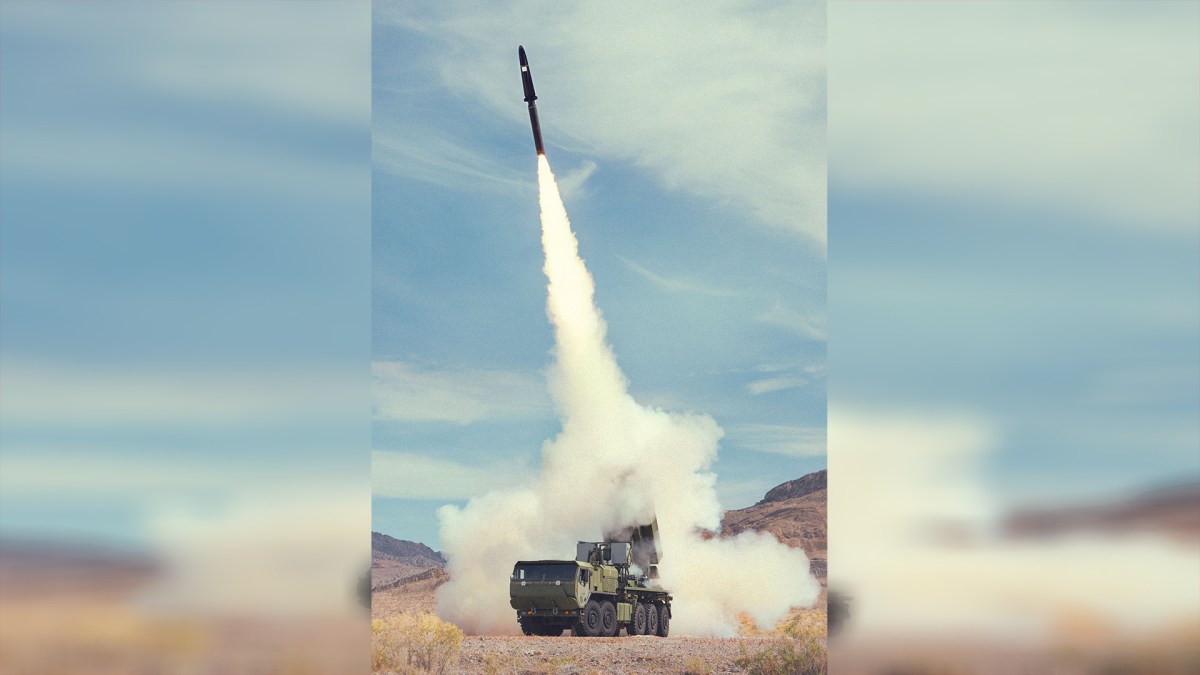
Blackbeard Hypersonic Missile Shown Being Fired From Ground Launcher黑胡子高超音速导弹从地面发射器发射的画面
Blackbeard is part of the Army’s push to make hypersonic weapons more mobile and affordable. Blackbeard is part of the Army’s push to make hypersonic weapons more mobile and affordable.
Published Oct 8, 2026 12:32 PM EDT
Castelion has released what appears to be the first image of its relatively ‘cheap’ Blackbeard hypersonic missile being fired from a ground launcher, providing a new look at the containerized launch architecture now under development for the U.S. Army.
The photograph, posted by Castelion on X, shows a Blackbeard missile leaving a launcher mounted on a high-mobility truck chassis. While the missile itself is by now a familiar sight , the new image offers a first public glimpse of how Castelion intends to package and operate the ground-launched version of Blackbeard, known as Blackbeard GL.
Container-compatible Blackbeard. Built to move with the fight. pic.twitter.com/OzWbiChCPQ — Castelion (@Castelion) October 8, 2026
Container-compatible Blackbeard. Built to move with the fight. pic.twitter.com/OzWbiChCPQ
The Army’s previously disclosed plans for the program call for an initial Blackbeard ground-launch demonstration using a modified Multiple Launch Rocket System Family of Munitions , or MFOM, pod, followed by the development of Blackbeard GL prototypes and a dedicated launcher pod. Ultimately, the service intends to conduct an MVP flight test using the M142 High Mobility Artillery Rocket System ’s (HIMARS) fire-control system.
Blackbeard for HIMARS. pic.twitter.com/uA9XgcGvsI — Castelion (@Castelion) August 3, 2026
Blackbeard for HIMARS. pic.twitter.com/uA9XgcGvsI
The Army’s Fiscal Year 2027 budget documentation indicates that this effort is moving toward increasingly representative hardware. Among the milestones listed for FY2027 is a live-fire launch of a “production representative” Blackbeard GL and launcher pod.
Castelion has already released extensive imagery of Blackbeard test vehicles, and the company formally unveiled the weapon’s current external configuration earlier this year . Those images showed a two-stage arrangement with a booster and an upper vehicle that has characteristics consistent with a hypersonic glide or maneuvering payload. Compared to the air-launched version, seen below, the ground-launch model lacks the cruciform tailfins at the rear of the lower stage, but otherwise appears similar.
The first official photo of the Blackbeard missile. Castelion
The precise propulsion system and flight profile of the production weapon remain undisclosed. Little is known about its performance parameters, either. Castelion has previously hinted that the missile could strike targets at ranges of just under 500 miles, although its range would likely be reduced when launched from the ground, without the altitude and speed provided by an aircraft launch platform.
The launcher appears to use a relatively compact enclosed container, consistent with the Army’s stated interest in leveraging the existing MFOM ecosystem and, eventually, HIMARS. The photograph doesn’t establish how many Blackbeards could be carried by a single launcher, although, based on the dimensions, at least two and perhaps as many as four missiles appears a feasible load.
A mock-up of an ATACMS missile next to one of a standardized MFOM. U.S. Army
Exactly how closely the pictured launcher corresponds to the eventual production Blackbeard GL pod is also not yet clear. Castelion has previously stressed that its test hardware is deliberately designed to support rapid development cycles and should not necessarily be interpreted as representative of the final weapon system.
Castelion had previously shown Blackbeard-related test articles alongside palletized launch equipment, including launch hardware mounted on an Oshkosh MKR18 Logistics Vehicle System Replacement truck. The company has also said it was converting such a vehicle into a launcher for flight testing. That appears to be the vehicle shown in the new image, too.
A test article that Castelion has used in previous testing related to Blackbeard in front of a palletized launcher loaded on a truck. Castelion Corporation
The Army’s interest in Blackbeard GL is rooted in cost as much as performance.
The service has described the weapon as an affordable, mass-produced hypersonic precision-fire capability intended to engage time-sensitive moving and hardened targets. The stated objective has been to obtain roughly 80 percent of the capability of the Army’s planned Precision Strike Missile (PrSM) Increment 4 while achieving a substantially lower cost per round.
Existing U.S. hypersonic weapons such as the Army’s Dark Eagle Long Range Hypersonic Weapon use large, highly specialized launch equipment. Blackbeard is instead being developed around the idea that a hypersonic weapon can be sufficiently compact, inexpensive, and manufacturable to be treated more like a conventional tactical munition.
The U.S. Army’s Dark Eagle Long Range Hypersonic Weapon assigned to Bravo Battery, 5th Battalion, 3rd Field Artillery (Long Range Fires Battalion), 1st Multi-Domain Task Force, participates in an exercise on Joint Base Lewis-McChord, Washington. U.S. Army photo by Staff Sgt. Brandon Rickert Staff Sgt. Brandon Rickert
A containerized launcher compatible with an existing mobile fires ecosystem would reinforce that concept. It could allow the Army to introduce a new hypersonic effect without creating an entirely separate launcher, crew, transport, and reload architecture.
The ground-launched version is only one part of Castelion’s broader Blackbeard effort.
The company is also working with the Navy to integrate the weapon onto the F/A-18E/F Super Hornet . In April, Castelion received a $105 million Navy contract supporting integration and the transition toward an early operational capability, while a subsequent $23.4 million order covered 50 early-operational-capability pre-production missiles and associated storage and shipping containers.
A pair of Blackbeard hypersonic missiles mounted on a Super Hornet during a developmental test flight on September 18, 2026. Edited photo from PAE(A) U.S. Defense Media Activity/Edited photo from PAE(A)
The Navy has since moved into additional procurement, underscoring Castelion’s effort to establish Blackbeard as a weapon that can be produced in the quantities required. Blackbeard could also find its way onto Navy ships and submarines, as well as ground-based launchers, as we have discussed in the past .
As for the Army, the next major milestone will be the planned production-representative Blackbeard GL and launcher-pod live-fire testing.
An earlier Blackbeard-related test launch. Castelion
“Once Castelion achieves testing and validation, the Department will award a two-year multi-year procurement contract for a minimum of 500 Blackbeard missiles annually, with options to extend for up to five years,” the Pentagon announced in May of this year. “To further encourage Castelion’s self-funded facility expansion, the Department is actively seeking the necessary authorizations and appropriations to purchase over 12,000 Blackbeard missiles over five years.”
This reflects a broader and accelerating U.S. military push for lower-cost precision weapons that can be manufactured relatively simply and at scale, increasingly with help from non-traditional defense contractors . The goal is to build large stockpiles affordably before a major contingency, particularly a potential large-scale conflict with China in the Pacific, while ensuring production can keep pace with demand during a prolonged war.
Fow now, Castelion has demonstrated what the Army’s Blackbeard launch system actually looks like when it fires, at least in its initial form.
Contact the author: thomas@thewarzone.com
Comments couldn’t be loaded. Please refresh the page.
发布于美国东部时间2026年10月8日下午12:32
卡斯特利昂公司发布了其相对“便宜”的黑胡子高超音速导弹从地面发射器发射的第一张图片,让人们得以一窥目前正在为美国陆军开发的集装箱式发射架构。
这张由Castelion公司在X平台上发布的照片显示,一枚“黑胡子”导弹正从安装在高机动性卡车底盘上的发射架中发射出去。虽然这种导弹本身早已为人熟知,但这张新照片首次向公众展示了Castelion公司计划如何包装和操作“黑胡子”的陆基发射版本——“黑胡子GL”。
兼容容器的黑胡子。专为战斗而生。pic.twitter.com/OzWbiChCPQ — Castelion (@Castelion) 2026年10月8日
兼容集装箱的黑胡子。专为战斗而生。pic.twitter.com/OzWbiChCPQ
陆军此前公布的计划包括:首先使用改进型多管火箭炮系统系列(MFOM)吊舱进行“黑胡子”地面发射演示;随后开发“黑胡子”地面发射原型机和专用发射吊舱;最终,陆军计划使用M142高机动性火箭炮系统(HIMARS)的火控系统进行MVP飞行测试。
黑胡子为HIMARS而来。 pic.twitter.com/uA9XgcGvsI — Castelion (@Castelion) 2026年8月3日
黑胡子为HIMARS而战。 pic.twitter.com/uA9XgcGvsI
陆军2027财年预算文件显示,这项工作正朝着更具代表性的硬件方向发展。2027财年列出的里程碑之一是对“量产型”黑胡子榴弹发射器及其发射吊舱进行实弹射击。
卡斯特利翁公司此前已发布了大量“黑胡子”导弹测试飞行器的图片,并于今年早些时候正式公布了该武器目前的外部结构。这些图片显示,该导弹采用两级结构,由助推器和上级飞行器组成,其特征与高超音速滑翔或机动有效载荷相符。与下图所示的空射版本相比,地面发射版本缺少下级尾部的十字形尾翼,但其他方面看起来相似。
黑胡子导弹的首张官方照片。卡斯特利翁
该量产型武器的具体推进系统和飞行剖面仍未公开,其性能参数也鲜为人知。卡斯特利翁公司此前曾暗示,该导弹射程可达近500英里,但如果从地面发射,由于缺乏飞机发射平台提供的高度和速度,其射程可能会缩短。
该发射器似乎采用了一种相对紧凑的封闭式容器,这与陆军此前宣称的利用现有MFOM系统并最终接入HIMARS系统的意图相符。照片并未显示单个发射器可携带多少枚“黑胡子”导弹,但根据其尺寸判断,至少两枚,甚至可能多达四枚导弹都是可行的载荷。
一枚ATACMS导弹模型,旁边是一枚标准化的MFOM导弹模型。美国陆军
图中所示的发射器与最终量产的“黑胡子”榴弹发射器究竟有多大程度的相似性,目前尚不清楚。Castelion公司此前曾强调,其测试硬件的设计旨在支持快速的研发周期,因此不应被视为最终武器系统的代表。
卡斯特利昂公司此前曾展示过与“黑胡子”火箭相关的测试样品,以及托盘式发射设备,其中包括安装在奥什科什MKR18后勤车辆系统替换卡车上的发射硬件。该公司还表示,正在将这种车辆改装成发射车进行飞行测试。新图片中展示的车辆似乎也是这种改装车。
这是卡斯特利昂公司在之前与黑胡子相关的测试中使用的测试样品,测试样品位于装载在卡车上的托盘式发射器前方。
陆军对黑胡子榴弹发射器的兴趣,既源于其性能,也源于其成本。
该军种将这种武器描述为一种价格低廉、可大规模生产的高超音速精确火力武器,旨在打击对时间要求严格的移动目标和加固目标。其既定目标是在大幅降低单发成本的同时,达到陆军计划中的精确打击导弹(PrSM)第四阶段约80%的性能水平。
美国现有的高超音速武器,例如陆军的“暗鹰”远程高超音速武器,需要使用大型、高度专业化的发射设备。“黑胡子”高超音速武器的研发理念则不同,它认为高超音速武器可以足够紧凑、廉价且易于制造,从而更像传统的战术弹药。
美国陆军第1多域特遣部队第3野战炮兵营(远程火力营)第5营B连装备的“暗鹰”远程高超音速武器正在华盛顿州刘易斯-麦科德联合基地参加演习。美国陆军参谋军士布兰登·里克特摄
与现有移动火力系统兼容的集装箱式发射器将强化这一理念。它可以让陆军在无需创建完全独立的发射器、乘员、运输和装填体系的情况下,引入新的高超音速效应。
地面发射版本只是卡斯特里昂公司更广泛的“黑胡子”计划的一部分。
该公司还与海军合作,将该武器集成到F/A-18E/F“超级大黄蜂”战斗机上。今年4月,卡斯特利翁公司获得了一份价值1.05亿美元的海军合同,用于支持集成工作以及向早期作战能力过渡;随后,该公司又获得了一份价值2340万美元的订单,涵盖50枚具备早期作战能力的预生产型导弹以及相关的存储和运输容器。
2026年9月18日,两枚“黑胡子”高超音速导弹挂载在一架“超级大黄蜂”战斗机上,正在进行研发性试飞。图片由美国国防媒体活动PAE(A)提供/经编辑。
此后,海军已开始追加采购,这凸显了卡斯特利翁公司致力于将“黑胡子”导弹打造成为能够按所需数量生产的武器的努力。“黑胡子”导弹也可能装备海军舰艇、潜艇以及陆基发射装置,正如我们之前讨论过的。
至于陆军,下一个重大里程碑将是计划中的具有生产代表性的黑胡子榴弹发射器和发射吊舱的实弹测试。
早前与黑胡子有关的一次测试发射。卡斯特利昂
五角大楼今年5月宣布:“一旦卡斯特利翁公司完成测试和验证,国防部将授予其一份为期两年的多年采购合同,每年至少采购500枚‘黑胡子’导弹,并可选择续签至多五年。” “为了进一步鼓励卡斯特利翁公司自筹资金扩建设施,国防部正在积极寻求必要的授权和拨款,以便在五年内采购超过12000枚‘黑胡子’导弹。”
这反映出美国军方正加速推进低成本、可相对简便大规模生产的精确制导武器,并且越来越多地借助非传统国防承包商的力量。其目标是在重大突发事件发生前,特别是与中国在太平洋地区可能发生的大规模冲突前,以可承受的成本建立大量的武器储备,同时确保在持久战期间,生产能够满足需求。
现在,卡斯特利翁已经展示了陆军的黑胡子导弹发射系统在发射时的实际样子,至少是其初始形态。
联系作者:thomas@thewarzone.com
评论加载失败,请刷新页面。