Sikorsky’s “Black Hawk 2070” Strategy Includes Drones, New Engines, And Flying The Pilotless U-Hawk This Year西科斯基公司的“黑鹰2070”战略包括无人机、新型发动机以及今年试飞无人驾驶的U-Hawk直升机。
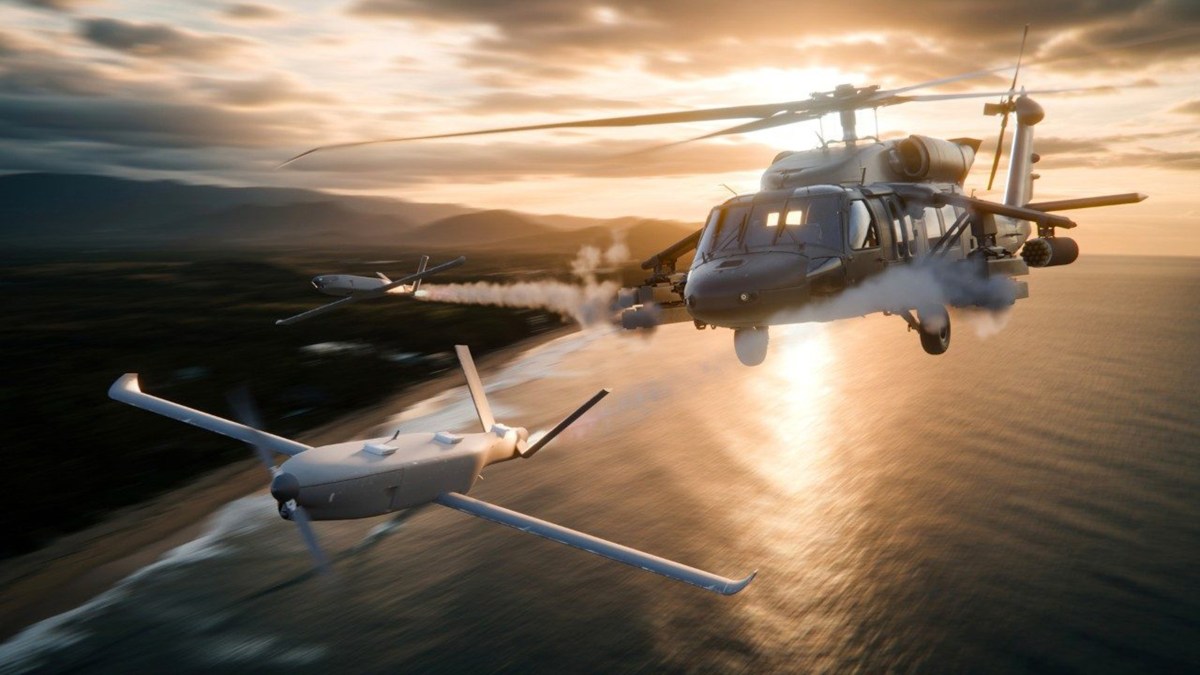
Branded Content: A planned suite of UH-60 upgrades includes the uncrewed U-Hawk, new engines, more range, launched effects, and expanding autonomy.
新闻视频
Published Oct 8, 2026 12:41 PM EDT
The UH-60 Black Hawk has been the rugged workhorse of U.S. Army aviation for nearly 50 years, with around 4,000 examples currently in service with 36 nations worldwide. Many of these helicopters, and new aircraft coming off the line, are set to fly as far out as 2070, and Sikorsky is curating a suite of upgrades to keep them valuable assets for the future fight. A new “digital backbone” is designed to underpin swift technological insertions such as launched effects , with related initiatives including the provision of more power to lug greater payloads, and the fully-autonomous U-Hawk cargo drone variant.
“As part of an overall “Black Hawk 2070” modernization effort we’re developing a number of complementary capabilities, including our U-Hawk uncrewed cargo variant, which we plan to fly later this year,” Jason Wrigley, Sikorsky’s director of business development for Black Hawk, told TWZ at the company’s Stratford plant in Connecticut.
Sikorsky plans to fly its U-Hawk uncrewed cargo version of the Black Hawk this year. Sikorsky
“A new digital backbone for the Black Hawk is at an advanced design phase in our labs and it’s designed to provide interfaces throughout the aircraft that will provide power, data, a network, cooling and most importantly, open architecture interfaces that enable the easy integration of new equipment, such as sensors. We see this as a core building block for the next generation of Black Hawk, along with new engines and other airframe improvements designed to futureproof the platform.”
The new digital backbone is designed to work in concert with a modern, software-driven strategy that meets the Army’s Modular Open Systems Approach and the desire to add technologies cheaper, faster, and more easily. Wrigley says that as customers identify new capabilities and needs for their Black Hawks, the digital backbone will be sufficiently efficient to permit customization even on a mission-by-mission basis. Sikorsky is also introducing a new modular nose to the H-60, which is reconfigurable with sufficient volume to support even more sensors and electronics.
“There’s a big focus on open architecture and that ability to quickly plug-and-play,” says Wrigley. “The new modular nose will change the look of the Black Hawk up front to provide even more space for equipment that will work directly with the new digital architecture.”
The new modular nose will give the Black Hawk more than twice the internal volume of the original nose section and it’s designed to provide space for internal electronics and an integrated mount for external sensor pods. It is designed to provide sufficient space to accommodate electronics that enable roles such as search and rescue, drone control, and flying in degraded environments, and it will also house some of the equipment required as the Black Hawk’s autonomous capabilities expand.
Sikorsky plans to introduce a new modular nose to the UH-60M. Sikorsky
Joshua Powers spent 22 years as an Army Aviation officer flying the Black Hawk, and he’s well qualified for his new role with Sikorsky handling business development for rapid capabilities insertions. “Army units know the Black Hawk inside out; how to fly it, maintain it, and use it to maximum effect. The upgrades we are developing will bring new capabilities faster, without time-consuming and complex changes to sustainment, training, and operations, plus we are adding more range, more payload, and more power to meet the demands of the Indo-Pacific region.”
“I find it amazing to pair new technology with a rugged platform like the Black Hawk. These new innovations are needed to meet the needs of the new complex battlefield. The fight I fought in Iraq is very different from the current operating environment and what future warriors are going to go up against, and what we’re asking them to do is very different from what came before.”
Bringing autonomous co-pilots to the Black Hawk
Autonomy is a central pillar of Sikorsky’s strategy for the future Black Hawk. The company’s MATRIX autonomy software is now being matured on a UH-60M variant, and while it’s not necessarily designed to completely replace pilots, MATRIX will assume some of their workload, making flying safer and simpler as mission sets grow increasingly complex and dangerous. “Pilots that are controlling collaborative drones, for example, need to be able to focus on the drone mission, and autonomy will help lighten their cognitive load,” explains Wrigley.
“The standard Black Hawk crew operates with two pilots. Adding our MATRIX autonomy system gives the operator options – a single pilot could fly without an unbearable workload and still fulfil a mission commander role, for example. The Army could then operate the Black Hawk with no pilots at all when that’s the appropriate option.”
The U.S. Army received its first UH-60MX Optionally Piloted Vehicle (OPV) on March 20, 2026. Sikorsky
Sikorsky’s MATRIX autonomy has been developed on the company’s UH-60A fly-by-wire Optionally Piloted Black Hawk , which has been tested by Sikorsky and Army aviators. MATRIX has accumulated more than 1,000 flight hours across 500 tests and demonstrations. It has already been integrated on over 20 different platforms, including on the Black Hawk for testing by the Defense Advanced Research Projects Agency (DARPA) and the U.S. Army in multiple exercises .
“We delivered the first UH-60MX to the Army earlier this year,” says Wrigley. The delivery marked the first full authority fly-by-wire and optionally-piloted UH-60 in the Army fleet. “They are using it for testing and soldier feedback to develop tactics, techniques and procedures for the autonomous Black Hawk. We have since received a contract to deliver three more MX aircraft to the Army.”
MATRIX autonomy kits have now been installed on all three U.S. Army Black Hawk models; the UH-60A, UH-60L and UH-60M. Sikorsky plans to incorporate autonomy options into all Black Hawks as they are built, plus the MATRIX system will be able to be retrofitted to existing examples.
Powers is well aware of the benefits autonomy will provide from complex combat operations to more mundane day-to-day missions. “Flying at night and seeing the tracer fire coming up at you, things like that, I honestly feel that’s not the big threat. It’s when you’re going to land and there’s just a big dust cloud. When you’re tired, you aren’t as focused. Having MATRIX, whether that’s with one, two, or no pilots, it’s about that reduced workload on the mission. Pilots won’t be as fatigued, plus they have the safety net of a fully autonomous aircraft that can, if needed, land in all of those difficult environments. It will give commanders more operational flexibility and the ability to mitigate risk in less-than-ideal conditions dictated by the enemy or weather.”
The first UH-60MX during testing alongside Sikorsky’s UH-60A Optionally Piloted Black Hawk. Sikorsky
“The Black Hawk operation isn’t just about pilots, it’s also that integrated four-person crew. As a pilot, you’re relying on your senses and also on the guys in the back to watch out and tell you where you’re going. MATRIX is just going to help that team effort and put you in a better position to bring the crew back safely. It integrates all the systems and sensors and uses altitude, airspeed, radar altimeter, drift indications, and puts the fly-by-wire technology to where it can make rapid adjustments and changes based on what it’s seeing with the sensors.”
The volume of testing, the maturity, and the confidence in MATRIX helped Sikorsky to develop the S-70UAS, or U-Hawk, which was unveiled in 2025 . The U-Hawk project essentially removes the cockpit and its associated equipment from a Black Hawk and replaces the front end with cargo doors to provide a huge internal space as a supply drone.
“We acquired a used UH-60L Black Hawk as the template for our initial U-Hawk. We added the clamshell doors and that was the actual aircraft that we showed at AUSA last year,” says Wrigley. “Since then we’ve been adding the fly-by-wire and integrating the MATRIX autonomy. It’s currently in our innovations hangar in Bridgeport, Connecticut, getting the final work done and it will make its first flight as a U-Hawk later this year.”
The first U-Hawk is based on a modified UH-60L. Sikorsky
Sikorsky sees the U-Hawk as a natural evolution for the Black Hawk in contested logistics missions, when cargo needs to be moved but the threat is sufficiently high that it drives a need for uncrewed platforms to tackle the mission.
“We’re spending a lot of time on the U-Hawk and its roles. As well as being an uncrewed cargo helicopter, it can also be a truck that can carry a large volume of launched effects,” explains Wrigley. “There are Black Hawk models on the market right now that are being divested, and we see those as being an ideal option for conversion to U-Hawk configuration to affordably introduce this capability to the market.”
The integration of small drones dubbed ‘launched effects’ into rotary-wing operations is a major initiative from the Army as a new means to collect intelligence for commanders on the battlefield, relay communications, jam and distract enemy emitters, and act as loitering munitions. These mini air-launched drones can be carried and fired from stub-wing-mounted launchers , with other concepts seeing larger volumes of them carried inside the cabin as a “mega-pack,” with Sikorsky seeing both as being highly-applicable to both the Black Hawk and the U-Hawk.
This is exactly the kind of capability that the digital backbone in the Black Hawk is intended to open the door to; installing plug-and-play drone command kits, which could enable the Black Hawk to act as a “drone mothership” to launch, task, and command swarms of multi-mission launched effects.
A Launched Effect-Medium Range is fired from a UH-60M Black Hawk during Project Convergence-Capstone 6, in July 2026. U.S. Army
The Army tested its latest operational concepts for launched effects during the Project Convergence Capstone 6 demonstration event this summer. This annual exercise is designed to develop concepts and tactics as well as gather soldier feedback, as it works to transition new systems into service. The latest exercise built on previous launched effects testing on the Black Hawk, when a UH-60M deployed Anduril’s Altius-700 launched effects that then operated as an autonomous hunter-killer team to locate targets, share data on those targets, and then strike them, without the need for the Black Hawk to expose itself to threats.
“As a young Black Hawk pilot, the OH-58 Kiowa Warrior was the primary scout platform, but it was limited by range and its ability to be detected,” explains Joshua Powers. “Today, we launch small drones that can remain unseen and they can give us real-time feedback. Launched effects make our lift assets more capable.”
“We see the Black Hawk as the aircraft capable of carrying, deploying and then acting as an airborne mission command node for launched effects,” adds Jason Wrigley. “In the operational environment of the future, it’s really about the mass of those launched effects. This isn’t about carrying one or two of them, this is about carrying and controlling a large number of them.”
A “quiver” of launched effects inside the U-Hawk shown at the AUSA 2026 trade event. Jamie Hunter
“We’ve tested them on the stub-wings, but we are also exploring what we call “quiver” – that large number of launched effects inside the cabin in that “mega-pack.” This creates additional opportunities for mass that we think is going to be really critical. We’ve done a lot of operational analysis in concert with the Army on what the right mix of launched effects might be to extend the standoff range of the aircraft to improve survivability – which is of course what it’s all about – but the right mix will ultimately come down to the mission. We have seen a lot of testing over the past few years, so we do believe this is a capability that can be introduced operationally soon on the Black Hawk.”
More power for more missions
To support the increased lift that might be needed for a missionized Black Hawk lugging large payloads, including an arsenal of launched effects, Sikorsky is well along in development of a new engine that is designed to create over 1,000 pounds of increased payload capacity and increased range for the Black Hawk. The T901 Improved Turbine Engine (ITE) from GE Aerospace provides 50 percent more horsepower over the existing T700 engines in the UH-60M.
“One of the key building blocks of the future of the Black Hawk are the twin ITEs as we look to expand the mission capability and the utility of this aircraft for decades to come,” explains Wrigley. Sikorsky began initial testing of the first UH-60M with ITE in January 2025. “We are actively in the test program right now at our test facility in West Palm Beach, Florida. The twin ITEs in each Black Hawk and that additional power translates into some pretty significant operational opportunities. Since our first flight with ITE in May 2025 we’ve flown the aircraft with the new engine for over 50 hours and up to 17,000 ft above sea level.”
A UH-60M fitted with twin GE Aerospace T901 Improved Turbine Engines (ITE). Sikorsky
Sikorsky is accompanying the addition of the new engines with a significant expansion of the fuel tank to increase capacity and range. This is being done without impinging on cabin volume and thus retaining the important ability to transport 11 combat troops, while increasing range by around 100 nautical miles. “The T901 also improves fuel efficiency and eases maintenance – so overall we are really improving the payload capacity of the aircraft. We’ll be getting to the milestone C production decision on ITE within the next couple of years, and at that point it will become a core element of the Black Hawk program going forward,” Wrigley explains.
Building Black Hawks
Touring the Black Hawk production line in Stratford, Connecticut, it’s a hive of activity. Many of the major components for each helicopter are manufactured here. The long final assembly line sees teams of workers busily constructing UH-60M and HH-60M medevac Black Hawks for both domestic and foreign military sales customers, along with new HH-60W Combat Rescue Helicopters for the U.S. Air Force and MH-60R Seahawks .
“We’re designing all of these upgrades with the intent that they will all be available off the production line in new build aircraft, as well as in kit form for upgrades to existing assets in the field,” notes Wrigley. “Here in Stratford in what we call the “back shop” we build all the rotor blades, gearboxes, and many other components that go into each aircraft. We are already thinking ahead and we’ve invested significantly into additive manufacturing, with 11 parts on the Black Hawk today that are additively manufactured. It’s a great place to start, but there’s a long way to go and we’re working on qualifying more challenging components and load-bearing parts.”
A brand new UH-60M in pre-delivery testing. Sikorsky
Cohesively, the digital backbone, larger fuel tank, new engines, and the new modular nose will all be introduced on the production floor in the coming years to pave the way for that increased payload capacity to carry fully-equipped combat troops, supplies, and all the new kit needed for the future fight and the Black Hawk’s role as a multi-mission forward battlefield node. The autonomous U-Hawk and the optionally piloted flexibility afforded by MATRIX – all of these pieces of the future Black Hawk are presently coming together under an overarching effort.
“The future Black Hawk will be that complement to the future long-range MV-75 Cheyenne II,” says Powers. “These won’t be a one-for-one replacement for every Black Hawk currently in the fleet – the MV-75 has a specific purpose and function that the Black Hawk isn’t designed to do. What the Black Hawk can do with these new upgrades is shape the battlefield and with its autonomy be out there flying missions into contested environments.”
U.S. Army UH-60 Black Hawks assigned to 4th Ranger Training Battalion. U.S. Army
“Those homeland missions are equally necessary. I recall talking about this in flight school when choosing an aircraft to fly, how it’s one thing to be deployed on combat missions, but it’s also about being back in the homeland on disaster relief when you need the Black Hawk to go out and save lives, those kinds of missions the Army National Guard does – it really underlines the importance and versatility of the Black Hawk.”
Over the past 50 years and looking ahead to the next 50, continuing the proven legacy of the Black Hawk will mean constant evolution to meet new missions and needs. Sikorsky’s task is for all of these new elements to meld into a future Black Hawk that’s ready to roll off this production line soon, that still also provides the same dependable, rugged capability for the Army at home or overseas, well into the future.
Comments couldn’t be loaded. Please refresh the page.
发布于美国东部时间2026年10月8日下午12:41
UH-60“黑鹰”直升机近50年来一直是美国陆军航空兵的可靠主力,目前全球36个国家约有4000架在役。许多现役直升机以及即将下线的新型飞机预计将服役至2070年,西科斯基公司正在制定一系列升级方案,以确保它们在未来的战争中继续发挥重要作用。一项新的“数字骨干网”旨在支持快速的技术部署,例如发射效应系统。相关举措包括提升动力以携带更大有效载荷,以及开发全自动的U-Hawk货运无人机。
“作为‘黑鹰 2070’整体现代化努力的一部分,我们正在开发许多互补能力,包括我们的 U-Hawk 无人货运型,我们计划在今年晚些时候进行试飞,”西科斯基公司黑鹰业务发展总监杰森·里格利在康涅狄格州斯特拉特福德的工厂告诉 TWZ。
西科斯基公司计划今年试飞其无人货运版“黑鹰”直升机U-Hawk。
“我们实验室正在对黑鹰直升机的新型数字骨干网进行高级设计,该骨干网旨在为整架飞机提供各种接口,包括电源、数据、网络、冷却系统,以及最重要的开放式架构接口,以便轻松集成传感器等新设备。我们认为这是下一代黑鹰直升机的核心组成部分,此外还有新型发动机和其他机身改进,旨在确保该平台面向未来。”
新的数字骨干网旨在与现代化的软件驱动战略协同工作,该战略符合陆军的模块化开放系统方法,并满足以更经济、更快捷、更便捷的方式添加新技术的需求。Wrigley 表示,随着客户对其黑鹰直升机提出新的功能和需求,该数字骨干网的效率将足以支持针对每个任务的定制。西科斯基公司还为 H-60 直升机引入了一种新型模块化机头,该机头可重新配置,并具有足够的空间来支持更多的传感器和电子设备。
“我们非常注重开放式架构和快速即插即用的能力,”Wrigley说道。“新的模块化机头将改变黑鹰直升机的前端外观,为能够直接与新数字架构配合使用的设备提供更多空间。”
全新的模块化机头将使黑鹰直升机的内部容积比原机头部分增加两倍以上,其设计旨在为内部电子设备和外部传感器吊舱的集成安装提供空间。它能够容纳支持搜救、无人机控制和恶劣环境飞行等任务所需的电子设备,并且还能容纳随着黑鹰直升机自主能力扩展而需要的部分设备。
西科斯基公司计划为UH-60M直升机引入一种新型模块化机头。
约书亚·鲍尔斯曾在美国陆军航空兵部队担任黑鹰直升机军官长达22年,他完全胜任在西科斯基公司负责快速能力升级业务拓展的新职位。“陆军部队对黑鹰直升机了如指掌,他们知道如何驾驶、维护和最大限度地发挥其效用。我们正在开发的升级方案将更快地带来新的能力,无需对维护、训练和作战进行耗时且复杂的改动,同时还能增加航程、有效载荷和动力,以满足印太地区的需求。”
“将新技术与黑鹰这样坚固耐用的平台相结合,我觉得非常棒。这些创新是为了满足新复杂战场的需求。我在伊拉克经历的战斗与当前的作战环境以及未来战士将要面对的挑战截然不同,我们要求他们做的事情也与以往大相径庭。”
为黑鹰直升机配备自主副驾驶
自主飞行是西科斯基公司未来黑鹰直升机战略的核心支柱。该公司的MATRIX自主飞行软件目前正在UH-60M型直升机上进行成熟测试。虽然MATRIX并非旨在完全取代飞行员,但它将分担飞行员的部分工作量,从而在任务日益复杂和危险的情况下,使飞行更加安全便捷。“例如,操控协同无人机的飞行员需要专注于无人机任务,而自主飞行将有助于减轻他们的认知负荷,”Wrigley解释道。
“标准的黑鹰直升机机组由两名飞行员组成。加装我们的MATRIX自主系统后,操作员将拥有更多选择——例如,一名飞行员即可在不承受过重工作负荷的情况下飞行,同时还能履行任务指挥官的职责。这样一来,在适当的情况下,陆军甚至可以完全依靠无人驾驶黑鹰直升机。”
美国陆军于2026年3月20日接收了首架UH-60MX可选有人驾驶飞行器(OPV)。西科斯基
西科斯基公司的MATRIX自主飞行系统基于其UH-60A电传操纵可选有人驾驶黑鹰直升机开发,并已由西科斯基公司和美国陆军飞行员进行测试。MATRIX系统已累计飞行超过1000小时,完成了500多次测试和演示。该系统已被集成到20多个不同的平台上,包括黑鹰直升机,用于美国国防高级研究计划局(DARPA)和美国陆军在多次演习中的测试。
“今年早些时候,我们向陆军交付了首架UH-60MX,”里格利说道。此次交付标志着陆军机队中首架配备全电传操纵系统和可选有人驾驶功能的UH-60直升机正式加入。“他们正利用这架直升机进行测试,并收集士兵反馈,以开发自主黑鹰直升机的战术、技术和操作流程。此后,我们又获得了向陆军交付三架MX型直升机的合同。”
MATRIX自主飞行套件现已安装到美国陆军所有三种型号的黑鹰直升机上:UH-60A、UH-60L 和 UH-60M。西科斯基公司计划在所有新生产的黑鹰直升机上都加入自主飞行选项,此外,MATRIX系统还可以改装到现有的黑鹰直升机上。
鲍尔斯深知自主飞行带来的诸多益处,从复杂的作战行动到日常任务,无一例外。“夜间飞行,看到曳光弹朝你飞来,诸如此类,说实话,我觉得这还不是最大的威胁。真正的威胁是降落时扬起的漫天尘土。疲惫的时候,注意力很难集中。有了MATRIX系统,无论是由一名、两名还是无人驾驶,关键在于减轻任务的工作负荷。飞行员不会那么疲惫,而且他们还有全自主飞行器作为安全保障,必要时可以在各种复杂环境下降落。这将赋予指挥官更大的作战灵活性,并使其能够在敌情或天气等不利条件下降低风险。”
首架UH-60MX正在与西科斯基UH-60A可选载人黑鹰直升机进行测试。西科斯基
“黑鹰直升机的飞行操作不仅仅关乎飞行员,更关乎四人机组的协同配合。作为飞行员,你不仅要依靠自己的感官,还要依靠后座机组人员的观察和指示。MATRIX系统能够更好地辅助团队协作,让你更有能力安全地将机组人员带回基地。它整合了所有系统和传感器,利用高度、空速、雷达高度表、漂移指示等数据,并结合电传操纵技术,根据传感器获取的信息进行快速调整和改变。”
MATRIX 的大量测试、成熟度和可靠性帮助西科斯基公司开发了 S-70UAS,即 U-Hawk,该无人机于 2025 年亮相。U-Hawk 项目本质上是从黑鹰直升机上移除驾驶舱及其相关设备,并将前端替换为货舱门,从而提供巨大的内部空间,使其成为一款补给无人机。
“我们购置了一架二手的UH-60L黑鹰直升机作为我们首架U-Hawk直升机的原型机。我们为其加装了蚌壳式舱门,这架飞机就是去年我们在AUSA展会上展出的那架,”Wrigley说道。“从那时起,我们一直在为其加装电传操纵系统并集成MATRIX自主飞行系统。目前,这架飞机正在我们位于康涅狄格州布里奇波特的创新机库中进行最后的收尾工作,并将于今年晚些时候作为U-Hawk直升机进行首飞。”
第一架U-Hawk直升机是以改进型的UH-60L为基础制造的。西科斯基
西科斯基认为,在有对抗的后勤任务中,当需要运输货物但威胁足够高,以至于需要无人平台来执行任务时,U-Hawk 是 Black Hawk 的自然演进。
“我们投入大量时间研究U-Hawk及其用途。它不仅可以作为无人货运直升机,还可以作为运输车,运载大量发射效果物,”Wrigley解释道。“目前市场上有一些黑鹰直升机正在被淘汰,我们认为它们是改装成U-Hawk配置的理想选择,能够以经济实惠的方式将这种能力引入市场。”
将被称为“发射效应”的小型无人机整合到旋翼机作战中,是美国陆军的一项重大举措,旨在为战场指挥官提供情报收集、中继通信、干扰和分散敌方无线电发射器以及作为巡飞弹药的新手段。这些小型空射无人机可由短翼上的发射器携带和发射,也有方案设想将更多数量的无人机以“巨型包”的形式携带在机舱内。西科斯基公司认为这两种方案都非常适合黑鹰和U-Hawk直升机。
这正是黑鹰直升机数字骨干网旨在实现的能力;安装即插即用的无人机指挥套件,使黑鹰直升机能够充当“无人机母舰”,发射、分配任务并指挥多任务发射效应集群。
2026年7月,在“融合计划-顶点6”演习期间,一枚中程发射效应导弹从UH-60M“黑鹰”直升机上发射。美国陆军
今年夏季,陆军在“融合项目顶石6”演示活动中测试了其最新的发射效应作战概念。这项年度演习旨在开发概念和战术,并收集士兵反馈,以推进新系统的服役过渡。此次演习建立在之前黑鹰直升机发射效应测试的基础上,当时一架UH-60M直升机部署了安杜里尔公司的Altius-700发射效应装置,该装置随后作为一个自主猎杀小组运行,负责定位目标、共享目标数据并进行打击,而无需黑鹰直升机暴露自身于威胁之中。
“作为一名年轻的黑鹰直升机飞行员,OH-58基奥瓦勇士直升机是主要的侦察平台,但它的航程和被探测能力都受到限制,”约书亚·鲍尔斯解释说。“如今,我们发射小型无人机,它们可以保持隐蔽,并为我们提供实时反馈。这些无人机的部署使我们的运输能力更强。”
“我们认为黑鹰直升机能够携带、部署并作为空中任务指挥节点,指挥发射的效应物,”杰森·里格利补充道。“在未来的作战环境中,关键在于发射效应物的数量。这不仅仅是携带一两个效应物的问题,而是要携带和控制大量的效应物。”
在 AUSA 2026 贸易展上,U-Hawk 导弹内部展示了一系列发射效果装置。杰米·亨特
“我们已经在短翼上测试过这些武器,但我们也在探索我们称之为‘箭袋’的技术——即在机舱内用‘巨型弹包’携带大量发射效果。这为增加质量提供了更多机会,我们认为这将至关重要。我们与陆军合作进行了大量的作战分析,研究发射效果的最佳组合,以延长飞机的防区外射程,提高生存能力——这当然是最终目的——但最终的最佳组合将取决于任务。过去几年我们已经进行了大量的测试,因此我们相信这项能力很快就能在黑鹰直升机上投入实战。”
更强大的动力,执行更多任务
为了满足执行任务的黑鹰直升机在携带大型有效载荷(包括各种发射效应物)时可能需要的更大升力,西科斯基公司正在积极研发一种新型发动机,旨在为黑鹰直升机增加超过1000磅的有效载荷能力和航程。通用电气航空航天公司生产的T901改进型涡轮发动机(ITE)比UH-60M直升机上现有的T700发动机功率提升了50%。
“双ITE发动机是黑鹰直升机未来发展的关键组成部分之一,我们希望借此提升该机型在未来几十年内的任务能力和实用性,”Wrigley解释道。西科斯基公司于2025年1月开始对首架配备ITE发动机的UH-60M进行初步测试。“我们目前正在佛罗里达州西棕榈滩的测试基地积极开展测试项目。每架黑鹰直升机都配备双ITE发动机,其带来的额外动力将转化为一些非常重要的作战机会。自2025年5月首次使用ITE发动机飞行以来,我们已累计飞行超过50小时,飞行高度最高达到海拔17000英尺。”
一架配备两台通用电气航空航天公司T901改进型涡轮发动机(ITE)的UH-60M直升机。西科斯基
西科斯基公司在加装新型发动机的同时,大幅扩容了油箱,以提升载弹量和航程。扩容并未影响机舱空间,因此仍能搭载11名作战人员,同时航程增加约100海里。“T901发动机还提高了燃油效率,简化了维护——因此,我们确实提升了飞机的有效载荷能力。未来几年内,我们将就ITE发动机的生产做出里程碑式的C级决策,届时它将成为黑鹰项目未来发展的核心组成部分,”里格利解释道。
建造黑鹰
参观位于康涅狄格州斯特拉特福德的黑鹰直升机生产线,这里一片繁忙景象。每架直升机的许多主要部件都在这里生产。长长的总装线上,工人们正忙着为国内外军售客户组装UH-60M和HH-60M医疗后送黑鹰直升机,以及为美国空军生产新型HH-60W战斗救援直升机和MH-60R海鹰直升机。
“我们设计所有这些升级方案的目的,是希望它们既能直接应用于新生产的飞机,也能以套件形式用于现有飞机的升级,”Wrigley指出。“在斯特拉特福德,我们称之为‘后勤车间’的地方,我们生产所有旋翼叶片、齿轮箱以及每架飞机所需的许多其他部件。我们已经着眼未来,并在增材制造领域投入巨资,目前黑鹰直升机上已有11个部件采用增材制造技术制造。这是一个很好的开端,但还有很长的路要走,我们正在努力认证更具挑战性的部件和承重部件。”
一架全新的UH-60M直升机正在进行交付前测试。西科斯基
未来几年,数字骨干网、更大的油箱、新型发动机和新型模块化机头都将陆续投入生产,从而提升有效载荷能力,使其能够搭载全副武装的作战部队、补给品以及未来战争所需的所有新型装备,并发挥黑鹰直升机作为多任务前沿战场节点的作用。自主式U-Hawk系统和MATRIX系统提供的可选有人驾驶灵活性——所有这些未来黑鹰直升机的组成部分,目前都在一项总体计划下逐步整合。
“未来的黑鹰直升机将成为未来远程MV-75‘夏延II’直升机的有力补充,”鲍尔斯说道。“它们不会完全取代目前机队中的每一架黑鹰直升机——MV-75有黑鹰直升机无法胜任的特定用途和功能。黑鹰直升机通过这些新的升级,能够更好地塑造战场格局,并凭借其自主飞行能力,在敌对环境中执行任务。”
隶属于美国陆军第4游骑兵训练营的UH-60黑鹰直升机。
“这些国土防线任务同样重要。我记得在飞行学校选择要驾驶的飞机时就讨论过这个问题,执行作战任务是一回事,但回到国土进行灾难救援也是一回事,当需要黑鹰直升机出去拯救生命时,陆军国民警卫队就执行这类任务——这真正凸显了黑鹰直升机的重要性和多用途性。”
过去五十年以及展望未来五十年,延续黑鹰直升机久经考验的辉煌历史意味着它需要不断进化以满足新的任务和需求。西科斯基的任务是将所有这些新元素融合到未来的黑鹰直升机中,使其能够尽快下线,并在未来很长一段时间内继续为美国陆军在国内或海外提供同样可靠、坚固耐用的能力。
评论加载失败,请刷新页面。