Shield AI expects to fly its unmanned fighter jet within monthsShield AI预计将在几个月内试飞其无人战斗机。
The Navy is kicking in $150 million to further develop the X-BAT.
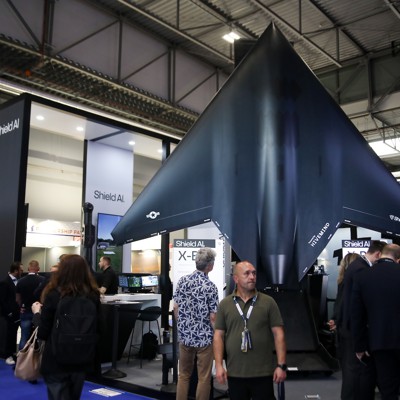
An X-BAT mock-up on display during the 34th International Defense Industry Exhibition at Targi Kielce in Kielce, Poland, on September 8, 2026. Klaudia Radecka / NurPhoto via Getty Images
The Navy is kicking in $150 million to further develop the X-BAT.
Shield AI expects to start flying its X-BAT prototype unmanned fighter jet by year’s end—and is getting $150 million from the Navy to keep developing it, officials said.
“We've been building two prototype vehicles—they're full scale. The first one will be done in the next couple of weeks here,” said Armor Harris, Shield AI’s senior vice president of aircraft. “And then we'll be getting into flight testing at the end of this year…going straight to the vertical takeoff and landing tests as the final de-risk of the [technology].”
Shield AI also secured $150 million from the Navy to continue developing the X-BAT, a modification to an other transaction agreement . The venture-capital-backed company promised to match the investment with its own funds. That brings total planned development spending on the project, which also received $50 million from the Navy and the Defense Innovation Unit in August and a dollar match from Shield, to $400 million.
“We really developed X-BAT in collaboration with NAVAIR and NAWCAD , which is the Naval Air Warfare Center Aircraft Division—the experts for naval aviation,” Harris said. “The Navy has been funding the development through the newly created Rapid Capability Cell. So there was an initial $50 million investment earlier this year. This is basically the next round of investment, which is $150 million to continue the development of the platform.”
The company also recently named two sites for production and flight testing of the autonomous jet.
Under the X-BAT contract, the Navy money will be released to Shield AI as it meets developmental milestones.
“There will be a follow-on phase in the future if Shield AI and X-BAT continue to perform well—all leading up to fielding an early operational capability in about 2029. So basically, the way that the OTA is structured is that there's milestone-based payments for Shield achieving specific objectives along the way,” Harris said.
The company also aims to export the aircraft as well as sell it to the Pentagon.
“There's been a tremendous amount of international interest in X-BAT because of its multi-role capabilities, its ability to be runway independent, and basically what's called the cost-per effect,” he said. Particularly interested countries are “looking to augment F-35 and F-16 capabilities” and those “that don't necessarily have the infrastructure and the size of an air force needed to operate a jet like the F-35.”
NEXT STORY: Defense Business Brief: 1:1 with Gabe Camarillo; Tariff ripple effects?, and more
2026年9月8日,在波兰凯尔采举行的第34届国际防务工业展览会(Targi Kielce)上,展出了X-BAT模型。图片来源:Klaudia Radecka / NurPhoto via Getty Images
海军将投入 1.5 亿美元用于进一步开发 X-BAT。
Shield AI公司官员表示,该公司预计将于今年年底开始试飞其X-BAT原型无人战斗机,并从海军获得了1.5亿美元的资金用于继续研发。
“我们一直在建造两架原型机——它们都是全尺寸的。第一架将在未来几周内完成,”Shield AI公司负责飞机业务的高级副总裁阿莫尔·哈里斯说道。“然后我们将在今年年底开始飞行测试……直接进行垂直起降测试,作为这项技术最终降低风险的手段。”
Shield AI公司还从海军获得了1.5亿美元的资金,用于继续开发X-BAT项目,这是对另一项交易协议的修改。这家风险投资支持的公司承诺将以自有资金匹配这笔投资。这使得该项目的计划研发总支出达到4亿美元,此前该项目在8月份还获得了海军和国防创新部门提供的5000万美元资金,以及Shield AI公司提供的配套资金。
哈里斯说:“我们与海军航空系统司令部(NAVAIR)和海军航空作战中心飞机部(NAWCAD)——海军航空领域的专家——合作开发了X-BAT。海军一直通过新成立的快速能力中心为该项目提供研发资金。今年早些时候,我们获得了5000万美元的初始投资。这笔1.5亿美元的投资是下一轮,用于继续推进该平台的研发。”
该公司最近还指定了两个地点用于生产和试飞这款无人驾驶喷气式飞机。
根据 X-BAT 合同,海军的资金将根据 Shield AI 达到的开发里程碑进行拨付。
“如果Shield AI和X-BAT继续表现良好,未来将会有后续阶段——所有这些都是为了在2029年左右部署早期作战能力。所以基本上,OTA的结构方式是,Shield在实现特定目标的过程中会根据里程碑支付款项,”哈里斯说。
该公司还计划出口这种飞机,并向五角大楼出售。
他说:“X-BAT之所以引起国际社会的极大兴趣,是因为它具备多用途能力、无需跑道即可起降,而且性价比极高。” 一些国家尤其对此感兴趣,它们“希望增强F-35和F-16的作战能力”,而另一些国家“则不一定具备操作F-35这类战机所需的空军基础设施和规模”。
下一篇报道:国防商业简报:专访加布·卡马里洛;关税的连锁反应?等等