Lessons for CENTCOM from counter-drone experiments in the Arizona desert亚利桑那沙漠反无人机试验给中央司令部带来的启示
Officials said the “realities of the desert” like intense heat, wind, dust and glare closely replicate the physical challenges faced by forces in CENTCOM.
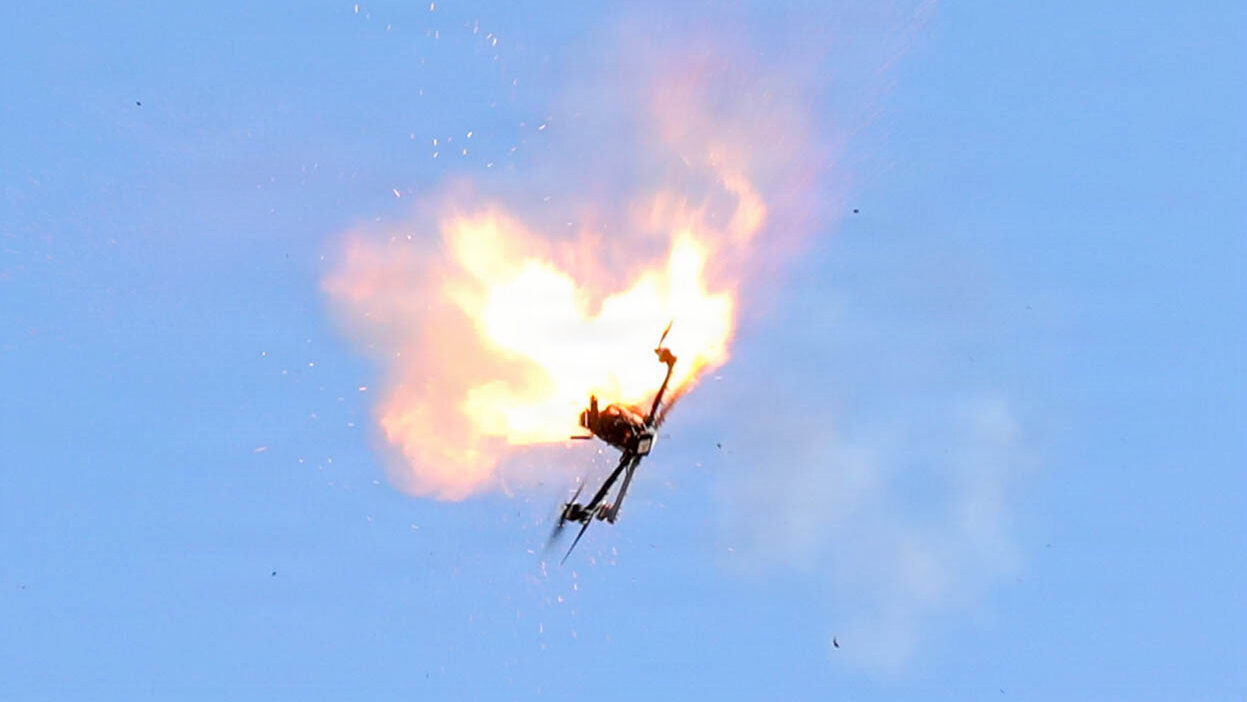
A drone shot down by Genesis Arms Gen-12 SBM during exercise Falcon Peak at Cibola Site 17, Yuma Proving Ground, Arizona, Sept. 22, 2026. (Dept. of War photo by SSgt. Colten Tessness)
YUMA PROVING GROUND, Ariz. — As American servicemembers sweated in the Arizona desert, stress testing various counter-drone technologies, some senior officials had their minds thousands of miles away — thinking about how lessons gleaned here could help protect troops under US Central Command in the Middle East .
“Operating capabilities day after day in extreme desert conditions provides invaluable data on system durability and operator usability that directly translates to contested environments like the CENTCOM AO R [area of responsibility],” Marine Col. Scott Humr, deputy director of science and technology for the Army-led Joint Interagency Task Force (JIATF) 401 , told Breaking Defense last month shortly after the military concluded its most recent Falcon Peak exercise in Arizona desert.
He said the “realities of the desert” like intense heat, wind, dust and glare closely replicate the physical challenges faced by forces in CENTC OM in the Middle East. Handling such realities here in Yuma for Falcon Peak 26.2, put on by US Northern Command, allowed the team to “identify critical, highly practical sustainment needs that cannot be replicated in a laboratory.”
Related: Battling sand and wind, Pentagon evaluates counter-drone tech at southern border exercise
For instance, Humr said the task force had to pay close attention to how often solar panels powering the tech needed to be cleaned, as they would quickly become covered in dust. Soldiers had to make other “simple physical modifications” too, like getting new display shields so operators could read their screens in the unrelenting sunlight.
That information, in turn, can enable industry to better outfit troops in commands like CENTCOM.
“Passing this direct feedback from our operators back to developers ensures that counter-UAS [unmanned aerial systems] are fully ruggedized and optimized before they are deployed to forward combat environments,” he said.
Mike Wior, CEO of Allen Control Systems, the company that makes the counter-drone Bullfrog system, echoed Humr’s concerns over the wind. He told Breaking Defense on the sidelines of Falcon Peak that during the exercise his team had to adapt to the “gusts of wind that kind of come out of nowhere” and the crosswinds that affect the direction of the interceptors.
“That has been kind of an eye opener,” he said. “We’ve already been out there shooting for quite a while, and so we’ve been getting used to it. But it’s really, really good, comparable stuff to CENTCOM.”
The sentiment was echoed by Joe Cornelius, who’s firm Perseus makes drone interceptors that the company says cost under $5,000 a hit.
“Some of the big takeaways we took from [the exercise] were like, we need to do more robust testing on different wind environments and things like that.” Cornelius told Breaking Defense. “The winds out here at Yuma are about twice what we’ve ever tested with down in Texas. So that was a pretty big thing that we learned.”
Regarding the lessons learned related to tech, Brig. Gen. Matt Ross, JIATF-401’s commanding general, told reporters on Sept. 24 that the task force plans to inform leaders from CENTCOM of its success with constructing a “layered defense” during the exercis e — using different, overlapping defensive tech in a way that offers more than one chance to neutralize a threat. CENTCOM already uses layered defenses, but Ross said t hat beefing it up will be vital considering the ongoing risks Iranian Shaheed drones pose to US and allied bases in the region.
“We work in support of all the COCOMs, and so we and the services receive the requirements from them, and so we have provided support to [CENTCOM commander] Adm. [Brad] Cooper and CENTCOM,” Ross said. “I would say more than anything, [Falcon Peak] reinforced what we knew about the requirements for a counter-UAS ecosystem, meaning that we need a layered defense that consists of both active and passive sensing.”
He added that he’s seen how leaders in CENTCOM are “effectively” using the tools that are available, explaining that his task force’s role is to “try to give them some additional tools” so they can “layer them together in an effective manner to protect their critical assets.”
Though Ross didn’t specify what kind of tools could be offered to CENTCOM, during the exercise, the task force and NORTHCOM demoed three “lanes” of capabilities: sensing, kinetic interceptors (also known as drone-on-drone take downs) and ballistic take downs, which primarily consisted of small ammunition taking down the aircraft.
The Defense Innovation Unit (DIU) also played a role in finding relevant capabilities for CENTCOM during Falcon Peak. Angela Aspito, a director with DIU’s onramp hub in Arizona — which manages the continental US-based experimentation events for CENTCOM — told reporters DIU was successful in finding such capabilities, but she also did not specify on the types. But she said there are “gaps that we’re aware of that the warfighter needs to fill with technology.”
“It’s pretty relevant right now to be out in Arizona, getting everything that’s happening with the war in Iran and Epic Fury . There’s a lot of relevant capability that needs to be transitioned into the Middle East, and so the opportunity to see that on the battlefield today is really real,” Aspito said.
Breaking Defense Video
Unpacking Boeing’s F/A-XX win, plus a report from wartime Ukraine
How Hegseth envisions a new Autonomous Warfare Command
What Europe’s military air fleets will look like in 30 years
Riyadh gets closer to F-35s, Damascus presses sovereignty and an expert take on Iran
Drone-hunting on the border, plus turmoil at an Air Force think tank
The future of European airpower might be unmanned
The big news out of AFA, plus a guided tour of the show floor
Why the ‘right to repair’ matters to the Pentagon
What the Pentagon is testing along the US-Mexico border
Chairman Caine talks cislunar ops, plus a window into next-gen airlift
2026年9月22日,在亚利桑那州尤马试验场西博拉17号场地举行的“猎鹰峰”演习中,一架Genesis Arms Gen-12 SBM无人机被击落。(美国陆军部照片,由中士科尔顿·泰斯内斯拍摄)
亚利桑那州尤马试验场——当美国军人在亚利桑那州的沙漠中挥汗如雨,对各种反无人机技术进行压力测试时,一些高级官员的心思却在数千英里之外——思考着在这里获得的经验教训如何能够帮助保护美国中央司令部在中东的部队。
“在极端沙漠条件下日复一日地进行作战能力测试,能够提供关于系统耐久性和操作员可用性的宝贵数据,这些数据可以直接转化为像中央司令部责任区这样的对抗性环境,”陆军领导的联合跨部门特遣部队 (JIATF) 401 的科学技术副主任、海军陆战队上校斯科特·胡姆尔上个月在美军于亚利桑那沙漠结束最近一次“猎鹰峰”演习后不久告诉《防务新闻》。
他表示,沙漠的“现实”,例如酷热、狂风、尘土和强光,与美国中央司令部作战司令部在中东地区面临的实际挑战非常相似。在尤马参加由美国北方司令部组织的“猎鹰峰26.2”演习,正是应对了这些现实情况,使团队能够“识别出一些关键的、高度实际的后勤保障需求,这些需求无法在实验室中模拟”。
相关报道:五角大楼在南部边境演习中评估反无人机技术,应对沙尘和强风
例如,胡姆尔说,特遣部队必须密切关注为该技术供电的太阳能电池板的清洁频率,因为它们很快就会积满灰尘。士兵们还必须进行其他“简单的物理改造”,例如更换显示屏遮光罩,以便操作员在强烈的阳光下也能看清屏幕。
反过来,这些信息可以帮助工业界更好地为中央司令部等指挥机构的部队提供装备。
他说:“将我们操作员的直接反馈传递给开发人员,可以确保反无人机系统在部署到前线作战环境之前得到充分的加固和优化。”
生产反无人机“牛蛙”系统的艾伦控制系统公司首席执行官迈克·维奥尔也表达了与胡姆尔相同的担忧,认为风力会对无人机造成影响。他在“猎鹰峰”演习间隙接受《防务新闻》采访时表示,演习期间,他的团队不得不适应“突如其来的阵风”以及影响拦截器飞行方向的侧风。
“这真是让我大开眼界,”他说。“我们已经在外面拍摄了相当长一段时间,所以已经习惯了。但这真的非常棒,可以和中央司令部的拍摄相媲美。”
乔·科尼利厄斯也表达了同样的观点,他的公司 Perseus 生产无人机拦截器,该公司称每次拦截的成本低于 5000 美元。
科尼利厄斯告诉《防务新闻》:“我们从这次演习中得到的主要启示之一是,我们需要在不同的风况下进行更全面的测试等等。尤马这边的风力大约是我们之前在德克萨斯州测试过的风力的两倍。所以这是我们学到的一个重要经验。”
关于此次演习中汲取的技术经验,第401联合跨部门特遣部队(JIATF-401)指挥官马特·罗斯准将9月24日告诉记者,该特遣部队计划向中央司令部领导人汇报其在演习中成功构建“多层防御”的经验——即运用多种相互重叠的防御技术,从而提供多次机会来化解威胁。中央司令部目前已在使用多层防御,但罗斯表示,考虑到伊朗“烈士”(Shaheed)无人机对美国及其盟国在该地区的基地构成的持续威胁,加强多层防御至关重要。
罗斯说:“我们为所有联合作战司令部提供支持,因此我们和各军种都会收到他们的需求,我们也为中央司令部司令库珀海军上将和中央司令部提供了支持。我认为,最重要的是,猎鹰峰演习强化了我们对反无人机系统生态系统需求的认知,这意味着我们需要一个由主动和被动感知相结合的多层防御体系。”
他还补充说,他已经看到中央司令部的领导人是如何“有效地”使用现有工具的,并解释说,他的特别工作组的作用是“尝试为他们提供一些额外的工具”,以便他们能够“以有效的方式将这些工具分层组合起来,以保护他们的关键资产”。
虽然罗斯没有具体说明可以向中央司令部提供哪些工具,但在演习期间,特遣部队和北方司令部演示了三种能力:感知、动能拦截器(也称为无人机对无人机的击落)和弹道击落,其中主要包括使用小型弹药击落飞机。
在“猎鹰峰”演习期间,国防创新部门(DIU)也为中央司令部寻找相关能力发挥了作用。DIU位于亚利桑那州的准入中心主管安吉拉·阿斯皮托(Angela Aspito)告诉记者,DIU成功找到了这些能力,但她没有具体说明是哪些类型。该中心负责管理中央司令部在美国本土开展的各项试验活动。她表示,DIU确实找到了这些能力,“我们意识到存在一些技术缺口,需要作战人员用技术来填补”。
“现在身处亚利桑那州,了解伊朗战争和‘史诗狂怒’演习的最新进展,意义重大。有很多相关的能力需要转移到中东,因此,今天有机会在战场上亲眼目睹这些能力的运用,这确实是一个难得的机会,”阿斯皮托说道。
突破性防御视频
深入剖析波音F/A-XX的中标,以及来自战时乌克兰的报道
赫格塞斯设想的新型自主作战指挥部
30年后欧洲军用空军机队会是什么样子
利雅得距离F-35战机更近一步,大马士革强调主权,以及专家对伊朗的看法
边境无人机猎杀行动,以及空军智库的动荡
欧洲空军的未来或许在于无人化。
AFA展会最新动态,以及展会现场导览。
为什么“维修权”对五角大楼如此重要
五角大楼正在美墨边境测试什么?
凯恩主席谈近地月空间作业,以及下一代空运技术展望