Navy Doubles Down On X-BAT VTOL ‘Fighter’ Drone Development海军加倍投入X-BAT垂直起降“战斗机”无人机研发
X-BAT flight testing is getting closer on the horizon, and an extremely ambitious timeline to reach an operational capability has been revealed.
新闻视频
By Joseph Trevithick
Published Oct 8, 2026 2:26 PM EDT
Shield AI says it is on track to roll out the first prototypes of its X-BAT jet-powered stealth ‘fighter’ drone by the end of this month. Flight testing of this uncrewed aircraft, which is designed to take off and land vertically from a tail-sitting position, is still scheduled to kick off before the end of the year . X-BAT’s core concept was already highly ambitious , but an extremely aggressive timeline to reach some degree of operational capability through the U.S. Navy’s Runway Independent Maritime Expeditionary Strike (RIMES) program has now been disclosed.
TWZ got an update on X-BAT, which we were first to report on in-depth last year , in an interview yesterday with Shield AI’s Armor Harris, Senior Vice President and General Manager of the company’s aircraft division. This came ahead of today’s announcement that the company has received an additional $150 million in funding from the Office of the Under Secretary of War for Acquisition and Sustainment through its Defense Exportability Features program via the Navy. This is on top of the $50 million investment the Navy, in cooperation with the Pentagon’s Defense Innovation Unit, made in X-BAT’s development earlier this year as part of the RIMES effort. Shield AI has committed an equivalent amount of internal funding, for a combined total of $400 million.
“In broad strokes, the last year has been a bunch of collaborative risk reduction with the Navy. So, wind tunnel testing, engine testing, thermal testing, all kinds of stuff to basically take the major risks in the program, [and] burn them down, so we can move confidently into the production design,” Shield AI’s Harris told us. “The last culmination of the risk reduction is the flight testing of the two full-scale prototypes. The first one of those will be done at the end of October.”
“That’s a full-scale vehicle,” he continued. “It’s got the outer mold line, it’s got the F110 engine, the full propulsion path, everything in it.”
To date, Shield AI has only shown models of the X-BAT publicly. A new one displayed at the Navy League’s Sea-Air-Space 2026 exposition in April revealed major changes to the core design . This included a complete reworking of the planform from a ‘cranked kite’ type arrangement to one with a distinctly different arrowhead-shaped profile featuring a straight leading edge with a more dramatic sweep.
The video below includes clips showing the original X-BAT design and the current one.
The aforementioned “propulsion path,” testing of which has already been conducted on the ground, primarily consists of the General Electric F110 paired with an Axisymmetric Vectoring Exhaust Nozzle (AVEN). The nozzle was originally developed in the 1990s for an experimental thrust-vectoring F-16 fighter. Shield AI is using the original AVEN, which had been in storage for decades, to support development of X-BAT. The nozzle will provide pitch and yaw control, with roll control for the drone coming from bleed air routed through thrusters in the drone’s wings.
No runway, no problem. Shield AI and @GE_Aerospace just cleared a critical path to vertical flight, completing engine light-off testing of the Axisymmetric Vectoring Exhaust Nozzle (AVEN) for X-BAT. Engineers from both companies integrated the AVEN into GE Aerospace's… pic.twitter.com/OxV3y3sRKB — Shield AI (@shieldaitech) July 20, 2026
No runway, no problem. Shield AI and @GE_Aerospace just cleared a critical path to vertical flight, completing engine light-off testing of the Axisymmetric Vectoring Exhaust Nozzle (AVEN) for X-BAT. Engineers from both companies integrated the AVEN into GE Aerospace's… pic.twitter.com/OxV3y3sRKB
Shield AI has previously said that the roughly fighter-sized X-BAT will have a maximum range of 2,000 nautical miles and a service ceiling of around 50,000 feet. The company has also said in the past it is targeting an effective combat radius roughly twice that of the F-35, or around 1,340 nautical miles , but also that it could be closer to 1,000 nautical miles. Space has been made within the X-BAT design for a potential in-flight refueling capability, but there is no active work yet to integrate that feature.
In terms of payload, X-BAT’s design includes internal weapons bays roughly the same size as those on the F-35, as well as two external hardpoints under the wings. Those hardpoints are plumbed, meaning that range-extending drop tanks, or even buddy refueling stores to allow the drone to act as a tanker, could be carried. Baked-in modularity and open-architecture mission systems are intended to make it easier to fit various sensors, data links, and other capabilities down the line.
A rendering highlighting X-BAT’s stores carrying capabilities. Two AGM-154 Joint Stand-Off Weapon (JSOW) glide bombs are depicted here in the internal bays. The silhouette of an AGM-158C Long Range Anti-Ship Missile (LRASM) cruise missile is shown under the wing. Shield AI
“X-BAT’s really designed to be a multi-role capability, and, if you look out at the 10-20 year time horizon, it’s hard to predict what the future fight is going to look like,” Shield AI’s Harris noted. “We fundamentally believe that multi-role capabilities are critically Important. And, so, X-BAT, the reason why it’s sized to where it is is [sic] to be able to carry serious strike weapons internally and externally, in addition to being able to do air-to-air [combat], electronic warfare, and other mission sets.
“You could think of it as like X-35 versus F-35,” he also said yesterday when asked about any expectations now for further changes between the initial pair of prototypes and the final production design.
Lockheed Martin’s X-35 demonstrators are, in very broad strokes, similar to, but distinct from any of the resulting variants of the Joint Strike Fighter. Shield AI has notably already talked in the past about integrating more low-observable (stealthy) attributes to the exhaust end of the design down the line.
A side-by-side look at an X-35 demonstrator, at left, and a production F-35A, at right. USAF
“Then we’ll get into flight testing around the end of this year,” Harris added. “We’ll be doing vertical takeoff and landing testing with that [the initial prototypes] to actually prove out and develop the VTOL [vertical takeoff and landing] technology for X-BAT.”
Shield AI’s X-Forge 2 facility at the Newton City-County Airport in Kansas is set to be the main flight testing hub for X-BAT, as well as the focal point for sustainment of the drones. A production facility, X-Forge 3, is also being built in Des Moines, Washington. The company’s original site, X-Forge 1, is in Frisco, Texas.
A rendering of the X-Forge 2 facility. Shield AI
In terms of the actual flight test campaign, “you remember the X-BAT system has the air vehicle and the launch and recovery vehicle, which is the trailer that it launches and lands from,” Harris said. “Basically, the way the testing works is, we start with the vehicle horizontal, sitting on that launch and recovery vehicle, running the engine. Then we bring it up vertical, run the engine vertically, run the vehicle vertically.”
“Then we have one of the biggest cranes in the world that’s getting set up at our test site in Kansas right now, and we hang the vehicle suspended from that crane and do a bunch of testing while it’s hanging from the crane in free flight,” he continued. “Then we take the crane away, and then we do the actual untethered flights.”
Shield AI’s goal is to fly a fully missionized X-BAT in 2028 and start series production the following year.
A rendering of the X-Forge 3 production facility being built in Des Moines, Washington. Shield AI
On top of that, “the way that the [RIMES] program has been structured is getting to an early operational capability in 2029 is the end goal,” Shield AI’s Harris said.
When asked if this meant that RIMES is aiming “to eventually arrive at not just a demonstration of capability, but a real operationalized capability,” he said that was “correct.”
We will come back to this more later on, but suffice it to say up front, the prospect of X-BAT reaching an operational level of maturity within three years is extraordinarily ambitious, to say the least.
In the meantime, Shield AI has already been testing the mechanisms to “latch and unlatch” X-BAT to the launch and recovery system using an unpowered “battleship” test article, according to Harris. The design of the launch and recovery system has also evolved, and it is now self-propelled, at least to a degree, rather than just being a towed trailer.
“The launch and recovery vehicle is actually critical to the operation of the X-BAT weapon system because it enables survivability on the ground. So when you’re operating in a land-based environment, it enables basically shoot-and-scoot tactics,” Harris also noted. “Enemy transporter-erector-launchers [for missiles] are like pretty hard to find because they’re constantly moving around. Just like X-BAT, when it’s mated onto the launch and recovery vehicle, [it] is always moving around, makes it hard to track, hard to find, hard to destroy.”
A rendering of an X-BAT on a launch and recovery trailer in the fully erected position. Shield AI
The plan now is to “build the one-to-one launch and recovery vehicles to air vehicles. So the air vehicle is always on the trailer. It never comes off of it,” he continued. “Even maintenance to the air vehicle is done while it’s sitting on that launch and recovery vehicle.”
“In fact, we’re actually planning on building more than one-to-one of the launch and recovery vehicles, so that way you can preposition them around different islands, different places in the theater, and have multiple places the aircraft can lily pad from,” he added. “But you’re never putting multiple aircraft onto one launcher and launching them or something like that.”
“When you typically operate a jet, there’s a whole bunch of ground carts and stuff that you bring, like the ground power cart, the ground cooling cart, the air start cart, etc,” Harris further elaborated. “So we’ve moved a lot of those systems onto [the] launch and recovery vehicles, so you don’t have all these separate carts, which is pretty critical when you’re trying to do expeditionary operations.”
“The model for land-based operations is kind of a hub-and-spoke type model. So the squadrons are based at air bases. All the fuel and the weapons are generally based at the air bases, as well. But then you can distribute the aircraft all over the airfield,” he continued. “So, you think about what the enemy’s doing, they’re targeting the runways, they’re targeting the tarmacs, but you can disperse the aircraft around the perimeter of the airfield. You can launch them from the golf course. You can launch them from empty space in the taxiway, etc.”
A graphic highlighting various options for deploying X-BATs on land and at sea. Shield AI
Harris said that another “spoke” could be X-BATs operating from forward arming and refueling points (FARP). All of this is part of larger concepts of operations for the drone that Shield has been envisioning, and that are not at all limited to deployments at locations on land. Harris noted during the interview that the self-propelled nature of the current launch and recovery system would also help with moving the drones around on virtually any ship with sufficient deck space. This is where the RIMES program, which is separate and distinct from the U.S. Navy’s carrier-based Collaborative Combat Aircraft (CCA) drone ambitions , really comes in.
“I’ll say the fundamental value proposition of RIMES is that if you have a carrier-based CCA, you’re fundamentally constrained by the square footage of the deck of the aircraft carrier,” Harris explained. “So if you are taking an F-18 or an F-35 off, you better be replacing it with better capability per square foot of deck space than the thing that you’re taking off.”
“So, F/A-XX [the Navy’s sixth-generation carrier-based fighter, now to be built by Boeing ] is a huge leap in capability, right? Which is why that program makes a lot of sense,” he continued. “The challenge with CCA is: Does it really make sense to take a manned aircraft off of an aircraft carrier and replace it with an unmanned aircraft?”
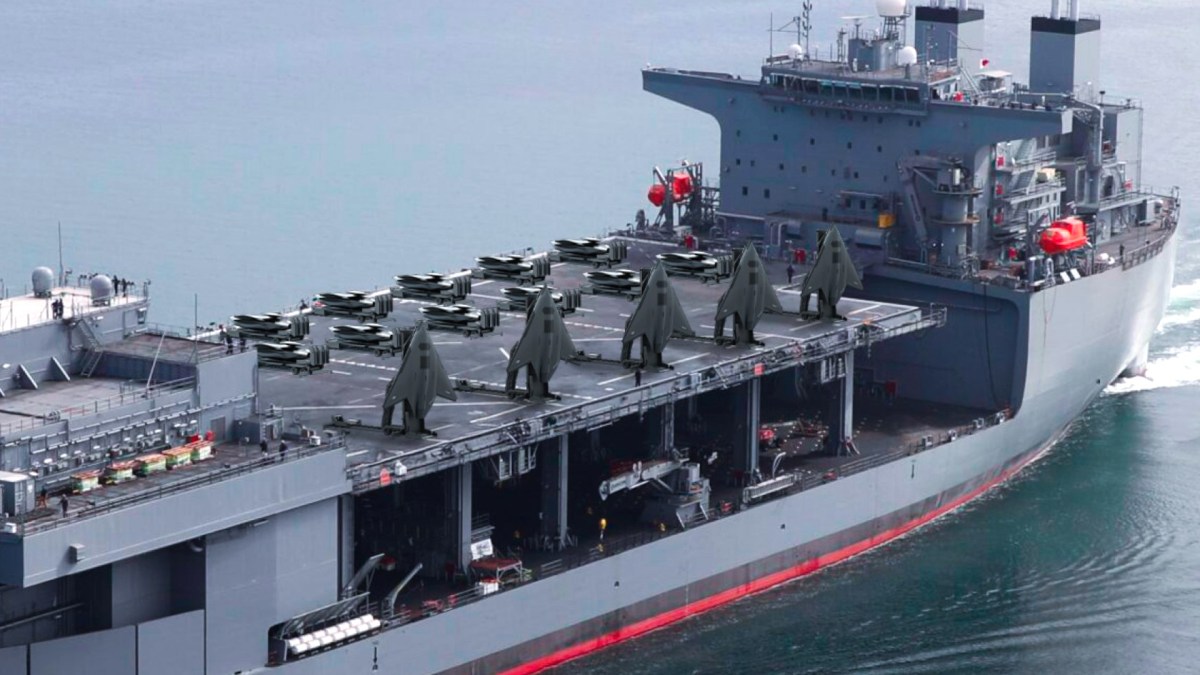
Shield AI’s argument here is that X-BAT disrupts this core equation by opening the door to a CCA-like capability, or even something more capable, that can be employed in a ship-based mode without sacrificing any crewed aircraft capacity on an aircraft carrier. Shield AI envisions dozens of X-BATs being employed from amphibious assault ships, as well as other kinds of amphibious warfare ships, including expeditionary sea base type vessels, as seen at the top of this story.
A rendering depicting X-BAT drones on the deck of the US Navy’s future America class amphibious assault ship USS Bougainville . Shield AI
“So when you think about the number of carrier air wings that the Navy has to deploy, deploying X-BAT across all these other ships basically significantly increases the number of carrier air wings,” Harris said.
As already mentioned, the current structure of the RIMES includes a target for an early operational capability in 2029, according to Harris. “We have a program defined to get there, and there’s basically milestone-based payments along the way, so as Shield performs and hits milestones, then the Navy kicks in additional funding,” he added.
“I don’t want to get ahead of the Navy, and give you a specific number, but like hundreds to low thousands,” he also said when asked if there was even a very rough planning figure for the eventual size of the RIMES drone fleet.
Many questions remain about X-BAT, which still has to demonstrate the viability of its vertical takeoff and landing capability, which underpins everything else. As we noted in our original in-depth report on this design, the core concept here is not new, and there have been many unsuccessful attempts to operationalize it in the past. Shield AI is of the view that groundwork has now been laid, including through the company’s past work with its much smaller internal combustion-engine-powered V-BAT tail-sitting VTOL drone , to truly realize a design of this kind.
The performance and capabilities that Shield AI expects from X-BAT once it is flying at all are also ambitious. A high degree of autonomy is also part of the full planned package, which will leverage the company’s already extensive work in this domain with its Hivemind software .
There are also questions about the Navy’s exact plans for RIMES, as well as its broader future drone fleets . Just this year, the service has issued several contracting notices pointing to rapidly evolving views about future carrier-based strike drones and other uncrewed aircraft. New requirements that Naval Air Systems Command (NAVAIR) released in August ostensibly for future CCA-type drones notably pointed more toward something that sounded very much like an advanced uncrewed combat air vehicle (UCAV), as you can read more about here .
Whether the 2029 operational timeframe the Navy is said to be aiming for under RIMES is firm, or even realistic in any way, remains to be seen. The actual definition of what constitutes an “early operational capability” could be very flexible, as well. It is also worth noting here that Shield AI is not the only company currently conducting work under RIMES . Whether the Navy might be planning to acquire more than one design through this program is unclear. We have reached out to the service for more information.
Other services could be interested in any operational capability produced through the RIMES effort, too. TWZ regularly highlights how runway-independent drones would be particularly well-suited to the U.S. Marine Corps new expeditionary and distributed concepts of operations . That service is already in the process of acquiring MQ-58B Valkyrie drones from Kratos that will be able to operate from conventional runways. They will also be capable of runway-independent launches, though they will still have to land conventionally. The baseline Valkyrie design lands via parachute.
A rendering of a landing gear-equipped version of the Valkyrie in line with what the Marines are now acquiring. Kratos
Aviation Week has reported separately today that Shield AI is looking to pitch the X-BAT to the U.S. Army as a successor to that service’s fleet of MQ-1C Gray Eagle armed drones .
In general, runway independence is of growing interest elsewhere across the U.S. military as threats to large, established bases continue to expand in scale and scope. The proliferation of various tiers of weaponized drones is a particularly significant factor in this, as TWZ just examined in detail this week in the context of the recent withdrawal of B-1 bombers from RAF Fairford in the United Kingdom. Ever more capable cruise, ballistic , and hypersonic missiles are also part of the full threat picture.
The conflict with Iran has also underscored the limits of what can be gained survivability-wise by dispersing traditional fixed-wing aircraft , especially within an existing airbase. As highlighted earlier, X-BAT could be dispersed very differently to nearly anywhere within a facility that can handle the thrust from the F110 engine in hover.
As it stands now, we are set to get our first view of a full-sized X-BAT prototype within the next few weeks as Shield AI continues to gear up for the start of actual flight testing before the end of the year.
Contact the author: joe@twz.com
Comments couldn’t be loaded. Please refresh the page.
作者:约瑟夫·特雷维西克
发布于美国东部时间2026年10月8日下午2:26
Shield AI公司表示,其X-BAT喷气动力隐形“战斗”无人机的首批原型机有望在本月底前推出。这款无人驾驶飞机采用尾座式垂直起降设计,其飞行测试仍计划于年底前启动。X-BAT的核心概念原本就极具雄心,而如今,该公司公布了更为激进的时间表,旨在通过美国海军的“跑道独立海上远征打击”(RIMES)项目,使其达到一定的作战能力。
TWZ昨日采访了Shield AI公司飞机部门高级副总裁兼总经理Armor Harris,了解了X-BAT的最新进展。去年,我们曾率先对X-BAT进行了深入报道。就在今天,Shield AI宣布已通过海军的国防出口能力项目,从美国陆军部负责采购和保障的副部长办公室获得了1.5亿美元的额外资金。此前,海军已与五角大楼国防创新部门合作,于今年早些时候为X-BAT的研发投入了5000万美元,作为RIMES项目的一部分。Shield AI也承诺投入等额的内部资金,总计4亿美元。
“总的来说,过去一年我们与海军开展了大量的合作风险降低工作。包括风洞测试、发动机测试、热测试等等,各种各样的测试,基本上都是为了排除项目中的主要风险,这样我们才能更有信心地进入生产设计阶段,”Shield AI公司的哈里斯告诉我们。“风险降低工作的最终目标是对两架全尺寸原型机进行飞行测试。第一架原型机的飞行测试将于10月底进行。”
“那是一辆全尺寸的样车,”他继续说道。“它有外形轮廓,有F110发动机,有完整的推进系统,所有部件都齐全。”
迄今为止,Shield AI公司仅公开展示过X-BAT的模型。今年4月在海军联盟举办的2026年海空航天博览会上展出的新款模型,揭示了其核心设计的重大变化。其中包括对平面形状的彻底重新设计,从“曲柄风筝”式布局转变为截然不同的箭头形轮廓,其特点是具有更显著后掠角的直线前缘。
下面的视频包含了展示最初的 X-BAT 设计和当前版本的片段。
上述“推进系统路径”(已完成地面测试)主要由通用电气F110发动机和轴对称矢量喷管(AVEN)组成。该喷管最初于20世纪90年代为实验性推力矢量F-16战斗机开发。Shield AI公司正在使用这套已封存数十年的AVEN喷管来支持X-BAT无人机的研发。该喷管将提供俯仰和偏航控制,而无人机的滚转控制则由引气通过机翼推进器实现。
没有跑道?没问题!Shield AI 和 @GE_Aerospace 刚刚扫清了垂直飞行的关键障碍,完成了 X-BAT 轴对称矢量喷管 (AVEN) 的发动机点火测试。两家公司的工程师将 AVEN 集成到了 GE Aerospace 的…… pic.twitter.com/OxV3y3sRKB — Shield AI (@shieldaitech) 2026年7月20日
没有跑道?没问题!Shield AI 和 @GE_Aerospace 刚刚扫清了垂直飞行的关键障碍,完成了 X-BAT 轴对称矢量喷管 (AVEN) 的发动机点火测试。两家公司的工程师将 AVEN 集成到了 GE Aerospace 的…… pic.twitter.com/OxV3y3sRKB
Shield AI此前曾表示,这款尺寸与战斗机相仿的X-BAT无人机最大航程为2000海里,实用升限约为50000英尺。该公司过去也曾表示,其目标有效作战半径约为F-35的两倍,即约1340海里,但也表示实际有效作战半径可能更接近1000海里。X-BAT的设计中预留了空中加油能力,但目前尚未开展相关集成工作。
在有效载荷方面,X-BAT 的设计包括与 F-35 尺寸大致相同的内部武器舱,以及机翼下的两个外部挂点。这些挂点已预先连接好油路,这意味着它可以携带增程副油箱,甚至可以携带伙伴加油装置,使无人机能够执行加油任务。内置的模块化设计和开放式架构的任务系统旨在方便日后加装各种传感器、数据链和其他功能。
这张渲染图突出了X-BAT的挂载能力。图中内部弹舱内展示了两枚AGM-154联合防区外武器(JSOW)滑翔炸弹。机翼下方则展示了一枚AGM-158C远程反舰导弹(LRASM)的轮廓。
“X-BAT 的设计初衷是成为一款多用途战机,但展望未来 10 到 20 年,很难预测未来的战争形态,”Shield AI 的哈里斯指出。“我们坚信多用途战机至关重要。因此,X-BAT 的尺寸设计是为了能够携带强大的内外打击武器,同时还能执行空对空作战、电子战和其他任务。”
“你可以把它想象成 X-35 与 F-35 的对比,”昨天当被问及对最初的两架原型机和最终生产设计之间可能存在的进一步变化有何预期时,他也这样说道。
洛克希德·马丁公司的X-35验证机,从总体上看,与联合攻击战斗机的任何衍生型号相似,但又有所不同。值得注意的是,Shield AI此前曾表示,未来将在X-35的尾气排放端集成更多低可探测性(隐身)特性。
左侧为X-35验证机,右侧为量产型F-35A,两者并排展示。美国空军
哈里斯补充说:“然后我们将在今年年底左右开始飞行测试。我们将对(最初的原型机)进行垂直起降测试,以真正验证和开发X-BAT的垂直起降技术。”
Shield AI位于堪萨斯州牛顿市县机场的X-Forge 2工厂将成为X-BAT无人机的主要飞行测试中心,同时也是无人机维护的中心枢纽。此外,位于华盛顿州得梅因的生产工厂X-Forge 3也正在建设中。该公司最初的工厂X-Forge 1位于德克萨斯州弗里斯科。
X-Forge 2 设施的效果图。Shield AI
关于实际的飞行测试,哈里斯说:“你们应该记得,X-BAT系统包括飞行器和发射回收车,也就是用来发射和回收飞行器的拖车。基本上,测试流程是这样的:我们先让飞行器水平放置在发射回收车上,启动发动机。然后我们把它竖起来,垂直运行发动机,让飞行器垂直飞行。”
“然后,我们会在堪萨斯州的测试场地架设一台世界上最大的起重机之一,我们会把飞行器悬挂在这台起重机上,进行一系列自由飞行测试,”他继续说道。“之后,我们会把起重机移走,然后进行真正的无绳飞行测试。”
Shield AI 的目标是在 2028 年试飞一架功能齐全的 X-BAT,并在次年开始批量生产。
这是位于华盛顿州得梅因市的 X-Forge 3 生产设施的效果图。Shield AI
除此之外,“[RIMES]计划的结构方式是,其最终目标是在2029年实现早期作战能力,”Shield AI的哈里斯说。
当被问及这是否意味着 RIMES 的目标“最终不仅是展示能力,而是实现真正的作战能力”时,他表示“没错”。
我们稍后会再详细讨论这个问题,但首先要说明的是,X-BAT 在三年内达到运行成熟水平的前景,至少可以说是一个极其雄心勃勃的目标。
与此同时,据哈里斯透露,Shield AI公司已经开始使用一艘无动力“战舰”测试船来测试将X-BAT与发射回收系统“连接和断开”的机制。发射回收系统的设计也得到了改进,现在它至少在一定程度上实现了自推进,而不再仅仅是一个被拖曳的拖车。
“发射回收车对于X-BAT武器系统的运行至关重要,因为它能确保其在地面上的生存能力。因此,在陆地作战环境中,它基本上可以实现‘打了就跑’的战术,”哈里斯还指出。“敌方的导弹运输-起竖-发射装置很难找到,因为它们一直在移动。就像X-BAT一样,当它与发射回收车对接后,它也一直在移动,这使得它难以追踪、难以发现、难以摧毁。”
X-BAT无人机完全展开后,安装在发射回收拖车上的渲染图。Shield AI
他继续说道:“现在的计划是‘建造与飞行器一一对应的发射回收车。这样,飞行器就始终在拖车上,永远不会离开拖车。甚至飞行器的维护也是在它停放在发射回收车上时进行的。’”
“事实上,我们计划建造多套发射和回收运载工具,这样就可以将它们预先部署在不同的岛屿、战区的不同地点,让飞机可以从多个地点起飞,”他补充道。“但你永远不会把多架飞机装在一个发射车上然后同时发射。”
哈里斯进一步解释说:“通常情况下,操作喷气式飞机时,需要携带一大堆地面设备,比如地面电源车、地面冷却车、空中启动车等等。所以我们把很多这类系统都转移到了发射和回收飞行器上,这样就不用携带这么多单独的设备了,这对于执行远征任务来说至关重要。”
“陆基作战模式有点像枢纽辐射式。飞行中队驻扎在空军基地。所有的燃料和武器通常也都存放在空军基地。但这样一来,你就可以把飞机分散部署在整个机场,”他继续说道。“所以,你要想想敌人在做什么,他们会攻击跑道,攻击停机坪,但你可以把飞机分散部署在机场周围。你可以从高尔夫球场起飞,也可以从滑行道的空地起飞等等。”
一张图表,重点展示了在陆地和海上部署 X-BAT 的各种方案。Shield AI
哈里斯表示,另一个“分支”可能是从前沿武器和加油点(FARP)起飞的X-BAT无人机。所有这些都是“盾牌”计划构想的无人机作战概念的一部分,而且这些概念绝不仅限于陆地部署。哈里斯在采访中指出,当前发射和回收系统的自推进特性也有助于在几乎任何甲板空间充足的舰艇上移动无人机。这正是RIMES项目发挥作用的地方,该项目独立于美国海军的舰载协同作战飞机(CCA)无人机计划。
“我认为RIMES的核心价值在于,如果你拥有一个舰载作战能力提升系统(CCA),那么你基本上会受到航母甲板面积的限制,”哈里斯解释说。“所以,如果你要撤下F-18或F-35,你最好用单位甲板面积上性能更高的机型来替代它。”
“所以,F/A-XX(海军第六代舰载战斗机,现在由波音公司建造)在性能上实现了巨大的飞跃,对吧?这就是为什么这个项目很有意义,”他继续说道。“CCA面临的挑战是:把有人驾驶飞机从航母上撤下来,换成无人驾驶飞机,真的有意义吗?”
Shield AI 的论点是,X-BAT 打破了这一核心平衡,它开启了一种类似 CCA 甚至更强大的能力,可以在舰载模式下使用,而无需牺牲航空母舰上任何载机运力。Shield AI 设想数十架 X-BAT 可以从两栖攻击舰以及其他类型的两栖作战舰艇(包括本文开头提到的远征海上基地舰)上部署。
一张渲染图,描绘了美国海军未来“美利坚”级两栖攻击舰“布干维尔”号甲板上的X-BAT无人机。Shield AI
“所以,当你考虑到海军必须部署的航母舰载机联队数量时,在所有这些其他舰艇上部署 X-BAT 基本上会显著增加航母舰载机联队的数量,”哈里斯说。
正如前文所述,哈里斯表示,RIMES目前的架构目标之一是在2029年实现早期作战能力。“我们已经制定了实现这一目标的计划,并且基本上是按里程碑付款,因此,随着‘盾牌’系统性能的提升并达到里程碑,海军就会追加资金,”他补充道。
“我不想抢在海军前面,给你一个具体的数字,但大概会有几百到几千架,”当被问及RIMES无人机机队的最终规模是否有一个非常粗略的规划数字时,他还这样说道。
关于X-BAT仍存在诸多疑问,它仍需证明其垂直起降能力的可行性,而这正是其他一切的基础。正如我们在之前对该设计的深度报道中所指出的,其核心概念并非新颖,过去也曾有过多次尝试将其付诸实践但均以失败告终。Shield AI认为,如今已具备实现此类设计的基础,这得益于该公司过去在其小型化内燃机动力尾座式垂直起降无人机V-BAT上所做的工作。
Shield AI对X-BAT一旦投入飞行后的性能和能力期望很高。高度自主性也是其完整计划的一部分,该计划将充分利用公司在该领域已有的Hivemind软件成果。
关于海军RIMES的具体计划,以及其更广泛的未来无人机机队规划,也存在一些疑问。仅今年一年,海军就发布了多份合同公告,表明其对未来舰载攻击无人机和其他无人飞行器的看法正在迅速转变。海军航空系统司令部(NAVAIR)8月份发布的新需求,表面上是针对未来的CCA型无人机,但实际上却更倾向于一种听起来很像先进无人作战飞行器(UCAV)的机型,您可以在这里阅读更多相关内容。
海军据称在RIMES项目下设定的2029年作战能力目标是否确定,甚至是否现实,目前尚不得而知。“早期作战能力”的具体定义也可能非常灵活。此外,值得注意的是,Shield AI并非目前唯一一家参与RIMES项目的公司。海军是否计划通过该项目采购多种设计方案,目前尚不清楚。我们已联系海军以获取更多信息。
其他军种也可能对RIMES项目所取得的任何作战能力感兴趣。TWZ经常强调,无需跑道起降的无人机尤其适合美国海军陆战队新的远征和分布式作战概念。海军陆战队目前正在从克拉托斯公司采购MQ-58B“女武神”无人机,该无人机能够从传统跑道起降。它们也具备无需跑道起降的能力,但仍然需要以传统方式着陆。“女武神”无人机的基本设计是通过降落伞着陆的。
这是根据海军陆战队目前正在采购的机型,绘制的配备起落架的瓦尔基里战机的效果图。克雷托斯
《航空周刊》今天另行报道称,Shield AI 正在寻求向美国陆军推销 X-BAT,作为该军种 MQ-1C 灰鹰武装无人机的继任者。
总体而言,随着大型成熟基地面临的威胁规模和范围不断扩大,美国军方其他部门也越来越关注跑道独立性。各类武装无人机的扩散是其中的一个重要因素,TWZ本周就英国皇家空军费尔福德基地近期B-1轰炸机撤离一事对此进行了详细分析。性能日益强大的巡航导弹、弹道导弹和高超音速导弹也是整体威胁图景的重要组成部分。
与伊朗的冲突也凸显了分散部署传统固定翼飞机在提高生存能力方面的局限性,尤其是在现有空军基地内。正如前文所述,X-BAT 的部署方式与基地内几乎任何能够承受 F110 发动机悬停推力的设施都截然不同。
就目前情况来看,随着 Shield AI 继续为年底前开始实际飞行测试做准备,我们有望在未来几周内首次看到全尺寸的 X-BAT 原型机。
联系作者:joe@twz.com
评论加载失败,请刷新页面。