Retired KC-10 Extender Tankers Could Get A Second Life With North African Mystery Operator退役的KC-10加油机或将借助北非神秘运营商的力量获得新生
The USAF wants to know what it would take to regenerate a quartet of KC-10s for an undisclosed operator, and there are a couple of likely suspects.
By Joseph Trevithick
Published Oct 8, 2026 7:58 PM EDT
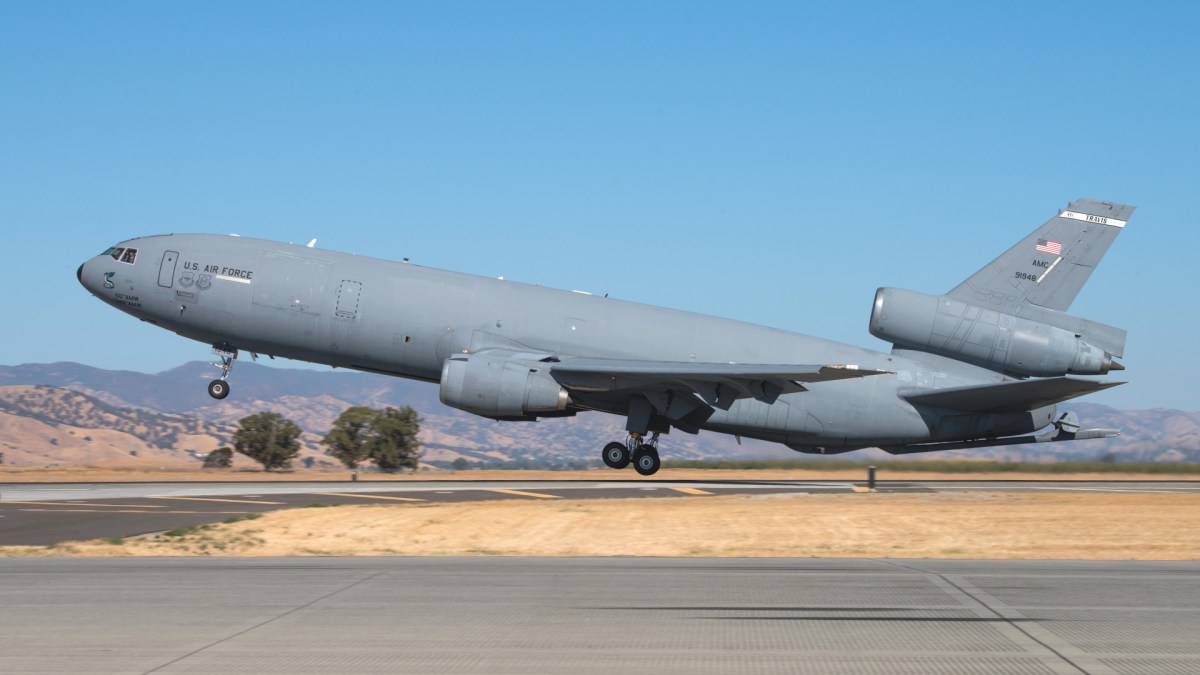
The last KC-10 heads into retirement in 2024. USAF/Kenneth Abbate
Just over two years after the U.S. Air Force retired the last of its KC-10A Extender aerial refueling tankers, four of those aircraft may be bound for a new career in North Africa for a mysterious end user.
The Air Force Life Cycle Management Center (AFLCMC) put out a contracting notice yesterday “solely for information and planning purposes” with the express intent “to identify potential industry sources that possess the capability, expertise, and facilities to execute the regeneration, one-time flight clearance, depot-level return to service, worldwide ferry delivery, in-country Contractor Logistics Support (CLS), and operational/maintenance training for up to four (4) KC-10 Extender aircraft.”
The KC-10s could be “transferred via Excess Defense Articles (EDA) to a partner nation in North Africa,” the notice adds, without naming the country in question.
Retired KC-10 tankers seen at the boneyard at Davis-Monthan Air Force Base in Arizona in 2025. US Military
The Air Force operated KC-10s between 1981 and 2024 . TWZ has reached out to the U.S. Air Force, as well as the U.S. State Department, for more information. The State Department directed us to contact the Pentagon.
The EDA program allows for materiel deemed extraneous to U.S. military needs to be transferred to allies and partners either at a reduced cost or as a grant. The foreign nation in question has to pay for those assets to be delivered, as well as refurbishment, if applicable.
It is important to note here that the Extender, as designed, is capable of refueling receivers using either the boom or the probe-and-drogue method. Tankers equipped for the probe-and-drogue method are, by far, more common internationally. We will come back to this later on.
A KC-10 seen refueling F-16 fighters via the boom. USAF
A KC-10 refuels a US Navy F/A-18 Hornet via the probe-and-drogue method. USN
While we don’t know what the North African country might be in line now to receive the quartet of KC-10s, Egypt and Morocco would seem to be the most likely candidates based on their current and planned aircraft inventories. They are also both major U.S. allies.
The Egyptian Air Force currently does not operate any dedicated aerial refueling tankers. The country is in the process of acquiring two new C-130J-30 Hercules aircraft for use as airlifters, as well as tankers, using the probe-and-drogue method. It does already fly C-130s, but none explicitly configured for aerial refueling duties. Egypt also has a very diverse array of fighters that includes U.S.-made F-16 Vipers that can only be refueled in mid-air via boom.
A US Air Force KC-10 refuels an Egyptian F-16 during an exercise in 2023. USAF/Staff Sgt. Emily Farnsworth
Morocco’s Air Force also flies F-16s and is in the process of acquiring more . The first new-production Block 72 F-16D for the Moroccan Air Force just flew for the first time earlier this week . Morocco does have an organic aerial refueling capability now, but in the form of C-130s equipped to dispense fuel via probe-and-drogue .
A Moroccan F-16 seen linking up with a US Air Force KC-135 tanker during an exercise. USAF
As mentioned, the KC-10 was designed to connect with receivers via probe-and-drogue, as well as boom, and could be used to refuel other tactical jets in Egyptian or Moroccan service. As an aside, fighters belonging to both regularly receive foreign tanker support during exercises, as already seen earlier in this story. Just last month, Chinese YY-20 tankers (also sometimes referred to as Y-20Us) notably did just this in an exercise in Egypt.
Footage released by Egypt’s official authorities from the “Eagles of Civilization 2026” joint air exercise shows Egyptian **MiG-29M/M2s and Rafale fighters receiving aerial refueling from a Chinese Y-20 tanker aircraft. pic.twitter.com/pvxkpsDHxG — 笑脸男人 (@lfx160219) September 7, 2026
Footage released by Egypt’s official authorities from the “Eagles of Civilization 2026” joint air exercise shows Egyptian **MiG-29M/M2s and Rafale fighters receiving aerial refueling from a Chinese Y-20 tanker aircraft. pic.twitter.com/pvxkpsDHxG
Whichever country may be in line to receive the four KC-10s, there is a question about the current state of those aircraft. Earlier in this story, we talked about the Extender’s capabilities as designed.
McDonnell Douglas (since absorbed into Boeing) delivered a total of 60 KC-10s to the U.S. Air Force between 1979 and 1987. The Extender was derived from the three-engine DC-10 airliner, the last of which was produced in 1989. The Air Force lost one of its KC-10s in an accident in 1987.
Of the remaining 59 KC-10s, 10 were put up for auction in a non-flyable state last year. For reasons that remain unclear, a single engine had been removed from under one of the wings of each of those aircraft. These Extenders were also among the first to be retired, and their booms had been stripped to be used as spares for the examples that remained in service until 2024. Private aerial refueling contractor Omega Air looks to have subsequently won those auctions . Omega also operates two ex-Dutch KDC-10 tankers , which are broadly similar to the KC-10, as well as another DC-10 converted into a probe-and-drogue-only tanker. The company has several Boeing 707-based tankers , as well.
One of Omega Air’s KDC-10s refuels US Air Force F-16s. USAF
The condition of the remaining 49 Extenders is unclear. Congress included a provision in the annual defense policy bill, or National Defense Authorization Act (NDAA), for the 2026 Fiscal Year that required the Air Force to preserve remaining retired KC-10s, but only stipulated they be maintained “in the same storage condition” they were in as of September 30, 2025. The bill, which was signed into law in December 2025, also made clear that the Air Force could still “dispose” of the aircraft in accordance with existing property management statutes .
Regenerating military aircraft, especially larger ones, back to service can be costly, complex, and time-consuming , even when they are kept in storage in a highly maintained state . In this particular case, acquiring KC-10s via the EDA program, with a very low up-front purchase price, could still be attractive to the right buyer, especially compared to the cost of acquiring new-production tankers.
Personnel at the boneyard at Davis-Monthan Air Force Base apply a protective coating to a KC-10. USAF
For a country like Egypt or Morocco that has never operated a boom-equipped tanker, second-hand Extenders could be a valuable entry point to future aerial refueling capabilities, as well. In general, organic aerial refueling capability is an important force multiplier for any air arm.
There is a possibility that KC-10s could be regenerated not as tankers, but as cargo aircraft, though this seems less likely to be the case. Cargo carrying was also an important duty for the Extenders while in U.S. Air Force service, and they still could operate in this role even when returned to service as tankers.
Though the aging KC-10s were getting increasingly more difficult to operate and maintain, the Air Force’s decision to retire them was still controversial . The Extender was a highly flexible tanker that could carry more fuel than the KC-46s that supplanted them. Clearly, there are others still interested in operating them.
It should be stressed that the AFLCMC contracting notice does not present the transfer of the four KC-10s as a done deal. At the same time, it has revealed that one of America’s partners in North Africa could breathe new life into four of these retired tankers.
Contact the author: joe@twz.com
Comments couldn’t be loaded. Please refresh the page.
作者:约瑟夫·特雷维西克
发布于美国东部时间2026年10月8日晚上7:58
最后一架KC-10将于2024年退役。美国空军/肯尼斯·阿巴特
美国空军退役最后一架 KC-10A Extender 空中加油机两年多后,其中四架飞机可能将被送往北非,为一位神秘的最终用户开启新的征程。
空军生命周期管理中心 (AFLCMC) 昨天发布了一份合同通知,“仅供参考和规划之用”,其明确目的是“寻找具备能力、专业知识和设施的潜在行业供应商,以执行最多四 (4) 架 KC-10 Extender 飞机的再生、一次性飞行许可、基地级恢复使用、全球转场交付、国内承包商后勤支持 (CLS) 以及操作/维护培训”。
该通知还补充说,KC-10 飞机可以“通过剩余国防物资(EDA)转让给北非的一个伙伴国家”,但没有指明是哪个国家。
2025年,退役的KC-10加油机停放在亚利桑那州戴维斯-蒙森空军基地的飞机坟场。美国军方
美国空军在1981年至2024年间使用过KC-10加油机。TWZ已联系美国空军和美国国务院以获取更多信息。国务院指示我们联系五角大楼。
美国出口发展局(EDA)计划允许将美国军方认为多余的物资以优惠价格或赠款的形式转让给盟友和伙伴国。相关外国必须支付这些物资的交付费用,以及必要的翻新费用。
需要特别指出的是,根据设计,Extender 既可以使用吊杆式加油机,也可以使用探管式加油机为受油机加油。在国际上,配备探管式加油机的油轮更为常见。我们稍后会详细讨论这一点。
一架KC-10加油机正在通过吊杆为F-16战斗机进行空中加油。美国空军
一架KC-10加油机采用探管式加油方式为一架美国海军F/A-18“大黄蜂”战斗机进行空中加油。
虽然我们目前尚不清楚哪个北非国家最终会接收这四架KC-10加油机,但根据埃及和摩洛哥现有的及计划中的飞机库存来看,它们似乎是最有可能的候选国。而且,这两个国家都是美国的重要盟友。
埃及空军目前没有专用的空中加油机。该国正在采购两架新的C-130J-30“大力神”运输机,用于运输和空中加油,采用的是探管式加油方式。埃及空军目前已经装备了C-130运输机,但没有专门配置用于空中加油的机型。埃及还拥有种类繁多的战斗机,其中包括只能通过硬管进行空中加油的美国制造的F-16“蝰蛇”战斗机。
2023年,一架美国空军KC-10加油机在一次演习中为一架埃及F-16战斗机进行空中加油。(美国空军/参谋军士艾米丽·法恩斯沃思摄)
摩洛哥空军也装备了F-16战斗机,并且正在采购更多。摩洛哥空军首架新生产的Block 72型F-16D战斗机于本周早些时候首飞。摩洛哥目前拥有空中加油能力,但使用的是配备探管式加油装置的C-130运输机。
在一次演习中,一架摩洛哥空军的F-16战斗机与一架美国空军的KC-135加油机进行空中加油对接。
如前所述,KC-10的设计使其能够通过探管和硬管两种方式与受油机对接,并可为埃及或摩洛哥空军的其他战术喷气式飞机提供空中加油。顺便一提,正如本文前面提到的,埃及和摩洛哥的战斗机在演习期间经常接受外国加油机的支援。就在上个月,中国的YY-20加油机(有时也称为Y-20U)在埃及的一次演习中就进行了这样的加油作业。
埃及官方发布的“文明之鹰2026”联合空中演习视频显示,埃及的米格-29M/M2和阵风战斗机正在接受中国运-20加油机的空中加油。 pic.twitter.com/pvxkpsDHxG — 笑脸男人 (@lfx160219) September 7, 2026
埃及官方发布的“文明之鹰2026”联合空中演习视频显示,埃及的米格-29M/M2和阵风战斗机正在接受中国运-20加油机的空中加油。 pic.twitter.com/pvxkpsDHxG
无论哪个国家最终获得这四架KC-10加油机,目前这些飞机的状态都是个问题。此前,我们已经讨论过KC-10的设计性能。
麦克唐纳·道格拉斯公司(后被波音公司收购)在1979年至1987年间共向美国空军交付了60架KC-10加油机。这款“延展者”加油机源自三引擎DC-10客机,最后一架DC-10于1989年生产。1987年,美国空军的一架KC-10在事故中损毁。
剩余的59架KC-10加油机中,有10架去年因无法飞行而被拍卖。原因尚不清楚,这些飞机的一侧机翼下方的一台发动机已被拆除。这些“延展者”(Extender)加油机也是最早退役的机型之一,它们的加油吊杆已被拆卸,用作剩余机型的备件,这些剩余机型服役至2024年。私人空中加油承包商欧米茄航空(Omega Air)似乎随后赢得了这些飞机的拍卖。欧米茄航空还运营着两架前荷兰的KDC-10加油机(与KC-10大致相同),以及一架改装成仅使用探管和锥套加油机的DC-10。该公司还拥有几架基于波音707平台的加油机。
欧米茄航空的一架KDC-10加油机正在为美国空军的F-16战斗机进行空中加油。
剩余的49架KC-10加油机的状况尚不明确。国会在2026财年的年度国防政策法案(即《国防授权法案》)中加入了一项条款,要求空军保存剩余的退役KC-10加油机,但仅规定这些飞机必须“保持与2025年9月30日相同的存放状态”。该法案于2025年12月签署生效,其中还明确指出,空军仍可根据现行的财产管理法规“处置”这些飞机。
修复军用飞机,尤其是大型飞机,使其重新服役可能成本高昂、复杂且耗时,即使它们一直处于高度维护的封存状态也是如此。就此而言,通过EDA项目以极低的预付价格获得KC-10加油机,对于合适的买家来说仍然具有吸引力,尤其与购买全新生产的加油机的成本相比。
戴维斯-蒙森空军基地飞机坟场的员工正在给一架KC-10加油机涂上保护涂层。美国空军
对于像埃及或摩洛哥这样从未操作过带吊杆加油机的国家来说,二手的Extender加油机也可能成为未来发展空中加油能力的重要切入点。总的来说,自主空中加油能力对于任何空军来说都是一项重要的战斗力倍增器。
KC-10加油机有可能被改造成运输机而非加油机,尽管这种可能性较小。在美军服役期间,KC-10“延展者”运输机也承担着重要的货运任务,即使改造成加油机后,它们仍然可以执行这项任务。
尽管老旧的KC-10加油机操作和维护难度日益增加,但空军决定将其退役仍然引发争议。“延展者”是一款高度灵活的加油机,其载油量比取代它的KC-46加油机更大。显然,仍有人对操作KC-10感兴趣。
需要强调的是,AFLCMC的合同公告并未将四架KC-10加油机的移交视为已成定局。但同时,公告也透露,美国在北非的某个合作伙伴可能会让这四架退役加油机重获新生。
联系作者:joe@twz.com
评论加载失败,请刷新页面。