Army’s new command plans to streamline autonomous warfare acquisition陆军新司令部计划简化自主作战采购流程
Experts weigh in on what it will take to be successful.
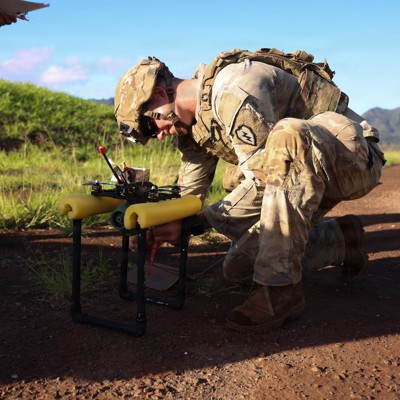
Soldiers assigned to the 25th Infantry Division prepares a first-person view kill drone for flight during training at Schofield Barracks, Hawaii, Sept. 11, 2026. U.S. Army / Pvt. Kahtia Babb
Experts weigh in on what it will take to be successful.
The Army is bringing futures back.
The service announced the creation of Futures and Autonomous Systems Command on Friday, a day after Defense Secretary Pete Hegseth announced the creation of a new combatant command for autonomous warfare in a speech to troops.
"Secretary Hegseth made it clear: We are done with the bureaucratic inertia holding back modernization,” acting Army Secretary Adam Telle said in a news release .
So how do they cut through bureaucracy with a new bureaucratic organization?
FASCOM will stand up in the wake of last year’s decision to consolidate Army Futures Command and Training and Doctrine Command , part of a multi-year effort by the service to reduce its general officer ranks . Hegseth has since taken the idea military-wide .
The difference is that FASCOM will be led by an acquisition executive, where Futures Command had four-star generals with infantry backgrounds at the helm during its short tenure. Though the command endeavoured to fix the Army’s broken requirements process, ultimately the final decisions and acquisitions were made at the Pentagon, creating a disconnect that FASCOM won’t have to deal with.
“So maybe this is kind of Futures Command 2.0, right?” John G. Ferrari , a senior fellow at the American Enterprise Institute and retired two-star general, told Defense One .
Except this time, rather than a standalone four-star command with no joint equivalent, FASCOM could nest under the new Autonomous Warfare Command as a service component.
“I think their theory of the case is that you have too many disparate organizations within the Pentagon working this, and that they're working in some cases counter to each other,” Ferrari said, referring to the Defense Innovation Unit , various service PAEs and the recently created Defense Autonomous Warfare Group .
A combatant command “gives a single military leader the authority, the responsibility, and the resources to drive this,” he said. “So I think it's an admission that the current organizational structure isn't going to deliver in a timely manner.”
It’s also a more permanent solution than another working group or special unit.
“I think what they're trying to do is create an enduring organization that will drive this thing into the future, for the future, and outlast them,” Ferrari said. “Because regardless of who wins the next presidential election, it won't be this president, and so there'll likely be changes…the thing that endures are these combatant commands.”
What we talk about when we talk about autonomy
The Defense Department’s push toward autonomous warfare is not about robot drones finding, fixing, and deploying their weapons at will—at least not yet.
The war in Ukraine is a test bed for autonomous operations, with Ukrainian troops using artificial intelligence to identify targets and help guide a weapon to the target. On the Russian side, according to Center for Strategic and International Studies fellow Kateryna Bondar , there are some indications that fully autonomous drones have attacked civilian targets.
“We can just infer this indirectly, because analysis of those systems show that they don't have any connection or communication system…and also they carry NVIDIA chips, which are able to process AI models on board, and also just observations how they behave,” she said.
And they’re not very accurate, she added, something that the U.S. military isn’t inclined to experiment with.
“So I would say that autonomy that is being deployed right now, it's not some super sophisticated technology, AI-enabled full autonomy, or anything like that,” Bondar said. “It's more a function that assists the human operator in getting the drone to a place where the target is, and then actually engaging it.”
Ukrainians are also using AI-assisted analysis to gather intelligence, but humans still do the decision-making.
“Now they're trying to train agents which can perform as humans, and this is, I think, a turning point where we can actually get to autonomous,” she said. “And I would also call it a weapon system because, if this agent is able to act and activate whatever effectors we have—be it missiles, be it drones, whatever it can employ—then the decision-making system and this agent can actually be called a weapon system.”
FASCOM would bring together the Army’s existing transformation efforts with regard to unmanned systems , with a new push to prioritize autonomy.
Telle’s memo calls on the service’s operations chief to figure out what kind of manning existing units will need to incorporate autonomous capabilities and designate a Portfolio Acquisition Executive for autonomy.
Someone with an operational background should be in charge, Ferrari argued, though the PAEs were recently reorganized from a mix of officers and civilians to all civilians in charge, with uniformed deputies.
“If it's just led by an acquisition executive, then you're going to have the same problem that the Army always has, which is an acquisition executive's leading something, not a warfighter,” he said.
There are, though, some battlefield lessons the U.S. military can incorporate, Bondar said, to be able to work with the bureaucracy of a new command without making new technology acquisition so rigid.
“There's a lot of conversation about feedback loop, and it actually makes sense because…when every commander or every unit, whoever is buying drones, has the direct phone number of the manufacturer, they can immediately call and say what should be improved, what didn't work,” she said. “Because for them, giving this feedback, it's not some sort of obligation or part of procedure—they really feel this need because their lives depend on this, and the lives of their people.”
The Army has its own version of this approach, once called Transformation-in-Contact and now dubbed Continuous Transformation , in which they invite vendors out to field exercises to get live feedback on their products.
The key to bringing it all together will be the funding, Ferrari said, which would have to come from this year’s proposed reconciliation bill . Otherwise, the service will be forced to wait until fiscal year 2028 to get into a budget.
The service is expected to provide more details about FASCOM’s genesis at the upcoming AUSA annual symposium in Washington D.C., which begins Oct. 12.
Help us report on the future of national security . Contact Meghann Myers: mmyers@defenseone.com, meghannmyers.55 on Signal.
NEXT STORY: GenAI.mil saw more than 2 million users in one week, top DOD official says
2026年9月11日,在夏威夷斯科菲尔德兵营,隶属于第25步兵师的士兵们正在训练中准备一架第一人称视角杀伤无人机进行飞行。美国陆军/列兵卡蒂亚·巴布
专家们就成功需要具备的条件发表了看法。
军队正在重塑未来。
周五,美国国防部宣布成立未来与自主系统司令部。此前一天,国防部长皮特·赫格塞斯在对部队发表讲话时宣布成立一个新的自主作战司令部。
“赫格塞斯部长明确表示:我们已经受够了阻碍现代化的官僚主义惰性,”代理陆军部长亚当·特勒在一份新闻稿中说。
那么,他们如何通过建立新的官僚机构来打破官僚主义的壁垒呢?
陆军未来司令部(FASCOM)的成立,源于去年陆军决定合并陆军未来司令部和训练与条令司令部,这是陆军多年来削减将级军官人数计划的一部分。此后,赫格塞斯将这一理念推广至全军。
不同之处在于,未来陆军司令部(FASCOM)将由一名采购主管领导,而未来司令部在其短暂的任期内却由具有步兵背景的四星上将掌舵。尽管该司令部努力改进陆军支离破碎的需求流程,但最终的决策和采购仍由五角大楼做出,造成了FASCOM无需面对的脱节问题。
“所以这或许可以看作是未来司令部 2.0 版,对吧?”美国企业研究所高级研究员、退役少将约翰·G·法拉利告诉《国防一号》杂志。
但这一次,FASCOM 不再是一个独立的四星级司令部,而是一个没有联合对应机构的部门,而是可以作为军种组成部分隶属于新的自主作战司令部。
“我认为他们的理论是,五角大楼内有太多不同的组织在负责这项工作,而且在某些情况下,他们的工作方向相互矛盾,”法拉利说道,他指的是国防创新部门、各个军种的PAE以及最近成立的国防自主作战小组。
他说:“作战司令部赋予一位军事领导人权力、责任和资源来推动这项工作。所以我认为这承认了目前的组织结构无法及时完成任务。”
它也比成立另一个工作组或特别小组更为长久。
“我认为他们想做的是创建一个能够长久存在的组织,推动这项事业走向未来,造福未来,并且比他们自己更长寿,”法拉利说。“因为无论谁赢得下一届总统大选,都不会是现任总统,所以很可能会出现一些变化……但这些作战司令部会一直存在下去。”
我们谈论自主性时,究竟在谈论什么?
美国国防部推动自主战争,并不是要让机器人无人机随意寻找、修理和部署武器——至少目前还不是。
乌克兰战争是自主作战的试验场,乌克兰军队利用人工智能识别目标并引导武器攻击目标。据战略与国际研究中心研究员卡捷琳娜·邦达尔称,有迹象表明,俄罗斯方面已使用全自动无人机袭击了民用目标。
“我们可以间接推断出这一点,因为对这些系统的分析表明,它们没有任何连接或通信系统……而且它们还搭载了英伟达芯片,能够处理板载人工智能模型,以及观察它们的行为,”她说。
她补充说,而且它们的准确性不高,美国军方也不愿意在这方面进行试验。
邦达尔说:“所以我认为,目前部署的这种自主性,并不是某种超级复杂的技术,也不是人工智能驱动的完全自主性之类的东西。它更像是一种辅助操作员将无人机引导到目标位置并进行攻击的功能。”
乌克兰人也在利用人工智能辅助分析来收集情报,但决策仍然由人来做。
“现在他们正试图训练能够像人类一样行动的智能体,我认为这是一个转折点,我们或许真的能够实现自主,”她说。“我还会把它称为武器系统,因为如果这个智能体能够行动并激活我们拥有的任何效应器——无论是导弹、无人机,还是它能够使用的任何武器——那么这个决策系统和这个智能体实际上就可以被称为武器系统。”
FASCOM 将整合陆军现有的无人系统转型工作,并大力推进自主化进程。
特勒的备忘录要求该部门的作战主管弄清楚现有部队需要什么样的人员配备才能具备自主能力,并指定一名负责自主能力的投资组合采购主管。
法拉利认为,应该由有实战经验的人来负责,尽管最近 PAE 的组织结构已经从军官和平民的混合改为全部由平民负责,并配备穿制服的副手。
他说:“如果只是由一名采购主管领导,那么你就会遇到陆军一直面临的同样问题,那就是由一名采购主管领导,而不是由一名作战人员领导。”
邦达尔表示,不过,美军可以借鉴一些战场经验,以便在不使新技术采购过于僵化的情况下,与新指挥部的官僚机构合作。
“现在大家都在讨论反馈机制,这其实很有道理,因为……当每个指挥官或每个单位,无论谁在采购无人机,都能直接联系到制造商,他们就可以立即打电话反馈哪些地方需要改进,哪些地方出了问题,”她说道。“因为对他们来说,提供反馈并非出于义务或程序上的要求——他们真心觉得有必要这样做,因为这关系到他们自身以及他们部下的生命安全。”
陆军也有自己的类似方法,曾经被称为“接触式转型”,现在被称为“持续转型”,他们会邀请供应商参加实地演习,以获得对其产品的实时反馈。
法拉利表示,关键在于资金,而这笔资金必须来自今年提出的预算协调法案。否则,这项服务将被迫等到2028财年才能纳入预算。
预计该机构将在即将于 10 月 12 日在华盛顿特区举行的 AUSA 年度研讨会上提供有关 FASCOM 起源的更多细节。
请帮助我们报道国家安全的未来。请联系 Meghann Myers:mmyers@defenseone.com,或在 Signal 上联系 meghannmyers.55。
下一篇报道:美国国防部高级官员称,GenAI.mil网站一周内用户数量超过200万。