Drones and autonomous warfare: ‘One-way attack’ and reshaping ISR无人机与自主作战:“单向攻击”与重塑情报、监视与侦察
AEVEX explains how autonomous air and maritime systems, drones and ISR capabilities are reshaping multi-domain warfare through coordinated operations, greater resilience and improved battlefield awareness.
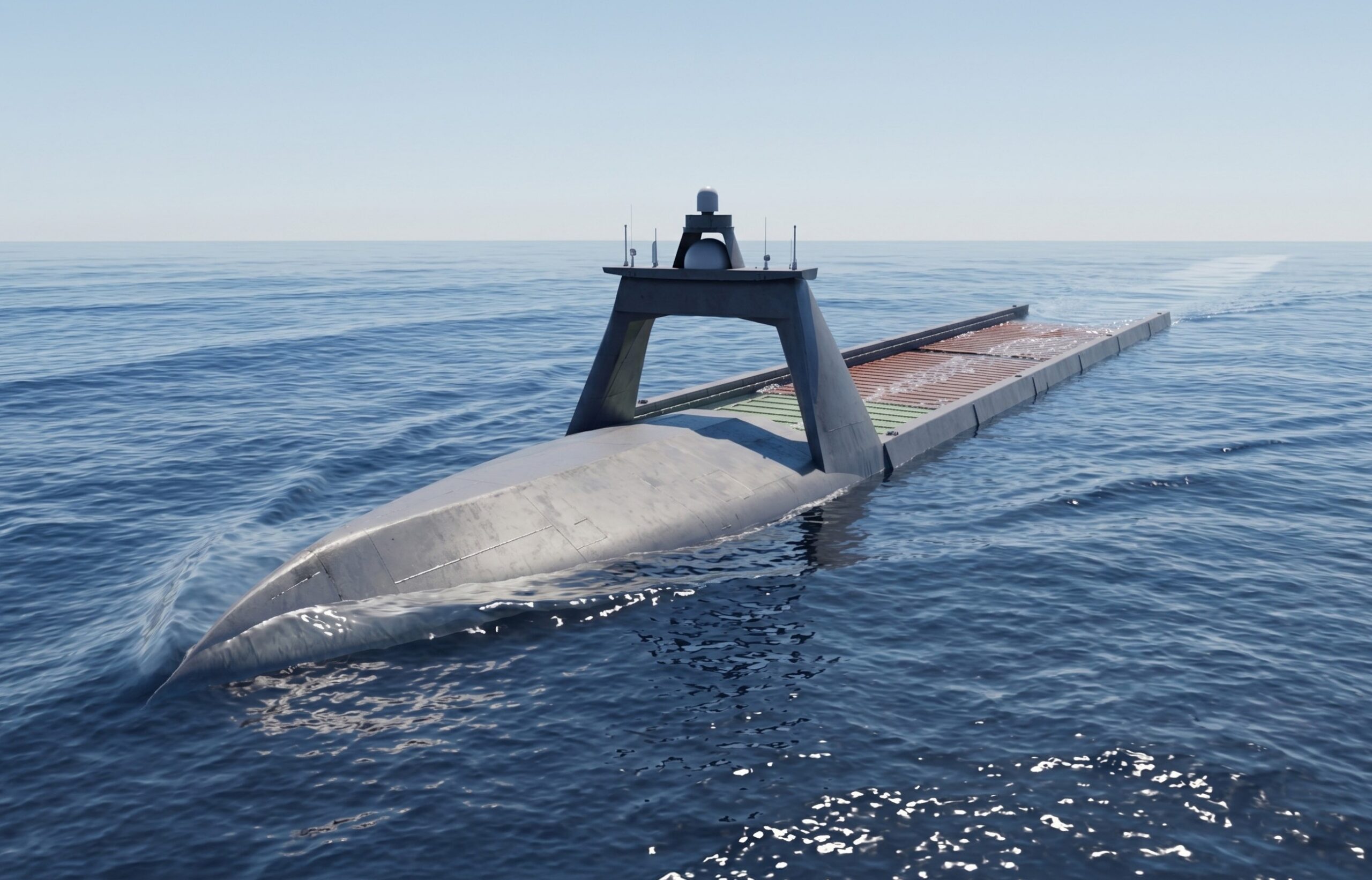
AEVEX Maritime Systems’ NightTrain is a semi-submersible, low visibility transport and delivery platform. (Photo courtesy of AEVEX Maritime Systems.)
Whether it’s seaborne reconnaissance platforms such as the Global Autonomous Reconnaissance Craft (GARC) – now called LYNX – or semi-submersible logistics such as AEVEX Maritime Systems’ NightTrain or high-flying drones providing ISR, autonomous systems are playing a growing role in multi-domain missions, offering longer time on site, greater coverage in contested areas and carrying out missions without putting crew members in harm’s way.
Breaking Defense spoke with Craig Anders, SVP of Growth at AEVEX, about the need for autonomy, how the company is building multi-domain solutions and lessons learned from the use of uncrewed systems in Ukraine and Iran.
What’s the threat scenario right now that is driving the need for air and maritime autonomy?
Craig Anders, SVP of Growth, AEVEX
Anders: We’re operating under this environment with persistent surveillance, ships, comms, everything’s exposed to attack. Everybody can see everything everywhere. Adversaries are out there deploying inexpensive systems at volume, at scale, and it disrupts the navigation and communications that we depend on to fight. GPS is a mess, comms are a mess, everything’s being jammed.
By creating the distributed capability to help grow reach and reduce the exposure of the manned side of things, both air and maritime autonomy can help maintain awareness, mission effects and keep the forces operating across way larger areas and swaths of the area of responsibility (AOR). These systems need to remain useful when navigation and communications are degraded and operating conditions change.
It’s such a dynamic battlefield these days that having autonomy that doesn’t rely on traditional methods of fighting is now this situation that is critical to mission success.
How have the lessons learned from Ukraine and Iran shaped the thinking around air and maritime autonomy?
We’ve learned both what to do and what not to do over the past four to five years. I was in the military and we started off the Phoenix Ghost program on the government side, and I was able to come here and continue that mission. One of the things we learned there is if you can’t cycle fast, if you don’t have people on the ground near the fight, you’re going to get left behind because being able to dynamically flex, have short engineering cycles, short stroke changes to systems outside the normal build process, you’re just going to lose.
Iran reinforces that pressure. They mass inexpensive threats on the battlefield. They levy pressure on our defenses, our inventories and our maritime access at a level we’ve never seen before. Affordability is key. Resilience of the system is key. Being able to adapt to keep it all working together is the only way to succeed in this environment.
We need functional systems in a degraded environment. We need to be able to have close connections between the operators and the engineers, and our production approach needs to be flexible enough to incorporate those changes fast. Otherwise, we’re not going to have what we need to fight. Even if we do deliver it, it’s not going to be very effective. We strive to shorten those engineering cycles, shorten those production cycles and continue to get users the things they need in a short timeline.
That’s because the Research, Development, Test, and Evaluation, RDT&E, cycle has to move at the pace of combat.
Right, and here’s the deal. Over time, airplanes aren’t going to grow extra wings or weird new kinds of propellers. This becomes largely an autonomy and a software fight. You have to have a good solid vehicle by which to implement these capabilities, whether it’s air, sea or subsea.
We’re taking the background we have in airborne intelligence, ISR, one-way attack and what we’ve learned on the battlefield, and producing that in a method that ties up with the way the US wants to fight.
What is evolving rapidly is how the US employs affordable unmanned systems at scale, across domains and as part of a broader force. That requires more than platforms. It requires concepts of operations, force structure, storage, forward support, and sustainment that keep those systems effective as conditions change.
What multi-domain capabilities are needed, and how has AEVEX evolved into a company that can offer them?
A key to this coming fight is understanding what layered defense and offense looks like. You don’t want to just send a couple long-range, one-way assets out there. They’ll probably just get shot down and you won’t know what happened. You don’t want to have a USV just floating out there in the water by itself. You want these things working together autonomously, but also passing information back to be used for the rest of the fight. Ultimately, this whole multi-domain concept is important to ensuring mission success in these AORs because of the uncertainty.
We believe that bringing in this BlackSea piece – there’s one-way attack boats, ISR boats, security, there’s mine sweeping. You have high-flying ISR assets that work with the boats. You have one-way attack that gets tied together by the boats on the water and the planes in the sky.
When you bring systems together to accomplish different parts of a mission, a common autonomy architecture and compatible interfaces can help them share information and coordinate more effectively. That is the opportunity we are pursuing across air, surface, and subsea capabilities. Our CompassX family of navigation and autonomy capabilities supports that approach, with modular hardware and software tailored to the platform and mission.
There are so many different capabilities you can bring to bear using these types of systems, whether it’s ISR, non-kinetic effects, EW/EA, mine sweeping, mine neutralization, critical infrastructure protection, long-range logistics. There’s so much you can bring to bear that helps take people out of harm’s way, but still accomplish the mission set. When you start to tie all these together across our divisions, it tells a story and sets a new standard on the battlefield.
How does having all of these systems working in conjunction give a more comprehensive picture of the battlefield to decision makers?
You’re going to see things you couldn’t see before. You’re going to see patterns develop. Every platform the military owns, operates or uses generates data, and that data, a lot of times, largely goes unused. As you start to pull together these systems of systems and these whole concepts of operations, you start to see different points where you can pull and utilize data to help make better decisions, target better, communicate better, share data across multiple common operating pictures, and enable the fighting man to make better decisions across the board.
You mentioned BlackSea Technologies, which you recently acquired and is now AEVEX Maritime Systems. What capabilities do they bring?
AEVEX already had surface capabilities through Mako. Our Maritime Systems division adds substantially greater maritime engineering, vessel manufacturing, and operational depth. That broadens both our portfolio and the expertise we can bring to customers.
When you look at their main system, it used to be called the GARC, now it’s LYNX. That’s a US Navy Program of Record. We’ve delivered 350 vessels, and now we’re revamping them to increase the comm/nav solution on it to make it even more adaptable in the current environment.
The LYNX – formerly the Global Autonomous Reconnaissance Craft (GARC) – reconnaissance platform is an uncrewed vessel that can stay on site for long periods of time to conduct reconnaissance operations. (Photo courtesy of AEVEX Maritime Systems.)
Those systems are fantastic. They’re all aluminum. We have more than 25,000 operational hours in them. They’re doing mine sweeping in the straits right now. They’re doing countermeasures. They have some unique reconfigurable capabilities that a lot of other people do not. Affordability is also central to our approach.
When you look at that, coupled with some of the other things we’re doing such as the NightTrain, low visibility container transport and delivery; that’s a semi-submersible, large ship, has a couple storage containers on the back. It has a wet bay and it does 2,700 nautical miles.
We have the sea-based petroleum distribution, which is a tanker that holds 185,000 gallons of gas that you can sink down to the sea floor and cache petroleum in place for contingency operations. It creates just a whole other level of how you would operate and fight in that environment.
What else should people know about AEVEX and what you’re doing in the field?
The biggest thing is multi-domain matters, because every mission out there crosses multiple domains. Bringing air, surface, and subsea capabilities together is going to give the warfighter what they need and create opportunities for more coordinated operations. It’s hard to fight in a vacuum. If you’re just focused on air, you’re just focused on sea, you’re missing out. You’re missing out on the CONOPS that help you win effectively and spend less doing it.
Autonomy is changing the way forces see and operate and deliver effects, sustain themselves. Autonomy is bringing capability to bear. Autonomy is also the back side, where you’re using data to analyze and grow your models in an effort to continue to iterate these systems to success. Its value is in real-world performance and real-world operating conditions, but you take that back and you grow your systems based on data and not conjecture. That’s exciting for me.
We bring substantial operational experience delivering and supporting these capabilities. That experience gives us a strong foundation for incorporating lessons from the field and continually improving our systems as requirements evolve. The production process has to keep pace as well, so we can move those improvements into repeatable builds and deliver them at the volume customers need.
That’s what we’re building at AEVEX: the ability to turn evolving mission requirements into capability customers can field and use. We help customers develop concepts of operations, integrate capabilities, and sustain them in the field. That is how we deliver solutions that remain useful as the mission changes.
AEVEX Maritime Systems公司的NightTrain是一款半潜式低能见度运输和配送平台。(图片由AEVEX Maritime Systems提供。)
无论是全球自主侦察艇(GARC,现称 LYNX)等海上侦察平台,还是 AEVEX 海事系统公司的 NightTrain 等半潜式后勤舰艇,亦或是提供情报、监视与侦察 (ISR) 的高空无人机,自主系统在多域任务中都发挥着越来越重要的作用,能够提供更长的现场作业时间、更广阔的争议区域覆盖范围,并在不危及船员安全的情况下执行任务。
Breaking Defense 采访了 AEVEX 的高级副总裁 Craig Anders,讨论了自主性的必要性、该公司如何构建多领域解决方案以及从在乌克兰和伊朗使用无人系统中吸取的教训。
当前什么样的威胁形势促使人们需要空中和海上自主能力?
Craig Anders,AEVEX 增长高级副总裁
安德斯:我们现在身处这样的环境,持续不断的监视、舰船、通信,一切都暴露在攻击之下。任何人都能看到任何地方的一切。对手正在大规模地部署廉价的系统,这扰乱了我们赖以作战的导航和通信。GPS 一片混乱,通信也一团糟,所有东西都受到了干扰。
通过构建分布式作战能力,扩大作战范围并降低有人操作的风险,空中和海上自主作战能力均有助于维持态势感知、确保任务效果,并使部队能够在更大范围的责任区内持续作战。即使导航和通信条件受损或作战环境发生变化,这些系统也必须保持有效运行。
如今的战场瞬息万变,拥有不依赖传统作战方式的自主能力,对于任务的成功至关重要。
从乌克兰和伊朗吸取的教训如何影响了人们对空中和海上自主权的思考?
过去四五年里,我们既学到了该做什么,也学到了不该做什么。我曾在军队服役,参与了政府部门的“凤凰幽灵”项目,后来我来到这里继续这项任务。我们学到的一点是,如果你不能快速迭代,如果你没有人员在前线作战,你就会被甩在后面。因为如果不能灵活应变,缩短工程周期,在常规制造流程之外对系统进行快速变更,你就注定会失败。
伊朗加剧了这种压力。他们在战场上大量部署廉价的威胁力量。他们以前所未有的力度对我们的防御、库存和海上通道施加压力。成本控制至关重要。系统的韧性至关重要。只有能够适应并保持各系统协同运作,才能在这种环境下取得成功。
我们需要在环境恶化的情况下也能正常运行的系统。我们需要确保运维人员和工程师之间保持紧密联系,并且我们的生产流程必须足够灵活,能够快速适应这些变化。否则,我们将无法拥有应对挑战所需的资源。即使我们最终交付了这些资源,其效果也不会很好。我们致力于缩短工程周期和生产周期,并持续在短时间内为用户提供他们所需的产品。
这是因为研发、测试和评估(RDT&E)周期必须跟上作战的步伐。
没错,关键就在这里。随着时间的推移,飞机不会长出额外的机翼,也不会装上奇形怪状的新型螺旋桨。这在很大程度上会演变成一场自主性和软件之争。你必须拥有一个可靠的载体来实现这些功能,无论是在空中、海上还是水下。
我们将利用我们在空中情报、ISR、单向攻击方面的背景知识以及我们在战场上学到的经验,并将其转化为一种与美国希望的作战方式相契合的方法。
美国正在迅速发展的是如何大规模地、跨领域地、并作为更广泛部队的一部分来运用价格合理的无人系统。这需要的不仅仅是平台本身,还需要作战概念、部队结构、存储、前沿支援和保障措施,以确保这些系统在不断变化的环境中依然有效。
需要哪些多领域能力?AEVEX 又是如何发展成为能够提供这些能力的公司?
即将到来的这场战斗的关键在于理解多层次防御和进攻的模式。你不能只派出几艘远程单向作战舰艇,它们很可能被击落,你根本不知道发生了什么。你也不能让一艘无人水面艇孤零零地漂浮在水面上。你需要这些舰艇能够协同自主作战,同时还能将信息传回后方,用于后续的战斗。归根结底,鉴于这些战区局势的不确定性,这种多域作战理念对于确保任务成功至关重要。
我们认为,引入黑海战区——这里有单向攻击艇、情报、监视与侦察艇、安保力量,还有扫雷力量。这里还有与这些艇协同作战的高空情报、监视与侦察力量。水上的艇和空中的飞机将单向攻击能力结合起来。
当您将多个系统整合在一起以完成任务的不同部分时,通用的自主架构和兼容的接口可以帮助它们更有效地共享信息和协调。这正是我们在空中、水面和水下能力领域努力实现的目标。我们的 CompassX 系列导航和自主能力正是基于此理念,采用模块化硬件和软件,可根据平台和任务进行定制。
利用这类系统,你可以发挥多种不同的能力,无论是情报、监视与侦察(ISR)、非动能效应、电子战/电子战、扫雷、地雷清除、关键基础设施保护还是远程后勤保障。你可以运用这些能力来保护人员安全,同时完成既定任务。当你把所有这些能力整合到我们各个部门时,它就展现出强大的作战能力,并在战场上树立了新的标杆。
所有这些系统协同工作,如何为决策者提供更全面的战场态势图景?
你会看到以前看不到的东西,你会看到一些模式逐渐形成。军队拥有、运营或使用的每个平台都会产生数据,而这些数据很多时候都未被利用。当你开始整合这些系统和作战概念时,你会开始发现不同的切入点,可以从中提取和利用数据,从而做出更好的决策、更精准地定位目标、更好地沟通、在多个通用作战图上共享数据,并使作战人员能够在各个方面做出更明智的决策。
您提到了您最近收购的BlackSea Technologies公司,该公司现在更名为AEVEX Maritime Systems。他们带来了哪些能力?
AEVEX此前已通过Mako平台具备水面作战能力。我们的海事系统部门将大幅提升我们在海事工程、船舶制造和运营方面的实力。这不仅拓宽了我们的产品组合,也增强了我们能够为客户提供的专业技术。
他们的主要系统以前叫GARC,现在叫LYNX。这是美国海军的正式项目。我们已经交付了350艘舰艇,现在正在对它们进行改造,以增强其通信/导航解决方案,使其更能适应当前的环境。
LYNX——前身为全球自主侦察艇(GARC)——是一种无人驾驶侦察平台,可在目标区域长时间停留,执行侦察任务。(图片由AEVEX海事系统公司提供。)
这些系统非常棒。它们全部采用铝制材料。我们已经使用这些系统运行了超过25000小时。它们目前正在海峡进行扫雷作业,并执行反制措施。它们拥有许多其他系统所不具备的独特可重构能力。经济性也是我们方案的核心。
当你把这些和我们正在进行的其他一些项目结合起来看,比如“夜行列车”——一种低能见度集装箱运输和配送系统;那是一艘半潜式大型船舶,船尾有几个储物集装箱。它有一个湿货舱,航程可达2700海里。
我们拥有海上石油配送系统,这是一种可容纳18.5万加仑汽油的油轮,可以沉入海底,将石油储存起来以备应急行动之需。这彻底改变了我们在这种环境下作战和行动的方式。
关于 AEVEX 以及你们在该领域的工作,人们还应该了解哪些内容?
最重要的是多域作战能力,因为每一项作战任务都涉及多个领域。将空中、水面和水下作战能力整合起来,能够为作战人员提供所需的一切,并创造更多协同作战的机会。孤立地作战是行不通的。如果只关注空中作战或海上作战,就会错失良机。你会错过那些能够帮助你高效取胜并降低成本的作战概念。
自主性正在改变部队观察、行动、执行任务和维持自身运转的方式。自主性赋予了部队强大的能力。自主性也体现在其后端,即利用数据分析和改进模型,从而不断迭代优化系统,最终取得成功。它的价值在于实际性能和实际作战环境,但你需要将这些数据转化为实际应用,并基于数据而非臆测来发展系统。这让我感到非常兴奋。
我们在交付和支持这些功能方面拥有丰富的运营经验。这些经验为我们奠定了坚实的基础,使我们能够吸取现场经验教训,并随着需求的演变不断改进我们的系统。生产流程也必须与时俱进,这样我们才能将这些改进转化为可重复的版本,并以客户所需的批量交付。
这就是我们在AEVEX所构建的:将不断变化的任务需求转化为客户可以部署和使用的能力。我们帮助客户制定作战概念、整合各项能力,并确保其在战场上的持续运行。这就是我们提供的解决方案如何随着任务的变化而保持有效性。