Lockheed unveils PAC-3 Edge, its next-gen Patriot interceptor洛克希德公司推出其下一代“爱国者”拦截导弹PAC-3 Edge
The aerospace giant intends to invest hundreds of millions of dollars of its own cash in the missile alone, alongside additional investments in its seeker and solid rocket motor, said Tim Cahill, president of Lockheed's missiles and fire control division.
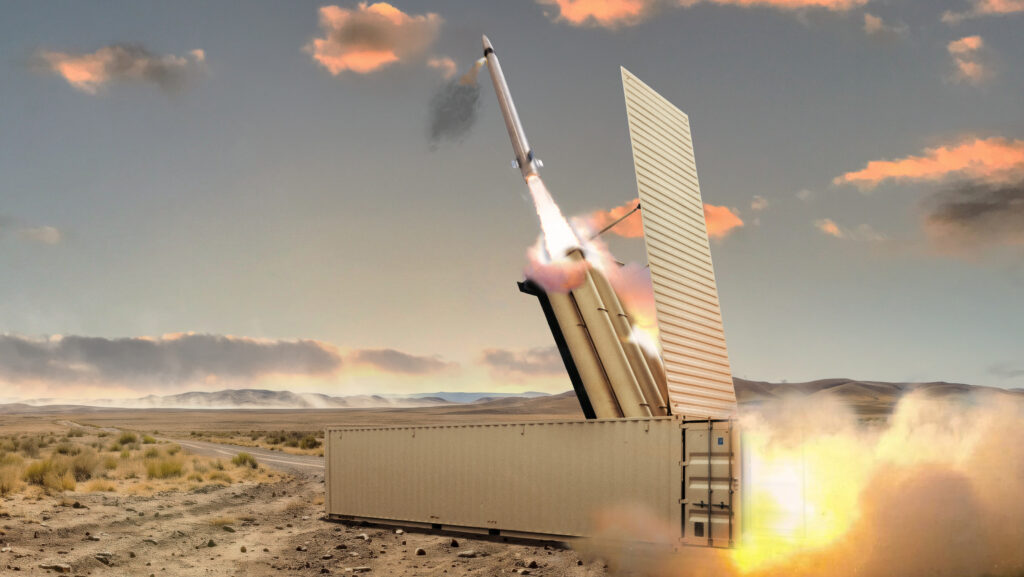
A rendering of Lockheed Martin's PAC-3 Edge interceptor, its offering for the Army’s Future Interceptor program. (Lockheed Martin)
WASHINGTON — Lockheed Martin today revealed the PAC-3 Edge, its offering for the Army’s future Patriot interceptor that can fly further and hit more capable targets than the current PAC-3 missile.
Tim Cahill, president of Lockheed’s missiles and fire control unit, said the new interceptor is meant for what Lockheed called the Army’s Future Interceptor program, which he indicated seeks to develop a next-gen version of the Patriot’s current PAC-3 missile segment enhancement (MSE). Cahill said Lockheed was one of two companies selected to advance in the program. He did not identify the other company, and the Army did not respond to a request for more information today.
The company is set to unveil a full-scale model of the new missile on Monday a t the Association for the US Army conference, Cahill said.
“PAC-3 Edge is designed to go after the most stressing targets that we — and, more importantly, that the Department of War — believes are the next-generation [threats] that they’re going to be seeing in the fight from our adversaries,” Cahill said in an interview with Breaking Defense ahead of AUSA.
“PAC-3 Edge will be longer ranged. It’ll be higher altitude. It’ll be more capable to take on targets that are trying to hide,” he added. “It’ll have greater sensitivity in its seeker. It’ll have greater capability to maneuver and to respond to threats.”
Lockheed intends to invest hundreds of millions of dollars of its own cash in the missile alone, alongside additional investments in its seeker and solid rocket motor, Cahill said.
“We’ve already probably somewhere between $50 [million] and $100 million or better put into this,” he said.
Lockheed is developing the seeker in-house, with the intent of being able to use the new technology across other offensive and defensive systems, Cahill said. The company plans to invest about $800 million into the seeker, having invested “several $100 million dollars” into it so far.
For the solid rocket motor, Lockheed is working with Northrop Grumman on a three-pulse moto r intended to provide greater range and altitude compared with the legacy PAC-3 missile, he said.
Lockheed intends to begin testing PAC-3 Edge in 2027, ahead of its first deployment in 2031, the company said in a news release.
The PAC-3 Edge will be made on Lockheed’s existing PAC-3 line in Camden, Ark. The company currently is ramping up production of the PAC-3 MSE under an agreement with the Pentagon to triple interceptor production over the next seven years.
T o support that effort, Lockheed is building a new MSE production facility outfitted with robotics, automation and AI meant to improve manufacturing efficiency, Cahill said. PAC-3 production will move to the new facility once it’s complete, an d the legacy facility will receive the same upgrades.
“That’ll be available then to build Edge in the future,” he said. “Before we ever get to the point where we’re producing Edge, we will have already outfitted the entire factory from end to end with the most modern manufacturing capability available, frankly, in the world.”
The Army has weathered fits and starts in its efforts to develop a next-generation interceptor for the Patriot missile defense system . In 2024, t he service announced plans to cancel the Lower-Tier Future Interceptor (LTFI) program , which saw both Raytheon and Lockheed competing to build the new missile.
But a year late r, an Army official suggested the program could move forward after all .
“There are some aspects of the LTFI program that are still somewhat pre-decisional, but I believe that we will get support for the program, and I may be in a position this time next year to begin program-of-record execution,” Maj. Gen. Frank Lozano, then the program executive officer for missiles and space, said in October 2025.
“I think right now the glass is probably half full that we’ll get to run that program, and so we’re really in the planning process in figuring out what that’s going to look like moving forward,” he added.
Cahill did not identify the second vendor working on the Army’s Future Interceptor program . The service did not immediately respond to Breaking Defense’s request for comment about the other company.
Earlier this year, Lockheed announced the development of the PAC-3 ACE, a less capable, lower-cost version of the MSE that would be available to international customers.
Moving Forward on the Weapons Boom
Since the start of the year, the Pentagon has raced to increase munitions production, inking multiyear framework agreements with weapons makers and suppliers meant to entice companies into modernizing facilities and making major capital investments. S ome of those agreements have been turned into undefinitized contract actions, allowing money to start flowing to companies for production.
The department recently awarded Lockheed undefinitized contract actions (UCAs) to ramp up PAC-3 and Terminal High Altitude Area Defense (THAAD) prod uction.
“We were moving forward anyway on our own investment, so we didn’t lose time on that. But clearly the UCAs get us all the contractual authority we need to move forward,” Cahill said. “Definitization of the final contracts — they’ll happen when they happen. Those won’t hold us up.”
Eventually, Congress will need to appropriate the money linked with production increases, bu t foreign military sales contracts and current domestic orders could help pad out any short-term delays as lawmakers work out the budget, Cahill added.
Lockheed’s partnership with General Dynamics to expand solid rocket motor production is also progressing well, Cahill said. The companies announced the partnership in 2024 with the plan for General Dynamics to produce solid rocket motors for Lockheed’s Guided Multiple Launch Rocket System (GMLRS) .
“We just had a motor firing here in the last few days,” he said. “There was a Lockheed Martin-designed GMLRS motor that was partnered with General Dynamics to put propellant in it and to actually fire the motor.”
Breaking Defense Video
New leaders, new drone command: What we expect from AUSA 2026
Unpacking Boeing’s F/A-XX win, plus a report from wartime Ukraine
How Hegseth envisions a new Autonomous Warfare Command
What Europe’s military air fleets will look like in 30 years
Riyadh gets closer to F-35s, Damascus presses sovereignty and an expert take on Iran
Drone-hunting on the border, plus turmoil at an Air Force think tank
The future of European airpower might be unmanned
The big news out of AFA, plus a guided tour of the show floor
Why the ‘right to repair’ matters to the Pentagon
What the Pentagon is testing along the US-Mexico border
这是洛克希德·马丁公司PAC-3 Edge拦截机的效果图,该拦截机是该公司为陆军未来拦截机项目提交的方案。(洛克希德·马丁公司)
华盛顿——洛克希德·马丁公司今天发布了PAC-3 Edge导弹,这是该公司为陆军未来的爱国者拦截导弹提供的方案,与目前的PAC-3导弹相比,它可以飞得更远,打击更强大的目标。
洛克希德·马丁公司导弹与火控部门总裁蒂姆·卡希尔表示,这款新型拦截器是为洛克希德公司所称的陆军“未来拦截器”项目而设计的。他指出,该项目旨在开发“爱国者”导弹系统现有PAC-3导弹段增强型(MSE)的下一代版本。卡希尔称,洛克希德·马丁公司是入选该项目的两家公司之一。他没有透露另一家公司的名称,陆军方面今天也未回应置评请求。
卡希尔表示,该公司将于周一在美国陆军协会会议上公布新型导弹的全尺寸模型。
“PAC-3 Edge 的设计目标是打击我们——更重要的是,美国战争部——认为下一代威胁——的最具压力的目标,这些威胁将来自我们的对手,”卡希尔在 AUSA 会议前接受 Breaking Defense 采访时表示。
“PAC-3 Edge导弹的射程更远,飞行高度更高,更能有效打击试图隐藏的目标,”他补充道,“它的导引头灵敏度更高,机动性和应对威胁的能力也更强。”
卡希尔表示,洛克希德公司计划仅在导弹研发上就投入数亿美元的自有资金,此外还将对导弹的导引头和固体火箭发动机进行额外投资。
他说:“我们可能已经在这个项目上投入了 5000 万到 1 亿美元,甚至更多。”
卡希尔表示,洛克希德公司正在自主研发这种导引头,目的是将这项新技术应用于其他进攻和防御系统。该公司计划为该导引头投资约8亿美元,而迄今为止已投入“数亿美元”。
他说,在固体火箭发动机方面,洛克希德公司正与诺斯罗普·格鲁曼公司合作研发一种三脉冲发动机,旨在提供比传统的 PAC-3 导弹更大的射程和更高的高度。
洛克希德公司在一份新闻稿中表示,该公司计划于 2027 年开始测试 PAC-3 Edge,并于 2031 年首次部署。
PAC-3 Edge 将在洛克希德公司位于阿肯色州卡姆登的现有 PAC-3 生产线上生产。该公司目前正根据与五角大楼达成的协议,提高 PAC-3 MSE 的产量,该协议旨在未来七年内将拦截弹的产量提高三倍。
卡希尔表示,为了支持这项工作,洛克希德公司正在建造一座新的MSE生产设施,该设施配备了机器人、自动化和人工智能技术,旨在提高生产效率。PAC-3的生产将在新设施建成后转移到那里,而原有的工厂也将进行同样的升级改造。
“到那时,这些资源就可以用来生产Edge了,”他说。“在我们真正开始生产Edge之前,我们已经将整个工厂从头到尾配备了世界上最先进的制造能力。”
美国陆军在研发下一代“爱国者”导弹防御系统拦截器方面经历了断断续续的进展。2024年,陆军宣布计划取消低层未来拦截器(LTFI)项目,该项目曾由雷神公司和洛克希德·马丁公司竞标建造新型导弹。
但一年后,一位陆军官员表示,该计划最终还是可以继续推进。
“LTFI 计划的某些方面仍处于决策前的阶段,但我相信我们会得到对该计划的支持,明年这个时候我或许就能开始正式执行该计划了。”时任导弹和太空项目执行官的弗兰克·洛萨诺少将在 2025 年 10 月表示。
“我认为目前来看,我们很有可能能够开展这个项目,所以我们现在正处于规划阶段,努力弄清楚未来该如何推进,”他补充道。
卡希尔没有透露参与陆军未来拦截器项目的第二家供应商是谁。陆军方面也没有立即回应《防务新闻》就另一家公司提出的置评请求。
今年早些时候,洛克希德公司宣布开发 PAC-3 ACE,它是 MSE 的一个性能较弱、成本较低的版本,将面向国际客户。
推进武器爆炸式增长
今年年初以来,五角大楼一直在加速提高军火产量,与武器制造商和供应商签署了多项多年框架协议,旨在吸引这些公司对设施进行现代化改造并进行重大资本投资。其中一些协议已经转化为未定合同,资金开始流向相关公司用于生产。
该部门最近授予洛克希德公司未确定合同行动 (UCA),以加快 PAC-3 和末段高空区域防御系统 (THAAD) 的生产。
“我们本来就在推进自己的投资项目,所以并没有耽误时间。但很显然,统一合同协议赋予了我们推进项目所需的所有合同授权,”卡希尔说。“最终合同的敲定——顺其自然吧。这些都不会阻碍我们。”
卡希尔补充说,最终国会需要拨款来弥补与产量增长相关的资金,但对外军售合同和目前的国内订单可以帮助缓解立法者制定预算期间可能出现的任何短期延误。
卡希尔表示,洛克希德与通用动力公司扩大固体火箭发动机生产的合作进展顺利。两家公司于2024年宣布建立合作伙伴关系,计划由通用动力公司为洛克希德的制导多管火箭系统(GMLRS)生产固体火箭发动机。
他说:“就在前几天,我们这里刚刚进行了一次发动机点火测试。那是一款由洛克希德·马丁公司设计的GMLRS发动机,通用动力公司参与了加注推进剂和点火测试。”
突破性防御视频
新领导人,新无人机指挥部:我们对 AUSA 2026 的期待
深入剖析波音F/A-XX的中标,以及来自战时乌克兰的报道
赫格塞斯设想的新型自主作战指挥部
30年后欧洲军用空军机队会是什么样子
利雅得距离F-35战机更近一步,大马士革强调主权,以及专家对伊朗的看法
边境无人机猎杀行动,以及空军智库的动荡
欧洲空军的未来或许在于无人化。
AFA展会最新动态,以及展会现场导览。
为什么“维修权”对五角大楼如此重要
五角大楼正在美墨边境测试什么?