One year in, Army’s FUZE leader eyes ‘bigger’ acquisition challenges上任一年后,陆军FUZE项目负责人将目光投向“更大”的采购挑战
The Army innovation hub's first year also revealed the challenge of making sure promising technologies don’t stop at the prototype stage, FUZE Director Matt Willis told Breaking Defense.
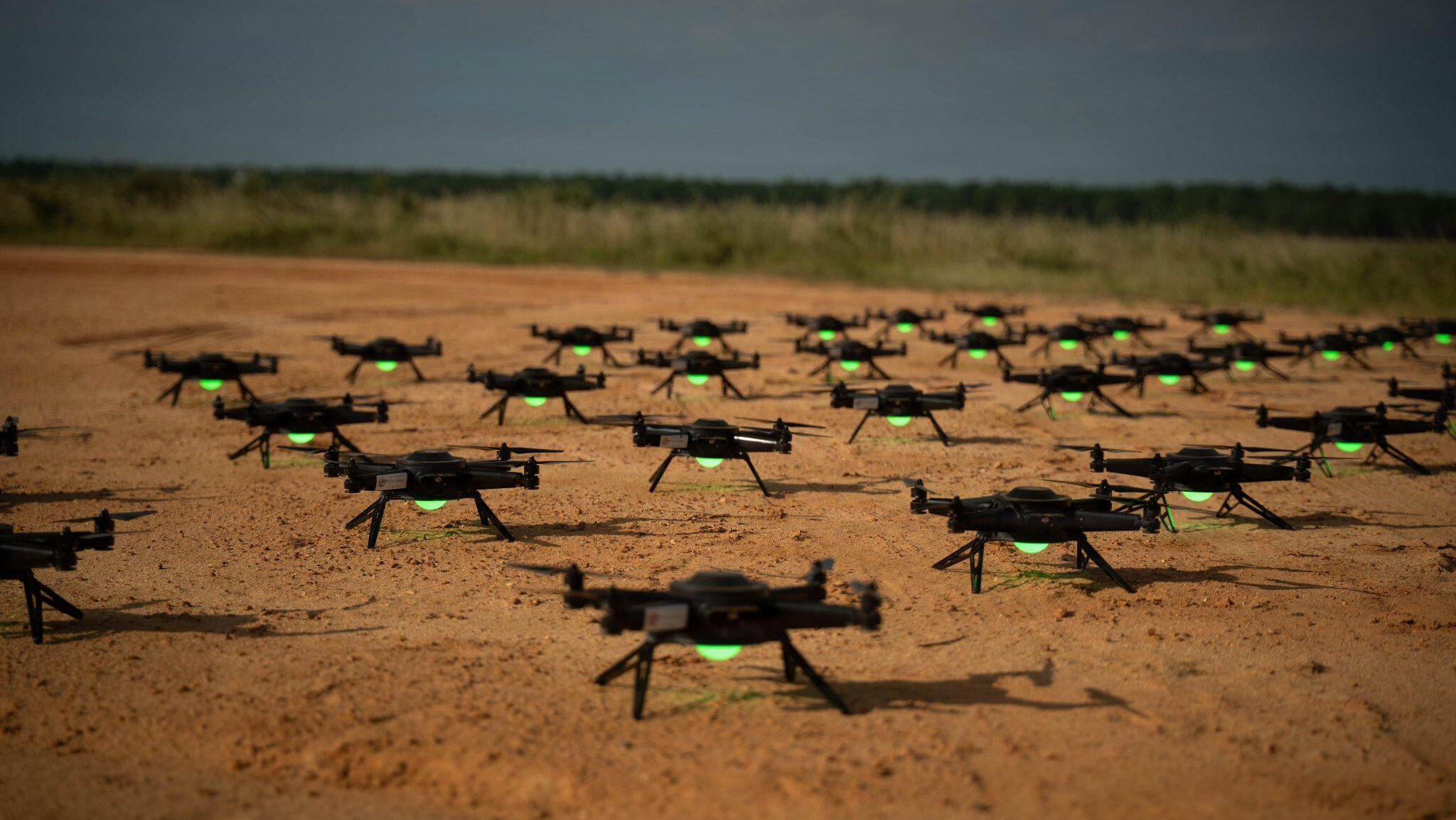
Drones synchronize before a swarm flight during the XVIII Airborne Corps’ Scarlet Dragon 26-3 at Fort Bragg, N.C., Sept. 16, 2026. (U.S. Army photo by Sgt. Noe Cork)
WASHINGTON — After a first year focused on adapting prototype technologies for military use, the Army’s FUZE innovation hub is setting sights on more complex acquisition challenges in fiscal 2027.
“A lot of what we’ll see in FY27 is leveraging mechanisms within the Army FUZE portfolio to address bigger Army acquisition problems, and I think again this demonstrates that the Army recognizes we need to diversify the defense industrial base,” FUZE Director Matt Willis told Breaking Defense in an interview last month.
Established in September 2025 by then-Army Secretary Dan Driscoll , FUZE is the service’s flagship venture-capital innovation engine designed to accelerate deployment of new technologies using pre-existing acquisition mechanisms. The office falls under the Army’s Pathway for Innovation and Technology (PIT) portfolio, which is facilitated by the Assistant Secretary of the Army for Acquisition, Logistics and Technology office.
According to Willis, the organization’s overall goal is to find new tech and deliver it to the warfighter faster. But FUZE’s first year also showed the challenge of making sure promising technologies don’t stop at the prototype stage where they can fall into the ever-dreadful tech valley of death .
That prompted t he organization to focus on getting Army acquisition officials involved earlier to create a clearer path toward procurement in FY27, he said.
“We need to incentivize innovation, and we need to invest in emerging or bleeding-edge capabilities to stay ahead of the rapidly evolving threat landscape … or how fast war is changing. We can see that in Ukraine and elsewhere,” Willis said.
Broadly, the PIT acts as a “plus one” structure in tandem with the Army’s six Portfolio Acquisition Executives (PAEs), bringing together multiple offices focused on fielding emerging capabilities. All organizations within the PIT are geared toward harnessing innovation and getting tech to the warfighter sooner, but FUZE specifically uses a venture-capital style model to do so.
FUZE is allocated $750 million in annual, “non-dilutive” research, development, test and evaluation (RDT&E) funds. The money is pulled together from four existing innovation efforts — xTech , Small Business Innovation Research/Small Business Technology Transfer (SBIR/STTR) Programs, the Technology Maturation Initiative and the Army Manufacturing Technology Program .
Before FUZE, the four funding streams were dispersed throughout the Army, making it difficult for companies to understand how to acquire funding for a promising capability, Willis said.
“The big piece and the power of the Army FUZE program is this sort of continuity, or seamlessness — or as seamless as we can make it in the government,” Willis said.
First, companies demonstrate their capabilities during Army xTech competitions and if they are placed among the top contenders they win a cash prize. Then, the SBIR program gives those vendors additional money to develop initial prototypes, while the TMI funding helps with “scaling that prototype,” Willis said. The final step is securing the ManTech investment, which vendors use to reduce manufacturing costs.
Once this process is complete, the Army’s network of venture and private capital partners “inject” funding into the companies so they can eventually scale their products and get on contract with the service through the PAEs, Willis explained.
“This has really been foundational in terms of bridging the gap between [the Army’s] mission needs and private sector venture capital,” he said. “Rather than expecting startups to just rely solely on government R&D funding, we’re actively signaling defense priorities to private markets.”
But FUZE is still refining the process to ensure vendors come out with a contract instead of a box full of prototypes, he said. To achieve this, the office wants to engage with PAEs from the outset to ensure there’s a clear pathway for tech to advance.
“I’d say we’re doubling down or tripling down on this sort of mandate that, for all of our FUZE investments — for all the project investments that we’re making — we’re building in this piece where we have buy-in from the warfighting unit,” Willis said.
Drones Dominate, EW Less So
FUZE held about 16 xTech competitions in fiscal 2026 focused primarily on drones , counter-drone systems , electronic warfare and energy resiliency. Willis said the office “exceeded” its goal of getting capabilities into the field within 60 to 75 days of posting a solicitation — a process that can traditionally take several months or even years.
In some cases, the organization was able to go from a solicitation to contracts in less than five days. All four technology areas have made it into the field in some capacity, meaning the tech was either delivered to a unit for permanent use or as part of a “soldier experimentation event,” Willis said.
Vendors were more receptive to some capabilities than others, with drone and counter-drone tech being the most popular among industry, Willis said.
“The commercial sector is already mass producing these platforms at high volume, and what we’re looking for in the Army is not starting with basic research and matriculating all the way up through a prototype,” he said. “Then a big piece for us from an adaptation perspective is — how can we make them military grade?”
By contrast, electronic warfare drew less industry interest because “it has the least overlap with commercial applications,” Willis said. As for energy resiliency capabilities, FUZE has provided some solutions to the field, but it’s still “definitely the latest push,” he added.
FUZE now wants to tackle more challenging acquisition problems, including low-cost interceptors . While these systems are not considered widely commercially available or affordable, they can be built using off-the-shelf, inexpensive components, Willis explained.
To kickstart the effort, FUZE launched the xTech Disrupt Fires competition to search for a second low-cost interceptor for the Army’s Indirect Fire Protection Capability (IFPC) Increment 2 program specifically designed to hit low-flying and supersonic targets.
During the annual AUSA conference this year, FUZE will award up to four companies a $1 million cash prize each for the program, “which is intended to jumpstart capability development for the second interceptor,” Willis said.
The prize pool is far smaller than the funding required to build the IFPC Increment 2 interceptors currently being developed. Lockheed Martin and a Boeing-Anduril team were recently selected to move onto the second phase of the initial competition, but Willis clarified that while FUZE tech could feed into the larger Army IFPC Inc 2 program, the two are separate for now.
“We’re executing this [FUZE] competition to see if we can incentivize or identify novel technology approaches to meet this mission. So this is in parallel,” he said. “If successful at the end, there will be an opportunity to integrate within the broader program of record, but the vendors that were selected for IFPC Inc 2 second interceptor are moving along their way.”
Apart from the low-cost interceptor competition, Willis said there are other larger acquisition issues FUZE plans to tackle in FY27, but declined to share them as he said they are “not fully baked.”
“I’d say we’ve moved away from the prior acquisition methodology of spending years, if not decades, developing some bespoke, eloquent solution that really didn’t work in the field to recognizing that we need to move quickly and take risks to make sure that our soldiers have access to the best technology,” Willis said.
Breaking Defense Video
New leaders, new drone command: What we expect from AUSA 2026
Unpacking Boeing’s F/A-XX win, plus a report from wartime Ukraine
How Hegseth envisions a new Autonomous Warfare Command
What Europe’s military air fleets will look like in 30 years
Riyadh gets closer to F-35s, Damascus presses sovereignty and an expert take on Iran
Drone-hunting on the border, plus turmoil at an Air Force think tank
The future of European airpower might be unmanned
The big news out of AFA, plus a guided tour of the show floor
Why the ‘right to repair’ matters to the Pentagon
What the Pentagon is testing along the US-Mexico border
2026年9月16日,在北卡罗来纳州布拉格堡举行的第十八空降军“猩红巨龙26-3”演习中,无人机在集群飞行前进行同步操作。(美国陆军照片,摄影:诺伊·科克中士)
华盛顿——在第一年专注于将原型技术应用于军事用途之后,陆军的 FUZE 创新中心正着眼于 2027 财年更复杂的采购挑战。
“我们在 2027 财年将看到的很多事情是利用陆军 FUZE 组合内的机制来解决更大的陆军采购问题,我认为这再次表明陆军认识到我们需要使国防工业基础多元化,”FUZE 主任 Matt Willis 上个月在接受 Breaking Defense 采访时表示。
FUZE由时任陆军部长丹·德里斯科尔于2025年9月创立,是陆军旗舰风险投资创新引擎,旨在利用现有采购机制加速新技术部署。该机构隶属于陆军创新与技术之路(PIT)项目组合,由陆军负责采购、后勤和技术的助理部长办公室负责协调。
威利斯表示,该组织的总体目标是寻找新技术并更快地将其交付给作战人员。但FUZE成立第一年也暴露出一项挑战:如何确保有前景的技术不会止步于原型阶段,从而避免陷入可怕的“技术死亡谷”。
他说,这促使该组织更早地让陆军采购官员参与进来,以便在 2027 财年为采购创造更清晰的路径。
威利斯说:“我们需要激励创新,需要投资于新兴或前沿技术,才能在快速演变的威胁形势……或者说战争快速变化的形势下保持领先地位。我们在乌克兰和其他地方都能看到这一点。”
总体而言,PIT 作为一个“+1”架构,与陆军的六个项目采购执行机构 (PAE) 协同运作,汇集了多个专注于部署新兴能力的部门。PIT 内的所有机构都致力于利用创新并尽快将技术交付给作战人员,但 FUZE 特别采用了一种风险投资式的模式来实现这一目标。
FUZE每年获得7.5亿美元的“非稀释性”研发、测试和评估(RDT&E)资金。这笔资金来自四个现有的创新项目——xTech、小型企业创新研究/小型企业技术转移(SBIR/STTR)计划、技术成熟度计划和陆军制造技术计划。
威利斯说,在 FUZE 之前,这四项资金来源分散在陆军各处,这使得各公司很难了解如何为一项有前途的能力获得资金。
威利斯说:“陆军 FUZE 计划的关键和力量在于这种连续性或无缝性——或者说,在政府层面尽可能做到无缝。”
首先,各公司在陆军xTech竞赛中展示自身能力,如果名列前茅,即可获得现金奖励。然后,SBIR计划会为这些供应商提供额外资金,用于开发初始原型,而TMI的资金则有助于“扩大原型规模”,威利斯说道。最后一步是获得ManTech投资,供应商可以利用这笔资金降低制造成本。
威利斯解释说,一旦这个过程完成,陆军的风险投资和私人资本合作伙伴网络就会向这些公司“注入”资金,以便它们最终能够扩大产品规模,并通过 PAE 与陆军签订合同。
他说:“这对于弥合陆军任务需求与私营部门风险投资之间的差距至关重要。我们不再指望初创企业仅仅依赖政府研发资金,而是积极向私营市场传递国防优先事项的信息。”
但他表示,FUZE仍在完善流程,以确保供应商最终提交的是合同,而不是一堆原型产品。为了实现这一目标,该机构希望从一开始就与PAE(产品评估机构)进行沟通,以确保技术发展有清晰的路径。
威利斯说:“我认为我们正在加倍甚至三倍地投入到这种使命中,那就是,对于我们所有的 FUZE 投资——对于我们正在进行的所有项目投资——我们都在构建一个能够获得作战部队支持的体系。”
无人机占据主导地位,电子战则相对不那么重要。
FUZE在2026财年举办了约16场xTech竞赛,主要集中在无人机、反无人机系统、电子战和能源韧性方面。威利斯表示,该办公室“超额完成”了其目标,即在发布招标后60至75天内将相关能力投入使用——而这一过程通常需要数月甚至数年。
在某些情况下,该组织能够在不到五天的时间内完成从招标到签订合同的整个过程。威利斯表示,所有四个技术领域都已在某种程度上投入实战,这意味着这些技术要么已交付给部队永久使用,要么作为“士兵试验活动”的一部分。
威利斯表示,供应商对某些技术的接受度高于其他技术,其中无人机和反无人机技术在业内最受欢迎。
他说:“商业领域已经在大规模生产这些平台,而我们在陆军寻求的不是从基础研究开始,一路研发到原型机。从适应性的角度来看,对我们来说的关键在于——如何才能使它们达到军用级别?”
相比之下,电子战并未引起业界的太多关注,因为“它与商业应用的重叠度最低”,威利斯说道。至于能源韧性能力,FUZE已经为该领域提供了一些解决方案,但这仍然“无疑是最新的发展方向”,他补充道。
FUZE公司现在希望解决更具挑战性的情报获取问题,包括低成本拦截器。威利斯解释说,虽然这些系统目前尚未被广泛商业化或价格昂贵,但它们可以使用现成的廉价组件来构建。
为了启动这项工作,FUZE 发起了 xTech Disrupt Fires 竞赛,旨在为陆军的间接火力防护能力 (IFPC) 增量 2 项目寻找第二款低成本拦截器,专门用于打击低空飞行和超音速目标。
威利斯表示,在今年的美国陆军协会(AUSA)年会上,FUZE 将向至多四家公司颁发 100 万美元的现金奖励,用于支持该项目,“旨在启动第二代拦截器的能力开发”。
奖金池远小于目前正在研发的IFPC第二阶段拦截器所需的资金。洛克希德·马丁公司和波音-安杜里尔联合团队最近入选第一阶段竞赛的第二阶段,但威利斯澄清说,虽然FUZE的技术可以应用于规模更大的陆军IFPC第二阶段项目,但目前这两个项目是独立的。
“我们正在开展这项[FUZE]竞赛,看看能否激励或找到能够完成这项任务的新技术方案。所以这项工作是并行进行的,”他说道。“如果最终成功,将有机会将其整合到更广泛的正式项目中,但入选IFPC Inc 2第二拦截器的供应商正在按计划推进。”
除了低成本拦截器竞争之外,威利斯表示,FUZE 计划在 2027 财年解决其他更大的收购问题,但他拒绝透露,因为他说这些问题“还没有完全定型”。
威利斯说:“我认为我们已经摒弃了以往那种花费数年甚至数十年时间开发一些定制的、精妙的解决方案,而这些解决方案在实际应用中却并不奏效的采购方法,转而认识到我们需要快速行动并承担风险,以确保我们的士兵能够获得最好的技术。”
突破性防御视频
新领导人,新无人机指挥部:我们对 AUSA 2026 的期待
深入剖析波音F/A-XX的中标,以及来自战时乌克兰的报道
赫格塞斯设想的新型自主作战指挥部
30年后欧洲军用空军机队会是什么样子
利雅得距离F-35战机更近一步,大马士革强调主权,以及专家对伊朗的看法
边境无人机猎杀行动,以及空军智库的动荡
欧洲空军的未来或许在于无人化。
AFA展会最新动态,以及展会现场导览。
为什么“维修权”对五角大楼如此重要
五角大楼正在美墨边境测试什么?