The Story Of The Jet That Would Have Delivered South Africa’s Nuclear Bomb讲述那架本应运送南非核弹的喷气式飞机的故事
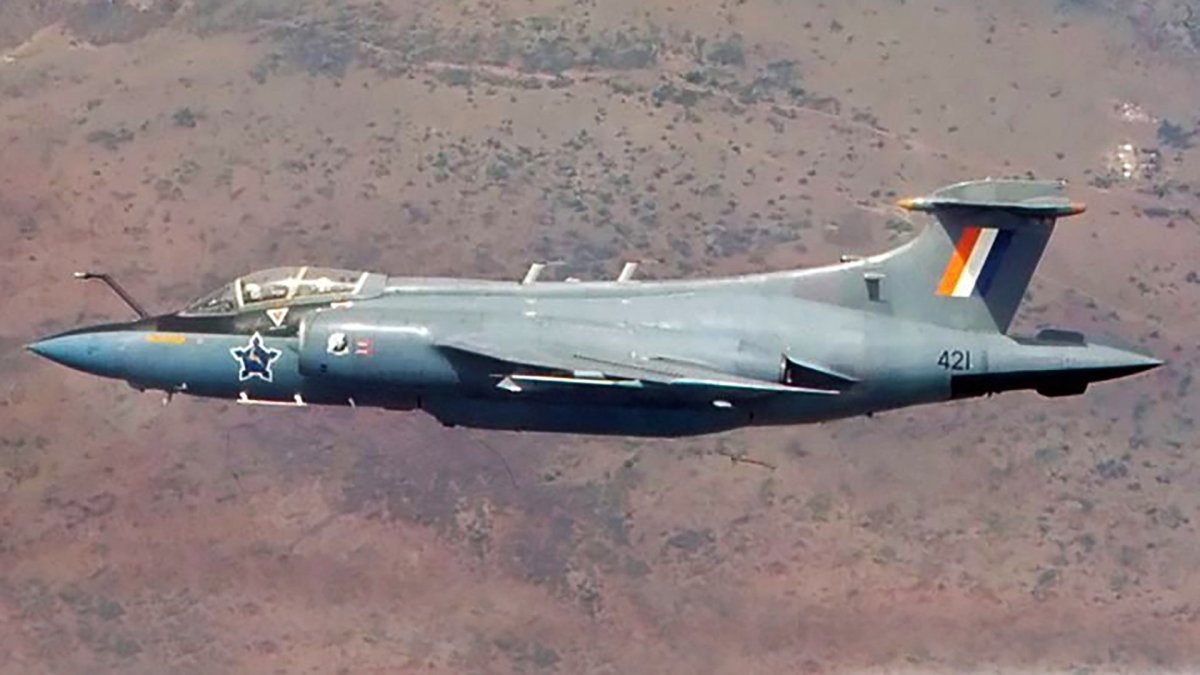
The British-made Buccaneer strike aircraft was adapted to carry apartheid-era South Africa’s guided nuclear bomb.
新闻视频
Updated Jan 18, 2021 5:07 PM EST
South Africa, an international pariah for much of the Cold War due to its apartheid policy, remains the only country to have developed nuclear weapons and then voluntarily given them up. Before it did so, the main focus of these developments was an air-launched weapon that was intended to be delivered by a Hawker Siddeley Buccaneer strike aircraft. This combination could potentially have struck targets in other countries in sub-Saharan Africa, as part of South Africa’s long-running campaign against regional rebel groups, or even hostile revolutionary governments.
With plenty of uranium available, South Africa had already become interested in nuclear energy as a source of electrical power by the early 1970s. It sought to enrich uranium for its own use and for export and, at the same time, the government began to examine the military potential of these developments. In the same period, the country was becoming increasingly entrenched in the Border War in what was then known as South West Africa, which remained under South African control until 1990, at which point it became the independent country of Namibia. As a sideshow to that conflict, the South African Defense Force (SADF) also became involved in fighting in Angola to the north, where it would meet well-equipped Cuban and other Soviet-backed forces.
A South African Air Force Buccaneer S50 at Ysterplaat in 1970. At least one of these aircraft was modified to carry a nuclear weapon., Col André Kritzinger/Wikimedia Commons
By 1974, the South African regime had decided to develop a nuclear weapon that could be used, if required, in these escalating conflicts. Not surprisingly, the efforts to build these weapons of mass destruction were conducted in strict secrecy, but after weapons inspectors were invited into the country in 1993, many more details started to become available. There remain still, however, some significant gaps in our knowledge, including the possible test of a South African nuclear device in 1979 — the so-called Vela incident — when a U.S. reconnaissance satellite detected a flash over the South Atlantic, suggestive of an atmospheric nuclear explosion.
What is known is that by 1977, a single gun-type nuclear device — a fission-based weapon like the U.S. Little Boy bomb dropped over Hiroshima during World War II — was nearly ready to be tested, when the Soviet Union and the United States uncovered the plans. At this point, secrecy around the program increased further and it was switched from scientific to military control, led by the arms contractor Kentron, which had established a new facility for the purpose by 1980.
Ultimately, South Africa succeeded in producing five complete nuclear devices that could have been deployed operationally, plus a test device. The first true operational weapon — initially codenamed Hobo and later Cabot — was a six-kiloton device made ready in 1982. One more device was left unfinished by 1989 when it was decided to suspend work on the program. These were all of the gun type, although in 1985, work was also launched on a more advanced uranium implosion device, similar in broad strokes to the U.S. Fat Man bomb also dropped on Japan during World War II, without producing any weapons.
South Africa also began planning for how to deliver its warheads if the need arose. One option was to place the device on a medium-range ballistic missile (MRBM), based on the Israeli Jericho 2 missile. However, the device was always designed to be interchangeable for different delivery systems and was small enough to be accommodated in an air-launched glide bomb. It seems the preferred aircraft to carry this was the British-built Hawker Siddeley Buccaneer , originally developed as a naval strike aircraft that served aboard British aircraft carriers . The United Kingdom had transferred these aircraft to South Africa from 1965, despite having just introduced an arms embargo because of the country’s apartheid policy, one year earlier.
The Raptor I glide bomb served as the basis for South Africa’s air-launched nuclear weapon., Denel Dynamics
South Africa ordered 16 of the Buccaneer S50 version, a land-based strike variant tailored specifically for the country’s requirements, with the powered folding-wing system found on the British Royal Navy jets deleted and with additional provisions for flying in a ‘hot and high’ environment. These included a pair of retractable Bristol Siddeley BS.605 rocket engines in the rear fuselage to boost takeoff performance, although these were rarely used.
A Bristol Siddeley BS.605 rocket engine on display at the RAF Museum Cosford., Nimbus227/Wikipedia Commons
To get around the embargo, the United Kingdom had agreed to deliver the Buccaneers on the understanding they would be used for purely defensive missions, such as protecting the shipping lanes around the Cape. In reality, not only would these aircraft see extensive combat in Angola, but they would also be earmarked to carry South Africa’s nuclear weapons. British authorities did subsequently cancel South African options to buy another 14 Buccaneers.
SAAF Buccaneers lined up. , Uncredited
Buccaneers in formation., SAAF
After crew training in the United Kingdom, the South African Air Force (SAAF) Buccaneers were delivered between November 1965 and October 1966. Attrition was notably high, with one of the jets ditching in the sea on its delivery flight. By 1979, only six of the 16 Buccaneers reportedly remained in service. Ultimately, no fewer than 13 aircraft were involved in serious incidents during the type’s career, with 10 aircrews losing their lives.
Over Angola, the SAAF Buccaneers were especially active from 1978, including flying bombing raids during that year’s Battle of Cassinga fought against the South West Africa People’s Organization (SWAPO). SWAPO had been using bases in Angola to support its campaign for independence in what would later become Namibia.
Other raids were flown against SWAPO training camps in Zambia, with the jets employing conventional bombs, unguided rockets, and French-made AS30 guided missiles, the latter of which had a range of up to 7.5 miles. The jets were also upgraded throughout their service, receiving a reconnaissance pod, threat warning receivers, and countermeasures dispensers.
South African troops on patrol near the Angola border in the early 1980s., Smikect/Wikimedia Commons
Adapting the indigenous nuclear weapon for air-launch by the Buccaneer was to involve a version of the locally developed H-2 television-guided glide bomb, subsequently also known as the Raptor I. The basic H-2 had a range of up to 37 miles and after its TV seeker had locked onto a target, control of the weapon could also be handed over to another aircraft within a radius of up to 125 miles, via a data-link pod. Opting for a glide bomb may also have had the advantage of reducing the need for nuclear delivery programming aboard the aircraft and providing the aircrew with a more straightforward mission profile, without the need for specific bomb delivery techniques.
The Raptor I-based option had the benefit of being able to be launched from a Buccaneer outside the range of the Soviet-made, Cuban-operated air defense systems that were a serious threat to SAAF aircraft operating over Angola. The Buccaneer could also extend its range through aerial refueling, in conjunction with the SAAF’s Boeing 707 tankers, putting many more targets within reach. In a demonstration of the Buccaneer’s endurance, one of those jets had remained airborne for 9 hours and 5 minutes in December 1966, with the aid of two inflight refuelings.
A South African Air Force 707 demonstrates aerial refueling with a pair of Cheetah fighter jets. , Col André Kritzinger/Wikimedia Commons
The nuclear-tipped glide bomb based on the H-2 received the codename Hamerkop , after a bird native to parts of southern Africa, the appearance of which, according to myth, was a harbinger of death for the people below.
This delivery system was more within the technical reach of South Africa than an MRBM and it appears that this view that the Hamerkop was more likely to be a success led to the complete termination of the development of such a missile. In a bizarre addendum to the latter, the prototype transporter developed for the MRBM, known as Moerse Lorrie Zonder Naam , or ‘huge lorry without a name’ was repurposed as a fire truck . The same design also served as the basis for an ammunition resupply vehicle for the G6 self-propelled howitzer .
The switch from civilian to military leadership from 1977 had resulted in significant disruption for the South African nuclear weapons program, but there were other, technical, hitches, too. For example, no devices were produced between 1982 and 1986, partly due to concerns with the safety of an air-launched weapon. Tests had shown that a gun-type device, when dropped accidentally or jettisoned from the aircraft carrying it if it suffered a malfunction, could detonate due to the impact alone, without being electrically armed. A significant redesign was required during this period to prevent this from happening.
As far as is known, only a single Buccaneer was ever modified for the carriage of the Hamerkop, probably between 1987 and 1989, coinciding with the period in which most of the usable weapons were completed. This aircraft is serial number 422, today preserved at the SAAF Museum in Swartkop, near Pretoria. While five Hamerkops were built (corresponding with the five functional nuclear devices), there is no record of any test flights or launches of unarmed weapons from Buccaneers or other aircraft. The weapon reportedly had a 20-kiloton yield.
Hawker Siddeley Buccaneer S50 serial number 422 preserved in the SAAF Museum at Swartkop., NJR ZA/Wikimedia Commons
The final death knell for South Africa’s nuclear weapons program was the presidency of F. W. de Klerk , who came to power in 1989, deciding to do away with it. There was apparently no significant opposition from the military, whose experience in years cross-border campaigns had not revealed any requirement for a weapon of this type. Ultimately, the actual utility of a nuclear weapon in the conflict in Angola was always negligible, and its use would represent an unprecedented escalation while further ostracizing the South African regime. Moreover, the end of apartheid now seemed to be in sight, and possession of weapons of mass destruction would do nothing to enhance South Africa’s international position then, or in the future. While a veil of secrecy remained over the program, de Klerk oversaw the removal of enriched uranium from the weapons that had been completed.
In 1991, South Africa finally signed the 1968 Non-Proliferation Treaty and, two years later, de Klerk acknowledged the existence of the nuclear weapons program. Survivors of the SAAF Buccaneer fleet were withdrawn in the same year, by which time only five examples were reportedly still airworthy. Some lingered on for some years longer in private hands, including providing flights to thrill-seekers with the Thunder City company in Cape Town.
That was not the end of the line for the glide bomb, however. In 1998, the conventionally armed H-2 was declassified and began to be marketed as the Raptor I. Further development led to the improved Raptor II, which added different guidance options, and was exported to Algeria and Pakistan, followed by the MUlti-Purpose Stand-Off Weapon (MUPSOW), a jet-powered cruise missile.
The Raptor II glide bomb, derived from the H-2., Denel Dynamics
South Africa may also have assisted Pakistan in developing its own Ra’ad cruise missile — also nuclear-armed. As Dr. Jeffrey Lewis, founding publisher of Arms Control Wonk.com and an expert on missiles and nuclear weapons at the Middlebury Institute of International Studies at Monterey points out, it is also conceivable that South Africa may have only worked on a conventional version of the Ra’ad. Either way, if true, it brings the story of South Africa’s quest to build an air-launched nuclear weapon full circle.
Today, very little of the hardware related to the South African nuclear weapons program remains, although Buccaneer 442 at Swartkop stands testament to what might have been, but thankfully wasn’t.
Contact the author: thomas@thedrive.com
Comments couldn’t be loaded. Please refresh the page.
更新于美国东部时间2021年1月18日下午5:07。
南非因其种族隔离政策,在冷战的大部分时间里都处于国际社会的孤立地位,但它仍然是唯一一个研发出核武器后又自愿放弃核武器的国家。在此之前,南非研发核武器的主要目标是研制一种空射核武器,计划由霍克·西德利“海盗”攻击机投放。这种武器组合原本可以打击撒哈拉以南非洲其他国家的目标,作为南非长期打击地区叛乱组织甚至敌对革命政府行动的一部分。
由于铀资源丰富,南非早在20世纪70年代初就对核能作为电力来源产生了浓厚的兴趣。南非寻求浓缩铀以供自身使用和出口,与此同时,政府也开始研究这些技术在军事方面的潜力。在同一时期,南非日益深陷于当时被称为西南非洲的边境战争之中。该地区一直处于南非的控制之下,直到1990年才脱离南非,成为独立的纳米比亚国家。作为这场冲突的副线,南非国防军(SADF)还卷入了北部安哥拉的战斗,在那里他们与装备精良的古巴军队和其他苏联支持的军队交战。
1970年,一架南非空军的S50“海盗”攻击机停在伊斯特普拉特机场。至少有一架这样的飞机被改装用于携带核武器。(图片来源:安德烈·克里茨格上校/维基共享资源)
到1974年,南非政权决定研制一种核武器,以便在不断升级的冲突中必要时使用。不出所料,这些大规模杀伤性武器的研制工作是在严格保密的情况下进行的。但在1993年武器核查人员受邀进入南非后,更多细节开始浮出水面。然而,我们仍然对南非的核试验存在一些重大认知空白,例如1979年南非可能进行的核试验——即所谓的“维拉号”事件。当时,一颗美国侦察卫星在南大西洋上空探测到一道闪光,疑似大气层核爆炸。
已知的是,到1977年,一枚单管枪式核装置——一种类似于二战期间美国投掷在广岛的“小男孩”原子弹的裂变武器——已接近完成测试,但苏联和美国却发现了相关计划。此后,该计划的保密程度进一步提高,并由军火承包商肯特龙公司主导,从科研领域转为军事领域。肯特龙公司于1980年为此建立了一座新的设施。
最终,南非成功制造了五枚可投入实战的完整核装置,外加一枚试验装置。第一枚真正意义上的实战武器——最初代号为“流浪汉”(Hobo),后改为“卡伯特”(Cabot)——是一枚6千吨级的装置,于1982年研制完成。到1989年,由于项目暂停,还有一枚装置尚未完成。这些装置均为枪式核装置。尽管如此,在1985年,南非也启动了一种更先进的铀内爆装置的研发工作,该装置与二战期间投掷在日本的美国“胖子”原子弹在结构上相似,但最终并未研制出任何武器。
南非也开始着手规划在必要时如何投放核弹头。一种方案是将该装置安装在以以色列“杰里科2”导弹为基础的中程弹道导弹(MRBM)上。然而,该装置的设计初衷就是为了能够适配不同的投放系统,而且体积足够小,可以装入空射滑翔炸弹。似乎最理想的运载飞机是英国制造的霍克·西德利“海盗”攻击机,该机最初是作为英国航母上的舰载攻击机而开发的。尽管英国在一年前刚刚因南非的种族隔离政策而对其实施了武器禁运,但英国还是从1965年开始向南非转让了这些飞机。
猛禽I型滑翔炸弹是南非空射核武器的基础。——丹尼尔动力公司
南非订购了16架“海盗”S50型攻击机,这是一款专为南非需求量身定制的陆基攻击型,取消了英国皇家海军喷气式飞机上的动力折叠翼系统,并增加了在“高温高海拔”环境下飞行所需的额外装置。这些装置包括在机身后部安装两台可伸缩的布里斯托尔·西德利BS.605火箭发动机,以提升起飞性能,尽管这些发动机很少使用。
一台布里斯托尔·西德利BS.605火箭发动机,现陈列于英国皇家空军科斯福德博物馆。(图片来源:Nimbus227/维基共享资源)
为了规避禁运,英国同意交付“海盗”攻击机,前提是这些飞机仅用于防御任务,例如保护好望角附近的航道。但实际上,这些飞机不仅会在安哥拉经历大规模战斗,还会被指定用于运载南非的核武器。英国当局随后取消了南非购买另外14架“海盗”攻击机的选择权。
南非空军海盗式攻击机列队完毕。(未署名)
海盗队列队,南非空军
在英国完成机组人员训练后,南非空军(SAAF)的“海盗”攻击机于1965年11月至1966年10月间交付。该机型损耗率极高,其中一架在交付飞行途中迫降海面。据报道,到1979年,16架“海盗”攻击机中仅剩6架仍在服役。最终,该机型在其服役期间至少有13架飞机卷入严重事故,导致10名机组人员丧生。
自1978年起,南非空军的“海盗”攻击机在安哥拉上空尤为活跃,包括在当年与西南非洲人民组织(SWAPO)的卡辛加战役中执行轰炸任务。西南非洲人民组织曾利用其在安哥拉的基地支持其争取独立(即后来的纳米比亚)的运动。
其他空袭行动的目标包括赞比亚境内的西南非洲人民组织(SWAPO)训练营。这些战机使用了常规炸弹、非制导火箭弹以及法国制造的AS-30制导导弹,后者射程可达7.5英里。这些战机在服役期间也进行了升级,加装了侦察吊舱、威胁告警接收器和对抗措施投放器。
20世纪80年代初,南非军队在安哥拉边境附近巡逻。(图片来源:Smikect/Wikimedia Commons)
将国产核武器改装为“海盗”攻击机空投武器的方案,采用了国产H-2电视制导滑翔炸弹的改进型,该炸弹后来也被称为“猛禽I”。基本的H-2炸弹射程可达37英里,其电视导引头锁定目标后,可通过数据链吊舱将武器控制权移交给125英里半径内的另一架飞机。选择滑翔炸弹的另一个优势在于,它减少了机载核武器投放程序的编写需求,并为机组人员提供了更简单的任务流程,无需掌握特定的投弹技术。
基于猛禽I型发动机的方案优势在于,它可以从“海盗”攻击机上起飞,从而避开苏联制造、古巴操作的防空系统。这些防空系统对在安哥拉上空作战的南非空军飞机构成了严重威胁。“海盗”攻击机还可以通过空中加油来扩展航程,与南非空军的波音707加油机配合使用,从而打击更多目标。为了展示“海盗”攻击机的续航能力,1966年12月,一架“海盗”攻击机在两次空中加油的帮助下,连续飞行了9小时5分钟。
一架南非空军707飞机正在与两架猎豹战斗机进行空中加油演示。图片来源:安德烈·克里茨格上校/维基共享资源
这款基于 H-2 的核弹头滑翔炸弹获得了“锤头鹳”的代号,这个代号来源于非洲南部部分地区的一种鸟类,根据神话传说,这种鸟的出现预示着下方人们的死亡。
与中程弹道导弹相比,这种运载系统更符合南非的技术能力。似乎正是由于认为“锤头”导弹更有可能成功,才导致了中程弹道导弹研发的彻底终止。更令人匪夷所思的是,为中程弹道导弹开发的原型运输车——名为“无名巨型卡车”(Moerse Lorrie Zonder Naam)——被改装成了消防车。同样的设计也被用于G6自行榴弹炮的弹药补给车。
1977年南非核武器计划由文职领导层向军方领导层过渡,给该计划带来了重大冲击,但除此之外,还存在其他技术上的难题。例如,1982年至1986年间,南非没有生产任何核武器装置,部分原因是出于对空射武器安全性的担忧。测试表明,枪式核武器装置如果意外坠落或因故障从运载飞机上抛射出去,即使没有进行电气引爆,也可能仅因撞击而引爆。在此期间,南非核武器计划进行了重大重新设计,以防止这种情况发生。
据目前所知,仅有一架“海盗”攻击机被改装用于携带“锤头”核弹,改装时间可能在1987年至1989年间,与大部分可用核弹的研制完成时间相吻合。这架飞机的序列号为422,现保存在比勒陀利亚附近斯瓦特科普的南非空军博物馆。虽然共制造了五枚“锤头”核弹(与五枚可用的核装置相对应),但没有任何记录表明曾使用“海盗”攻击机或其他飞机进行过任何试飞或发射未装药核弹头的记录。据报道,该核弹的当量为20千吨。
Hawker Siddeley Buccaneer S50 序列号 422 保存在斯沃特科普的 SAAF 博物馆中。NJR ZA/Wikimedia Commons
南非核武器计划的最终终结,是弗雷德里克·威廉·德克勒克总统上任之时。他于1989年上台,决定废除该计划。军方显然没有提出任何实质性的反对意见,因为多年来的跨境作战经验表明,他们并不需要这类武器。最终,核武器在安哥拉冲突中的实际效用微乎其微,而使用核武器将导致前所未有的冲突升级,并进一步孤立南非政权。此外,种族隔离制度的终结似乎已近在眼前,拥有大规模杀伤性武器对提升南非当时的国际地位,乃至未来,都毫无益处。尽管该计划一直笼罩在秘密之中,德克勒克还是监督了已完成核武器中浓缩铀的移除工作。
1991年,南非终于签署了1968年《不扩散核武器条约》。两年后,德克勒克承认了核武器计划的存在。同年,南非空军的“海盗”攻击机机队全部退役,据报道,当时仅剩五架仍可飞行。部分飞机在私人手中继续服役数年,其中一架被开普敦的“雷霆城”公司用于为寻求刺激的游客提供飞行服务。
然而,滑翔炸弹的故事并未就此结束。1998年,常规武装的H-2型滑翔炸弹被解密,并开始以“猛禽I型”(Raptor I)的名称进行市场推广。进一步的研发催生了改进型的“猛禽II型”(Raptor II),该型增加了不同的制导选项,并出口到阿尔及利亚和巴基斯坦。随后,又出现了多用途防区外武器(MUPSOW),一种喷气动力巡航导弹。
Raptor II 滑翔炸弹,源自 H-2。,Denel Dynamics
南非可能也曾协助巴基斯坦研发其“雷霆”(Ra'ad)巡航导弹——该导弹同样携带核弹头。正如Arms Control Wonk.com网站的创始出版人、蒙特雷米德尔伯里国际研究学院导弹和核武器专家杰弗里·刘易斯博士所指出的,南非也可能只是参与研发了“雷霆”导弹的常规版本。无论如何,如果属实,这将使南非研制空射核武器的历程画上一个完整的句号。
如今,与南非核武器计划相关的硬件所剩无几,但斯瓦特科普的 Buccaneer 442 仍然见证着曾经可能发生但幸运的是最终没有发生的事情。
联系作者:thomas@thedrive.com
评论加载失败,请刷新页面。