The Mysterious Case Of The F-117 Nighthawk’s Flip-Down Radar LocatorsF-117“夜鹰”战斗机翻转式雷达定位器的神秘案例
The F-117 had extendable antenna farms that could detect and possibly locate enemy radar emitters, or did it?
Updated Jul 3, 2020 4:21 AM EDT
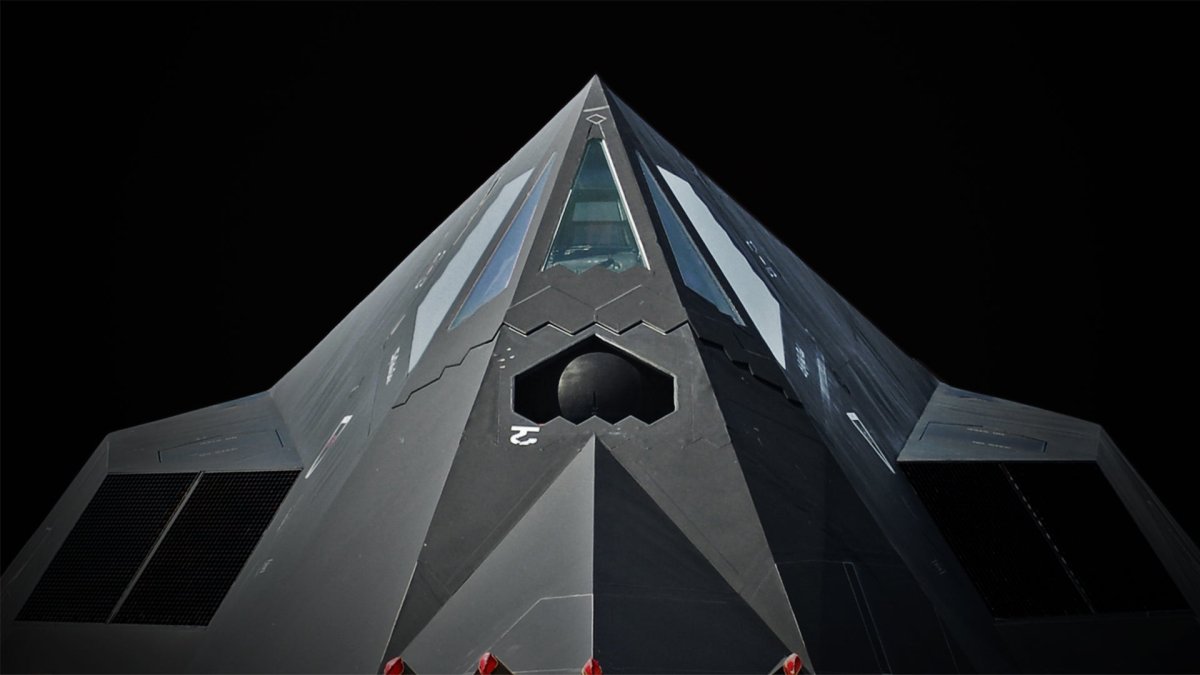
The F-117 continues to be one of the most intriguing aircraft ever built, even nearly a decade after it was retired, and close to 30 years after it was originally unveiled to the public. From the Nighthawk’s “cloaking device ” to its “ toxic death” paint job , it seem like some of the most interesting aspects of the F-117’s story are the small bits that have largely gone unreported. Maybe one of the most obscure and enigmatic details of the “Black Jet” is an elusive component called the Radar Locating System (RLS). For an aircraft that survives on its stealthy shape and coatings, these flip-down antenna arrays seem to deviate drastically from the F-117’s modus operandi. But then again, the impetus for their existence may make more sense than not—that is if they really existed at all.
The F-117’s Radar Locating System consists (as far as we know) of a pair of small planar antenna farms located under the aircraft’s wings, about ten feet from the wing roots, near their leading edges. The idea behind the system seems to have been that the F-117 pilot, who would normally retract all the jet’s antennas when moving into hostile territory to minimize its radar reflectivity, could activate the system and its antennas would pop down into the airstream. Once deployed, they would work as a radar homing and warning receiver (RHWR), not only notifying the pilot of the an enemy radar’s presence and type, but also its direction and maybe even its general location.
Based on some accounts, the RLS seems to have been more about using the F-117 for the destruction of enemy air defenses (DEAD) role than just avoiding enemy emitters, and was possibly part of a program that aimed to see the F-117 dynamically go after radar and SAM sites as a secondary mission set. Based on the information available, it may have also had a recording function and could have given the aircraft a secondary signals intelligence collection capability as well.
The only picture of the RLS available., James Goodall
The picture above is credited to James Goodall—if you don’t own James’s books, make sure to buy them , and a new one on nuclear fast attack subs is coming out this summer. It is a rare photo of this elusive system. According to one source, the array appears to be set up for spiral omni-directional electronic support measures (ESM) antennas, roughly 50mm in diameter, which are typical for 0.2-18GHZ surveillance coverage, and they can be specifically tuned to different bands. Because of their wide spacing on each side of the jet’s wings, the two sensor blocks/arrays coupled with the forward motion of the jet would provide direction finding ability. In other words, at least the threat emitter’s bearing could be identified, and possibly its range. This would be especially useful for finding and attacking newer road-mobile SAM systems like the S-300 and SA-11 that were emerging at the same time the F-117 was operating under high secrecy in the Nevada desert .
Today some of the most powerful capabilities that a combat aircraft possesses, especially the stealth kind like the F-22 and F-35, are their abilities to detect, classify and geolocate threat emitters and other components of an enemy’s integrated air defense systems (IADS) . This is done via antennas placed all around the aircraft, under its stealthy skin. These conformal arrays are tied to high-speed computers that use interferometry, a large threat library, and other methods to give pilots—and even other aircraft connected via data-link within the battlespace—a real time tactical “picture” of the electronic order of battle around them. RLS seems like a very early and somewhat poorly conceived attempt to give the F-117 a fraction of this capability. Because conformal arrays and their composite coverings were not available at the time, the flip-down method was likely used.
The likely problem with the system was that it drastically increased the F-117’s radar cross section when in use, as its flip-down antennas compromised the jet’s smooth ventral surface. This is an especially bad attribute when it comes to maintaining a very low radar cross section for the critical forward hemisphere of the aircraft. The likely result was the F-117’s radar signature bloomed drastically when the RLS was activated. As such, the system would not only blow the Nighthawk’s cover, but it would also turn it into a target. Not just that, but it would have only offered a “snapshot” of the electronic threat environment around the F-117 at any given time. That’s because the system would need to be retracted quickly, or it would turn the jet into a sitting duck while operating in enemy airspace.
By most accounts, it seems that the system was either just part of a test series, or was only used for a very limited amount of time operationally, and how many jets it was installed on remains an unknown—that is if it ever existed at all.
Some veteran F-117 maintainers seem to remember the quirky RLS trap doors pretty well. They even have mentioned that they were known to sag, which would not only hurt the jet’s stealth capabilities, but on dark nights that often were prime operations time for F-117 missions, partially opened RLS doors could be a hazard for maintainers foreheads.
Not just that, but the RLS is prominently featured in the F-117’s “Dash One” operating manual. It is not only mentioned, and its abandoned control panel identified, but its location is also shown clearly in a diagram of the jet. You can see the mentions below, and the entire manual is available online here .
Some of the snippets from the F-117’s Dash-1 that talk about the RLS. , F-117 Dash Manual
It has been noted that by 2006, the system was not listed in official hazard and crash responders documents which are posted online here . The diagram showing the RLS doors are still there, but it does not identify it as being something that is accessible like the rest of the aircraft’s retractable antenna, so it seems as if the doors were permanently sealed or filled-in at some point in time. This could have occurred during a depot overhaul or upgrade.
While we have a picture, written and first hand accounts of the Radar Locator System, it seems that its existence is still highly doubted by some—including the man that largely oversaw the development of the jet—senior Skunk Works engineer and F-117 program manager Alan Brown.
I chatted at length with Mr. Brown about the F-117 and this obscure, and let’s face it, mysterious feature. He was as puzzled as I was. After sending him the picture of it, he was kind enough to respond with his conclusions:
“This picture doesn’t look like anything that was ever put on a F-117A airplane, and as such I am inclined to discount the story entirely. The only possibility to my mind is that the USAF made the modification themselves without Lockheed’s knowledge, but that itself is impossible for me to believe, knowing how well we followed up with the airplane in the field. Lockheed Skunk Works always had a cradle-to-grave philosophy in terms of follow-up with its products in service.”
Mr. Brown was even nice enough to contact his successor as F-117 program manager, Sherm Mullin, to see what his thoughts were about the RLS enigma. His reply was just about the same as Mr. Brown’s, stating that “it was never put on the F-117, period.” Although he did mention that it could have been a concept from a study that occurred from 1984 to 1985 that apparently went off the rails conceptually and was disbanded with prejudice as a result.
During roughly that same time period it is known, although not well documented publicly, that the F-117 was tested with some fairly elaborate modifications. This supposedly included a handful of sensor systems in addition to the jet’s stock Infrared Acquisition And Designation System (IRADS). We know that a passive electronically scanned array (PESA) radar was flown on one F-117 in a specially-built radome fitted on the Nighthawk’s iconic wedge-like nose. Maybe RLS was one of the other mods that was deemed successful, and was accommodated for in some F-117s built, but never fully installed.
Still, you would think that even something as useless as an empty-flip down antenna array would be well known by the F-117s top engineers and program managers.
So there you have it, the obscure mystery of the F-117’s funky little flip-down Radar Locator System. For a jet that was made famous for its work during Desert Storm , it is really amazing that we are still finding new peculiarities of its design and genesis to discuss. Then again, the jet was so exotic for its time and its deep classification added massively to its murky lore—not to mention it has off-the-charts techno-sinister looks—that really it is mystery personified. The fact that it is still flying, and we are still wondering as to its applications , even after it left front line service almost a decade ago, goes to show you that the F-117 is a mystery machine at heart that just won’t die.
Contact the author: tyler@thedrive.com
Comments couldn’t be loaded. Please refresh the page.
更新于美国东部时间2020年7月3日凌晨4:21
即使在退役近十年、首次公开亮相近三十年后,F-117 仍然是有史以来最引人入胜的飞机之一。从“夜鹰”的“隐形装置”到“毒死”涂装,F-117 故事中最精彩的部分似乎恰恰是那些鲜为人知的细节。或许,这款“黑色战机”最晦涩难懂的细节之一,就是一个名为雷达定位系统(RLS)的神秘部件。对于一架依靠隐身外形和涂层来保持隐蔽的飞机来说,这些可翻转的天线阵列似乎与 F-117 的作战模式大相径庭。但转念一想,它们的存在或许并非毫无道理——前提是它们真的存在。
据我们所知,F-117的雷达定位系统由两组小型平面天线组成,位于机翼下方,距翼根约10英尺(约3米),靠近机翼前缘。该系统的设计理念似乎是,F-117飞行员在进入敌方领空时通常会收起所有天线以降低雷达反射率,而激活该系统后,天线会立即展开并进入气流中。展开后,这些天线将作为雷达归航告警接收器(RHWR)工作,不仅能告知飞行员敌方雷达的存在和类型,还能提供其方向,甚至可能包括大致位置。
根据一些资料,RLS系统似乎更侧重于利用F-117执行摧毁敌方防空系统(DEAD)的任务,而不仅仅是躲避敌方信号源。它可能是F-117动态攻击雷达和地空导弹阵地这一辅助任务计划的一部分。根据现有信息,RLS系统可能还具备记录功能,并可能赋予飞机辅助信号情报收集能力。
这是唯一一张罗伯特·路易斯·史蒂文斯(RLS)的照片。——詹姆斯·古德尔
上图由詹姆斯·古德尔(James Goodall)拍摄——如果您还没有詹姆斯的著作,务必购买,他的一本关于核动力快速攻击潜艇的新书将于今年夏天出版。这是一张难得一见的神秘系统照片。据消息人士透露,该阵列似乎是为直径约50毫米的螺旋式全向电子支援措施(ESM)天线而设置的,这种天线通常用于0.2-18GHz的监视覆盖范围,并且可以针对不同的频段进行专门调谐。由于这两个传感器模块/阵列在喷气式飞机机翼两侧间距较大,它们与飞机的前进运动相结合,能够提供测向能力。换句话说,至少可以确定威胁发射源的方位,甚至可能确定其距离。这对于发现和攻击新型公路机动式防空导弹系统(例如S-300和SA-11)尤其有用,这些系统与F-117在内华达沙漠进行高度保密演习的同时,也正在涌现。
如今,战斗机,尤其是像F-22和F-35这样的隐形战机,最强大的能力之一就是探测、识别和定位敌方综合防空系统(IADS)的威胁源和其他组件。这项能力是通过安装在飞机周围、隐形蒙皮下的天线实现的。这些共形阵列天线与高速计算机相连,利用干涉测量技术、庞大的威胁数据库和其他方法,为飞行员——甚至战场上通过数据链连接的其他飞机——提供周围电子战态势的实时战术“图像”。RLS系统似乎是早期尝试为F-117战斗机提供部分此类能力,但设计得并不完善。由于当时共形阵列天线及其复合材料蒙皮尚未问世,因此很可能采用了翻转式天线设计。
该系统可能存在的问题在于,其翻转式天线会破坏F-117光滑的腹部表面,从而大幅增加其雷达反射截面。这对于保持飞机关键前半球极低的雷达反射截面而言,无疑是一个极其不利的因素。其结果很可能是,当RLS系统启动时,F-117的雷达信号会急剧增强。因此,该系统不仅会暴露“夜鹰”的隐蔽性,还会使其自身成为攻击目标。不仅如此,该系统只能提供F-117周围电子威胁环境的“快照”。这是因为该系统必须迅速收回,否则在敌方空域作战时,它会使战机成为活靶子。
根据大多数说法,该系统要么只是测试系列的一部分,要么只在非常有限的时间内投入使用,至于它安装在多少架喷气式飞机上,至今仍是个谜——如果它真的存在过的话。
一些经验丰富的F-117维护人员似乎对RLS舱门的特殊设计记忆犹新。他们甚至提到,这些舱门容易下垂,这不仅会影响战机的隐身性能,而且在F-117执行任务的夜间,半开的舱门还可能对维护人员的额头造成危险。
不仅如此,RLS系统在F-117的“Dash One”操作手册中也有显著介绍。手册中不仅提到了RLS系统,还指出了其废弃的控制面板,并在飞机示意图中清晰地标示出其位置。您可以在下方看到相关内容,完整手册可在此处在线获取。
以下是F-117 Dash-1手册中关于RLS(后向后移动系统)的一些摘录。(F-117 Dash手册)
据观察,到2006年,该系统已未列入官方危险和事故应急响应文件中(该文件已发布在此处)。显示RLS舱门的示意图仍然存在,但并未像飞机其他可伸缩天线那样将其标识为可检修部件,因此这些舱门似乎在某个时间点被永久密封或填平。这种情况可能发生在一次大修或升级过程中。
虽然我们有雷达定位系统的图片、文字和第一手资料,但似乎有些人仍然对其存在表示高度怀疑——其中包括主要负责喷气式飞机开发的臭鼬工厂高级工程师兼 F-117 项目经理艾伦·布朗。
我和布朗先生就F-117战斗机以及这个鲜为人知、说实话,颇为神秘的特征进行了长时间的交谈。他和我一样感到困惑。我把照片发给他之后,他很友好地回复了我,并分享了他的结论:
“这张照片看起来不像F-117A飞机上曾经安装过的任何东西,因此我倾向于完全否定这个故事。在我看来,唯一的可能性是美国空军在洛克希德公司不知情的情况下自行进行了改装,但这本身就让我难以置信,因为我知道我们对这架飞机在服役期间的后续工作做得多么出色。洛克希德臭鼬工厂在产品服役的后续工作方面一直秉持着从摇篮到坟墓的理念。”
布朗先生甚至还特意联系了他的继任者、F-117项目经理谢尔姆·穆林,询问他对RLS系统的看法。穆林的回复与布朗先生几乎相同,他表示“RLS系统从未安装在F-117上,就这么简单。”不过,他也提到,RLS系统可能源于1984年至1985年间的一项研究,但该研究显然在概念上偏离了轨道,最终被断然终止。
大约在同一时期,虽然公开资料不多,但据了解,F-117 曾进行过一些相当复杂的改装测试。据称,除了原有的红外探测与指示系统(IRADS)外,还加装了一些传感器系统。我们知道,一架 F-117 曾搭载过被动电子扫描阵列(PESA)雷达,该雷达安装在特制的雷达罩内,罩体位于夜鹰标志性的楔形机头上。或许 RLS 系统也是被认为成功的改装之一,并已在一些 F-117 上进行了预留,但从未完全安装。
不过,你可能会认为,即使是像空置的翻转式天线阵列这样毫无用处的东西,F-117 的高级工程师和项目经理也应该很清楚。
这就是F-117那奇特的翻转式雷达定位系统背后的谜团。对于一架因在“沙漠风暴”行动中表现出色而闻名的战机来说,我们至今仍在不断发现其设计和研发过程中的新奇之处,这着实令人惊讶。不过话说回来,这架战机在当时的确非常独特,其高度保密的装备更增添了它的神秘色彩——更不用说它那极具科技感又略带诡异的外观了——它本身就是神秘的化身。即使在它退役近十年后,它仍然在飞行,我们仍然在探索它的用途,这足以说明F-117本质上就是一架永不消逝的神秘战机。
联系作者:tyler@thedrive.com
评论加载失败,请刷新页面。