Unhealthy air quality in S'pore sufficient to trigger haze pollution law; NEA is monitoring situation新加坡空气质量已达触发雾霾污染法的程度;国家环境局正在监测情况。
The last time NEA has sent notices to firms in Indonesia was during the 2015 crisis, and investigations into four companies remain open. Read more at straitstimes.com.
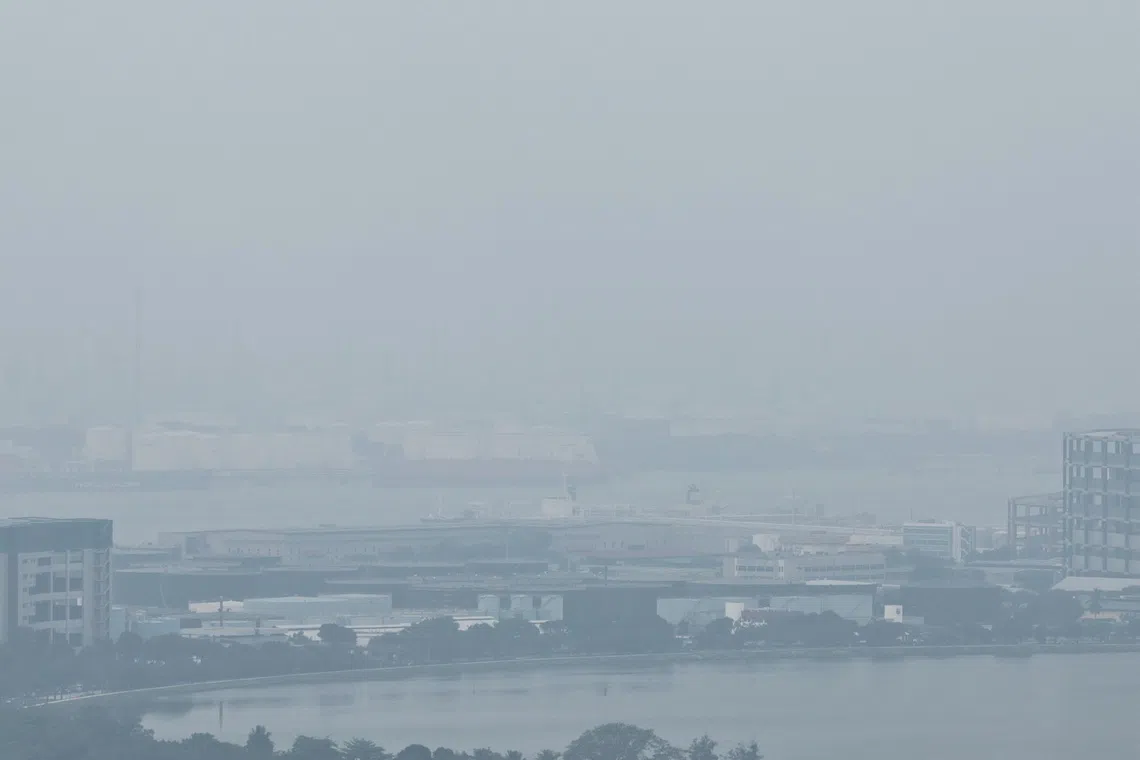
Hazy conditions seen from Clementi towards Jurong Island at about 7.20am on Oct 12.
ST PHOTO: KELVIN CHNG
Published Oct 12, 2026, 12:10 PM
Updated Oct 12, 2026, 12:10 PM
SINGAPORE - Since air quality in Singapore first dipped into unhealthy levels on Sept 4 after a couple of haze-free years, the country has faced several haze episodes that crossed the threshold for its Transboundary Haze Pollution Act to be enacted.
Asked if Singapore will be taking legal action against companies that could be responsible for the haze-belching fires in Indonesia , the National Environment Agency (NEA) said only that it “ has been closely monitoring the haze situation, gathering information on fire hotspots, their sources and impact on Singapore’s air quality”.
The law enacted in 2014 targets those responsible for causing or condoning fires if the haze causes the Pollutant Standards Index (PSI), a measure of air quality here , to stay in the unhealthy range in any part of Singapore for 24 hours or more. Air quality is considered unhealthy when PSI levels are 101 and above.
Satellite information, wind speed and direction and meteorological information, is used to determine if the smoke from that fire is likely to move in the direction of Singapore.
Those guilty under the Act can be fined up to $100,000 a day, capped at a total of $2 million.
The NEA spokesperson added that regional cooperation within ASEAN remains crucial in resolving transboundary haze pollution .
She pointed to the ASEAN Specialised Meteorological Centre, hosted by the Meteorological Service Singapore under the NEA, which provides early warning advisories and assessments of the current hotspot and smoke haze situation.
Such efforts help to support ASEAN Member States’ prevention and mitigation efforts, she said.
NEA is also in touch with the Jakarta-based Interim ASEAN Coordinating Centre for Transboundary Haze Pollution Control, which is coordinating information sharing among ASEAN Member States on the regional fire and haze situation, the NEA spokesman added.
The ASEAN Specialised Meteorological Centre focuses on early warning and hotspot monitoring. The new coordinating centre, on the other hand, aims to strengthen preparedness among ASEAN countries and reduce the impact of land and forest fires in the region, while mobilising resources to tackle the problem.
On Oct 10, Minister for Sustainability and the Environment Grace Fu told the media that Singapore stands ready to assist Indonesia amid the worsening haze conditions.
Indonesian officials later welcomed offers of assistance from Singapore and Malaysia, with one disaster management official saying firefighters on the ground could be more useful than helicopters.
Legal threshold breached
The haze episode on Sept 4 had already breached the threshold for Singapore’s anti-haze law to be enacted , when the PSI crept into the unhealthy range in the central region at 7am and lingered there until 8pm on Sept 5.
Since then, The Straits Times counted at least five other instances of unhealthy air quality lingering for over 24 hours .
Singapore is currently facing its longest episode of unhealthy air which started on Oct 5, and the PSI crept close to the very unhealthy range of 201 and above on Sept 9.
The PSI hit 192 in central Singapore at 6pm on Oct 9 , the highest so far in 2026.
The haze scourge is a perennial problem for South-east Asia.
For decades, it has come from forest and land fires in Indonesia , including provinces such as South Sumatra and Kalimantan largely due to the clearing of land through fires for agri-businesses such as oil palm and pulp plantations.
This year, the annual fire season is worsened by a super El Nino that makes the weather in equatorial ASEAN countries drier and hotter - resulting in longer-lasting fires that are harder to put out.
Other El Nino years in 1997 and 2015 also resulted in severe haze over Singapore and Malaysia.
The law was introduced after the 2013 haze crisis, when thick, toxic smog drifted to Singapore, pushing the PSI to a hazardous high of 401 .
When the law was passed in Parliament in 2014, several MPs insisted that the fines were too low compared with the size of the errant companies’ profits and the harm caused by the haze.
They also pointed to the difficulty of pinpointing the culprits responsible for setting fires to clear agricultural land, amid Indonesia’s complex, often overlapping land ownership.
On Oct 5, environmental group Greenpeace said it identified around 20 plantation companies with the most haze sources, and several are linked to business groups based in Singapore and Malaysia.
One concession is PT Damai Agro Sejahtera, which is affiliated with Bumitama Agri Ltd, an oil palm company headquartered in Singapore, Greenpeace said.
As at end-September, the Indonesian authorities have named 138 individual suspects involved in the fires, and has sealed 68 companies holding concessions.
On Sept 27, the Indonesian National Police said it is investigating the alleged involvement of 16 corporations and 43 individual suspects in the South Sumatra fires, and they have been detained.
Four 2015 cases remain open
The law was wielded for the first time in 2015, when the PSI breached hazardous levels with readings over 300. No fines have been meted out yet.
NEA had identified fires on plantations , or concession lands, associated with six Indonesian companies and issued legal notices to them.
Those were preventive measure notices that requested the firms to extinguish the fires, stop any burning activities, and submit to NEA any plans to extinguish the fire or prevent its recurrence.
Asked for an update on these cases, the spokesperson said investigations into four companies remain open. “As such, NEA is unable to disclose further details,” she added.
These four pulpwood plantation companies are PT Bumi Andalas Permai, PT Bumi Mekar Hijau, PT Sebangun Bumi Andalas Woods Industries, and PT Rimba Hutani Mas. Past reports showed that those companies were suppliers of Asia Pulp and Paper, which has a presence in Singapore.
The cases against two of the firms - PT Bumi Sriwijaya Sentosa and PT Wachyuni Mandira - were closed.
The NEA spokesperson said these firms had informed the agency that they were no longer associated with the affected lands before the fires occurred in 2015. She added: “Following further investigations, NEA accepted their explanations and closed the cases.”
The value of the law
Experts interviewed say the Transboundary Haze Pollution Act can serve as a deterrent to firms, but can be challenging to enforce.
International law expert Simon Tay, chairman of the Singapore Institute of International Affairs, told The Straits Times that the Act is still useful even if a case does not end in prosecution as it can trigger questions, investigations and accountability.
But he noted that Indonesia has the primary responsibility to tackle the fires, and the priority should be cooperation between governments and with companies to control the fires.
He added that there have bee n reservations from Indonesia about Singapore enforcing its laws outside its borders through the Transboundary Haze Pollution Act.
“Act first on the fires. Establish accountability when the facts are clearer,” said Tay.
Sean Tseng, an adjunct senior research fellow at the Asia-Pacific Centre for Environmental Law at NUS, said the law does not address the root cause of the burning and fires.
Another challenge is whether the law would have any real consequence even if a successful prosecution was brought under it, added Tseng , who co-authored the latest edition of Environmental Law in Singapore .
He said: “The Act can impose fines and allows for damages, but it would only matter if the errant entity had physical assets or subsidiaries in Singapore. Oftentimes , they may not.”
At the same time, Singapore will need to weigh the diplomatic consequences if it contemplates prosecution against non-Singapore entities.
Under the Act, individuals or organisations can also hold polluting firms accountable if they can prove that the haze episode led to injury or economic loss, if a sporting event had to be cancelled for example .
But there have been no known reports of such civil lawsuits under the Act so far, said Tseng.
He said: “We will likely need to contend with the reality that the Act best serves as a deterrent.
Shabana Begum is a correspondent, with a focus on environment and science, at The Straits Times.
National Environment Agency
10 月 12 日上午 7 点 20 分左右,从金文泰到裕廊岛方向出现雾霾天气。
《海峡时报》摄影:KELVIN CHNG
发布于2026年10月12日下午12:10
更新于2026年10月12日下午12:10
新加坡——自新加坡在经历了几年无雾霾天气后,于 9 月 4 日空气质量首次降至不健康水平以来,该国已多次遭遇雾霾事件,其程度超过了《跨境雾霾污染法》的生效门槛。
当被问及新加坡是否会对可能造成印尼烟雾弥漫的火灾的公司采取法律行动时,国家环境局 (NEA) 仅表示,“一直在密切监测烟雾情况,收集有关火灾热点、其来源以及对新加坡空气质量的影响的信息”。
2014年颁布的法律规定,如果雾霾导致新加坡任何地区的污染物标准指数(PSI,衡量空气质量的指标)连续24小时或以上处于不健康水平,则对引发或纵容火灾的责任人追究责任。当PSI值达到101及以上时,空气质量被视为不健康。
利用卫星信息、风速风向和气象信息,来确定火灾产生的烟雾是否可能向新加坡方向飘移。
根据该法案,违法者每天最高可被处以 10 万美元的罚款,最高罚款总额可达 200 万美元。
国家环境局发言人补充说,东盟内部的区域合作对于解决跨境雾霾污染仍然至关重要。
她指出,由新加坡国家环境局下属的气象局主办的东盟专业气象中心,提供关于当前热点和烟霾情况的早期预警建议和评估。
她表示,这些努力有助于支持东盟成员国的预防和缓解工作。
国家环境局发言人补充说,国家环境局还与位于雅加达的东盟跨境烟霾污染控制临时协调中心保持联系,该中心正在协调东盟成员国之间就区域火灾和烟霾情况进行信息共享。
东盟专业气象中心侧重于早期预警和热点监测。而新的协调中心则旨在加强东盟各国的防灾准备,减少该地区土地和森林火灾的影响,同时调动资源应对这一问题。
10月10日,新加坡永续发展及环境部长傅海燕向媒体表示,面对日益恶化的雾霾天气,新加坡随时准备向印尼提供援助。
印尼官员随后对新加坡和马来西亚提供的援助表示欢迎,一位灾害管理官员表示,地面消防员可能比直升机更有用。
已达到法定门槛
9 月 4 日的雾霾事件已经超过了新加坡反雾霾法的生效门槛,当时中部地区的空气污染指数 (PSI) 在早上 7 点就达到了不健康的范围,并一直持续到 9 月 5 日晚上 8 点。
此后,《海峡时报》统计到至少还有五起空气质量不佳持续超过 24 小时的事件。
新加坡目前正面临自 10 月 5 日开始的最长空气质量不佳期,空气污染指数 (PSI) 于 9 月 9 日逼近 201 及以上的非常不健康范围。
10 月 9 日下午 6 点,新加坡中部地区的 PSI 指数达到 192,这是 2026 年迄今为止的最高值。
雾霾是东南亚地区长期存在的问题。
几十年来,印度尼西亚的森林和土地火灾一直是造成火灾的主要原因,包括南苏门答腊省和加里曼丹省等地的火灾,这主要是由于为了发展油棕和纸浆种植园等农业企业而通过焚烧土地造成的。
今年,超级厄尔尼诺现象加剧了东盟赤道地区国家的年度火灾季节,导致当地气候更加干燥炎热,火灾持续时间更长,也更难扑灭。
1997 年和 2015 年的厄尔尼诺现象也导致新加坡和马来西亚出现严重的雾霾。
该法律是在 2013 年雾霾危机之后引入的,当时浓厚的有毒雾霾飘向新加坡,使 PSI 指数达到危险的 401。
2014 年议会通过该法律时,几位议员坚持认为,与违规公司的利润规模和雾霾造成的损害相比,罚款太低了。
他们还指出,由于印度尼西亚土地所有权复杂且经常重叠,因此很难确定放火清理农田的罪魁祸首。
10 月 5 日,环保组织绿色和平组织表示,他们已确定约 20 家种植园公司是雾霾的主要来源,其中几家与总部位于新加坡和马来西亚的商业集团有关联。
绿色和平组织表示,其中一家特许经营商是 PT Damai Agro Sejahtera,该公司隶属于总部位于新加坡的棕榈油公司 Bumitama Agri Ltd。
截至9月底,印尼当局已公布了138名与火灾有关的嫌疑人姓名,并查封了68家拥有特许经营权的公司。
9月27日,印尼国家警察表示,他们正在调查16家公司和43名个人嫌疑人涉嫌参与南苏门答腊火灾的案件,这些人已被拘留。
2015 年的四起案件仍未结案。
该法律于 2015 年首次启用,当时 PSI 读数超过 300,达到危险水平。目前尚未有人被处以罚款。
国家环境局 (NEA) 已确认与六家印尼公司相关的种植园或特许经营地发生火灾,并向这些公司发出法律通知。
这些是预防措施通知,要求各公司扑灭火灾,停止任何燃烧活动,并向国家环境局提交任何扑灭火灾或防止火灾再次发生的计划。
当被问及这些案件的最新进展时,发言人表示,对四家公司的调查仍在进行中。“因此,国家环境局无法透露更多细节,”她补充道。
这四家纸浆种植园公司是 PT Bumi Andalas Permai、PT Bumi Mekar Hijau、PT Sebangun Bumi Andalas Woods Industries 和 PT Rimba Hutani Mas。过去的报道显示,这些公司是亚洲纸浆造纸公司的供应商,该公司在新加坡设有业务。
针对其中两家公司——PT Bumi Sriwijaya Sentosa 和 PT Wachyuni Mandira 的案件已结案。
国家环境局发言人表示,这些公司在2015年火灾发生前已告知该机构,他们与受影响的土地已无任何关联。她补充说:“经过进一步调查,国家环境局接受了他们的解释,并结案了。”
法律的价值
受访专家表示,《跨界雾霾污染法》可以对企业起到威慑作用,但执行起来可能具有挑战性。
新加坡国际事务研究所主席、国际法专家郑文杰告诉《海峡时报》,即使案件最终没有被起诉,该法案仍然有用,因为它能够引发质疑、调查和问责。
但他指出,印尼负有应对火灾的首要责任,当务之急是政府与企业之间开展合作,共同控制火势。
他还补充说,印尼方面对新加坡通过《跨境烟霾污染法》在其境外执行法律有所保留。
“首先要扑灭火灾。等事实更清楚后再追究责任,”Tay说道。
新加坡国立大学亚太环境法中心兼职高级研究员曾先生表示,该法律没有解决焚烧和火灾的根本原因。
曾先生补充说,另一个挑战是,即使根据该法律成功提起诉讼,该法律是否会产生任何实际后果。曾先生是最新版《新加坡环境法》的合著者。
他说:“该法案可以处以罚款并允许赔偿,但这只有在违规实体在新加坡拥有实体资产或子公司的情况下才有效。很多时候,他们可能并没有。”
与此同时,如果新加坡考虑对非新加坡实体提起诉讼,则需要权衡其外交后果。
根据该法案,如果个人或组织能够证明雾霾事件导致人身伤害或经济损失(例如,体育赛事不得不取消),则可以追究污染企业的责任。
曾表示,目前还没有根据该法案提起此类民事诉讼的报道。
他说:“我们可能需要面对这样一个现实:该法案最大的作用就是起到威慑作用。”
沙巴娜·贝古姆是《海峡时报》的记者,主要关注环境和科学领域。
国家环境局