USS Sealion Was The Navy’s Unique Helicopter-Accommodating Submarine“海狮”号是美国海军唯一一艘可搭载直升机的潜艇。
A veteran of the Pacific War, this Balao class submarine was ideally suited to experiments with helicopters loaded with Marines.
Updated May 12, 2021 6:26 PM EDT
From the very early days of naval aviation, there have been attempts, some more successful than others , to operate fixed-wing aircraft, chiefly floatplanes , from submarines. By the time the helicopter had become an established part of air warfare, soon after World War II, the idea of any kind of aircraft-carrying submarines was essentially dead. But that didn’t stop the U.S. Navy from operating at least one helicopter from a submarine, during a remarkable series of trials aboard the USS Sealion in the mid-1950s.
By now, the helicopter had proven its worth in Korea and was increasingly becoming indispensable for maritime operations, too, its key missions including search and rescue, utility transport, and anti-submarine warfare. There was another mission that the helicopter was quickly making its own — amphibious assault. In November 1956, the Suez Crisis fiasco in Egypt saw British commandos flown by helicopter from the decks of aircraft carriers as part of an amphibious invasion force. It was the first time that such an operation was carried out and it would prove hugely influential.
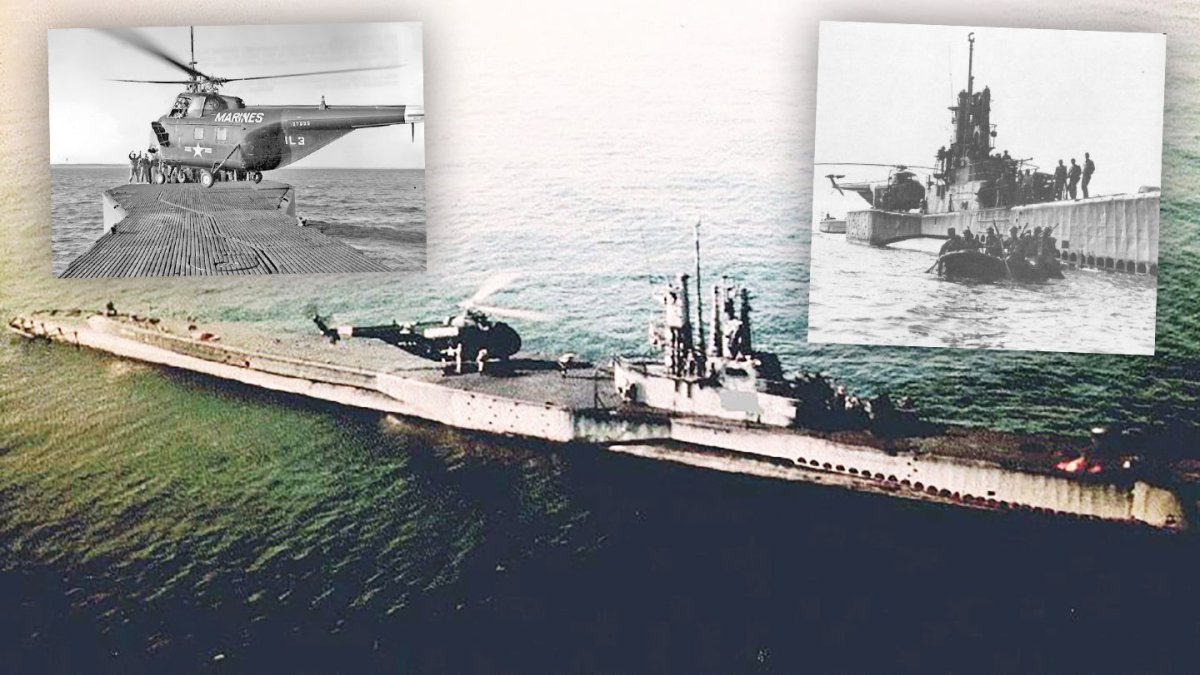
A U.S. Marine Corps Sikorsky HRS-1 helicopter landing aboard the submarine USS Sealion . , PUBLIC DOMAIN
In the same year in the United States, meanwhile, experiments using helicopters for the amphibious assault mission were also taking place. One of these aimed to examine whether it was possible to deliver a small team of Marines from a submarine at sea to the shore, where they could carry out reconnaissance missions. Inserting an advance party of reconnaissance troops was nothing new in itself, of course, and it was part of the existing submarine mission set. But using a helicopter to get them to their objective was new.
The submarine chosen for the exercise was the Balao class USS Sealion . This had originally been commissioned in March 1944 and was famously responsible for being the only submarine to sink a Japanese battleship during World War II, the Kongo , which was sent to the bottom of the sea in the Formosa Strait in November 1944.
Decommissioned at the end of the war, Sealion was then adapted as a troop-carrier submarine , losing its torpedo armament and being outfitted with accommodation for up to 123 troops or cargo. Meanwhile, above the deck, a large watertight cylindrical housing could carry additional equipment, such as an LVT , or tracked landing vehicle. This kind of installation was the precursor to the Dry Deck Shelters used on special mission submarines today. By late 1948, Sealion was operating as a submarine transport, SSP-315, with Marines embarked. A change in hull classifications in January 1950 saw Sealion reclassified a transport submarine, becoming ASSP-315, which was changed again to APSS-315 in October 1956.
USS Sealion after conversion as a submarine transport, SSP-315. Note the large stowage chamber aft of the conning tower., U.S. NAVY
During the mid-1950s, Sealion took part in maneuvers involving the Army, Marines, Underwater Demolition Teams, and Beach Jumper units, at some point losing the watertight deck housing. Presumably, by this point, the utility of being able to disembark a single LVT, or similar, had been discredited, but it did leave a considerable amount of flat deck space immediately behind the conning tower.
Surprisingly little information is available on the helicopter trials that took place on the Sealion , although photos indicate they made use of the ‘flight deck’ provided after the removal of the LVT’s container. Several of these photos record that the drills took place in or around May 1956.
USS Sealion during exercises with Marine scouts of the 2nd Marine Division in 1956., U.S. NAVY
The helicopter used has been reported as a Sikorsky HRS-3 , the Marine Corps version of the popular Sikorsky S-55. Powered by a 700-horsepower Wright R-1300-3 piston engine, this version was able to carry eight to 10 troops. However, at least one image shows an earlier model, the HRS-1, as used in Korea, which utilized the 600-horsepower Wright R-1340-57.
With no hangar, there was no way for the submarine to submerge with a helicopter on board and even in rough seas or poor weather, operations would likely have become very difficult, if not impossible. The limited available photos do not seem to reveal any additional support equipment to fuel the helicopter, or even secure it, suggesting these tests were designed just to study the basic feasibility of flying troop-laden helicopters to and from submarines.
Since there are no apparent records of helicopters operating from U.S. Navy submarines after this drill, we can probably safely assume that it wasn’t a success. At best, the rotary assault capacity offered would have been far less than even a modest-sized surface warship adapted for helicopter operations. Indeed, in 1958, the Navy began experiments with its first true helicopter carrier, the converted Essex class aircraft carrier USS Boxer (LPH-4).
Six UH-34 Seahorse helicopters in front of the landing platform helicopter USS Boxer ., U.S. Navy
There was, however, at least one interesting footnote to the story of the helicopter-carrying submarine.
On April 26, 1956, a month before an HRS-3 was being trialed aboard Sealion , another Balao class submarine, USS Corporal , was exercising with a Navy Sikorsky HSS-1 Seabat anti-submarine helicopter, part of a trials squadron that was attempting to track the submarine off the southern coast of Florida.
When the crew of the HSS-1 realized they were losing oil from the main rotor and were too far from the coast to recover on land. After issuing a mayday call, the Corporal surfaced to provide help, expecting to pick up survivors once the helicopter ditched. After making visual contact, the respective helicopter and submarine commanders agreed to attempt an emergency landing on the Corporal . Improvising all the way, the crews managed to safely recover the helicopter, although it was initially not even clear if the hull was wide enough to support the landing gear.
The U.S. Navy HSS-1 Seabat helicopter on the USS Corporal in 1956., U.S. NAVY
Between them, USS Sealion and Corporal had proven that it was possible to operate helicopters from submarines, whether planned in advance or in an emergency. But it was destined to be a brief cameo only and, today, the closest most submarines get to a helicopter is at the opposite end of a winch cable during personnel or cargo transfers.
As for USS Sealion , the submarine was decommissioned again in 1960 before returning to service the following year, again in a transport role. In 1962, the sub helped enforce the naval blockade against Cuba, during the Cuban Missile Crisis. For the remainder of the decade, Sealion continued to work with Marine Reconnaissance teams, SEALs , and Underwater Demolition Teams, finally being classified as an amphibious transport submarine, LPSS-315, before being decommissioned for the last time in 1970.
Carrying demolition equipment, U.S. Navy frogmen leave the submerged USS Sealion during a training exercise at St. Thomas, Virgin Islands in the early 1960s., U.S. NAVY
With such an illustrious period of service, from the war in the Pacific to the clandestine special forces missions of the Cold War, it’s perhaps not surprising that Sealion ’s helicopter operations are today little known.
Contact the author: thomas@thedrive.com
Comments couldn’t be loaded. Please refresh the page.
更新于美国东部时间2021年5月12日下午6:26
自海军航空兵诞生之初,就有人尝试从潜艇上操作固定翼飞机,主要是水上飞机,但成功率参差不齐。二战结束后不久,直升机成为空战中不可或缺的一部分,此时,任何类型的载机潜艇的想法基本上都已破灭。但这并没有阻止美国海军在20世纪50年代中期于“海狮”号潜艇上进行的一系列引人注目的试验中,至少从潜艇上操作过一架直升机。
到那时,直升机已在朝鲜战争中证明了自己的价值,并且在海上作战中也日益不可或缺,其主要任务包括搜救、通用运输和反潜作战。直升机很快又在另一项任务中占据了主导地位——两栖突击。1956年11月,在埃及苏伊士运河危机中,英国突击队员乘坐直升机从航空母舰甲板上起飞,作为两栖入侵部队的一部分。这是此类行动的首次实施,并将产生极其深远的影响。
一架美国海军陆战队的西科斯基HRS-1直升机降落在“海狮”号潜艇上。(公共领域)
与此同时,同年美国也在进行利用直升机执行两栖突击任务的试验。其中一项试验旨在检验能否将一小队海军陆战队员从海上潜艇运送到岸边,以便他们执行侦察任务。当然,派遣先遣侦察部队本身并非新鲜事,这早已是潜艇作战任务的一部分。但使用直升机将他们送达目标地点却是前所未有的。
此次演习选用的潜艇是巴劳级潜艇“海狮”号。该潜艇最初于1944年3月服役,并因在二战期间击沉日本战列舰“金刚”号而闻名,它是二战期间唯一击沉日本战列舰的潜艇。“金刚”号于1944年11月在台湾海峡沉入海底。
战争结束后,“海狮”号退役,随后被改装为运兵潜艇,拆除了鱼雷武器,并加装了可容纳123名士兵或货物的舱室。同时,在甲板上方,一个大型水密圆柱形舱室可以搭载额外的设备,例如两栖登陆车(LVT)。这种装置是如今特种任务潜艇上使用的干式甲板舱的前身。到1948年末,“海狮”号作为一艘潜艇运输舰(SSP-315)服役,舰上搭载着海军陆战队员。1950年1月,由于舰体分类的变更,“海狮”号被重新归类为运输潜艇,编号变为ASSP-315,并在1956年10月再次变更为APSS-315。
“海狮”号潜艇改装为潜艇运输舰后的照片,编号SSP-315。请注意指挥塔后方的大型储物舱。(美国海军)
20世纪50年代中期,“海狮”号参与了陆军、海军陆战队、水下爆破队和滩头突击队的联合演习,期间其水密甲板舱室一度损毁。想必此时单艘两栖登陆艇(LVT)或类似船只的登陆能力已不再实用,但这确实在指挥塔后方留下了相当大的平坦甲板空间。
令人惊讶的是,关于“海狮”号上进行的直升机试验,现有资料非常少,不过照片显示,试验中使用了拆除两栖登陆艇集装箱后腾出的“飞行甲板”。其中一些照片记录了演习时间在1956年5月前后。
1956年,美国海军“海狮”号潜艇与第二海军陆战师的侦察兵进行演习。
据报道,此次行动使用的直升机是西科斯基HRS-3,即广受欢迎的西科斯基S-55的美国海军陆战队版本。该机型搭载一台700马力的莱特R-1300-3活塞发动机,可搭载8至10名士兵。然而,至少有一张图片显示的是更早的型号HRS-1,该机型曾在朝鲜战争中使用,配备的是一台600马力的莱特R-1340-57发动机。
由于没有机库,潜艇无法搭载直升机下潜,即使在波涛汹涌的海面或恶劣的天气条件下,操作也可能变得非常困难,甚至不可能。现有照片数量有限,似乎并未显示任何用于为直升机提供燃料或固定直升机的额外支持设备,这表明这些测试的目的仅仅是为了研究载兵直升机往返潜艇的基本可行性。
由于此后没有美国海军潜艇进行直升机作战的明显记录,我们可以合理推断此次演习并不成功。充其量,其提供的旋翼攻击能力也远不及一艘适中型的、改装用于直升机作战的水面舰艇。事实上,早在1958年,美国海军就开始对其第一艘真正的直升机航母——由埃塞克斯级航空母舰改装而成的“拳师”号(LPH-4)进行试验。
六架UH-34“海马”直升机停在“拳师”号两栖攻击舰的直升机起降平台前。(美国海军)
然而,关于这艘载有直升机的潜艇的故事,至少还有一个有趣的注脚。
1956 年 4 月 26 日,在 HRS-3 型直升机在“海狮”号潜艇上进行试验前一个月,另一艘巴劳级潜艇“下士”号与海军西科斯基 HSS-1“海蝙蝠”反潜直升机进行演习,该直升机隶属于一个试验中队,该中队试图在佛罗里达州南部海岸追踪这艘潜艇。
当HSS-1直升机的机组人员意识到主旋翼漏油,且距离海岸太远无法在陆地上进行救援时,他们发出求救信号。随后,“下士”号潜艇浮出水面提供援助,希望在直升机迫降后救起幸存者。在目视确认后,直升机和潜艇的指挥官一致同意尝试在“下士”号上进行紧急迫降。尽管最初甚至不确定船体宽度是否足以支撑起落架,但机组人员最终还是成功地安全地回收了直升机。
1956年,美国海军“下士”号两栖攻击舰上的HSS-1“海蝙蝠”直升机。
“海狮”号和“下士”号潜艇共同证明了从潜艇上操作直升机是可行的,无论是事先计划好的还是紧急情况下的。但这注定只是昙花一现,如今,大多数潜艇与直升机最接近的时刻,莫过于在人员或货物转运时通过绞车缆绳与直升机进行连接。
至于“海狮”号潜艇,它在1960年再次退役,次年重新服役,再次执行运输任务。1962年古巴导弹危机期间,该潜艇参与了对古巴的海上封锁。在接下来的十年里,“海狮”号继续与海军陆战队侦察队、海豹突击队和水下爆破队合作,最终被归类为两栖运输潜艇LPSS-315,并于1970年最后一次退役。
20世纪60年代初,在美属维尔京群岛圣托马斯岛的一次训练演习中,美国海军蛙人携带爆破设备离开水下潜艇“海狮”号。
从太平洋战争到冷战时期的秘密特种部队任务,海狮直升机部队曾有过如此辉煌的服役经历,因此,如今海狮直升机部队的行动鲜为人知也就不足为奇了。
联系作者:thomas@thedrive.com
评论加载失败,请刷新页面。