Army sent balloon swarms to Middle East to support CENTCOM operations美国陆军向中东地区派遣气球群,以支援中央司令部的行动。
The Army gleaned a trio of observations about how those balloons operated, but it is not yet clear what path the service will pursue when it comes to stratospheric sensing capabilities, Andrew Evans said.
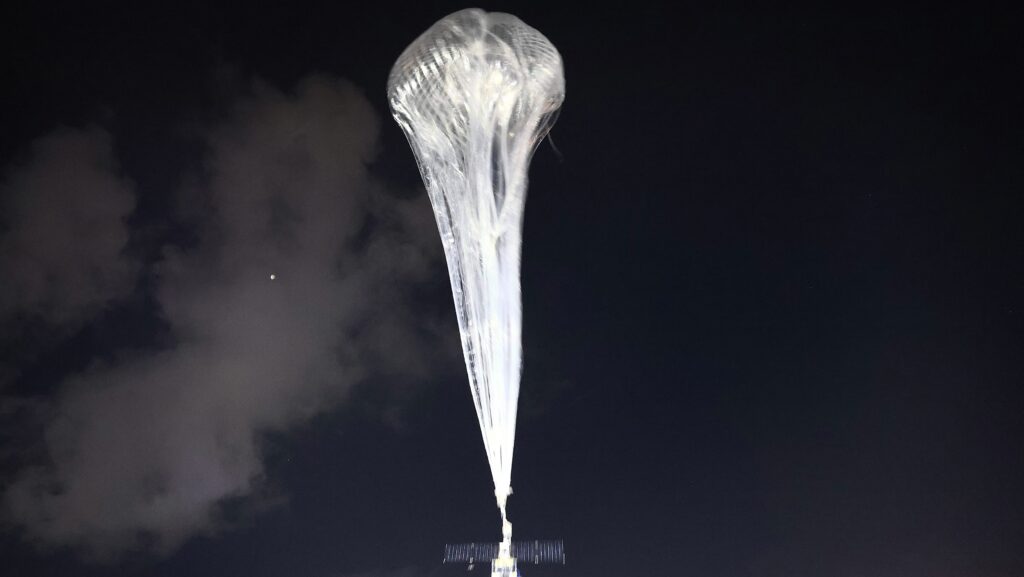
The 3D Multi-Domain Task Force, in conjunction with the Office of the Undersecretary of Defense, launched High-Altitude Balloons (HABs) from Won Pat International Airport in Guam on June 10, 2024. T (US Army/ Sgt. Perla Alfaro)
WASHINGTON — After scrubbing a large-scale, high-altitude balloon demonstration in the Indo-Pacific last year to send the assets over to the Middle East, the US Army has gleaned a series of observations for future use, according to a senior service official.
“We were asked to pivot and do some experimentation in combination with operations, and we pivoted and supported operations in CENTCOM [US Central Command],” Andrew Evans, the director for the Strategy & Transformation Office inside the Army’s Deputy Chief of Staff for Intelligence shop (G-2), told Breaking Defense today.
“They were effective for the mission that they were assigned,” he added, though he was not able to disclose the exact location and operational scenarios in which they were used.
The Army has tested out high-altitude balloons multiple times in the last few decades, and the service has revived the push to deploy them in recent years for added battlefield sensing and communications. Testing has typically included one or two balloons at a time, but the Army was looking to experiment with over a hundred high-altitude balloons in the skies over waters in the Indo-Pacific in 2026. While that didn’t come to fruition, smaller balloon swarms were used in CENTCOM.
“From a scale perspective, we went from one to two to dozens simultaneously,” Evans said on the sidelines of the Annual Association of the US Army conference. The smaller swarms were enough to highlight a trio of challenges associated with operating those autonomous balloons inside a theater with active military operations.
First, there were logistical challenges tied to transporting the balloons into the Middle East and then storing them.
“Balloons can be a little finicky in terms of temperature, and you have to contend with environmental characteristics,” Evans said.
Then, there were questions about how to support and operate the balloons — something the Army and joint force will need to do “a little bit of additional thinking” about regarding what force structure will need to look like, Evans said.
“We had a lot of help from vendors in this space, but as you think about employing your systems and going from something like a Pacific [theater] to something like a CENTCOM [theater], you learn where those friction points might exist between what the military might need to inherently own, and … what a vendor could help provide in terms of the service,” Evens said.
Given the ongoing regional options, industry had to put the military in “driver’s seat” to ensure everything was in accordance with the proper authorities the US military had.
“And there’s just not a lot of folks that are trained on how to operate it, so we’ve learned some things along the way and we’re going to take those back,” Evans said.
Another challenge, albeit one expected, was related to airspace control. While Evans did not expand on this point, airspace control has been a point of contention as the military seeks to add aerial drones into airspace that also includes manned military aircraft and commercials planes.
“There were some challenges. … That was not a new finding, [but] a consistent observation,” Evans said.
As for what’s next for balloon experiments and buys, Evans said Army leaders are pretty certain that they need stratospheric sensing capabilities, but it is “unclear” how they will be delivered.
“Would it be a balloon? Would it be a solar glider? Would it be some sort of pseudo satellite?” he said. “It’s unclear. No decision has been made.”
2024年6月10日,第三多域特遣部队与国防部副部长办公室合作,从关岛沃恩帕特国际机场放飞了高空气球。(美国陆军/佩拉·阿尔法罗中士)
华盛顿——据一位高级军官透露,去年美国陆军取消了在印太地区进行的大规模高空气球演示,并将相关资源转移到中东后,美国陆军已经收集了一系列观察结果以供将来使用。
“我们被要求调整策略,并结合作战行动进行一些试验,我们调整了策略,并支持了美国中央司令部的作战行动,”陆军情报副参谋长办公室(G-2)战略与转型办公室主任安德鲁·埃文斯今天告诉《防务新闻》。
“它们在执行分配的任务中发挥了有效作用,”他补充道,但他无法透露它们被使用的确切地点和作战场景。
过去几十年间,美国陆军多次测试高空气球,近年来又重新启动了高空气球部署计划,以增强战场感知和通信能力。以往的测试通常每次只使用一到两个气球,但陆军曾计划在2026年于印太地区水域上空试验一百多个高空气球。虽然该计划最终未能实现,但美国中央司令部曾使用过规模较小的气球群。
“从规模上看,我们同时操控的气球数量从单个增加到两个,再到几十个,”埃文斯在美国陆军协会年会间隙说道。即使是规模较小的气球群,也足以凸显在正在进行军事行动的战区内操控这些自主气球所面临的三大挑战。
首先,将气球运送到中东并储存它们存在后勤方面的挑战。
“气球对温度比较敏感,而且你必须考虑环境因素,”埃文斯说。
随后,出现了关于如何支持和操作气球的问题——埃文斯说,陆军和联合部队需要“再多思考一下”部队结构需要是什么样子。
“我们在这个领域得到了供应商的很多帮助,但是当你考虑如何运用你的系统,并从像太平洋战区这样的地区扩展到像中央司令部战区这样的地区时,你就会明白,军方自身需要拥有的东西和供应商可以提供的服务之间可能存在哪些摩擦点,”埃文斯说。
鉴于当前各地区的选择,业界不得不让军方“掌控局面”,以确保一切都符合美国军方所拥有的适当授权。
“而且接受过操作培训的人并不多,所以我们一路摸索出了一些东西,我们会把这些东西带回去,”埃文斯说。
另一个挑战,尽管在意料之中,与空域管制有关。埃文斯并未就此展开详述,但空域管制一直是争论的焦点,因为军方试图将无人机引入到包括有人驾驶军用飞机和民用飞机在内的空域。
“确实存在一些挑战……这不是什么新发现,而是一个持续存在的现象,”埃文斯说。
至于气球试验和采购的下一步计划,埃文斯表示,陆军领导人非常确定他们需要平流层传感能力,但目前还“不清楚”这些能力将如何实现。
“会是气球吗?会是太阳能滑翔机吗?会是某种伪卫星吗?”他说道,“目前还不清楚,尚未做出决定。”