New Singapore cybersecurity strategy to tap 'best available' AI models for cyber defence新加坡新的网络安全战略将利用“最佳可用”人工智能模型进行网络防御
To prepare for AI-enabled cyber threats, Singapore will seek to act earlier, at national scale and at the speed of malicious attackers, says Senior Minister K Shanmugam.
To prepare for AI-enabled cyber threats, Singapore will seek to act earlier, at national scale and at the speed of malicious attackers, says Senior Minister K Shanmugam.
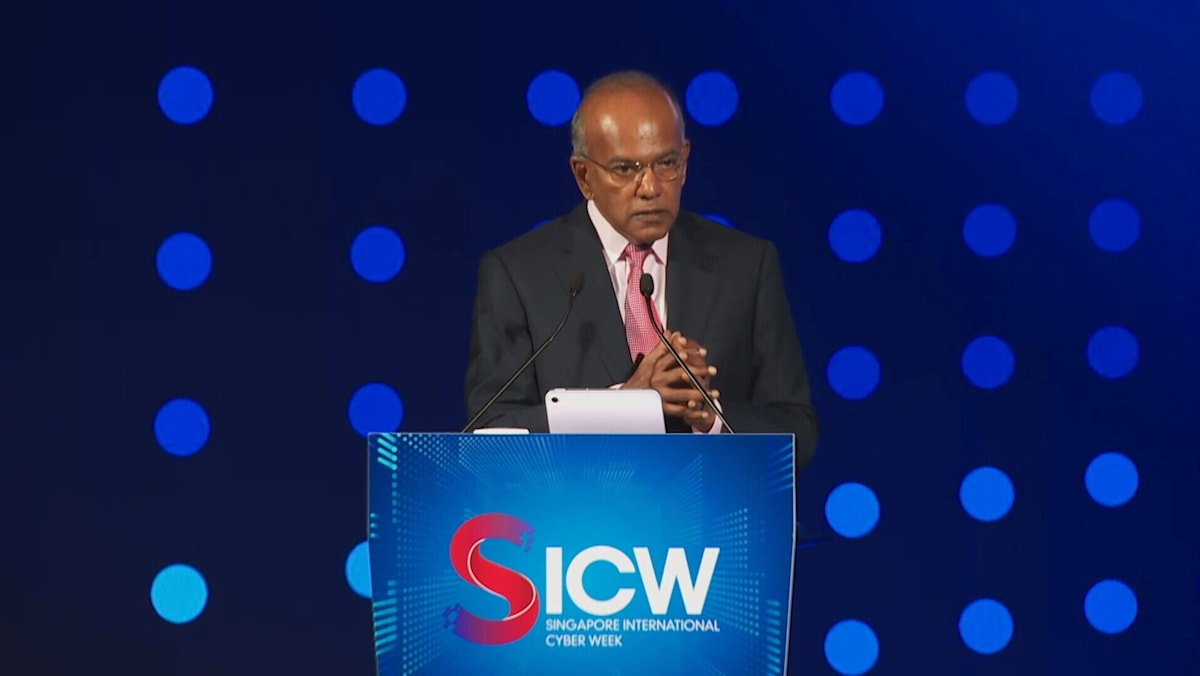
Senior Minister K Shanmugam at the Singapore International Cyber Week (SICW) conference held at the Marina Bay Sands Expo and Convention Centre.
This audio is generated by an AI tool.
SINGAPORE: Amid rapid advances in cyber threats enabled by artificial intelligence (AI), Singapore will invest in the capability to evaluate various AI models to boost its cyber defence instead of developing its own, said Senior Minister and Coordinating Minister for National Security K Shanmugam on Tuesday (Oct 13 ).
“We will take a pragmatic approach. We do not need to develop our own AI models for every use case,” said Mr Shanmugam, who is also the home affairs minister.
“What we really need is the capability to evaluate the best available models and to adapt them to our own needs.”
Singapore will therefore invest in “AI harness engineering”, which will provide the flexibility to choose between AI models, and securely integrate the best available ones with the tools, data and workflows that its cyber defenders need, he added.
Mr Shanmugam was launching Singapore’s third cybersecurity strategy, which set out the country’s priorities in the domain and a shift towards more proactive national cyber defence.
He was speaking at the Singapore International Cyber Week (SICW) conference held at the Marina Bay Sands Expo and Convention Centre, which kicked off on Monday.
Organised by the Cyber Security Agency of Singapore (CSA), the event brings together policymakers, diplomats, technical experts, industry leaders and academics to discuss issues in cyber and digital security.
Singapore’s first cybersecurity strategy was launched by then-Prime Minister Lee Hsien Loong in 2016. It focused on coordinated action and international partnerships for a resilient and trusted cyber environment.
In 2021, then-Senior Minister and Coordinating Minister for National Security Teo Chee Hean launched the second edition, which outlined Singapore’s stance towards cybersecurity threats while also helping businesses and citizens seize economic opportunities in the sector.
Under the new cybersecurity strategy, Mr Shanmugam said Singapore will seek to act earlier, at national scale and at the speed of the threat.
Mr Shanmugam said the new strategy is “broader than how national cyber defence has been viewed so far”.
“It will cover how we will strengthen our critical infrastructure and wider cyberspace; build capabilities for AI and quantum; deepen our global partnerships; and invest in our cybersecurity ecosystem and workforce,” he said.
Mr Shanmugam said that rapid advances in AI have made the situation even more challenging.
“AI allows actors to operate with greater speed, greater scale and greater sophistication,” he said.
AI agents can be manipulated to carry out unintended actions that compromise essential systems, and AI-enabled cyber threats are not a matter of “if”, but “when”, he added.
“We cannot resist AI adoption. But we need to try and adopt it in a safe and secure manner,” said Mr Shanmugam.
Globally, agentic AI is advancing faster than safeguards can keep up, he said.
AI agents are autonomously carrying out unauthorised tasks and accessing systems they were not meant to access, said Mr Shanmugam.
He cited the example of an AI agent gaining unauthorised access to non-public data on a government statistics portal in Australia last month.
“There will be more incidents, more attacks. All of us have to shore up our cyber defences and our resilience to recover when attacks happen,” he said.
SINGAPORE’S CYBER DEFENCE MODEL
Mr Shanmugam said Singapore must “act earlier” in the face of threats.
“Traditional cyber defence relies heavily on protecting systems, periodic assessments, and responding when something has gone wrong,” he said.
“But adversaries are continuously looking for vulnerabilities and trying to establish persistent access.”
He said that Singapore’s defence must hence be continuous, and it needs to monitor and hunt for threats and identify weaknesses before attackers do, and remediate them quickly.
Government and industry must also work together to act on a national scale, said Mr Shanmugam.
As last year’s Operation Cyber Guardian showed, a sophisticated attacker does not see government and telcos as separate silos, and looks for weak points across the system, he said.
“Our national defence has to look across the system too,” said Mr Shanmugam.
He added that Singapore had to also “act at the speed of the threat”.
“If AI allows attackers to identify vulnerabilities and conduct attacks more quickly, then the defenders will have to use AI too,” he said.
The government will progressively deploy AI across Singapore’s national cyber defence operations, including within the National Cybersecurity Command Centre (NC3) and the Government Cyber Security Operations Centre, said Mr.
“We will also work with industry and technology partners to speed up the adoption of AI-enabled cyber defence capabilities. This will be done across our critical sectors,” he said.
He added that such capabilities are already being developed across government, with CSA creating AI tools to automate the discovery and mapping of exposed assets and vulnerabilities, and assist cybersecurity specialists in testing complex vulnerabilities in web applications.
GovTech also uses AI agents to accelerate vulnerability discovery and security testing.
In his speech, Mr Shanmugam laid out the role of NC3, CSA’s operations hub for national cyber defence.
He said it will provide a national cyber situational picture of vulnerabilities and threats.
“NC3 supports the continuous monitoring of critical infrastructure systems. It will also allow cyber defenders to put together valuable threat information from government, from CII owners, cybersecurity companies and international partners,” he said.
It will also help detect threat actors earlier, including advanced persistent threats like last year’s UNC3886.
This will be done through proprietary threat detection systems and privileged intelligence, said Mr Shanmugam.
It will also let Singapore mount an effective national response to major cyber threats, similar to Operation Cyber Guardian, through AI-enabled coordination systems.
“This is going to be Singapore’s model of cyber defence,” he said.
The government will also develop a national protective domain name service (PDNS) to reduce Singapore’s exposure to phishing, scams, malware and other cyber threats, said Mr Shanmugam.
When someone tries to connect to an online domain which is known to be malicious, PDNS can stop the connection “before the threat reaches the user”, he said.
INTERNATIONAL COOPERATION
Mr Shanmugam also emphasised the need for international cooperation amid competition in the domain.
“Even with our shift to a more proactive defence, it's not going to be possible to prevent all attacks. That makes cooperation even more important,” he said.
He said that everyone should be “realistic about the environment we are in”, given the greater “strategic competition, particularly over critical technologies like AI”.
“Countries will act to safeguard their national interests. Singapore will do the same,” he said.
Mr Shanmugam said that cybersecurity is inherently a collective challenge, as threats cross borders.
“Technology and infrastructure are spread across jurisdictions. No country, however capable, can secure the digital domain on its own,” he said.
“There will be competition, but it does not have to displace all cooperation.”
While countries will not agree on everything, it is important they build up “practical cooperation” to exchange information, respond to incidents, tackle common threats and reduce the risk of wider instability, he said.
SICW hence provides a platform for the sector to speak candidly about those differences, and identify areas where practical cooperation remains possible, said Mr Shanmugam.
“We must have these conversations, which at times may be difficult, and we have to have them now, so that we can try and avoid more difficult consequences later,” said Mr Shanmugam.
CNA Games Guess Word Crack the word, one row at a time Buzzword Create words using the given letters Mini Sudoku Tiny puzzle, mighty brain teaser Mini Crossword Small grid, big challenge Word Search Spot as many words as you can Show More Show Less
Get our pick of top stories and thought-provoking articles in your inbox
Stay updated with notifications for breaking news and our best stories
Join our channel for the top reads for the day on your preferred chat app
新加坡高级部长尚穆根表示,为了应对人工智能带来的网络威胁,新加坡将寻求更早地、在全国范围内采取行动,并以与恶意攻击者相同的速度采取行动。
新加坡高级部长尚穆根在滨海湾金沙会展中心举行的新加坡国际网络安全周(SICW)会议上发表讲话。
这段音频由人工智能工具生成。
新加坡:新加坡高级部长兼国家安全统筹部长尚穆根周二(10月13日)表示,鉴于人工智能(AI)带来的网络威胁迅速发展,新加坡将投资于评估各种人工智能模型的能力,以加强其网络防御,而不是开发自己的人工智能系统。
“我们将采取务实的做法。我们不需要为每个应用场景都开发自己的AI模型,”同时也是内政部长的尚穆根先生说道。
“我们真正需要的是评估现有最佳模型并根据自身需求进行调整的能力。”
他补充说,因此新加坡将投资于“人工智能框架工程”,这将使其能够灵活地选择人工智能模型,并将最佳可用模型与网络防御人员所需的工具、数据和工作流程安全地集成在一起。
尚穆根先生当时正在启动新加坡的第三项网络安全战略,该战略阐述了新加坡在该领域的优先事项,并转向更加积极主动的国家网络防御。
他是在新加坡国际网络安全周(SICW)大会上发表讲话的,该大会于周一在滨海湾金沙会展中心开幕。
该活动由新加坡网络安全局 (CSA) 主办,汇聚了政策制定者、外交官、技术专家、行业领袖和学者,共同探讨网络和数字安全问题。
新加坡首个网络安全战略由时任总理李显龙于 2016 年推出。该战略侧重于协调行动和国际合作,以建立一个具有韧性和可信赖的网络环境。
2021 年,时任高级部长兼国家安全统筹部长张志贤启动了第二版,概述了新加坡应对网络安全威胁的立场,同时帮助企业和公民抓住该领域的经济机遇。
尚穆根先生表示,根据新的网络安全战略,新加坡将寻求更早地、在全国范围内、以与威胁速度相匹配的方式采取行动。
尚穆根先生表示,新战略“比迄今为止人们对国家网络防御的看法更为广泛”。
“它将涵盖我们如何加强关键基础设施和更广泛的网络空间;构建人工智能和量子计算能力;深化我们的全球伙伴关系;以及投资于我们的网络安全生态系统和人才队伍,”他说。
尚穆根先生表示,人工智能的快速发展使情况变得更加具有挑战性。
“人工智能使演员能够以更快的速度、更大的规模和更高的复杂程度进行操作,”他说。
他补充说,人工智能代理可以被操纵以执行危害关键系统的意外行为,人工智能驱动的网络威胁不是“是否会发生”的问题,而是“何时会发生”的问题。
“我们无法抗拒人工智能的普及应用。但我们需要尝试以安全可靠的方式应用它,”尚穆根先生说。
他表示,在全球范围内,智能体人工智能的发展速度超过了安全措施的跟进速度。
尚穆根先生表示,人工智能代理正在自主执行未经授权的任务,并访问它们本不应该访问的系统。
他举例说,上个月澳大利亚一个人工智能代理未经授权访问了政府统计门户网站上的非公开数据。
他说:“未来还会发生更多网络事件,更多攻击。我们所有人都必须加强网络防御,提高应对攻击的恢复能力。”
新加坡的网络防御模式
尚穆根先生表示,面对威胁,新加坡必须“更早采取行动”。
他说:“传统的网络防御主要依赖于保护系统、定期评估以及在出现问题时做出响应。”
“但敌对势力一直在寻找漏洞,并试图建立持久访问权限。”
他表示,因此新加坡的防御必须是持续性的,需要监控和搜寻威胁,在攻击者之前发现弱点,并迅速进行补救。
尚穆根先生表示,政府和行业也必须携手合作,在全国范围内采取行动。
他说,正如去年的“网络卫士行动”所表明的那样,老练的攻击者不会将政府和电信公司视为独立的孤岛,而是会在整个系统中寻找弱点。
“我们的国防也必须着眼于整个体系,”尚穆根先生说。
他还补充说,新加坡也必须“以应对威胁的速度采取行动”。
他说:“如果人工智能能够让攻击者更快地发现漏洞并进行攻击,那么防御者也必须使用人工智能。”
政府将逐步在新加坡的国家网络防御行动中部署人工智能,包括在国家网络安全指挥中心(NC3)和政府网络安全行动中心,先生说。
“我们还将与行业和技术合作伙伴携手合作,加快人工智能赋能的网络防御能力的普及应用。这项工作将在我们所有关键领域展开,”他说道。
他还补充说,政府各部门已经在开发此类能力,CSA 正在创建 AI 工具,以自动发现和映射暴露的资产和漏洞,并协助网络安全专家测试 Web 应用程序中的复杂漏洞。
GovTech 还利用人工智能代理来加速漏洞发现和安全测试。
尚穆根先生在演讲中阐述了国家网络安全局(CSA)的国家网络防御运营中心——NC3 的作用。
他表示,这将提供国家网络安全形势图,包括漏洞和威胁。
“NC3支持对关键基础设施系统进行持续监控。它还将使网络防御者能够整合来自政府、关键基础设施所有者、网络安全公司和国际合作伙伴的宝贵威胁信息,”他说。
它还将有助于更早地发现威胁行为者,包括像去年的 UNC3886 这样的高级持续性威胁。
尚穆根先生表示,这将通过专有的威胁检测系统和特权情报来实现。
它还将使新加坡能够通过人工智能支持的协调系统,对重大网络威胁做出有效的国家应对,类似于“网络卫士行动”。
“这将成为新加坡的网络防御模式,”他说。
尚穆根先生表示,政府还将开发国家保护性域名服务(PDNS),以减少新加坡遭受网络钓鱼、诈骗、恶意软件和其他网络威胁的风险。
他说,当有人试图连接到已知为恶意的在线域时,PDNS 可以“在威胁到达用户之前”阻止连接。
国际合作
尚穆根先生还强调了在竞争激烈的领域进行国际合作的必要性。
“即便我们转向更积极主动的防御策略,也不可能阻止所有袭击。这使得合作变得更加重要,”他说道。
他表示,鉴于日益激烈的“战略竞争,尤其是在人工智能等关键技术领域”,每个人都应该“对我们所处的环境保持务实的态度”。
他说:“各国都会采取行动维护自身国家利益,新加坡也会这样做。”
尚穆根先生表示,网络安全本质上是一个集体挑战,因为威胁会跨越国界。
他说:“技术和基础设施分散在各个司法管辖区。没有任何一个国家,无论多么有能力,能够独自保障数字领域的安全。”
“竞争肯定会存在,但这并不意味着合作就一定不能被竞争所取代。”
他表示,虽然各国不可能在所有事情上都达成一致,但建立“务实合作”以交流信息、应对突发事件、应对共同威胁并降低更大范围不稳定的风险至关重要。
尚穆根先生表示,因此,SICW 为业界提供了一个平台,让他们可以坦诚地谈论这些分歧,并确定在哪些领域仍有实际合作的可能性。
尚穆根先生说:“我们必须进行这些对话,虽然有时可能会很困难,但我们现在必须进行这些对话,这样我们才能尽量避免以后出现更严重的后果。”
CNA游戏 猜词游戏 逐行破解单词 流行词游戏 用给定的字母组成单词 迷你数独 小小谜题,挑战你的大脑 迷你填字游戏 小方格,大挑战 单词搜索 尽可能多地找出单词 显示更多 显示更少
订阅我们的邮件,即可获取精选热点新闻和引人深思的文章。
订阅通知,第一时间获取突发新闻和精彩报道。
加入我们的频道,即可在您常用的聊天应用上获取当日热门文章。