Army plans ‘rodeo’ to round up supply-chain problems陆军计划通过“牛仔竞技”来解决供应链问题
The service’s “biggest acquisition program” is fostering new companies, acting secretary says.
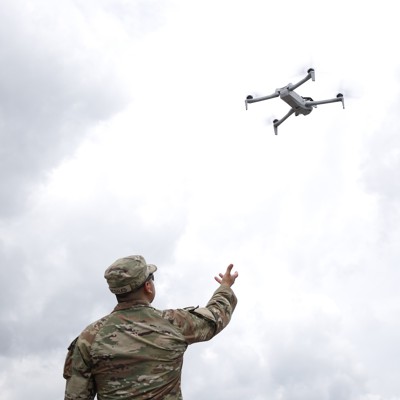
A soldier with the 101st Airborne 2-327 Multi-Purpose Company catches a drone in the Pentagon parking lot on June 14, 2025. Getty Images / Samuel Corum
The service’s “biggest acquisition program” is fostering new companies, acting secretary says.
The U.S. Army is planning a "rodeo" to round up problems that slow the deployment of new weapons, and rope in new ways to improve supply chains and make parts in more places, the service’s acting chief said today.
The “Manufacturing Rodeo,” planned sometime in 2027, will serve as a sort of public competition to expose where the industrial base is failing to meet demand and where new players are providing innovative approaches.
“We need to strain the nation's larger industrial base. We're going to stress-test the supply chain, the manufacturing processes, and see where it breaks,” Adam Telle said at the Association of the U.S. Army’s annual conference in Washington, D.C.
Production bottlenecks and a lack of suppliers for many key parts have plagued the Army for decades. The Government Accountability Office, among others, has detailed many breaking points. But, Telle said, those reports don’t capture how bad the problem could become as the Army seeks new drones and counterdrone weapons with components made by companies far from the service’s control.
For instance, he said, the Army needs to “make millions” of one-way attack drones.
“It may look simple, but it's a flying supply chain. If somebody else controls one part, they can break the whole thing,” the acting chief said.
Parts for such drones are largely made in China , which uses its market dominance to help other autocratic states like Russia and Iran attack U.S. forces and partner militaries in Europe .
Telle, who did not name any adversary, said that “an economy that's an extension of the national-security apparatus” can be “ruthlessly efficient” in deploying weapons.
“Over there, you flip a switch, and by law, by design, the economy is nationalized,” he said.
The acting Army chief listed steps the Pentagon has taken to overcome bureaucratic sluggishness in developing and deploying new technologies, such as pushing more acquisition authority down to battalion-level commanders, getting more self-sustained power on U.S. bases, and introducing a program to allow private companies to test new weapons on U.S. Army ranges. New private ranges, such as Second Bend Labs , are also renting time and space to defense startups eager to gain a foothold.
Telle said fostering new companies is more important than any single program.
“When someone tells you the Army's biggest acquisition program is this tank or that helicopter or this missile system, tell them they're wrong. The biggest acquisition program in the Army is building a system of seamless, frictionless, symbiotic relationship with American ingenuity.”
NEXT STORY: Army’s new command plans to streamline autonomous warfare acquisition
2025年6月14日,美国陆军第101空降师第2-327多用途连的一名士兵在五角大楼停车场捕获了一架无人机。图片来源:Getty Images / Samuel Corum
代理部长表示,该部门的“最大收购计划”正在培育新公司。
美国陆军代理司令今天表示,陆军正计划开展一项“综合行动”,以解决阻碍新武器部署的问题,并引入新的方法来改善供应链,在更多地方生产零部件。
计划于 2027 年某个时候举行的“制造业竞技赛”将作为一种公开竞赛,以揭示工业基础在哪些方面无法满足需求,以及新参与者在哪些方面提供了创新方法。
“我们需要对国家庞大的工业基础进行压力测试。我们将对供应链和制造流程进行压力测试,看看哪里会出问题,”亚当·特勒在华盛顿特区举行的美国陆军协会年会上说道。
几十年来,生产瓶颈和许多关键零部件供应商短缺一直困扰着美国陆军。包括美国政府问责局在内的多个机构详细列举了许多导致问题恶化的因素。但特勒表示,这些报告并未反映出,随着陆军寻求使用由远离其控制的公司生产的零部件来制造新型无人机和反无人机武器,这个问题可能会变得多么严重。
例如,他说,陆军需要“制造数百万架”单向攻击无人机。
“这看起来很简单,但实际上是一条瞬息万变的供应链。如果其他人控制了其中一个环节,他们就能破坏整个供应链,”代理局长说道。
此类无人机的零部件大多产自中国,中国利用其市场主导地位帮助俄罗斯和伊朗等其他专制国家攻击美国军队和欧洲的伙伴军队。
特勒没有指名道姓地指出任何对手,但他表示,“作为国家安全机构延伸的经济”在部署武器方面可以“极其高效”。
他说:“在那边,你只要拨动一个开关,根据法律和设计,经济就被国有化了。”
代理陆军参谋长列举了五角大楼为克服官僚机构在研发和部署新技术方面的迟缓而采取的措施,例如将更多采购权下放至营级指挥官,增强美军基地的自主供电能力,以及推出一项允许私营公司在美国陆军靶场测试新型武器的计划。此外,像Second Bend Labs这样的新型私营靶场也向渴望站稳脚跟的国防初创企业出租场地和时间。
特勒表示,扶持新公司比任何单一项目都更重要。
“如果有人告诉你陆军最大的采购项目是这辆坦克、那架直升机或这套导弹系统,你要告诉他们,他们错了。陆军最大的采购项目是构建一个与美国创造力无缝衔接、无摩擦、互惠互利的系统。”
下一篇报道:陆军新司令部计划简化自主作战采购流程