Drones Are Creating New Opportunities For The U.S. Army To Deceive Its Enemies无人机为美国陆军欺骗敌人创造了新的机会
Deception and guile are emerging as primary tasks for uncrewed platforms in the Army's new concept of operations.
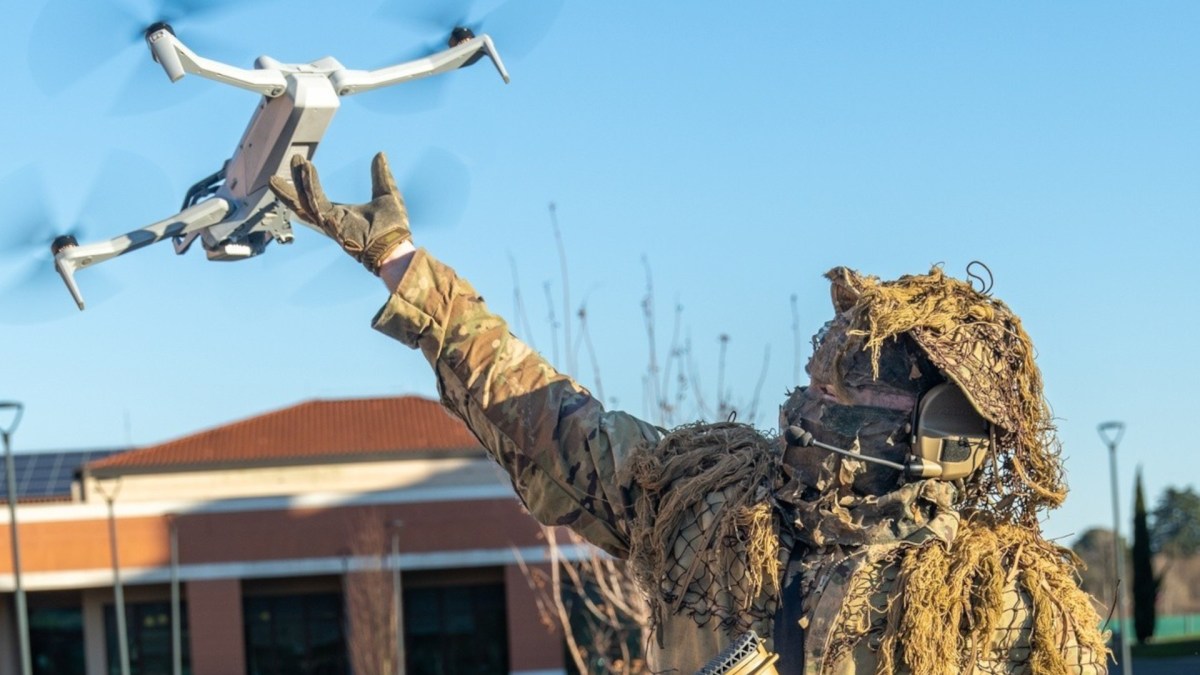
By Joseph Trevithick
Published Oct 13, 2026 8:19 AM EDT
For more than a year, U.S. Army forces in Europe have been experimenting with new counter-drone capabilities, as well as tactics, techniques, and procedures to go with them, under the umbrella of what is dubbed Project Flytrap . In doing so, the service has also been gaining valuable new insights into how uncrewed systems can help shape the battlefield for friendly forces. It is particularly interesting to hear how the Army envisions using uncrewed platforms to open up new avenues for deceiving opponents.
Army Col. Timothy Price, head of the 2nd Cavalry Regiment , discussed the use of uncrewed platforms for deception and other operational concepts that have emerged in the course of Project Flytrap during a talk yesterday. Price’s remarks came at the Association of the U.S. Army’s (AUSA) main annual convention, at which TWZ is in attendance . 2nd Cavalry Regiment, based in Germany, is a brigade-sized mechanized formation equipped primarily with variants of the Stryker 8×8 light armored vehicle .
Stryker light armored vehicles assigned to 2nd Cavalry Regiment seen configured for a Project Flytrap event. US Army Sgt. Alejandro Carrasquel
Price, by way of introduction, described modern battlefields full of uncrewed platforms in the air and on the ground as presenting new twists on long-standing problem sets. More specifically, he started by describing the typical approach to getting past a minefield or similar obstacle using an established framework called SOSRA, which stands for Suppress, Obscure, Secure, Reduce, Assault .
“If we were going to breach a mined wire obstacle , the first step of SOSRA – suppress – would be the utilization of indirect fires, to get the enemy’s head down, and direct fire systems, so they would not maneuver on you, fix them in place, and you can make a decision about how you’re going to approach the problem,” the 2nd Cavalry Regiment commander explained. “The next step would be to obscure it. In the historical sense, obscurations used is [sic] smoke, to mask your movement to the point of breach, so the enemy doesn’t know what you’re doing. And then, of course, secure would be to establish frontside security, [and] allow your engineers to come up within this local security bubble. They’ll utilize some kind of line charge to open the breach, reduce it – that’s the ‘R’ – and then bring on a follow-on force of assault through.”
“We were brought up around the old traditional mined wire obstacles that we had to physically breach. This is no different,” he added. “It’s just a multi-domain environment. So it’s built up of a combination of electronic warfare, kinetic UAS [uncrewed aerial systems] threats, and then counter-UAS threats, and then the network that holds [that all] together that forms the obstacle, which a unit has to maneuver through in order to maintain the offensive.”
A briefing slide Col. Price showed at AUSA yesterday while talking about SOSRA on the modern ‘multi-domain’ battlefield. Jamie Hunter
Within this environment, Col. Price described the suppression step of SOSRA as having a different kind of probing dimension, particularly to feel out an enemy’s uncrewed capabilities, as well as those in the electromagnetic spectrum. He also noted that brigade-sized formations like this no longer necessarily have all the required tools organizationally to ‘service’ that aspect of the mission. This is in part because what has to be suppressed, including ground control stations for enemy drones, might now be miles behind the front line.
So, “what we have to do is allow the enemy to turn on their systems. How do I suppress them to allow division, or higher, to put an effect on them for suppression? It probably looks like flying small, attritable UAS [sic] into their security area” in the rear, he said. This, in turn, “cause[s] the enemy to do one of two things, either … go from passive to active with their EW [electronic warfare] systems, or to turn on radars to actually figure out what they’re seeing, which then forms the signature which higher headquarters can use to target.”
Though Col. Price did not describe it as such, there is already something of a deception aspect to this step in fooling enemy emitters to switch on and expose themselves. This, as a general tactic , is also hardly new . Stimulating air defenses, in particular, is a key part of operations to gather intelligence on those capabilities , as well as to suppress and destroy them. Once you have categorized and geolocated an emitter, it is a logical step to then target it. The ultimate goal, with data being passed along a more deeply networked kill chain, is for the time it takes for fires to be brought to bear to be almost instantaneous.
In 2020, then-Army Col. Scott Woodward, at the time commander of the 11th Cavalry Regiment, shared this annotated satellite image showing the electronic emissions signature of a battalion-sized element, underscoring how such signals exposed a unit to attack. US Army via X
Regardless, deception comes far more into play in the obscure step, according to the 2nd Cavalry Regiment commander.
“Obscuration is different, as well. So instead of trying to hide behind smoke as we maneuver through it, what is the deception plan, right? How am I trying to show the enemy a signature that says I’m going to breach over here when I’m actually going to breach here, right?” he asked rhetorically. “So, that’s probably the implementation of UGVs [uncrewed ground vehicles] with some kind of decoy emitter on top of them to pull the enemy’s eyes, resources, and time to a point that allows me to focus my assets and resources on the point of breach.”
The use of uncrewed platforms as decoys is also not new , and even more complex concepts have emerged within the U.S. military in the past. Uncrewed systems have also been developed for military and other purposes over the years that are designed to mimic something else entirely, including for purposes of deception . This includes masquerading as birds and other animals .
Back in 2019, TWZ was the first to report in detail on a Navy effort to develop and field an entire networked, cooperative electronic warfare ecosystem, at that time referred to as the Netted Emulation of Multi-Element Signature against Integrated Sensors, or NEMESIS. This was also a drone-heavy cross-domain concept intended to make many types of sensors over vast areas believe they were ‘seeing’ the same false fleets of aircraft and/or ships, and deceive and confuse the enemy on a grand scale. This, in turn, represented a massive leap in electronic warfare capabilities.
An unclassified 2014 briefing slide with details about NEMESIS. Note the inclusion of drone boats among other uncrewed platforms in the associated graphic. USN An unclassified 2014 briefing slide with details about NEMSIS. Note the inclusion of drone boats among other uncrewed platforms in the associated graphic. USN
There is also overlap here with reported sightings of what are now commonly called unidentified aerial phenomena (UAP), and that used to be called unidentified flying objects (UFO). As we have reported on repeatedly over the years , while some UAP sightings remain unexplained, many more have turned out to be drones . Adversaries have been using uncrewed capabilities for intelligence gathering and deception purposes against American interests at home and abroad, likely in part by exploiting UAP stigma for cover . We have talked in the past about how drones will be used in more and more exotic ways to confuse opponents.
I don’t know what this is, or if it’s legit BUT remember we are in a new age of misdirection, decoy and guile. Specifically using low end drone technology. There are more ways to stimulate an enemy air defense system, distract a populous, assess the flow of public info from a… https://t.co/wW7YVlbayB — Tyler Rogoway (@Aviation_Intel) September 21, 2026
I don’t know what this is, or if it’s legit BUT remember we are in a new age of misdirection, decoy and guile. Specifically using low end drone technology. There are more ways to stimulate an enemy air defense system, distract a populous, assess the flow of public info from a… https://t.co/wW7YVlbayB
When it comes to UGVs, specifically, 2nd Cavalry Regiment , as well as units elsewhere across the U.S. Army , have been experimenting with various designs in recent years. The service has been trying for years to expand its operational use of UGVs, in general, but has faced repeated setbacks .
“It’s also spectral camouflage . So how are we controlling our heat and thermal signatures on our vehicles and our people?” Price continued. “It’s basic soldier discipline issues. It’s how we use our radios. It’s where we’re talking, where we’re not. But that’s what obscuration looks like.”
A Soviet-designed 2S3 self-propelled howitzer as seen through a thermal camera, offering a good example of how heat signatures can put forces at risk. CI Systems
As a reminder, Project Flytrap’s primary focus has been on counter-drone capabilities, which come into play heavily during the secure stage.
“There’s multi-layered assets on top of that to allow that convergence for our success at the point of breach. I’m going to focus on our corner, our part of the battle, right?” he said. “So, I’m looking at active and passive electronic warfare systems – that can either, one, find [threats], let me know that I’ve got some kind of system flying or operating against me and, then, if it’s an active system, take some kind of effect to maybe cut a downlink and disrupt that system – all the way down to the individual soldier with a shotgun.”
As mentioned, the ‘obstacle’ to be ‘reduced’ at the end of this is not necessarily something as simple as a minefield surrounded by barbed wire anymore. Now it could be enemy one-way-attack drone capabilities preventing holding up an advance. Col. Price, in turn, described friendly kamikaze drones as part of the equation for breaching past those threats. Decoys and deception have a continued role to play in this phase.
“This is where, at the brigade level, we introduce one-way attack munitions to try to destroy the C2 [command and control] network that the enemy is using to operate this reconnaissance/strike complex” that is standing in the way, he explained. “There’s layers to it, right? Like they’ve got a close side to this that’s the local part of this reconnaissance/strike complex. They’ve probably got a theater level that the Corps [the U.S. Army’s command echelon above divisions] and higher is trying to target as we are forcing people to turn on systems to communicate. But at the regiment level, I’m looking at one-way attack munitions, focused on C2 nodes, headquarters, and ground control stations that [sic] I can disrupt their ability to put lethal effects on me as we begin to open the breach.”
The U.S. Army is in the process of fielding a variety of weaponized drones, including loitering munitions and designs capable of releasing grenades and other small bomblets.
A member of the 2nd Cavalry Regiment holds a small quadcopter drone in one hand and a simulated bomblet in the other during an exercise in 2025. US Army
During a question-and-answer session that followed his remarks, Col. Price was asked about whether lessons learned and other observations from Ukraine, and specifically that country’s recent Operation Vivaldi counteroffensive, had contributed to this evolving framework.
“In terms of Vivaldi, I’m not an expert, so I’m not going to make any kind of estimations on how that worked or why,” he said in response. “But I will say, if you look at the focus of that operation, you can probably make the assumption that there was convergence of efforts across the different headquarters to enable success. So that’s how I would relate to the two.”
“In order to be successful for a multi-domain breach, the tactical level requires my higher headquarters to be part of that solution to enable me with resources and capabilities that I don’t have in here at the brigade level,” he continued. “I would imagine it’s very similar in the other operational comparisons.”
Though certainly true, in broad strokes, this response in some ways underscores how the U.S. Army continues to lag behind global trends in the use of uncrewed systems, as now typified by the ongoing war in Ukraine. Army leaders have been open about this continued reality in the past, despite efforts to try to reverse it.
“We’re behind. I’ll just be candid. I think we know we’re behind,” Army Lt. Gen. Charles Costanza said during a panel discussion at AUSA last year, in response to a direct question at the panel from our Howard Altman. Costanza was talking about both the employment of drones and counter-drone capabilities, and highlighted work being done then under Project Flytrap, as you can read more about here .
Another 2nd Cavalry Regiment Stryker configured for the counter-drone role seen during a Project Flytrap exercise. US Army
Costanza was head of V Corps, a key component of the U.S. Army presence in Europe, at the time. He was removed from that post abruptly in August for reasons that remain unclear, but were reportedly tied to disputes between top Army leadership and Secretary Pete Hegseth. Secretary of the Army Dan Driscoll resigned last month, amid reports of months of friction with Hegseth about various policies .
The Pentagon under Hegseth has launched a number of initiatives to accelerate the fielding of new uncrewed capabilities across the U.S. military, especially within smaller ground units. This now includes plans for a new Autonomous Warfare Command (AUTOWARCOM) unveiled last month.
For units like the 2nd Cavalry Regiment, new drone-centric concepts of operations are already taking shape. Beyond using them for surveillance and as one-way-attack munitions, there is also a clear focus emerging on employing expanding uncrewed capabilities to deceive opponents and prevent them from making the best use of their own resources.
Contact the author: joe@twz.com
Comments couldn’t be loaded. Please refresh the page.
作者:约瑟夫·特雷维西克
发布于美国东部时间2026年10月13日上午8:19
一年多来,驻欧美军一直在代号为“捕蝇草计划”(Project Flytrap)的框架下,试验新型反无人机能力以及与之配套的战术、技术和程序。在此过程中,美军也获得了关于无人系统如何帮助友军塑造战场格局的宝贵新见解。尤其值得关注的是,美军设想如何利用无人平台开辟欺骗对手的新途径。
陆军上校蒂莫西·普莱斯(Timothy Price)是第二骑兵团的指挥官,他在昨天的一次演讲中探讨了无人平台在欺骗行动中的应用,以及在“捕蝇草计划”(Project Flytrap)中涌现的其他作战理念。普莱斯是在美军协会(AUSA)年度大会上发表上述讲话的,TWZ记者也出席了此次大会。第二骑兵团驻扎在德国,是一支旅级规模的机械化部队,主要装备有各种型号的“斯特瑞克”(Stryker)8×8轻型装甲车。
隶属于第二骑兵团的“斯特瑞克”轻型装甲车,已完成为“捕蝇草计划”演习而进行的改装。美国陆军中士亚历杭德罗·卡拉斯奎尔
普莱斯在引言中指出,现代战场上充斥着空中和地面的无人平台,这给长期存在的难题带来了新的变化。更具体地说,他首先介绍了使用名为SOSRA的成熟框架来穿越雷区或类似障碍的典型方法,SOSRA代表压制(Suppress)、隐蔽(Obscure)、确保(Secure)、减少(Reduce)和突击(Assault)。
“如果我们要突破布满地雷的铁丝网障碍,SOSRA(突击、掩护、压制)的第一步是利用间接火力压制敌人,使其低头,并使用直接火力系统阻止他们机动,固定住阵地,这样你就可以决定如何应对这个问题,”第二骑兵团指挥官解释道。“下一步是掩护。从历史上看,掩护通常使用烟雾,用来掩盖你的行动,直到突破口,这样敌人就不知道你在做什么。当然,接下来是确保安全,也就是建立正面安全区,让你的工兵部队在这个安全区内推进。他们会使用某种线状炸药炸开缺口,缩小缺口——这就是‘R’——然后让后续的突击部队通过。”
“我们从小就习惯于突破传统的铁丝网地雷障碍。现在的情况也一样,”他补充道。“只不过这是一个多域环境。它由电子战、无人机系统(UAS)的动能威胁、反无人机系统(UAS)的威胁以及将所有这些威胁连接起来的网络构成了障碍,部队必须穿越这个障碍才能保持进攻势头。”
昨天,普莱斯上校在AUSA会议上谈到现代“多域”战场上的SOSRA时,展示了一张简报幻灯片。杰米·亨特
在这种环境下,普莱斯上校将SOSRA的压制步骤描述为一种不同的探测维度,尤其旨在摸清敌方的无人机能力以及电磁频谱能力。他还指出,像这样的旅级规模部队,在组织上未必具备执行该任务所需的全部资源。部分原因是,需要压制的目标,包括敌方无人机的地面控制站,现在可能位于前线后方数英里处。
所以,他解释说:“我们必须让敌人启动他们的系统。我该如何压制他们,才能让师级或更高级别的部队对他们进行压制呢?这可能看起来就像是向他们的后方安全区域投放小型、易损耗的无人机。” 这反过来又“迫使敌人采取两种行动之一,要么……将他们的电子战系统从被动状态转为主动状态,要么开启雷达来实际识别目标,从而形成上级指挥部可以用来进行目标打击的特征信号。”
虽然普莱斯上校没有这样描述,但这一步骤本身就带有欺骗的意味,即诱使敌方发射器开启并暴露自身。作为一种通用战术,这并非什么新鲜事。尤其重要的是,刺激防空系统是收集敌方防空能力情报以及压制和摧毁这些能力的关键环节。一旦确定了发射器的类别和地理位置,接下来的攻击目标就顺理成章了。最终目标是,通过更深度的网络化杀伤链传递数据,使火力几乎瞬间就能发挥作用。
2020年,时任陆军上校、第11骑兵团指挥官斯科特·伍德沃德分享了这张带有注释的卫星图像,图像显示了一个营级单位的电子辐射特征,强调了此类信号如何使部队暴露于攻击之下。美国陆军通过X
不过,据第二骑兵团指挥官称,欺骗行为在隐蔽的步骤中发挥的作用更大。
“伪装也不同。所以,我们不是试图在烟雾中穿行时躲在后面,而是应该采取欺骗策略,对吧?我该如何向敌人发出信号,让他们以为我要从这里突破,而实际上我却要从这里突破?”他反问道。“所以,这可能就是使用无人地面车辆(UGV),并在车顶安装某种诱饵发射器,将敌人的注意力、资源和时间吸引到某个地方,这样我就可以集中兵力和资源攻击突破点。”
使用无人平台作为诱饵并非新鲜事,美国军方过去甚至出现过更为复杂的概念。多年来,人们也开发了用于军事和其他用途的无人系统,旨在模仿其他事物,包括用于欺骗目的。这包括伪装成鸟类和其他动物。
早在2019年,TWZ就率先详细报道了美国海军开发和部署一套完整的联网协同电子战生态系统的计划,当时该系统被称为“针对集成传感器的多元素特征网络化仿真”(Netted Emulation of Multi-Element Signature against Integrated Sensors,简称NEMESIS)。这套系统也是一个以无人机为核心的跨域作战概念,旨在使大片区域内的多种传感器误以为它们“看到”的是同一支虚假的飞机和/或舰艇编队,从而大规模地欺骗和迷惑敌人。这标志着电子战能力的一次巨大飞跃。
一份2014年非密级简报幻灯片,详细介绍了NEMESIS系统。请注意相关图表中包含了无人艇以及其他无人平台。美国海军
这里也存在与目前普遍称为不明空中现象(UAP,过去称为不明飞行物UFO)的目击报告重叠的情况。正如我们多年来反复报道的那样,虽然一些UAP目击事件仍无法解释,但更多事件最终被证实是无人机所为。敌对势力一直在利用无人飞行器进行情报收集和欺骗活动,以损害美国在国内外的利益,这很可能部分是利用了人们对UAP的负面印象作为掩护。我们过去曾讨论过,无人机将以越来越奇特的方式被用于迷惑对手。
我不知道这是什么,也不知道它是否属实,但请记住,我们正处于一个充满误导、诱饵和诡计的新时代。特别是利用低端无人机技术。现在有更多方法可以刺激敌方防空系统、分散民众注意力、评估公共信息的流动…… https://t.co/wW7YVlbayB — Tyler Rogoway (@Aviation_Intel) 2026年9月21日
我不知道这是什么,也不知道它是否属实,但请记住,我们正处于一个充满误导、诱饵和诡计的新时代。特别是利用低端无人机技术。现在有更多方法可以刺激敌方防空系统、分散民众注意力、评估公共信息的流动…… https://t.co/wW7YVlbayB
就无人地面车辆(UGV)而言,特别是第二骑兵团以及美国陆军其他部队,近年来一直在试验各种不同的设计。多年来,陆军一直试图扩大UGV的作战应用范围,但屡遭挫折。
“这也是一种光谱伪装。那么,我们如何控制车辆和人员的热量和热信号呢?”普莱斯继续说道,“这关乎士兵的基本纪律。关乎我们如何使用无线电。关乎我们在哪里通话,在哪里不通话。这就是伪装的效果。”
这是通过热成像仪拍摄到的苏联设计的2S3型自行榴弹炮,很好地展示了热信号如何使部队面临风险。CI Systems
需要提醒的是,“捕蝇草计划”的主要重点是反无人机能力,这在安全阶段发挥了重要作用。
“除此之外,我们还有多层级的资源,以确保在突破口处取得胜利。我将重点放在我们这边,我们这部分的战斗上,对吧?”他说道。“所以,我正在研究主动和被动电子战系统——它们可以,首先,发现威胁,让我知道有某种系统在攻击我,然后,如果是主动系统,可以采取某种措施,比如切断下行链路,干扰该系统——一直到手持霰弹枪的单个士兵。”
如前所述,此次行动最终需要“消除”的“障碍”已不再仅仅是布满铁丝网的雷区。如今,它可能是敌方单向攻击无人机的能力,足以阻止我方推进。普莱斯上校则指出,友方自杀式无人机也是突破这些威胁的关键因素之一。诱饵和欺骗在这一阶段仍将发挥重要作用。
“在旅级层面,我们会使用单向攻击弹药,试图摧毁敌方用于操控侦察/打击复合体的指挥控制网络,”他解释说,“这个复合体阻碍着我们前进。它有多层结构,对吧?比如,他们有一个近防区,也就是这个侦察/打击复合体的本地部分。他们可能还有一个战区级,军级(美国陆军师级以上的指挥层级)及更高级别的部队正在试图攻击这个战区,因为我们正在迫使他们开启通信系统。但在团级层面,我正在研究单向攻击弹药,重点攻击指挥控制节点、指挥部和地面控制站,这样我就可以干扰他们对我造成致命打击的能力,从而在我们开始打开突破口时阻止他们。”
美国陆军正在部署各种武器化无人机,包括巡飞弹和能够投放手榴弹及其他小型炸弹的设计。
2025年的一次演习中,美国陆军第二骑兵团的一名士兵一手拿着小型四旋翼无人机,一手拿着模拟子炸弹。
在随后的问答环节中,普莱斯上校被问及从乌克兰,特别是该国最近的维瓦尔第行动反攻中吸取的教训和其他观察结果,是否对这一不断发展的框架做出了贡献。
“就维瓦尔第而言,我并非专家,所以我不会对其运作方式或原因做出任何推测,”他回应道。“但我可以说,如果你仔细观察那次行动的重点,你或许可以推断出,各个总部之间为了取得成功而进行了协同努力。这就是我对这两件事的看法。”
“为了成功实施多域突破,战术层面需要我的上级指挥部参与解决方案,为我提供旅级单位所不具备的资源和能力,”他继续说道。“我想其他作战层面的情况也大致相同。”
虽然这的确属实,但从总体上看,这种回应在某种程度上凸显了美国陆军在无人系统使用方面仍然落后于全球趋势,而目前乌克兰战争正是这种趋势的典型例证。尽管曾有人试图扭转这种局面,但陆军领导人过去也曾公开承认这一现状。
“我们落后了。我就直说了吧。我想我们自己也知道我们落后了。”陆军中将查尔斯·科斯坦扎去年在美国陆军协会(AUSA)的一次小组讨论会上,在回答我们记者霍华德·奥特曼的直接提问时说道。科斯坦扎当时正在谈论无人机的使用和反无人机能力,并重点介绍了“捕蝇草计划”(Project Flytrap)下的工作,您可以在这里阅读更多相关内容。
在“捕蝇草计划”演习中,可以看到另一辆隶属于美国陆军第二骑兵团的“斯特瑞克”装甲车,该车已改装为反无人机作战装备。
科斯坦扎当时是美国陆军驻欧部队的关键组成部分——第五军的司令。他于8月突然被免职,原因至今不明,但据报道与陆军高层领导和陆军部长皮特·赫格塞斯之间的分歧有关。陆军部长丹·德里斯科尔上个月辞职,此前有报道称,他与赫格塞斯在多项政策问题上存在数月摩擦。
在赫格塞斯领导下的五角大楼已启动多项举措,旨在加快美军,特别是小型地面部队部署新型无人作战能力。这其中包括上个月公布的新的自主作战司令部(AUTOWARCOM)计划。
对于像第二骑兵团这样的部队来说,以无人机为中心的新型作战概念已经初具雏形。除了将其用于侦察和作为单向攻击弹药外,部队还明显更加注重运用不断扩展的无人作战能力来迷惑对手,阻止其最大限度地利用自身资源。
联系作者:joe@twz.com
评论加载失败,请刷新页面。