Sig Sauer’s M250 Machine Gun Gets Shorter And Lighter After Army Feedback根据陆军反馈,西格绍尔M250机枪变得更短更轻。
Changes that led to the M250A1 mirror the evolution of the Army's new M7 rifle from Sig into the M8 carbine after criticism.
新闻视频
By Joseph Trevithick , Howard Altman
Published Oct 13, 2026 3:38 PM EDT
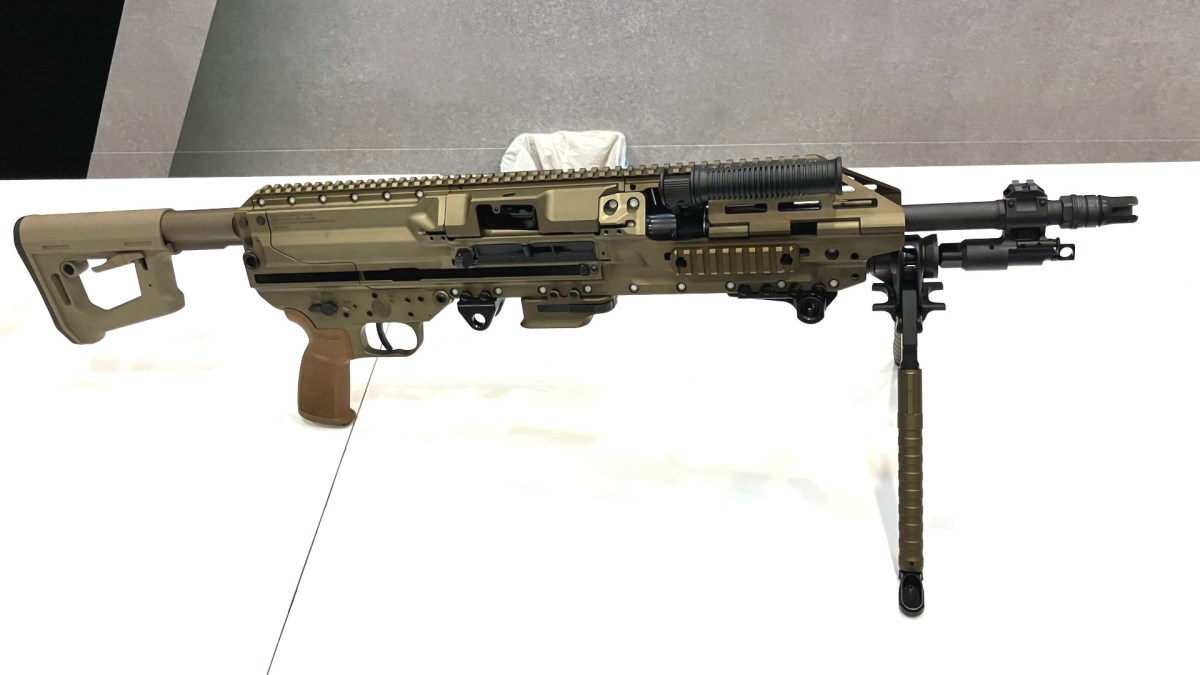
Feedback from the U.S. Army has led to an improved A1 version of the service’s still very new 6.8x51mm M250 light machine gun . Manufacturer Sig Sauer has shortened and lightened the barrel, reduced the overall weight, changed the buttstock, and made various other improvements to improve reliability and ease of use. The evolution of the M250 mirrors the transformation of Sig’s M7 rifle for the U.S. Army into the M8 carbine , where weight and bulk were major points of criticism of the original design.
Jason St. John, senior director of strategic products for the Defense Strategies Group at Sig Sauer, talked about the new M250A1 with our Howard Altman at the Association of the U.S. Army’s (AUSA) main annual convention today. The U.S. Army has already been acquiring and fielding baseline M250s as part of its Next Generation Squad Weapons (NGSW) program. The NGSW family also includes the M7 rifle and now the M8 carbine from Sig, both also chambered to fire the 6.8x51mm round. The Army chose Sig as the winner of the NGSW competition in 2022. The service is still in the early stages of fielding the NGSW family as replacements for a substantial portion of its existing 5.56x45mm M4A1 carbines and M249 Squad Automatic Weapons (SAW).
A promotional image of Sig Sauer’s entrants into the NGSW competition at the time of the company’s win in 2022. Sig Sauer
“We continuously and constantly evaluate and evolve our designs, and we discover things,” St. John told us. “Parts that might be able to be manufactured a little bit easier with a little bit of a design change. They might be more reliable, more durable than you currently have. You might look at the system and say, hey, we have an ability to make these recommendations because we see this from other customers across the board. We hear it from our inputs of soldiers that are in our ranks, and you know maybe old relationships out in the field.”
“The [NGSW] program office represents the entire formation, so they get feedback in the totality of every single unit that has them [M250s and other guns in the NGSW family] in their hands,” he continued. If “a systemic issue or something that needs to be addressed, then they run the soldier touchpoint events, which we’re fortunate enough to be a part of. And then we get unfiltered feedback from soldiers that day in the field while they’re encountering something that they have a concern about.”
As noted at the start, the most immediate standout feature on the M250A1 being shown at AUSA this week is the new 13-inch barrel. M250s entering Army service now have roughly 16-inch-long barrels. The Army’s official fact sheet says the machine gun was originally expected to come with a 17.5-inch barrel.
“We shortened the barrel to 13 inches, but the Army’s also buying the 16-inch barrel,” St. John explained. “So in some ways, you could consider it mission-configurable, whether they want to utilize a 13-inch barrel or a 16-inch barrel, to what they’re doing.”
“You’re going to maintain the same basic ballistics that you had with the M7 [rifle’s] 13-inch barrel, and then you’re going to have more maneuverability because you’re going to have a shorter weapon system,” he added. “You add the 16-inch barrel, and you get that lethality requirement with the length of barrel that they originally required. So you have some flexibility there.”
“You shorten the barrel, you’re going to lose velocity,” St. John did acknowledge. “We did not change the ammo. The Army had determined with the barrel change that they were meeting their ballistic and lethality goals with that length of barrel.”
With the current 6.8x51mm ammunition, “we’re operating in the mid-70s [sic; 70,000 pounds per square inch] as far as pressure, and the case has 125K psi potential,” he also noted. “If you wanted to shorten the barrel and you did have some lethality concerns or wanted more performance, all you need to simply do is just increase the little bit more pressure in the cartridge case, and you overcome that shortness.”
A graphic showing the components of a typical 6.8x51mm round, which has a hybrid case design with a steel base and brass body. Sig Sauer
“We didn’t do that. The Army said it wasn’t necessary, but you know, as the battlefield evolves and defensive postures change, If that becomes necessary, one of the great things about the NGSW program is the ability for the weapon systems and the ammunition to grow in their performance capacity,” he continued.
In the case of the 13-inch barrel, “we tapered the barrel down a little bit to add a little bit of weight savings,” he noted.
TWZ has reached out to Sig about getting more complete specifications for the M250A1, including overall length and total weight with different barrel options. The baseline version weighs some 13 pounds, empty, and without optics and other accessories, according to the Army’s fact sheet. As already mentioned, the M7 rifle also got progressively shorter and lighter before giving way fully to the M8 carbine, in part through reprofiling of the barrel. The empty weight of the M8 with its 10-inch barrel is close to one pound less than that of the 13-inch barrelled M7.
A US Army Ranger fires an M250 light machine gun. US Army
Different barrels can be readily swapped out on the M250A1, as well as the baseline M250. However, the new variant features significant changes to the quick-change barrel arrangement on the gun and associated elements of the design.
“It was interchangeable before, but it didn’t have a quick-change barrel handle. It wasn’t meant to be changed, and therefore it didn’t need the insulation of [sic; for] a hot barrel like you get with a barrel with a quick-change barrel handle,” according to St. John. “I think initially with the [M]250 program, it wasn’t necessary, and potentially might not have been desired initially. And why put that weight burden on there if we weren’t going to utilize it, right?”
St. John did not elaborate further on why these features were initially deemed unnecessary.
“When you look at the top cover of the forearm, that used to be loose, and now it’s captured, meaning that when you change the barrel, it actually came off completely in your hand,” he also noted. “We utilized a similar design to our .338 MMG [Medium Machine Gun], and then we make it captured now, so you’re not going to lose it.”
A picture of soldiers recieving instruction on baseline M250. The top cover on the example seen in front is open, and it notably lacks a handle to help with barrel changes. US Army
“We added a funnel to guide your gas piston in, so that when you’re doing barrel change operations, you don’t have to be precisely lined up,” he added. Now, “you have something that’s going to guide it in a stressful environment, to get that into position to do your barrel change.”
The M250A1 features a host of other changes that are unrelated to the barrel.
Sig also “improved our gas system a little bit, just to make it more reliable and durable,” to include modifications to keep it better “insulated from carbon and things like that.”
“We opened up the trigger guard to incorporate the Arctic fight, the Arctic glove, more so than just the operational normal tactical gloves,” according to St. John. “We opened it up a little bit more to accomplish that.”
An M250 seen during cold-weather testing. US Army
The Arctic is an ever-more strategic region where the U.S. faces growing geopolitical competition, especially from Russia and now China. Army officials also regularly point out that the harsh environment presents challenges when using standard equipment designed around use in more temperate locales.
“We improved the buttstock, and we improved the interface … to the receiver,” St. John explained. “We’ve made the interface between that more robust because through IMTing, and over time, and the buttstock getting slammed on the ground, and just normal military training and operations, we noticed that we had a tendency for some of them to loosen up and have some play in them.”
“The entire buttstock is a different buttstock than they had,” he added. “They [Army soldiers] preferred that buttstock over the buttstock that we had on it. So we just put soldiers’ preference on there. … It’s just a commercially available [design from] Magpul that they thought was better than the other Magpul that day one we were using.”
Changes were made to points where the M250 is designed to be attached to tripods on the ground or pintle mounts on vehicles.
“We put cross-bolts through the receiver to provide more durability,” he explained. “Initially, it was like an M-LOK type of lockup, and you can just think of a steel nut on an aluminum receiver being vibrated over a life cycle of the weapon system, it has some unfortunate wear characteristics. So, putting these cross pins redirects that force, and the way we lock it down with a saddle screw prevents that from happening and provides long-term durability to the receiver in the pintle and T&E [traverse and elevation] tripod-mounted configuration.”
The continued evolution of the M250 is not new. Sig talked to TWZ at AUSA last year about changes, including to the bipod and top cover, that were already making their way into the design.
The Army has yet to formally adopt the M250A1 configuration, and further changes could be made before service moves to officially acquire an improved version of the gun.
“This is likely to be the accepted configuration. We anticipate that acceptance,” Sig’s St. John told us. “We just finalized the acceptance on the M8, and they’re moving into the acceptance of the [M]250s. We anticipate right now, with the feedback that we’re getting from the program office, that the majority, if not all, of these changes are likely to be accepted.”
It’s important to reiterate that changes to the M7 rifle, and then the Army’s decision to transition fully to the further evolved M8 carbine, followed significant criticism of the core design of those guns and their ammunition, as well as the underlying doctrine. Sig has repeatedly pushed back on those critiques , and the Army continues to push ahead with the entire NGSW program.
Despite the steadily shortening barrels on guns in the NGSW family, the Army’s position remains that the weapons chambered for the new 6.8x51mm round offer essential additional accuracy, range, and terminal effectiveness over existing 5.56x45mm types . The genesis of the NGSW program had been heavily informed by the war in Afghanistan, where there were regular reports of U.S. ground units being outranged by their opponents. Adversary body developments were also a factor.
It is also important to point out that teething troubles are not at all uncommon in major weapon system programs, including when it comes to small arms. Sig has drawn attention to the less than positive reception that the AR-15/M16 family initially received in the mid-1960s, which led to a host of changes to that design. Rifles and carbines in that pattern are now in widespread service across the U.S. military and with dozens of armed forces and security services globally.
Regardless, even with the Army still very early on in the process of fielding the entire NGSW family of guns, the M250 light machine gun’s design is now evolving significantly.
Contact the author: joe@twz.com
Comments couldn’t be loaded. Please refresh the page.
作者:约瑟夫·特雷维西克、霍华德·奥特曼
发布于美国东部时间2026年10月13日下午3:38
美国陆军的反馈促成了该军种新型6.8×51毫米M250轻机枪的改进型A1的诞生。制造商西格绍尔缩短并减轻了枪管重量,降低了整体重量,改进了枪托,并进行了其他多项改进,以提高可靠性和易用性。M250的改进历程与西格绍尔为美国陆军研制的M7步枪向M8卡宾枪的演变如出一辙,后者最初的设计也曾因重量和体积过大而饱受诟病。
今天,在美军协会(AUSA)年度大会上,西格绍尔国防战略集团战略产品高级总监杰森·圣约翰与我们的霍华德·奥特曼探讨了新型M250A1步枪。作为下一代班组武器(NGSW)项目的一部分,美国陆军已经开始采购和部署M250系列步枪。NGSW系列还包括西格绍尔公司生产的M7步枪和新推出的M8卡宾枪,这两款步枪均使用6.8×51毫米口径弹药。陆军在2022年的NGSW竞标中选择了西格绍尔公司作为中标方。目前,陆军仍处于部署NGSW系列步枪的早期阶段,这些步枪将用于替换其现有的大部分5.56×45毫米口径M4A1卡宾枪和M249班用自动武器(SAW)。
这是西格绍尔公司在2022年赢得NGSW竞赛时,其参赛作品的宣传图片。
圣约翰告诉我们:“我们不断地评估和改进我们的设计,并从中发现新的东西。比如,稍微改动一下设计,某些部件的制造可能就会更容易一些。它们可能比你现在使用的部件更可靠、更耐用。你可能会审视一下系统,然后说,嘿,我们有能力提出这些建议,因为我们从其他客户那里也看到了类似的情况。我们从我们队伍中的士兵那里也听到了这些反馈,而且你可能还通过一些在前线建立的老关系了解到了这一点。”
“[NGSW]项目办公室代表整个部队,因此他们能够获得所有装备[M250和其他NGSW系列武器]的单位的全面反馈,”他继续说道。“如果存在系统性问题或需要解决的问题,他们就会组织士兵交流活动,我们很荣幸能够参与其中。这样,我们就能获得士兵当天在战场上遇到问题时最直接的反馈。”
正如开头所述,本周在AUSA展会上展出的M250A1最引人注目的特点是其全新的13英寸枪管。目前陆军服役的M250机枪枪管长度约为16英寸。陆军官方资料显示,该机枪最初预计配备17.5英寸枪管。
圣约翰解释说:“我们把枪管缩短到了13英寸,但陆军也在采购16英寸的枪管。所以从某种程度上来说,你可以认为它是任务可配置的,他们可以根据具体任务选择使用13英寸的枪管还是16英寸的枪管。”
“你将保持与M7步枪13英寸枪管相同的基本弹道性能,同时由于武器系统更短,机动性也会更强,”他补充道。“加上16英寸枪管,就能满足最初要求的杀伤力要求。所以这方面有一定的灵活性。”
圣约翰承认:“缩短枪管肯定会降低弹速。我们没有更换弹药。陆军方面已经确定,更换枪管后,他们能够以原有的枪管长度达到弹道性能和杀伤力目标。”
他还指出,目前6.8x51毫米弹药的膛压“在70磅/平方英寸左右(原文如此,应为70,000磅/平方英寸),而弹壳的膛压潜力可达125,000磅/平方英寸”。“如果你想缩短枪管,但又担心杀伤力不足或想要提升性能,你只需要稍微增加弹壳内的膛压,就能克服枪管长度不足的问题。”
图示展示了典型的6.8x51毫米子弹的组成部分,这种子弹采用混合弹壳设计,钢制底座和黄铜弹体。西格绍尔
“我们没有那样做。陆军说没必要,但是你知道,随着战场演变和防御态势的变化,如果真的有必要,新一代武器系统(NGSW)项目的一大优势就是武器系统和弹药的性能可以不断提升,”他继续说道。
他指出,对于 13 英寸枪管,“我们稍微缩小了枪管的直径,以减轻一些重量。”
TWZ已联系西格绍尔公司,希望获得M250A1的更完整规格,包括不同枪管选项下的总长度和总重量。根据陆军的情况说明书,基本型M250A1的空枪重量约为13磅,不含光学瞄具和其他配件。如前所述,M7步枪在完全被M8卡宾枪取代之前,其长度和重量也在不断缩短,部分原因是枪管形状的重新设计。配备10英寸枪管的M8卡宾枪的空枪重量比配备13英寸枪管的M7卡宾枪轻近1磅。
一名美国陆军游骑兵正在使用M250轻机枪射击。美国陆军
M250A1 和基础型 M250 都可以轻松更换不同的枪管。然而,新型号在枪支的快速更换枪管装置及其相关设计元素方面进行了重大改进。
圣约翰表示:“以前枪管是可以互换的,但它没有快拆枪管手柄。它本来就不是设计用来更换枪管的,因此不需要像快拆枪管手柄那样对枪管进行隔热处理。我认为在M250项目初期,这种隔热措施并非必要,或许最初也并非我们想要的。如果我们不打算使用它,为什么要增加额外的重量呢?”
圣约翰没有进一步详细说明为什么这些功能最初被认为是不必要的。
“你看前护木的上盖,以前是松动的,现在是固定的,也就是说,换枪管的时候,它会完全取下来,”他还指出。“我们采用了和.338 MMG(中型机枪)类似的设计,现在改成了固定式,这样就不会弄丢了。”
一张士兵正在接受M250基础型机枪使用培训的照片。照片中前方这支机枪的顶盖是打开的,而且明显缺少用于更换枪管的把手。美国陆军
“我们增加了一个漏斗来引导气活塞进入,这样在进行枪管更换操作时,就不需要精确对准了,”他补充道。“现在,即使在压力较大的环境下,也有东西可以引导它就位,方便你进行枪管更换。”
M250A1 还进行了一系列与枪管无关的其他改进。
Sig 还“稍微改进了我们的气体系统,使其更加可靠耐用”,包括进行一些修改,使其“更好地与碳等物质隔离”。
圣约翰表示:“我们扩大了扳机护圈的开口,以便更好地适配北极作战手套,而不仅仅是普通的战术手套。我们为此做了更多改进。”
一辆M250坦克正在进行寒冷天气测试。美国陆军
北极地区战略地位日益重要,美国在此面临日益激烈的地缘政治竞争,尤其来自俄罗斯,如今也包括中国。军方官员也经常指出,严酷的环境给使用专为温带地区设计的常规装备带来了挑战。
圣约翰解释说:“我们改进了枪托,也改进了枪托与机匣的连接处。我们加强了连接处的牢固性,因为通过持续的训练和使用,以及枪托在日常军事训练和作战中被猛烈撞击,我们注意到有些连接处容易松动,出现晃动。”
“整个枪托都和他们之前用的不一样,”他补充道。“他们(陆军士兵)更喜欢这个枪托,而不是我们当时用的那个。所以我们就把士兵们的喜好换上了……这只是Magpul公司一款市面上能买到的枪托,他们认为比我们当时用的Magpul枪托要好。”
M250 的设计中,用于连接地面三脚架或车辆上的枢轴支架的部位进行了更改。
他解释说:“我们在机匣上加装了横向螺栓,以提高其耐用性。最初,它采用的是类似M-LOK的锁定方式,你可以想象一下,铝制机匣上的钢螺母在武器系统的整个使用寿命周期中会受到振动,这会导致一些磨损问题。因此,加装这些横向销钉可以转移这种力,而我们用鞍形螺钉将其固定的方式则可以防止这种情况发生,从而确保机匣在枪架和三脚架(横向和纵向)安装配置下的长期耐用性。”
M250的持续改进并非新鲜事。去年在AUSA展会上,Sig曾与TWZ谈及一些改进措施,包括对两脚架和顶盖的改动,这些改动当时已经在设计中逐步落实。
陆军尚未正式采用 M250A1 配置,在正式采购改进型火炮之前,可能还会进行进一步的改动。
“这很可能是最终被接受的配置。我们预计它会被接受,”Sig公司的圣约翰告诉我们。“我们刚刚完成了M8的验收工作,他们现在正着手验收M250。根据我们从项目办公室得到的反馈,我们预计即使不是全部,大部分变更也都会被接受。”
必须重申的是,M7步枪的改进,以及随后陆军决定全面过渡到更先进的M8卡宾枪,都是在对这些枪支及其弹药的核心设计以及相关理论提出诸多批评之后做出的。西格公司多次反驳这些批评,而陆军也继续推进整个新一代武器系统(NGSW)项目。
尽管新一代战略武器(NGSW)系列枪械的枪管长度不断缩短,但陆军仍然坚持认为,使用新型6.8×51毫米弹药的武器相比现有的5.56×45毫米口径武器,在精度、射程和终端杀伤力方面都具有显著优势。NGSW项目的诞生很大程度上受到了阿富汗战争的影响,当时美军地面部队经常在射程上落后于对手。敌方武器装备的发展也是一个重要因素。
值得注意的是,大型武器系统项目,包括小型武器项目,初期出现问题并非罕见。西格绍尔公司曾指出,AR-15/M16系列步枪在20世纪60年代中期最初反响平平,这导致其设计进行了一系列改进。如今,该系列步枪和卡宾枪已在美国军队以及全球数十个国家的武装部队和安全机构中广泛服役。
无论如何,即使陆军仍处于部署整个 NGSW 系列枪支的早期阶段,M250 轻机枪的设计现在也发生了显著变化。
联系作者:joe@twz.com
评论加载失败,请刷新页面。