Bradley’s Old TOW Launchers Get New Teeth With Spike Missile Adapter布雷德利战车的旧式TOW导弹发射器换装了Spike导弹适配器
The system allows old TOW missile launchers to fire the massively more capable Spike LR2 without major modifications. The system allows old TOW missile launchers to fire the massively more capable Spike LR2 without major modifications.
新闻视频
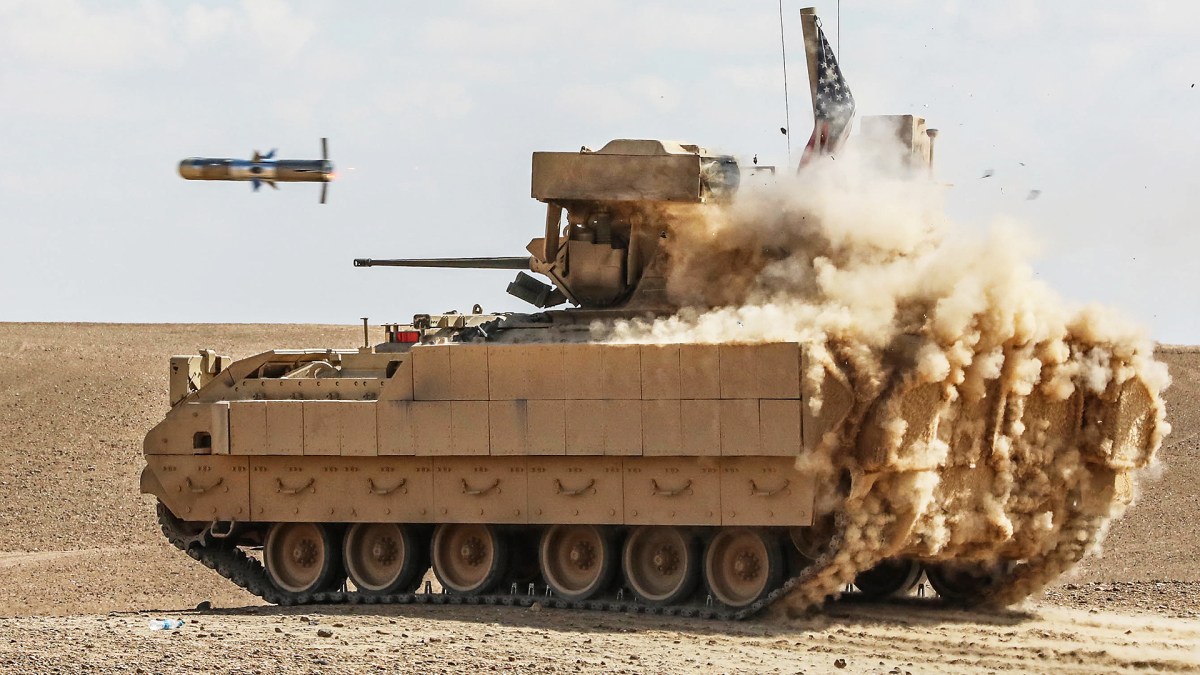
Published Oct 13, 2026 2:35 PM EDT
U.S. Army photo by Spc. William Gore
Rafael USA and Leonardo DRS have presented a capability that would allow fighting vehicles equipped with legacy Tube-launched, Optically tracked, Wire-guided (TOW) missile launchers to fire Rafael’s Spike LR2 anti-armor missiles. The effort builds on a demonstration dating back to 2021, with the companies now presenting a more mature adapter solution designed to integrate the Israeli-made missile into existing platforms.
Roman Palaria, Rafael’s vice president for marketing and business development in its land and naval division, discussed the system in an interview with TWZ at the Association of the U.S. Army’s (AUSA) main annual convention . He explained that the earlier demonstration, part of Project Convergence 2021 , used a version of the adapter that had not yet reached its final configuration. Leonardo DRS, Rafael’s U.S. partner, subsequently developed the mechanical and electrical components needed to connect the Spike LR2 to the TOW launcher and the vehicle’s existing systems.
The Rafael/Leonardo adaptor that allows TOW missile launchers to fire Rafael’s Spike LR2 anti-armor missiles. Howard Altman
The approach is intended to avoid replacing the launcher or radically overhauling the vehicle’s gunner station. Instead, the adapter provides the mechanical interface for loading the Spike LR2 missile and the electrical connections needed to communicate with the vehicle. Additional electronic components are installed within the vehicle to support the missile’s functions.
The adaptor configured for TOW (left) and Spike LR2 (right) missiles. Leonardo DRS
“We’re doing minimum changes to the vehicle,” Palaria said, describing the goal of making the integration as seamless as possible for the operator.
The Bradley infantry fighting vehicle is a prominent potential application, although the companies say the capability could extend to other platforms that use TOW launchers. The Army has operated TOW-equipped vehicles for decades, creating a substantial installed base of launch systems that could potentially benefit from the approach. As for the Bradley, the Army effort to replace its TOW missiles has been a long one, but is yet to produce any real results .
A U.S. Army M2A4 Bradley. The TOW launcher can be clearly seen on the side of the turret. U.S. Army photo by Sgt. Austin Steinborn
Spike LR2 was successfully test-fired from M2A4 Bradley equipped with Multi-Purpose Missile Launcher (MPML), developed by Rafael and DRS. Adapters allow the system to remain compatible with existing TML/UTML launchers. Spike LR2 has also been proposed for the CCMS-H and XM30. pic.twitter.com/KB9EYwi6BI — Ronkainen (@ronkainen7k15) October 13, 2026
Spike LR2 was successfully test-fired from M2A4 Bradley equipped with Multi-Purpose Missile Launcher (MPML), developed by Rafael and DRS. Adapters allow the system to remain compatible with existing TML/UTML launchers. Spike LR2 has also been proposed for the CCMS-H and XM30. pic.twitter.com/KB9EYwi6BI
After a missile is fired, its launch tube remains in the launcher and can be removed to accommodate another missile.
The central attraction of the system is the ability to combine existing launcher infrastructure with the Spike LR2’s unique engagement capabilities.
During Project Convergence 2021, two Spike missiles were fired from a TOW launcher, and both reportedly hit their intended targets. The adapter now being presented reflects subsequent development work by Leonardo DRS, including refinement of the mechanical interface and vehicle electrical integration.
An M2A3 Bradley uses its twin-tube, turret-mounted launcher to fire a BGM-71 TOW anti-tank missile. U.S. Army photo by Spc. Brandi Frizzell
The system is designed to preserve the vehicle’s existing TOW capability while adding the option to use Spike LR2. That would give commanders another missile option without necessarily requiring wholesale replacement of installed launcher equipment. The extent to which individual vehicles could use both missile types would depend on the completed integration and applicable qualification requirements.
Another view of the Rafael/Leonardo Spike LR2 adaptor. Howard Altman Howard Altman
The Spike LR2 offers capabilities differ substantially from those of the legacy TOW missile. Palaria cited a maximum range of approximately 5.5 kilometers (3.4 miles) and highlighted the missile’s day/night imaging seeker, which provides video to the operator during flight. The longest-range TOW missile versions max out at around 4.5 kilometers (2.8 miles).
In contrast, Spike LR2’s imaging capability supports engagement of targets beyond the operator’s direct line of sight, as well as observation of the target area during the missile’s approach. Depending on the engagement, the operator can acquire a target through the missile’s seeker, adjust the engagement, or select a different target while the missile is in flight.
These features contrast with the traditional TOW’s semi-automatic command to line-of-sight (SACLOS) guidance, in which the gunner tracks the target through the launcher’s observation system and guides the missile throughout its flight. Spike LR2’s onboard imaging provides a different set of options for engagements in which direct observation is limited or target conditions change after launch. This can also include striking targets behind cover.
Palaria also described the LR2’s two warhead options. The first of these is a tandem-charge anti-tank warhead, which Rafael claims is able to penetrate any modern main battle tank. It consists of a precursor warhead and the main warhead, which are designed to penetrate the reactive armor, and the main armor, respectively.
The second option is a multi-purpose configuration. It has a programmable fuze, which allows the missile to be employed against different target types. Depending on the selected mode, the warhead can be configured for direct-impact or timed-detonation effects, for example, detonating above the ground for anti-personnel missions, or penetrating a building, in which case the first charge will make a hole in in a wall, and then the second charge will go inside and explode after a short delay.
The adapter offers a potential route to adding new missile capabilities to existing Army vehicles while limiting changes to their launcher hardware and crew interface.
Operator training would obviously be necessary. Although the gunner would continue using the vehicle’s existing console and displays, Palaria acknowledged that Spike LR2 introduces additional functions, controls, and engagement procedures.
Slovenian soldiers engage targets with a Spike LR anti-tank missile during a live-fire exercise. U.S. Army photo by Visual Information Specialist Davide Dalla Massara/Released
For the Army, the proposition is straightforward: retain a familiar launcher architecture while potentially adding a missile with greater reach, onboard imaging, and more flexible engagement options that exceed line-of-sight tracking. The adapter’s significance lies in making that combination possible without starting from a clean sheet.
Whether that capability becomes a fielded upgrade will depend on the Army’s requirements, testing, integration decisions, and procurement plans. But the widespread uptake of the Spike series of missiles around the globe, combined with the very large existing TOW missile operator base, means the adapter solution could well be of interest to customers outside the U.S. Army, too.
Contact the author: thomas@thewarzone.com
Comments couldn’t be loaded. Please refresh the page.
发布于美国东部时间2026年10月13日下午2:35
美国陆军下士威廉·戈尔拍摄
美国拉斐尔公司和莱昂纳多DRS公司联合展示了一项新技术,该技术可使配备传统管式发射、光学跟踪、线导(TOW)导弹发射器的作战车辆发射拉斐尔公司的“长钉”LR2反装甲导弹。这项技术建立在2021年进行的演示基础上,两家公司此次展示了一种更为成熟的适配器解决方案,旨在将以色列制造的这款导弹集成到现有平台上。
拉斐尔公司陆海业务部市场营销和业务发展副总裁罗曼·帕拉里亚在美国陆军协会(AUSA)年度大会期间接受TWZ采访时谈到了该系统。他解释说,此前作为“融合2021项目”一部分的演示所使用的适配器版本尚未达到最终配置。拉斐尔公司的美国合作伙伴莱昂纳多DRS公司随后开发了将Spike LR2系统连接到TOW导弹发射器和车辆现有系统所需的机械和电气组件。
拉斐尔/莱昂纳多适配器,使TOW导弹发射器能够发射拉斐尔公司的“长钉”LR2反装甲导弹。霍华德·奥特曼
该方案旨在避免更换发射器或对车辆的炮手舱进行彻底改造。适配器提供装载“长钉”LR2导弹的机械接口以及与车辆通信所需的电气连接。车辆内部还安装了其他电子元件以支持导弹的各项功能。
适配器配置用于TOW导弹(左)和Spike LR2导弹(右)。莱昂纳多DRS
“我们对车辆的改动极少,”帕拉里亚说道,他表示,目标是尽可能地为操作员实现无缝集成。
布雷德利步兵战车是这项技术的一个突出潜在应用对象,不过相关公司表示,该技术也可扩展到其他使用TOW导弹发射器的平台。美国陆军使用配备TOW导弹的车辆已有数十年历史,积累了相当数量的发射系统,这些系统有望从这项技术中受益。至于布雷德利战车,陆军更换TOW导弹的努力已持续多年,但至今尚未取得任何实质性成果。
一辆美国陆军M2A4布雷德利步兵战车。炮塔侧面的TOW导弹发射器清晰可见。美国陆军中士奥斯汀·斯坦伯恩摄
Spike LR2导弹已成功从配备多用途导弹发射器(MPML)的M2A4布雷德利步兵战车上进行试射,该发射器由拉斐尔公司和DRS公司联合研制。适配器使该系统能够与现有的TML/UTML发射器兼容。Spike LR2导弹也已被提议用于CCMS-H和XM30导弹系统。pic.twitter.com/KB9EYwi6BI — Ronkainen (@ronkainen7k15) October 13, 2026
Spike LR2导弹已成功从配备多用途导弹发射器(MPML)的M2A4布雷德利步兵战车上进行试射,该导弹由拉斐尔公司和DRS公司联合研制。适配器使该系统能够与现有的TML/UTML发射器兼容。Spike LR2导弹也已被提议用于CCMS-H和XM30导弹系统。pic.twitter.com/KB9EYwi6BI
导弹发射后,其发射管仍留在发射器内,可以取出以容纳另一枚导弹。
该系统的核心吸引力在于能够将现有的发射基础设施与 Spike LR2 独特的交战能力相结合。
在2021年“融合计划”(Project Convergence 2021)期间,两枚“长钉”(Spike)导弹从陶式(TOW)导弹发射车发射,据报道均击中了预定目标。此次展示的适配器体现了莱昂纳多DRS公司后续的研发成果,包括对机械接口和车辆电气集成方面的改进。
一辆M2A3布雷德利步兵战车使用其炮塔上的双管发射器发射一枚BGM-71 TOW反坦克导弹。美国陆军下士布兰迪·弗里泽尔摄
该系统旨在保留车辆现有的TOW导弹能力,同时增加使用Spike LR2导弹的选项。这将为指挥官提供另一种导弹选择,而无需彻底更换已安装的发射设备。单个车辆能够使用两种导弹的程度将取决于最终的集成情况和相关的鉴定要求。
Rafael/Leonardo Spike LR2适配器的另一视角。霍华德·奥特曼
Spike LR2导弹的性能与传统的TOW导弹截然不同。帕拉里亚指出,其最大射程约为5.5公里(3.4英里),并重点介绍了该导弹的昼夜成像导引头,该导引头可在飞行过程中向操作员提供视频图像。而TOW导弹最远射程的型号最大射程约为4.5公里(2.8英里)。
相比之下,Spike LR2的成像能力支持对超出操作员直接视线范围的目标进行攻击,并可在导弹接近目标的过程中观察目标区域。根据攻击目标的不同,操作员可以通过导弹的导引头锁定目标、调整攻击方式,或在导弹飞行过程中选择其他目标。
这些特性与传统的TOW导弹的半自动指令瞄准线(SACLOS)制导方式截然不同。在传统的TOW导弹中,炮手通过发射器的观测系统跟踪目标,并在整个飞行过程中引导导弹。Spike LR2的机载成像功能为直接观测受限或发射后目标状况发生变化的作战场景提供了不同的选择。这还包括打击掩体后的目标。
帕拉里亚还介绍了LR2的两种弹头选项。第一种是串联装药反坦克弹头,拉斐尔公司声称它能够穿透任何现代主战坦克。它由一个前置弹头和一个主弹头组成,分别用于穿透反应装甲和主装甲。
第二种方案是多用途配置。它配备可编程引信,使导弹能够用于打击不同类型的目标。根据所选模式,弹头可配置为直接撞击或定时引爆,例如,在地面上方引爆以执行反人员任务,或穿透建筑物,在这种情况下,第一枚装药会在墙上炸出一个洞,然后第二枚装药进入洞内,并在短暂延迟后引爆。
该适配器为现有陆军车辆增加新的导弹能力提供了一种潜在途径,同时限制了对其发射器硬件和乘员界面的改动。
操作员培训显然是必要的。虽然炮手将继续使用车辆现有的控制台和显示器,但帕拉里亚承认,Spike LR2 引入了额外的功能、控制和交战程序。
在一次实弹演习中,斯洛文尼亚士兵使用“长钉LR”反坦克导弹攻击目标。美国陆军视觉信息专家戴维德·达拉·马萨拉拍摄/发布
对陆军而言,方案很简单:保留熟悉的发射装置架构,同时可能加装射程更远、配备机载成像装置和更灵活交战选项(超越视距跟踪)的导弹。适配器的意义在于,它无需从零开始就能实现这种组合。
该功能能否最终成为一项实战升级,将取决于陆军的需求、测试、集成决策和采购计划。但鉴于“长钉”系列导弹在全球范围内的广泛应用,以及庞大的“陶”式导弹现有用户群体,该适配器方案很可能也会引起美国陆军以外客户的兴趣。
联系作者:thomas@thewarzone.com
评论加载失败,请刷新页面。