Specter Jet-Powered Drone Aims At Low Cost, Multi-Mission, Single UseSpecter喷气动力无人机旨在实现低成本、多任务、一次性使用
The turbojet-powered drone is designed for one-way attack missions, but AEVEX says it could also carry cameras, jamming gear, and other payloads. The turbojet-powered drone is designed for one-way attack missions, but AEVEX says it could also carry cameras and other non-kinetic payloads.
新闻视频
Published Oct 13, 2026 1:47 PM EDT
AEVEX Corp. has publicly shown its Specter jet-powered drone for the first time at the Association of the U.S. Army’s (AUSA) annual meeting in Washington, D.C., where TWZ is in attendance . The aircraft is the latest development from a company that has played a significant role in the U.S. military’s one-way attack drone efforts. Most notably, it built the secretive Phoenix Ghost family rushed to Ukraine in 2022.
AEVEX announced Specter in September, describing it as a high-speed, low-cost, jet-powered autonomous platform designed for high-risk operational environments. The aircraft is being developed around a modular architecture, with ground-launched and air-launched variants planned. Its interchangeable nose section is intended to accommodate different payloads, including kinetic warheads, electronic warfare equipment, intelligence, surveillance and reconnaissance (ISR) systems, and other future capabilities.
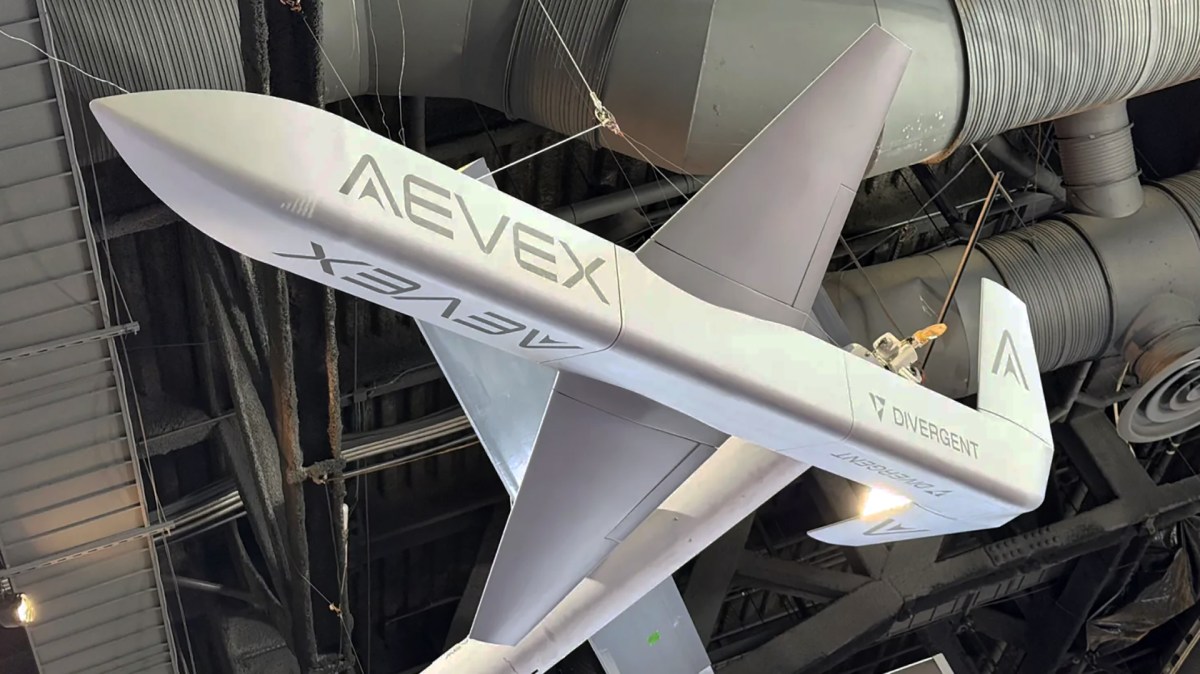
The Specter jet-powered drone shown for the first time at the Association of the U.S. Army’s (AUSA) annual meeting in Washington, D.C. Jamie Hunter
That flexibility is central to how AEVEX is pitching the aircraft. The company is aiming for an adaptable system that can be configured for different operational needs while remaining affordable enough to be used basically as a cruise missile in combat applications.
The aircraft’s external configuration features a prominent V-shaped lower fuselage, high-mounted, unswept trapezoidal wings, a v-tail and rear-mounted conformal engine intakes. Clearly, low observability was one design driver for Specter, with the goal of balancing survivability with low-cost likely factored in heavily. AEVEX has not publicly discussed Specter’s low-observable characteristics.
The company has also not disclosed key performance and technical details, including the aircraft’s range, payload capacity, communications architecture, terminal targeting methods or the extent of its autonomous capabilities.
A rendering of the Specter in flight. AEVEX Corp. AEVEX Corp.
“We’re really excited to kind of really up our stats on range and speed,” Craig Anders, an AEVEX representative, told TWZ at AUSA, describing Specter’s turbine engine. The aircraft is being designed to reach speeds in the sub-Mach range, he said.
Anders also elaborated on how Specter is intended to carry more than a conventional warhead. “This thing is going to have the ability to carry cameras and different types of non-kinetic effect payloads,” he said, describing it as a “multi-mission, multi-domain fighter.”
Despite that broader mission set, attrition remains a core part of the concept. Anders said the idea was for the aircraft to be attritable, with a relatively low price tag allowing commanders to send it farther into dangerous areas without putting more expensive capabilities at risk.
The distinction is important. Specter is not being presented simply as a disposable munition, nor as a high-end unmanned combat aircraft. Instead, AEVEX appears to be pursuing a middle ground: a jet-powered platform that can perform one-way attack missions but also support reconnaissance and provide other effects in high-threat areas, depending on its configuration. It is also meant to be built economically at scale.
AEVEX is developing Specter with Divergent, an engineering and manufacturing company known for its digital production processes and metal additive manufacturing. The partnership is intended to help make the aircraft easier to manufacture at scale while supporting changes to its design and configuration.
Anders said Divergent works with AEVEX engineers on the aircraft’s digital design and produces its fuselage. AEVEX is responsible for the internal systems, mission integration, flight characteristics and navigation science, he explained.
The manufacturing approach is a significant part of the program’s affordability ambitions. AEVEX says Divergent’s Digital Manufacturing and Production System (DAPS) is being used to support scalable production and manufacturability. However, the companies have not disclosed Specter’s projected unit cost or demonstrated that it can yet be produced at the volumes and prices the concept ultimately requires.
AEVEX is also drawing on its CompassX autonomy architecture and experience delivering thousands of autonomous systems. The company says Specter’s open interfaces and software-defined capabilities are intended to allow the platform to evolve as operational requirements change, rather than being optimized around one fixed mission.
Specter remains in development, with its first flight planned for December 2026. Anders said the initial flight would be a basic test, with early test aircraft fitted with landing gear so they can be recovered and reused for work on flight characteristics and handling. It isn’t clear if a truly reusable gear-equipped operational version is eyed for the future. Regardless, further testing could include tuning the aircraft’s dive profile.
The planned initial configuration uses a ground launch assisted by a rocket, or rocket-assisted takeoff (RATO), system. An air-launched version is also on the roadmap, Anders said, with that capability expected to follow in the relatively near term.
AEVEX is pursuing several potential military applications. Anders identified the U.S. Army’s Family of Affordable Mass Missiles (FAMM) effort as a primary focus, while noting that the service has its own high-speed requirements. He also said the company is looking at opportunities associated with Rapid Dragon and other programs.
In FY 2027, the US Air Force is requesting $55 Million in discretionary and $300 Million in mandatory (reconciliation) funds for the Family of Affordable Mass Missile (FAMM) to procure 1,000 All Up Rounds covering both the Palletized (FAMM-P) and Lugged (FAMM-L) variants. The… pic.twitter.com/EgVaefmJgY — Air-Power | NatSec Ledger (@NatSecLedger) April 22, 2026
In FY 2027, the US Air Force is requesting $55 Million in discretionary and $300 Million in mandatory (reconciliation) funds for the Family of Affordable Mass Missile (FAMM) to procure 1,000 All Up Rounds covering both the Palletized (FAMM-P) and Lugged (FAMM-L) variants. The… pic.twitter.com/EgVaefmJgY
Those comments indicate the range of applications AEVEX hopes Specter could address, not that the aircraft has been selected for any of them. Its performance, cost and ability to meet specific requirements will need to be demonstrated as development and testing progress.
Specter’s intended combination of jet propulsion, attritability and modular payloads could offer an enticing balance. It is not being presented as a higher-end ‘exquisite’ cruise missile, but neither is it limited to carrying a single payload type. The challenge for AEVEX will be delivering enough speed, range and mission flexibility to make the aircraft useful across multiple roles without pushing its price beyond what operators can justify procuring it in large numbers.
A stealthy weapon that is jet-powered like Specter, one that can be configured for various types of one-way missions, could bridge the gap between far more advanced and costly autonomous aircraft and cruise missiles and lower-end one-way attack drones. There have been other concepts that are similar to Specter, we are living in a low-cost cruise missile explosion of sorts, but the company’s unique pedigree of innovation and fast fielding in the one-way attack munition space could give Specter additional credence.
Contact the author: thomas@thewarzone.com
Comments couldn’t be loaded. Please refresh the page.
发布于美国东部时间2026年10月13日下午1:47
AEVEX公司在华盛顿特区举行的美国陆军协会(AUSA)年会上首次公开展示了其Specter喷气式无人机,TWZ也出席了此次年会。这款无人机是该公司最新研发的成果,该公司在美国军方的单向攻击无人机项目中扮演了重要角色。最值得一提的是,该公司制造了神秘的Phoenix Ghost系列无人机,并于2022年紧急交付给乌克兰。
AEVEX公司于9月发布了Specter无人机,称其为一款高速、低成本的喷气式自主平台,专为高风险作战环境而设计。该无人机采用模块化架构,计划推出陆基和空基两种型号。其可互换的机头部分旨在适配不同的有效载荷,包括动能弹头、电子战设备、情报、监视和侦察(ISR)系统以及其他未来功能。
Specter喷气式无人机在华盛顿特区举行的美国陆军协会(AUSA)年会上首次亮相。——杰米·亨特
这种灵活性是AEVEX公司推销这款飞机的核心所在。该公司旨在打造一款适应性强的系统,能够根据不同的作战需求进行配置,同时保持足够的经济性,使其基本上可以作为巡航导弹用于作战应用。
该机的外部结构特征包括醒目的V形下机身、高位安装的无后掠梯形机翼、V形尾翼和后置保形发动机进气口。显然,低可探测性是“幽灵”(Specter)的设计驱动因素之一,而兼顾生存能力和低成本的目标很可能也是重要的考量因素。AEVEX公司尚未公开讨论“幽灵”的低可探测性特性。
该公司也没有披露关键性能和技术细节,包括飞机的航程、有效载荷能力、通信架构、终端目标定位方法或其自主能力的程度。
Specter飞行中的渲染图。AEVEX公司。AEVEX公司。
“我们非常兴奋能够大幅提升航程和速度方面的性能,”AEVEX公司的代表克雷格·安德斯在AUSA展会上告诉TWZ,他指的是Specter的涡轮发动机。他说,这款飞机的设计目标是达到亚马赫速度。
安德斯还详细阐述了“幽灵”导弹的设计初衷是携带除传统弹头以外的更多武器。“这玩意儿将能够携带摄像机和各种类型的非动能效应载荷,”他说道,并将其描述为一款“多任务、多域战斗机”。
尽管任务范围更广,但损耗机制仍然是该概念的核心部分。安德斯表示,设计理念是让这种飞机具备可损耗性,同时保持相对较低的价格,使指挥官能够将其派往更危险的区域,而不会危及更昂贵的作战能力。
这种区别至关重要。“幽灵”无人机并非简单地被定位为一次性弹药,也并非高端无人作战飞机。相反,AEVEX公司似乎正在寻求一种折衷方案:一种喷气动力平台,既能执行单程攻击任务,又能根据配置在高威胁地区支援侦察并发挥其他作用。此外,它还旨在实现经济高效的规模化生产。
AEVEX正与Divergent公司合作开发Specter飞机。Divergent是一家工程制造公司,以其数字化生产流程和金属增材制造技术而闻名。此次合作旨在帮助Specter飞机更易于大规模生产,并支持对其设计和配置进行更改。
安德斯表示,Divergent公司与AEVEX公司的工程师合作进行飞机的数字化设计并生产机身。他解释说,AEVEX公司则负责内部系统、任务集成、飞行特性和导航科学。
制造方式是该项目实现低成本目标的重要组成部分。AEVEX 表示,他们正在使用 Divergent 的数字化制造和生产系统 (DAPS) 来支持可扩展的生产和可制造性。然而,两家公司尚未披露 Specter 的预计单位成本,也未证明其能够以最终概念所需的产量和价格进行生产。
AEVEX 还借鉴了其 CompassX 自主架构以及交付数千套自主系统的经验。该公司表示,Specter 的开放式接口和软件定义功能旨在使平台能够随着运行需求的变化而演进,而不是围绕单一固定任务进行优化。
Specter仍在研发中,计划于2026年12月进行首飞。安德斯表示,首飞将是一次基础测试,早期测试飞机将配备起落架,以便回收并重复使用,用于飞行特性和操控性能的测试。目前尚不清楚未来是否会推出真正可重复使用起落架的作战版本。无论如何,后续测试可能包括调整飞机的俯冲剖面。
安德斯表示,计划中的初始配置采用火箭助推地面发射,即火箭助推起飞(RATO)系统。空射版本也在研发计划之中,预计该能力将在不久的将来实现。
AEVEX公司正在探索多种潜在的军事应用。安德斯指出,美国陆军的“经济型大规模导弹系列”(FAMM)项目是其主要关注点,同时他也提到,陆军自身也有高速导弹的需求。他还表示,公司正在研究与“快速龙”(Rapid Dragon)导弹及其他项目相关的机遇。
2027财年,美国空军申请5500万美元的自由支配资金和3亿美元的强制性(协调)资金,用于采购“经济型大规模导弹系列”(FAMM)共计1000枚导弹,涵盖托盘式(FAMM-P)和拖挂式(FAMM-L)两种型号。…… pic.twitter.com/EgVaefmJgY — Air-Power | NatSec Ledger (@NatSecLedger) April 22, 2026
2027财年,美国空军申请5500万美元的自由支配资金和3亿美元的强制性(协调)资金,用于采购“经济型大规模导弹系列”(FAMM)共计1000枚导弹,涵盖托盘式(FAMM-P)和拖挂式(FAMM-L)两种型号。…… pic.twitter.com/EgVaefmJgY
这些评论表明了AEVEX希望Specter能够满足的应用范围,但并不意味着该飞机已被选中用于任何特定应用。其性能、成本以及满足特定需求的能力还需要在研发和测试过程中得到验证。
“幽灵”导弹计划采用喷气推进、可损耗性和模块化有效载荷的组合,有望实现极具吸引力的平衡。它并非定位为高端“精致”的巡航导弹,但也并非只能携带单一类型的有效载荷。AEVEX公司面临的挑战在于,如何在保证足够速度、航程和任务灵活性的前提下,使该导弹能够胜任多种任务,同时又不至于使价格超出运营商的承受范围,从而避免大量采购。
像“幽灵”(Specter)这样采用喷气动力、可配置执行各种单程任务的隐形武器,有望弥合更先进、更昂贵的自主飞行器和巡航导弹与低端单程攻击无人机之间的差距。虽然此前也出现过一些与“幽灵”类似的概念,我们正处于某种低成本巡航导弹爆发式发展的时代,但该公司在单程攻击弹药领域独特的创新能力和快速部署能力,无疑会为“幽灵”增添更多可信度。
联系作者:thomas@thewarzone.com
评论加载失败,请刷新页面。