Israel’s IAI unveils 3 new air defense systems at AUSA以色列航空工业公司(IAI)在AUSA展会上推出三款新型防空系统。
Unveiled today during the AUSA conference, the three systems represent the different approaches defense companies are pursuing as unmanned aerial vehicles reshape modern warfare.
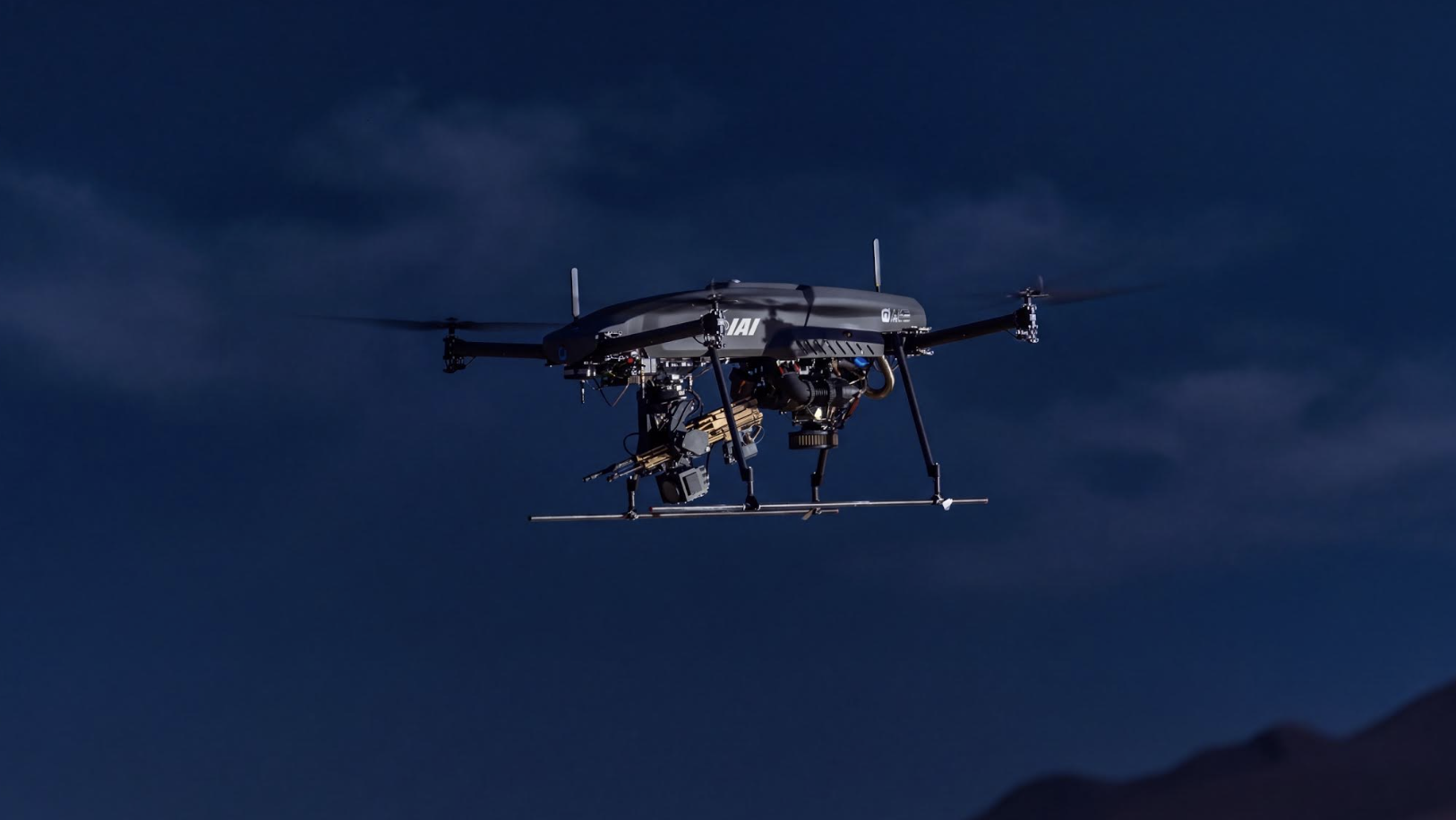
Fire Storm 250 (Credit: Israel Aerospace Industries)
JERUSALEM — Israel Aerospace Industries has unveiled a trio of new systems at the annual AUSA conference that reflect efforts to adapt existing technologies to emerging battlefield threats.
The new capabilities include a mobile aerostat-based radar as well as a counter-drone interceptor that doesn’t use an explosive warhead. The third system — called Fire Storm 250 and developed with Sig Sauer — is a drone equipped with an M250 machine gun.
Dror Bar, executive vice president at IAI and CEO of the company’s Elta Systems, told Breaking Defense that the new aerostat-radar system, called Point@Air, addresses a shift in how the platforms are being used. Aerostats, which are essentially large balloons or dirigibles, have long been used for surveillance but have become vulnerable to drone attacks due to their static infrastructure, Bar said.
Point@Air combines an aerostat with a phased-array radar that Bar said can detect a wide range of targets, from fighter aircraft and large drones to cruise missiles and maritime targets. At around 70 meters (230 feet) long, the system is designed to operate without fixed infrastructure and can be redeployed to a new location within hours, he said.
The capability addresses a vulnerability Israel recently experienced when Hezbollah targeted a large aerostat in northern Isra el, Bar explained. By al lowing operators to move the aerostat, IAI aims to make it harder for adversaries to pinpoint its position and target it with one-way attack drones.
“When sunset arrives, you just fold it and move to the next hill or two, and when morning comes, your enemy sees that you are not there anymore,” Bar said.
He noted that the system could have applications in homeland security missions, as well as for US Central Command and other military commands.
While its core technology is fully developed, Point@Air remains in the demonstration phase as IAI works with US-based TCOM to adjust the platform’s size and configuration, Bar said. TCOM is the prime contractor for the US Army’s aerostat platforms.
IAI also brought its HawkGuard platform to AUSA as another solution geared toward the rapidly evolving counter-drone sector — which Bar called the “holy grail” for defense companies.
“Everybody is searching for an ultra low-cost effector against drones across the world,” he said.
HawkGuard uses an inert interceptor equipped with a large net rather than an explosive warhead. Radar and optical sensors help guide the interceptor towards its target, forming what Bar described as a closed-loop system.
“This closed-loop system allows you to intercept all kinds of drones in a very cost-effective way without affecting the environment,” he said.
The absence of explosives can make HawkGuard suitable for use in populated environments or near sensitive installations, such as sites containing fuel or other explosive materials. The system “has been widely tested” against a range of threats and is already “deployed with several customers,” Bar said.
Bar said HawkGuard can intercept a range of drones, including those that don’t use communications links. The system combines radar and electro-optical sensors with command-and-control technology to detect, track and guide interceptor drones toward their targets. It’s a relatively short-range syste m, he said, t hough IAI has not publicly disclosed its precise range.
Bar noted that the company sees HawkGuard as an additional layer of defense rather than a standalone solution.
“As we have understood, starting from Ukraine, there is no single silver bullet to kill these drones,” he said. “HawkGuard gives our customers the ability to use a very cost-effective, kinetic, inert effector.” He sees good potential for the system in North America, including to protect US military bases against emerging drone threats.
Sticking with the theme of new systems that combine elements of existing technology, IAI and Sig Sauer also announced the completion of a firing test for Fire Storm 250 — an unspecified tactical UAV equipped with Sig Sauer’s Microlight Remote Controlled Weapon Station (RCWS) and an M250 machine gun. During the test, the drone hovered over a simulated battlefield and fired on targets.
“Firing was conducted from varying distances and altitudes, demonstrating the system’s operational flexibility, integrated safety and accuracy under different conditions,” the companies said in a statement.
The companies declined to disclose which UAV is used for the Fire Storm 250, but images of the system show a drone similar to IAI’s APUS 60. The companies also did not specify how many rounds of ammunition the system can carry.
The company statement noted the drone is a “multi-fuel internal-combustion engine” that can be refueled in the field using commonly available fuel, avoiding lengthy battery-charging cycles or specialized infrastructure.
The companies said the test “demonstrated the system’s ability to combine airborne surveillance, target identification and precision firepower in a realistic battlefield scenario.”
Moshe Levy, executive vice president of IAI and general manager of its Military Aircraft Group, said in the statement that the test demonstrated the potential to integrate weapons with uncrewed aircraft in operational settings. He added that “the next generation of unmanned systems will be defined not only by autonomy, but by how effectively they integrate sensing, decision-making and action within the operational environment.”
Sali Okanin, Sig Sauer’s Israel general manager, added : “We’re proud of the new SIG SAUER M250, which is combat-proven technology. It is a belt-fed platform with greater range than legacy systems and weight savings that not only provide squad-level benefits but also make drone capabilities possible,” Okanin said.
火风暴250(图片来源:以色列航空航天工业公司)
耶路撒冷——以色列航空航天工业公司在一年一度的美国航空航天学会(AUSA)会议上推出了三款新系统,体现了该公司为适应新兴战场威胁而努力将现有技术应用于实际研发。
新装备包括一款移动式系留气球雷达,以及一款不使用爆炸弹头的反无人机拦截器。第三套系统——名为“火风暴250”(Fire Storm 250),由美国国防部与西格绍尔公司联合研发——是一款配备M250机枪的无人机。
以色列航空工业公司(IAI)执行副总裁兼旗下埃尔塔系统公司(Elta Systems)首席执行官德罗尔·巴尔(Dror Bar)告诉《防务新闻》(Breaking Defense),名为Point@Air的新型系留气球雷达系统旨在应对平台使用方式的转变。巴尔表示,系留气球本质上是大型气球或飞艇,长期以来一直用于监视,但由于其固定的基础设施,很容易受到无人机的攻击。
Point@Air系统将系留气球与相控阵雷达相结合,巴尔表示,该系统能够探测多种目标,从战斗机、大型无人机到巡航导弹和海上目标。他指出,该系统长约70米(230英尺),无需固定基础设施即可运行,并可在数小时内重新部署到新的位置。
巴尔解释说,这项功能旨在解决以色列近期遭遇的漏洞,当时真主党袭击了以色列北部的一个大型系留气球。以色列航空工业公司(IAI)希望通过允许操作人员移动系留气球,使对手更难确定其位置并使用单向攻击无人机进行打击。
“日落时分,你只需收拾行囊,移步到旁边一两座山丘,当清晨来临,你的敌人就会发现你已经不在那里了,”巴尔说道。
他指出,该系统可应用于国土安全任务,以及美国中央司令部和其他军事指挥部。
巴尔表示,虽然Point@Air的核心技术已经完全开发完成,但目前仍处于演示阶段,IAI正与美国TCOM公司合作调整平台的尺寸和配置。TCOM是美国陆军系留气球平台的主要承包商。
IAI 还将其 HawkGuard 平台带到了 AUSA,作为面向快速发展的反无人机领域的另一项解决方案——巴尔称之为国防公司的“圣杯”。
他说:“全世界都在寻找一种成本极低的对抗无人机的武器。”
HawkGuard 使用的是一种惰性拦截器,它配备一张大型网,而非爆炸性弹头。雷达和光学传感器帮助引导拦截器飞向目标,形成巴尔所描述的闭环系统。
他说:“这种闭环系统能够以非常经济高效的方式拦截各种无人机,而不会对环境造成影响。”
由于不含爆炸物,HawkGuard 系统适用于人口密集区域或敏感设施附近,例如存放燃料或其他爆炸性材料的场所。巴尔表示,该系统“已针对多种威胁进行了广泛测试”,并且“已部署到多家客户处”。
巴尔表示,HawkGuard系统可以拦截多种无人机,包括那些不使用通信链路的无人机。该系统结合了雷达和光电传感器以及指挥控制技术,能够探测、跟踪并引导拦截无人机飞向目标。他指出,该系统的拦截范围相对较短,但以色列航空工业公司(IAI)尚未公开其具体拦截范围。
Bar 指出,该公司将 HawkGuard 视为额外的防御层,而不是一个独立的解决方案。
“正如我们从乌克兰事件中了解到的,目前还没有一种万全之策可以彻底摧毁这些无人机,”他说道。“HawkGuard系统让我们的客户能够使用一种非常经济高效的动能惰性效应器。”他认为该系统在北美拥有良好的应用前景,包括用于保护美国军事基地免受新兴无人机威胁。
秉承融合现有技术元素的创新系统理念,以色列航空工业公司(IAI)和西格绍尔公司宣布完成了“火风暴250”(Fire Storm 250)的射击测试。这是一款未公开型号的战术无人机,配备了西格绍尔公司的微型遥控武器站(RCWS)和一挺M250机枪。测试期间,该无人机在模拟战场上空盘旋并向目标开火。
两家公司在一份声明中表示:“射击测试从不同的距离和高度进行,证明了该系统在不同条件下的操作灵活性、综合安全性和准确性。”
两家公司拒绝透露“火风暴250”系统所使用的无人机型号,但系统图片显示其与以色列航空工业公司(IAI)的APUS 60无人机类似。两家公司也未说明该系统可携带多少发弹药。
该公司声明指出,该无人机采用“多燃料内燃机”,可在现场使用常用燃料进行加油,避免了漫长的电池充电周期或专门的基础设施。
两家公司表示,此次测试“证明了该系统能够在真实的战场场景中将空中监视、目标识别和精确火力结合起来”。
以色列航空工业公司(IAI)执行副总裁兼军用飞机集团总经理摩西·莱维在声明中表示,此次测试展示了在作战环境中将武器与无人机相结合的潜力。他补充说,“下一代无人系统不仅取决于其自主性,还取决于它们如何在作战环境中有效地整合感知、决策和行动。”
西格绍尔以色列总经理萨利·奥卡宁补充道:“我们为新款西格绍尔M250感到自豪,它是一款经过实战检验的技术。它采用弹链供弹,射程比传统系统更远,重量更轻,不仅能为班组带来优势,还能实现无人机作战能力。”