Commentary: Singapore's wealth tax debate should move beyond inheritance评论:新加坡财富税辩论应超越继承法范畴。
Rather than focusing on inheritance, should Singapore’s wealth tax debate look at whether property price gains were privately earned or collectively generated? NUS Business School professor Simon Poh weighs in.
新闻视频
Rather than focusing on inheritance, should Singapore’s wealth tax debate look at whether property price gains were privately earned or collectively generated? NUS Business School professor Simon Poh weighs in.
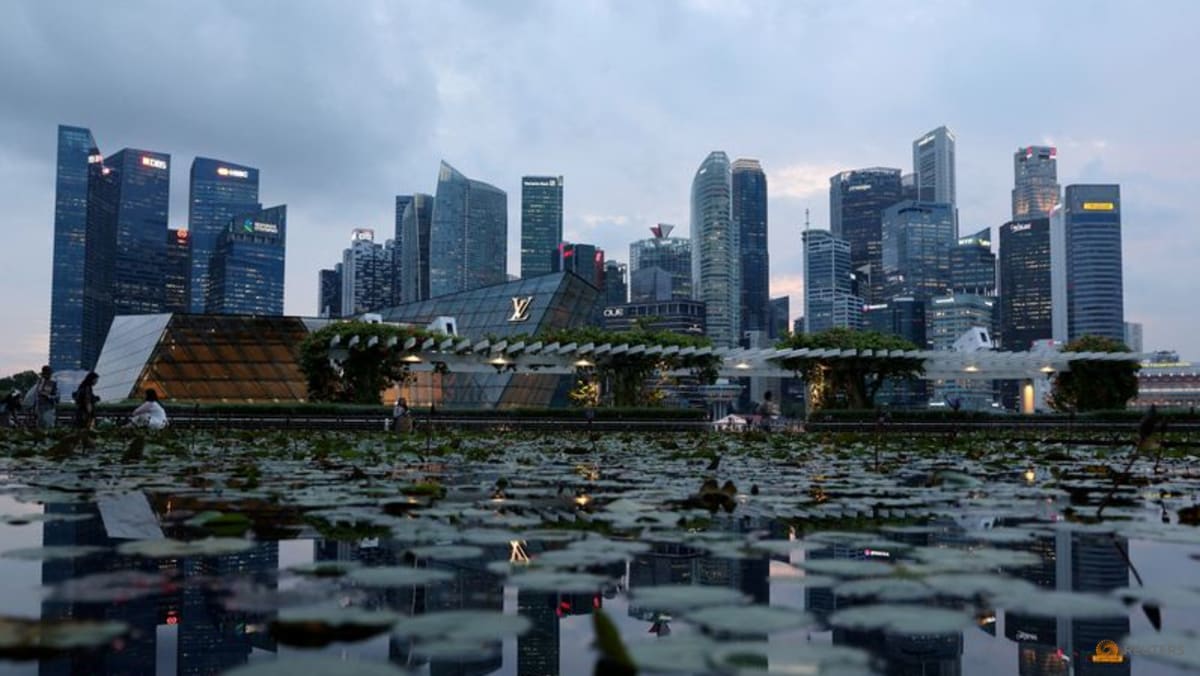
A view of the central business district's skyline in Singapore on May 27, 2025. (File photo: Reuters/Edgar Su)
This audio is generated by an AI tool.
SINGAPORE: The debate over how Singapore should tax wealth has never quite gone away, as policymakers grapple with a familiar challenge: How can the country guard against rising wealth inequality without undermining its competitiveness and attractiveness to investors?
Some proposals were floated recently in parliament. For example, Member of Parliament Shawn Loh suggested taxing inherited high-value properties, “perhaps the most expensive 1 per cent of properties”, as he called the growing wealth divide “one of the greatest challenges of our time”.
Earlier in the year, Singapore’s first-ever official measure of wealth inequality – which was higher than income inequality – also prompted calls from both sides of the House for greater taxation of assets, including reinstating estate duties.
For several years, Singapore has gradually expanded the use of wealth taxes through tweaking property taxes, stamp duties and taxes on luxury vehicles . Property taxes and stamp duties are, in effect, indirect wealth taxes that are relatively easy to administer and difficult to avoid because the underlying assets are visible and immovable.
CNA Games Guess Word Crack the word, one row at a time Buzzword Create words using the given letters Mini Sudoku Tiny puzzle, mighty brain teaser Mini Crossword Small grid, big challenge Word Search Spot as many words as you can Show More Show Less This approach also has important advantages over a comprehensive net wealth tax. Unlike financial assets, private businesses or overseas investments, property values can be readily observed and verified. Administrative costs are relatively low and opportunities for avoidance are more limited. These practical considerations explain why Singapore has historically relied on property-related taxes as its primary form of wealth taxation.
This approach also has important advantages over a comprehensive net wealth tax. Unlike financial assets, private businesses or overseas investments, property values can be readily observed and verified. Administrative costs are relatively low and opportunities for avoidance are more limited. These practical considerations explain why Singapore has historically relied on property-related taxes as its primary form of wealth taxation.
A TAX ON INHERITED PROPERTIES?
The question raised by Mr Loh is whether this framework should be extended to inherited wealth.
There are compelling arguments in support. Inheritance taxes have often been described as consistent with meritocratic principles. They can help prevent excessive accumulations of wealth across successive generations and preserve equality of opportunity. These considerations become more relevant as asset values, particularly residential property values, continue to rise.
Yet the shortcomings of traditional inheritance taxes should not be underestimated. Singapore abolished estate duty in 2008 partly to strengthen its competitiveness as a regional wealth management hub.
Furthermore, wealthy individuals frequently have opportunities to reduce exposure through lifetime gifts, trust structures and advance succession planning. The result is that inheritance taxes can sometimes generate less revenue than expected while imposing considerable administrative complexity.
For these reasons, caution remains on reintroducing a broad-based inheritance tax. By comparison, targeting high-value inherited property can be a low-hanging fruit after considering the shortcomings of a pure wealth tax, as well as the ease and cost-effectiveness of implementing such a proposal.
CURRENT DEBATE MAY BE TOO NARROW
However, Mr Loh's suggestion also raises an important issue that perhaps deserves greater attention than inheritance itself.
A substantial portion of property appreciation in Singapore is not generated solely by the efforts of individual property owners. Property values often rise because of public investments in transport infrastructure, urban renewal, schools, healthcare facilities, security and economic development. A homeowner who does nothing may still experience significant capital gains because of broader societal progress.
This leads to a potentially different policy question: Rather than focusing primarily on whether wealth was inherited, should policy focus on whether gains were privately earned or collectively generated?
Economists have long referred to this concept as "economic rent" or unearned gains arising from scarcity and public investment. In land-constrained cities such as Singapore, landowners often benefit from increases in value created by the wider community rather than by their own investment decisions. If so, there may be a stronger policy rationale for taxing such gains than for taxing inheritance per se.
Viewed through this lens, the inheritance-tax debate may be too narrow. The real issue may be how society shares the benefits created collectively when property values substantially exceed inflation over long periods.
One possibility is to examine whether existing property taxes sufficiently capture these gains. Another is to consider targeted transfer taxes that apply only when very high-value properties change hands, whether through sale, gift or inheritance. Such an approach would focus less on the identity of the recipient and more on the amount of societal wealth embedded within the asset.
This perspective can address one of the longstanding weaknesses of traditional inheritance taxes, which often raise concerns about fairness because beneficiaries may be forced to liquidate family businesses or homes to pay taxes. By contrast, a system linked to realised transactions or deferred payment mechanisms could alleviate cash-flow concerns, while still capturing part of the economic value generated by society as a whole.
That said, measuring the amount of societal wealth within an asset poses its own set of challenges. For example, when assessing the price appreciation in a property, there may not be consensus on whether this is attributed to a new MRT, a new mall or other intangible reasons.
BEHAVIOURAL EFFECTS OF WEALTH TAXES
There is another dimension that has received relatively little attention in the Singapore debate. Wealth taxes are often discussed primarily as revenue-raising tools but their behavioural effects may be equally important.
Property taxes influence investment decisions, allocation of capital and housing market dynamics. If carefully designed, they can encourage more productive deployment of capital rather than passive accumulation of appreciating assets.
At a time when policymakers are seeking to support entrepreneurship, innovation and economic dynamism, it may be worth considering whether parts of the tax system inadvertently favour asset appreciation over productive risk-taking.
This does not mean that property ownership should be discouraged. Rather, it suggests that the tax system should maintain a balanced treatment between wealth generated through enterprise and wealth from passive asset appreciation.
Ultimately, Singapore’s wealth tax debate should not be framed as a simple choice between having or not having an inheritance tax. A more useful question is how Singapore can continue to preserve meritocracy while maintaining competitiveness, attracting capital and ensuring that the gains from collective national success are shared fairly.
Simon Poh is Associate Professor (Practice) of the Department of Accounting at the National University of Singapore (NUS) Business School. The opinions expressed are those of the writer and do not represent the views and opinions of NUS.
Get our pick of top stories and thought-provoking articles in your inbox
Stay updated with notifications for breaking news and our best stories
Join our channel for the top reads for the day on your preferred chat app
与其关注遗产继承,新加坡的财富税辩论是否应该着眼于房产价格上涨是私人所得还是集体所得?新加坡国立大学商学院教授西蒙·波对此发表了看法。
2025年5月27日,新加坡中央商务区的天际线景观。(资料照片:路透社/Edgar Su)
这段音频由人工智能工具生成。
新加坡:关于新加坡应该如何对财富征税的争论从未真正消失,因为政策制定者们一直在努力应对一个熟悉的挑战:如何在不损害其竞争力和对投资者的吸引力的情况下,防止财富不平等加剧?
最近国会提出了一些提案。例如,国会议员肖恩·洛建议对继承的高价值房产征税,“或许是占房产总数1%的最昂贵房产”,他称日益扩大的贫富差距是“我们这个时代面临的最大挑战之一”。
今年早些时候,新加坡首次公布了官方的财富不平等指标——该指标高于收入不平等指标——这也引发了国会两院呼吁对资产征收更多税款,包括恢复遗产税。
多年来,新加坡通过调整房产税、印花税和豪华车辆税,逐步扩大了财富税的使用范围。房产税和印花税实际上是间接财富税,由于标的资产是看得见且不可移动的,因此征收起来相对容易且难以规避。
CNA游戏 猜词游戏 逐行破解单词 流行词游戏 用给定的字母组成单词 迷你数独 小谜题,脑力挑战 迷你填字游戏 小方格,大挑战 单词搜索 尽可能多地找出单词 显示更多 显示更少 这种方法相比全面的净财富税也具有重要的优势。与金融资产、私人企业或海外投资不同,房地产价值易于观察和核实。行政成本相对较低,避税的机会也更有限。这些实际因素解释了为什么新加坡历来依赖房地产相关税作为其主要的财富税形式。
与全面的净资产税相比,这种方法也具有显著优势。与金融资产、私人企业或海外投资不同,房地产价值易于观察和核实。行政成本相对较低,避税机会也更为有限。正是基于这些实际考虑,新加坡历来将房地产税作为其主要的财富税形式。
对继承财产征税?
罗先生提出的问题是,这一框架是否应该扩展到继承财富。
支持征收遗产税的理由十分充分。遗产税常被认为符合精英统治原则,有助于防止财富在代际间过度积累,并维护机会平等。随着资产价值,尤其是住宅物业价值的持续上涨,这些考量显得尤为重要。
然而,传统遗产税的弊端不容低估。新加坡于2008年废除遗产税,部分原因是为了增强其作为区域财富管理中心的竞争力。
此外,富裕人士通常可以通过生前赠与、信托架构和提前进行继承规划来减少遗产税的征收。因此,遗产税有时产生的税收收入可能低于预期,同时还会带来相当大的行政复杂性。
鉴于以上原因,对于重新引入覆盖面广的遗产税仍需谨慎。相比之下,考虑到纯粹财富税的种种弊端,以及此类方案实施的便捷性和成本效益,针对高价值继承财产征税或许是一个更易实现的目标。
当前的辩论可能过于狭窄
然而,罗先生的建议也引出了一个重要问题,这个问题或许比继承本身更值得关注。
新加坡房产增值并非完全由个人业主的努力所致。公共投资,例如对交通基础设施、城市更新、学校、医疗设施、安保和经济发展的投资,往往能推高房产价值。即使业主不做任何投资,也能因更广泛的社会进步而获得可观的资本收益。
这就引出了一个可能不同的政策问题:政策不应主要关注财富是否是继承所得,而应关注财富收益是私人所得还是集体所得?
经济学家长期以来将这种概念称为“经济租金”,即因资源稀缺和公共投资而产生的非劳动所得。在新加坡等土地资源紧张的城市,土地所有者往往受益于更广泛的社会创造的价值增长,而非自身投资决策带来的收益。如果情况确实如此,那么对这类收益征税或许比对遗产本身征税更具政策合理性。
从这个角度来看,遗产税的争论可能过于狭隘。真正的问题或许在于,当房产价值长期远超通货膨胀时,社会该如何分享由此产生的集体收益。
一种可能性是考察现有的房产税是否足以涵盖这些收益。另一种可能性是考虑征收定向转让税,仅在高价值房产易手时征收,无论转让方式是出售、赠与还是继承。这种方法较少关注受益人的身份,而更多地关注资产所蕴含的社会财富。
这种观点可以解决传统遗产税长期存在的一个缺陷,即受益人可能被迫变卖家族企业或房产来缴纳税款,从而引发公平性方面的担忧。相比之下,与已实现交易或延期支付机制挂钩的遗产税制度既可以缓解现金流方面的担忧,又能保留社会整体创造的部分经济价值。
话虽如此,衡量一项资产所蕴含的社会财富也面临着一系列挑战。例如,在评估房产价格上涨时,人们可能并不清楚这究竟是源于新建地铁、购物中心还是其他无形因素。
财富税的行为效应
在新加坡的讨论中,还有一个层面却鲜少受到关注。财富税通常被视为一种主要的财政收入工具,但其对人们行为的影响可能同样重要。
房产税会影响投资决策、资本配置和住房市场动态。如果设计得当,房产税可以鼓励资本进行更高效的配置,而不是被动地积累增值资产。
在政策制定者寻求支持创业精神、创新和经济活力之际,或许值得考虑一下,税收制度的某些部分是否无意中偏袒了资产增值而非生产性风险承担。
这并非意味着应该抑制人们拥有房产。相反,这表明税收制度应该在企业创造的财富和被动资产增值带来的财富之间保持平衡的待遇。
归根结底,新加坡的财富税辩论不应被简单地定义为是否征收遗产税的问题。更有意义的问题是,新加坡如何在保持竞争力、吸引资本并确保国家集体成功带来的收益公平分配的同时,继续维护精英制度。
Simon Poh是新加坡国立大学商学院会计系副教授(实践方向)。文中观点仅代表作者个人意见,并不代表新加坡国立大学的立场。
订阅我们的邮件,即可获取精选热点新闻和引人深思的文章。
订阅通知,第一时间获取突发新闻和精彩报道。
加入我们的频道,即可在您常用的聊天应用上获取当日热门文章。