Sikorsky Aiming For Black Hawk ‘Nose Jobs’ To Be Available Within The Next Year西科斯基公司计划在明年内推出黑鹰直升机的“鼻部整形”方案
A larger swappable nose creates opportunities to rapidly inject new capabilities and flexibility into old and new H-60 helicopters.
新闻视频
By Joseph Trevithick , Howard Altman
Published Oct 14, 2026 8:12 AM EDT
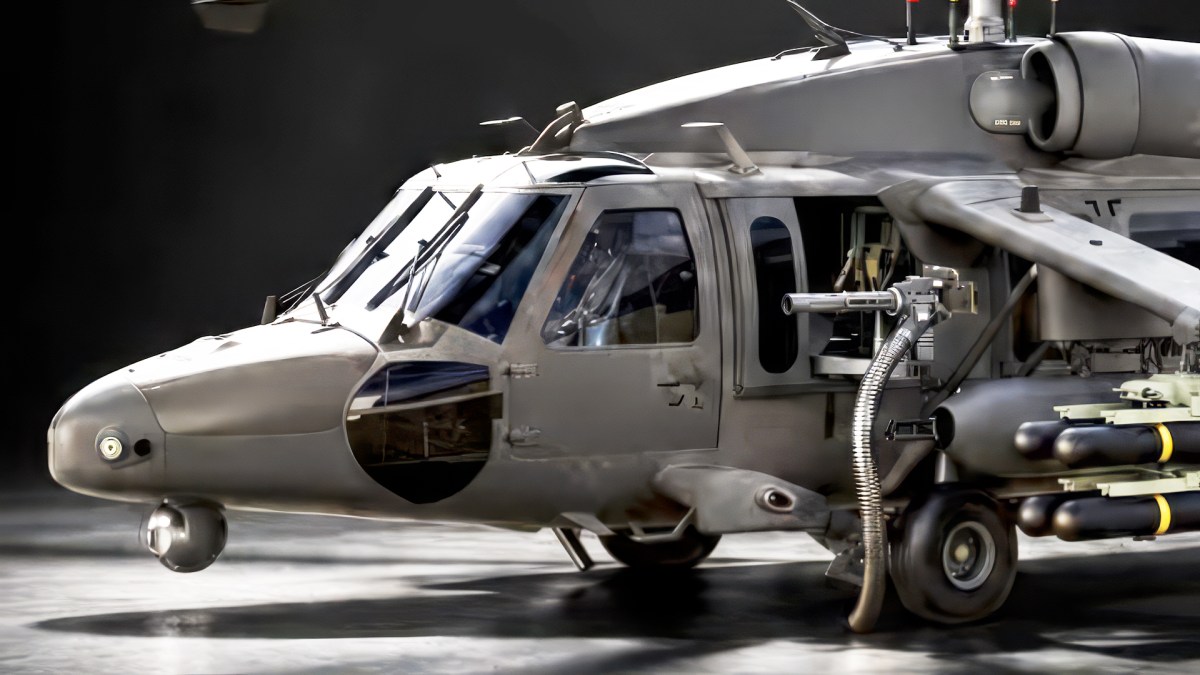
Sikorsky is aiming to start offering a new modular and readily swappable nose for the venerable H-60 family of helicopters within the next year or so. The noses will be made available on new-production H-60s, as well as be retrofittable to helicopters in service now. The ‘nose jobs’ will help operators relatively quickly reconfigure their H-60s for very different missions, from cargo-carrying to serving as gunships , as required. It also opens new avenues to integrating autonomous capabilities and other advanced functionality.
Our Howard Altman had a chance to speak with representatives from Sikorsky, now a subsidiary of Lockheed Martin, about the plans for the new nose for the H-60-series at the Association of the U.S. Army’s (AUSA) main annual convention today. This is part of a larger vision for keeping the design operationally relevant into the 2070s, which also includes uprated engines and increased total payload capacity. You can read more about the overall Black Hawk 2070 strategy here .
Of the different elements of Black Hawk 2070, “the nose is a good one, and it’s one that’s on a pretty accelerated timeline. Within the next, I would say, year or so, the nose will be available to be retrofitted or to be coming off the line,” Jason Wrigley, Sikorsky’s director of business development for Black Hawk, said. “We’ve gone through a design cycle with it.”
As it stands now, the new nose structure will offer roughly double the physical space of the standard nose on current-generation H-60s today.
“We’ve done the design. We then 3D-printed the noses, and we did that so that we can physically interact with it, because the whole point of this is for maintainability and access to be able to integrate these different sensors and comms gear,” he continued. “We’ve gotten some feedback from the engineers, from operators, from maintainers, and that goes back into the next cycle of the design.”
Exploring ways to optimize accessibility to areas of the new nose was a major focus of this ‘test print,’ according to Wrigley. Sikorsky has a scale model on the show floor at AUSA this week that highlights how the current design opens from the top, as seen below. Ensuring that it will be possible to keep any systems inside sufficiently cooled has also been an important design consideration already.
Overall, “we just are kind of confirming, can we reach everywhere we need to? What are the different configurations?” he added. There’s been “a lot of work with the [U.S.] Army around what do you envision potentially could go in here?”
“This is one of those cases also where our whole engineering team gets more comfortable. It’s not something where the Army came to us and said, ‘this is exactly what I want. Here’s my spec,'” he also noted. “It was more, ‘here’s what I want to achieve. Here’s what I want to be able to do.’ And so we went off and designed that.”
Another look at the long-nosed Black Hawk model on display at AUSA. Jamie Hunter
“I like to highlight this, because it’s part of the way we’re also changing the way we design and deliver the Blackhawk,” Wrigley added as an aside. “So we’re very much in a model-based environment.”
While Wrigley mentioned sensors and communications equipment as possible payloads to fit into that extra space initially when talking with us today, he made clear later on that these are just some of the potential options.
“It’s using the old term, but it’s open architecture, and so the whole point is whatever the mission requires” can go into these new extended noses, he explained. “There’s always a demand for real estate up front.”
It’s very true that more specialized variants of the H-60, such as the MH-60s operated by the U.S. Army’s elite 160th Special Operations Aviation Regiment , often have modified noses loaded with radars, other sensors , and additional systems. The new HH-60W Jolly Green II rescue helicopters for the U.S. Air Force are another prime example of this, and there are many more .
A head-on look at one of the 160th Special Operations Aviation Regiment’s MH-60s, with a nose absolutely crammed with sensors and other systems. USN
A look at the distinctive nose on the HH-60W Jolly Green II packed with sensors and other gear. USAF
“There’s a big focus on open architecture and that ability to quickly plug-and-play,” Wrigley also told TWZ earlier this month in the context of the larger Black Hawk 2070 plan. “The new modular nose will change the look of the Black Hawk up front to provide even more space for equipment that will work directly with the new digital architecture.”
In terms of swapping out modular noses on individual helicopters, Wrigley said that it is still too early in the design process to know exactly how that would be done and how long it might take to do so in practice.
“Part of the design process is to also write up the documentation for the retrofit, but we don’t see this one as very invasive,” he explained.
It is not hard to imagine use cases for long-nosed H-60s, especially ones that can then be reconfigured between missions, and not just for the U.S. Army. As Wrigley already underscored, there is long-standing demand for H-60s with longer and larger noses to accommodate additional mission systems. Modular noses, in general, have been becoming more and more common in aviation design for some time now.
The ability to readily swap modular noses could also allow operators of even relatively small H-60 fleets to gain a valuable new degree of multi-mission capability. As one example, cargo-carrying helicopters could be converted into gunships, and back again, as required, using a small common pool of noses with the requisite sensors, laser designators, and other equipment. All of this could offer cost benefits when it comes to sustainment and logistics, as well as added operational flexibility.
The long-nosed Black Hawk model on display at AUSA is notably configured as a gunship. Sikorsky has also talked previously about leveraging the new nose to reconfigure H-60s for search and rescue, airborne drone control, and other missions.
A full view of the model of the gunship-configured H-60 with the new modular nose on display at AUSA. Jamie Hunter
Just being able to install a radar for one series of missions, and then quickly switch over to an electro-optical wide-area surveillance system or another kind of sensor for the next run of sorties, would bring new adaptability to the already very flexible Black Hawk. Defensive systems could also be readily swapped from aircraft to aircraft, as well as more quickly upgraded, as needed.
The modular nose also opens the door to a new way to integrate advanced capabilities, including autonomy packages, which Wrigley said is also driving demand for more space at the front end of the helicopter. Sikorsky has been developing various tiers of autonomous capabilities for the H-60 family for years now, including artificial intelligence-driven ‘copilots’ designed just to help reduce the workload of human crew members and increase safety margins. Autonomous flight capabilities require additional sensors, such as LIDAR and cameras, to help with navigation and to provide additional situational awareness. At least some of those components could be hosted within new modular noses.
At the same time, integrating higher degrees of autonomy could require more substantial modification. Sikorsky is now developing a fully uncrewed version of the H-60, and has been doing so with an eye toward converting older Black Hawks to this configuration as they are retired from service, as you can read more about here .
In line with the Black Hawk 2070 vision, the modular noses could be part of a broader equation for modernizing existing H-60 fleets, as well.
“In our conversations with the Army, I think they’ve been using a phrase that they call targeted modernization,” Wrigley told us, speaking more generally. “There’s a daunting task that says there’s 1,000-1,500 Black Hawks in inventory. If you literally tried to upgrade every one of them, it’s a very expensive proposition, and it probably takes a long time.”
“I don’t think that’s the way they’re thinking about it. I think they’re thinking about it more on a battalion basis or a unit basis,” he continued. “Like, what’s the mission, and maybe certain Black Hawks get upgraded with autonomy, and other Black Hawks get upgraded with sort of the expanded launched effects capability, the engine, the structural upgrades, the [stub] wings, stuff like that.”
“Maybe some of them become ‘Superhawks’ or whatever, [and] get the whole package,” he added.
There is certainly still work to be done on the development of the new modular nose and then actually integrating it onto the H-60 platform. At the same time, Sikorsky clearly already sees demand for this new feature, which could lead to a breadth of new opportunities for new and old helicopters in the H-60 line.
Contact the author: joe@twz.com
Comments couldn’t be loaded. Please refresh the page.
作者:约瑟夫·特雷维西克、霍华德·奥特曼
发布于美国东部时间2026年10月14日上午8:12
西科斯基公司计划在未来一年左右的时间内,为久经考验的H-60系列直升机提供一种新型模块化、可快速更换的机头。这种机头将首先应用于新生产的H-60直升机,同时也可用于现有服役直升机的改装。这种“机头改装”将帮助运营商根据需要,相对快速地重新配置H-60直升机,以适应从货物运输到武装直升机等各种不同的任务。此外,它还为集成自主能力和其他先进功能开辟了新的途径。
在今天举行的美国陆军协会(AUSA)年度大会上,我们的记者霍华德·奥特曼有机会与洛克希德·马丁公司旗下子公司西科斯基公司的代表就H-60系列直升机新型机头的计划进行了交流。这是旨在使该机型在2070年代仍具有作战效能的宏伟蓝图的一部分,该蓝图还包括升级发动机和提高总有效载荷能力。您可以在这里阅读更多关于“黑鹰2070”战略的信息。
西科斯基公司黑鹰2070项目业务发展总监杰森·里格利表示:“黑鹰2070的各个部件中,机头部分尤为出色,而且研发进度相当迅速。我估计,在未来一年左右的时间里,机头就可以进行改装或直接下线生产了。我们已经完成了它的整个设计周期。”
就目前来看,新的机头结构将提供大约是当前一代 H-60 标准机头两倍的物理空间。
“我们已经完成了设计。然后我们用3D打印机打印了机头,这样做是为了能够进行实际操作,因为关键在于便于维护和接入,以便集成各种不同的传感器和通信设备,”他继续说道。“我们已经从工程师、操作员和维护人员那里收集了一些反馈,这些反馈将用于下一轮设计。”
据 Wrigley 介绍,此次“测试打印”的重点之一是探索如何优化新机头各区域的易用性。西科斯基公司本周在 AUSA 展会上展出了一个比例模型,展示了当前设计的顶部开启方式,如下图所示。确保内部所有系统都能得到充分冷却也是一项重要的设计考量。
他补充说:“总的来说,我们只是在确认,我们能否覆盖所有需要覆盖的区域?有哪些不同的配置方案?”他还提到,“我们与美国陆军进行了大量合作,探讨你们设想这里最终可能安装哪些设备?”
“这也是我们整个工程团队更加得心应手的案例之一。陆军并没有直接找到我们说,‘这就是我想要的,这是我的规格说明’,”他还指出,“而是说,‘这是我想要达到的目标,这是我想要能够做到的事情。’然后我们就着手设计了。”
再来看看AUSA展出的长鼻黑鹰模型。杰米·亨特
“我想强调这一点,因为这也是我们改变黑鹰直升机设计和交付方式的一部分,”里格利补充道。“所以我们现在很大程度上是在一个以模型为基础的环境中。”
虽然 Wrigley 今天在与我们交谈时最初提到传感器和通信设备可以作为有效载荷装入额外的空间,但他后来明确表示,这些只是一些潜在的选择。
“虽然用了老词,但这就是开放式架构,所以关键在于,无论任务需要什么”,都可以应用到这些新的延伸部分,他解释说。“前部空间总是有需求的。”
的确,H-60 的一些更专业化的型号,例如美国陆军精锐的第160特种作战航空团使用的 MH-60,通常会改装机头,装载雷达、其他传感器和附加系统。美国空军新型的 HH-60W“快乐绿巨人 II”救援直升机就是另一个典型的例子,这样的例子还有很多。
正面视角拍摄第160特种作战航空团的一架MH-60直升机,机头密密麻麻地塞满了传感器和其他系统。美国海军
仔细观察一下HH-60W“快乐绿巨人II”直升机独特的机头,它上面装满了传感器和其他设备。美国空军
“我们非常注重开放式架构和快速即插即用的能力,” Wrigley 本月初在接受 TWZ 采访时谈到更大的“黑鹰 2070”计划时也表示。“新的模块化机头将改变黑鹰直升机的前端外观,为能够直接与新数字架构配合使用的设备提供更多空间。”
就更换单架直升机的模块化机头而言,Wrigley 表示,目前设计过程还处于早期阶段,尚不清楚具体该如何操作以及实际操作需要多长时间。
“设计过程的一部分还包括编写改造文档,但我们认为这次改造不会造成太大的侵入性,”他解释说。
不难想象长机头H-60直升机的用途,尤其是那些可以在任务间隙重新配置的机型,而且其用途不仅限于美国陆军。正如Wrigley已经强调的那样,长期以来,人们一直需要机头更长更大的H-60直升机来容纳额外的任务系统。模块化机头在航空设计领域也已经变得越来越普遍。
模块化机头的便捷更换能力,即使是规模相对较小的H-60机队也能获得宝贵的多任务能力。例如,运输直升机可以根据需要改装成武装直升机,反之亦然,只需使用一套配备必要传感器、激光指示器和其他设备的通用机头即可。所有这些都有助于降低维护和后勤成本,并提高作战灵活性。
在AUSA展会上展出的长鼻黑鹰直升机明显被改装成了武装直升机。西科斯基公司此前也曾表示,将利用这种新型机头设计,对H-60直升机进行改装,使其能够执行搜救、空中无人机控制和其他任务。
在AUSA展出的H-60武装直升机模型全貌,该模型配备了新型模块化机头。杰米·亨特
仅仅能够为一系列任务安装雷达,然后迅速切换到光电广域监视系统或其他类型的传感器以进行下一系列飞行任务,就能为本已非常灵活的黑鹰直升机带来新的适应性。防御系统也可以根据需要轻松地在不同飞机之间互换,并更快地进行升级。
模块化机头也为集成先进功能开辟了新途径,包括自主飞行套件。Wrigley 表示,这些套件的出现也推动了对直升机前端更大空间的需求。多年来,西科斯基一直在为 H-60 系列直升机开发不同级别的自主飞行功能,包括旨在减轻机组人员工作负荷并提高安全裕度的人工智能“副驾驶”。自主飞行功能需要额外的传感器,例如激光雷达和摄像头,以辅助导航并提供更全面的态势感知。至少部分此类组件可以集成到新型模块化机头中。
与此同时,要实现更高程度的自主性,可能需要进行更大幅度的改造。西科斯基公司目前正在研发H-60的完全无人驾驶版本,并计划将退役的老款黑鹰直升机改装成这种配置,您可以在这里阅读更多相关信息。
与“黑鹰 2070”愿景相一致,模块化机头也可以成为对现有 H-60 机队进行现代化改造的更广泛方案的一部分。
“在与陆军的沟通中,他们似乎一直在使用一个叫做‘定向现代化’的术语,”里格利更笼统地告诉我们,“他们面临着一项艰巨的任务,那就是现役的黑鹰直升机有1000到1500架。如果真的要对每一架都进行升级,那将是一项非常昂贵的工程,而且可能需要很长时间。”
“我不认为他们是这么想的。我认为他们更多是从营级或单位级的角度来考虑的,”他继续说道。“比如,任务是什么,也许某些黑鹰直升机会升级自主飞行能力,而另一些黑鹰直升机则会升级增强型发射效果能力、发动机、结构升级、短翼等等。”
“也许他们中的一些人会成为‘超级鹰队’之类的球员,获得全部荣誉,”他补充道。
新型模块化机头的研发以及将其集成到H-60平台上,无疑仍有许多工作要做。与此同时,西科斯基显然已经看到了市场对这项新功能的需求,这可能为H-60系列的新老直升机带来广泛的新机遇。
联系作者:joe@twz.com
评论加载失败,请刷新页面。