Ukraine races to field faster interceptors as Russia hammers its energy grid俄罗斯重创乌克兰电网,乌克兰加紧部署速度更快的拦截器
With jets being used in more and more Russian attacks, Ukraine is leveraging fighter jets, AI-aimed gun turrets and scarce missiles for air defense.
KYIV, Ukraine — Russia is still using fast jet-powered drones to batter Ukraine’s energy facilities, bridges and other critical infrastructure at speeds beyond the reach of most of Kyiv’s drone interceptors, despite U.S. President Donald Trump’s unilateral announcement on Sunday of an energy ceasefire between the two countries.
Russia began using the jets heavily in July, when their numbers jumped fivefold from the previous month. They can now reach speeds of up to 373 mph (600 km/h) — more than three times the speed of the propeller-driven Geran-2 drones they evolved from — far exceeding the top velocity of the average Ukrainian interceptor drone, air force officials told lawmakers last week.
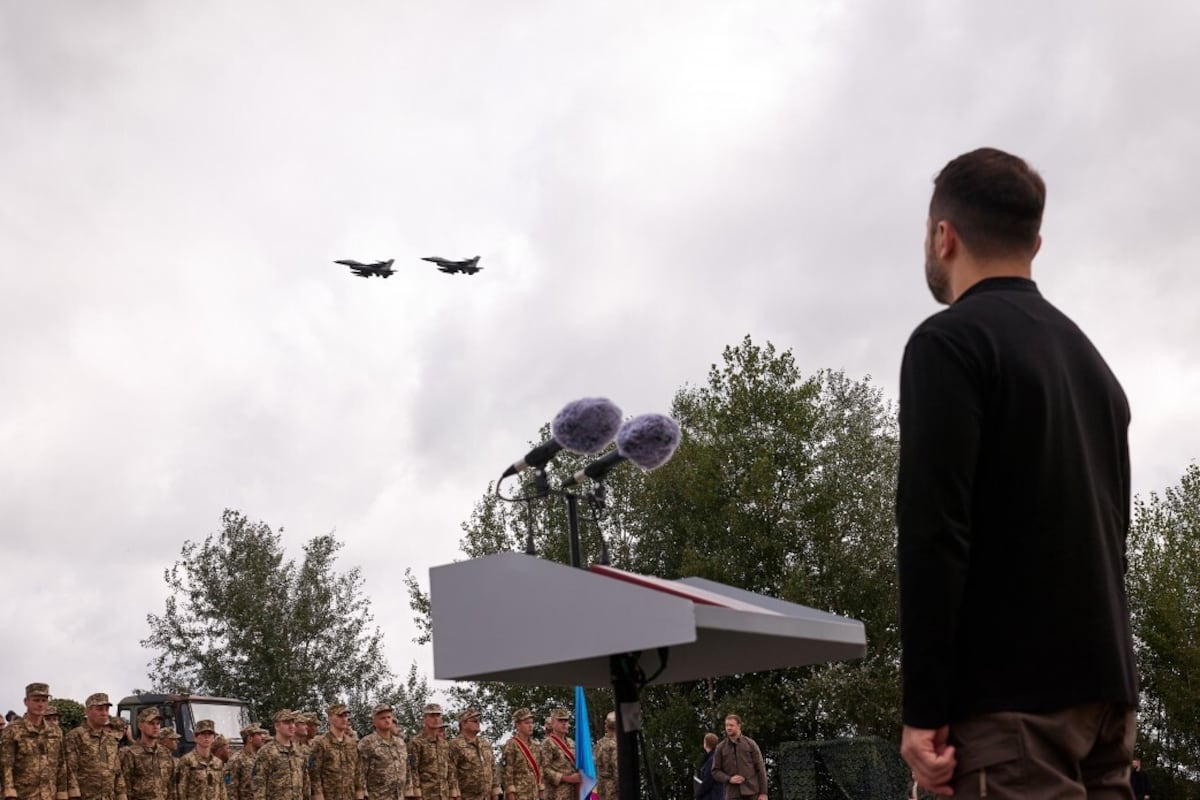
To stop the drones, Ukraine must instead rely on F-16s, newly installed machine gun turrets that use artificial intelligence to aim and costly air-defense missiles that are in short supply globally.
“Ukraine did not strike Russian oil refining and the energy sector in general for two days after the American president announced a ceasefire in the energy sector. But Russia did not listen to the American president,” Ukrainian President Volodymyr Zelenskyy wrote after jets seriously damaged a gas production facility in the northeastern Kharkiv region on Sunday night.
Russia launched 167 missiles and drones overnight Tuesday into Wednesday, including 77 jet-powered drones, which officials said struck one of Kyiv’s main power plants and left 600,000 without power.
Ukraine’s Air Force says they are beginning to field more effective countermeasures, but with Russia continuing to optimize the design of jet-powered drones to destroy critical infrastructure, the development of jets and anti-jet interceptors has become the latest neck-and-neck technology race on the battlefield.
Iran shipped Russia its first Shahed-131 and Shahed-136 drones in mid-August 2022, and Moscow rebranded them the Geran-1 and Geran-2 and was firing them at Ukrainian civilian infrastructure by that October.
Those propeller-driven drones were slow enough for Ukraine to build an economical defense around mobile fire teams and cheap interceptor drones rather than spending scarce missiles on every Shahed, and in February the interceptors accounted for more than 70% of Shahed downings over Kyiv .
The jet-powered Gerans are outrunning that defense, and Russia has since stopped building the slower Geran-3 and ramped up production of the Geran-4, which cruises at 217 to 311 mph (350 to 500 km/h), and the missile-shaped Geran-5, which carries a 90-kilogram (198-pound) warhead, Militarnyi reported in August, citing Ukraine’s military intelligence agency, known as HUR.
“The Geran-5 flies 150km/h faster than the Geran-4, so the goal is to intercept from the front rather than the rear — a much harder problem to solve,” an engineer at a Ukrainian defense contractor told the Kyiv Independent .
And they are still getting faster, with the Air Force projecting speeds of 500 to 560 mph (800 to 900 km/h), though none have been recorded yet, its deputy commander, Col. Yurii Cherevashenko, told a parliamentary commission Oct. 6.
A Geran-4 version Russia began flying this autumn is built to take out infrastructure, navigating by a U.S.-made magnetometer and an optical system and carrying a new warhead designed to cut bridges and power line supports, HUR said in an Oct. 5 statement .
The new 88-pound (40-kilogram) warhead “was created specifically to destroy high-voltage pylons and iron bridge structures,” Serhii “Flash” Beskrestnov, an EW expert and adviser to Zelenskyy, wrote on Telegram Sept. 30 when Russia was first spotted using the upgrade on a jet drone.
These optimized Russian jet drones hit Kyiv’s South Bridge, which carries cars and metro trains across the Dnipro River, at least five times on Oct. 1 and 2, once exploding near a pier as a train crossed overhead, then struck the city’s North Bridge on Oct. 3, officials said.
Ukrainian interceptors stopped roughly 90% of the older propeller-driven drones , but against the jets, the interception rate has been significantly lower.
“Initially, we saw a very low interception rate in Ukraine. It then rose to more than 30%, and in recent nights it has increased to over 50%,” Matthias Lehna, vice president of German drone maker Quantum Systems, told Ukrinform last week.
Air force officials reported downing 77% of incoming jet-powered drones on Tuesday night.
Ukraine put its first jet interceptor, the Alexa Spatium, into service only on Aug. 21, and a handful of other prototypes, including Wild Hornets’ STING S and SkyFall’s P1-SUN Jetkiller, have successfully downed a small number of Geran-5s, according to officials speaking to the Kyiv Independent.
Fourteen companies are flight-testing jet interceptors with the Air Force, and three have shown promising results, but the deputy air force commander said officials don’t expect the jet interceptors to be delivered at the scale Ukraine needs until the end of November at the earliest.
Jet drones already make up approximately 40% of the drones Russia launches and the Air Force expects that share to reach up to 80% of total attacks.
Katie Livingstone is the Ukraine correspondent for Defense News and Military Times. Based in Kyiv, she has covered Russia's full-scale invasion since its first days. She is a former Fulbright fellow whose award-winning work has appeared in outlets across Europe and the U.S.
乌克兰基辅——尽管美国总统唐纳德·特朗普周日单方面宣布两国停火,但俄罗斯仍在利用高速喷气式无人机袭击乌克兰的能源设施、桥梁和其他关键基础设施,其速度远超基辅大多数无人机拦截器的拦截范围。
俄罗斯从7月份开始大量使用这些战机,数量比上个月增加了五倍。空军官员上周告诉议员们,这些战机现在的速度可达每小时373英里(600公里),是其前身——螺旋桨驱动的“格朗-2”无人机速度的三倍多,远远超过乌克兰拦截无人机的平均最高速度。
为了阻止无人机,乌克兰必须依靠 F-16 战斗机、新安装的利用人工智能进行瞄准的机枪炮塔以及全球供应短缺的昂贵防空导弹。
“在美国总统宣布能源领域停火后的两天里,乌克兰没有对俄罗斯炼油厂和整个能源部门发动袭击。但俄罗斯没有听从美国总统的命令,”乌克兰总统泽连斯基在周日晚间战机严重损毁东北部哈尔科夫地区的一处天然气生产设施后写道。
俄罗斯周二晚至周三凌晨发射了 167 枚导弹和无人机,其中包括 77 架喷气式无人机。官员称,这些无人机击中了基辅的一座主要发电厂,导致 60 万人断电。
乌克兰空军表示,他们正在部署更有效的反制措施,但随着俄罗斯不断优化喷气式无人机的设计以摧毁关键基础设施,喷气式飞机和反喷气式拦截机的研发已成为战场上最新的激烈技术竞赛。
2022年8月中旬,伊朗向俄罗斯交付了首批Shahed-131和Shahed-136无人机,莫斯科将其重新命名为Geran-1和Geran-2,并在同年10月开始用它们攻击乌克兰的民用基础设施。
这些螺旋桨驱动的无人机速度很慢,因此乌克兰可以围绕机动火力小组和廉价的拦截无人机建立经济的防御体系,而不是将稀缺的导弹用于每一架“沙赫德”无人机。2 月份,拦截无人机在基辅上空击落的“沙赫德”无人机中占 70% 以上。
据《军事报》8 月份援引乌克兰军事情报机构 HUR 的消息报道,喷气式动力“格兰”导弹已经突破了这种防御,俄罗斯已经停止生产速度较慢的“格兰-3”型导弹,并加大了“格兰-4”型导弹的产量。“格兰-4”型导弹的巡航速度为 217 至 311 英里/小时(350 至 500 公里/小时),而“格兰-5”型导弹则携带 90 公斤(198 磅)的弹头。
“Geran-5 的飞行速度比 Geran-4 快 150 公里/小时,因此目标是从正面而不是从背面拦截——这是一个更难解决的问题,”乌克兰国防承包商的一名工程师告诉《基辅独立报》。
空军副司令尤里·切列瓦申科上校 10 月 6 日告诉议会委员会,这些战机的速度还在不断提升,空军预计速度可达每小时 500 至 560 英里(800 至 900 公里),尽管目前还没有记录到这样的速度。
俄罗斯于今年秋季开始试飞的 Geran-4 型导弹旨在摧毁基础设施,它采用美国制造的磁力计和光学系统进行导航,并携带一种新型弹头,该弹头旨在切断桥梁和电力线支撑结构。HUR 在 10 月 5 日的一份声明中表示。
9月30日,俄罗斯首次被发现在喷气式无人机上使用升级后的新型88磅(40公斤)弹头时,电子战专家、泽连斯基的顾问谢尔盖·“闪电”·别斯克列斯特诺夫在Telegram上写道,这种新型弹头“专门用于摧毁高压电塔和铁桥结构”。
官员称,这些经过优化的俄罗斯喷气式无人机在 10 月 1 日和 2 日至少五次撞击了基辅南桥(该桥横跨第聂伯河,汽车和地铁列车在此通行),其中一次在列车驶过时于码头附近爆炸,然后在 10 月 3 日撞击了该市的北桥。
乌克兰拦截机拦截了大约 90% 的老式螺旋桨无人机,但对喷气式飞机的拦截率明显较低。
“最初,我们在乌克兰的拦截率非常低。后来上升到 30% 以上,最近几个晚上又上升到 50% 以上,”德国无人机制造商 Quantum Systems 副总裁 Matthias Lehna 上周告诉乌克兰通讯社。
空军官员报告称,周二晚间击落了 77% 的来袭喷气式无人机。
据基辅独立报报道,乌克兰官员称,乌克兰第一架喷气式拦截机 Alexa Spatium 于 8 月 21 日才投入使用,其他一些原型机,包括 Wild Hornets 的 STING S 和 SkyFall 的 P1-SUN Jetkiller,已经成功击落了少量 Geran-5 战斗机。
目前有 14 家公司正在与空军合作进行喷气式拦截机的飞行测试,其中 3 家公司取得了令人鼓舞的成果,但空军副司令表示,官员们预计最早也要到 11 月底才能以乌克兰所需的规模交付喷气式拦截机。
喷气式无人机目前已占俄罗斯发射无人机总数的约 40%,空军预计这一比例将达到总攻击次数的 80%。
凯蒂·利文斯通是《防务新闻》和《军事时报》的乌克兰特派记者。她常驻基辅,自俄罗斯全面入侵乌克兰之初便开始报道此事。她曾是富布赖特学者,其获奖作品发表于欧洲和美国的多家媒体。