How Poland’s air force is responding to Russian drones in the skies波兰空军如何应对俄罗斯无人机在空中的行动
Maj. Gen. Ireneusz Nowak, the operational commander for the Polish Armed Forces, said 80 percent of his service’s attention is focused on the air defense, with the ground and air components of Poland’s integrated air defenses still three to four years away.
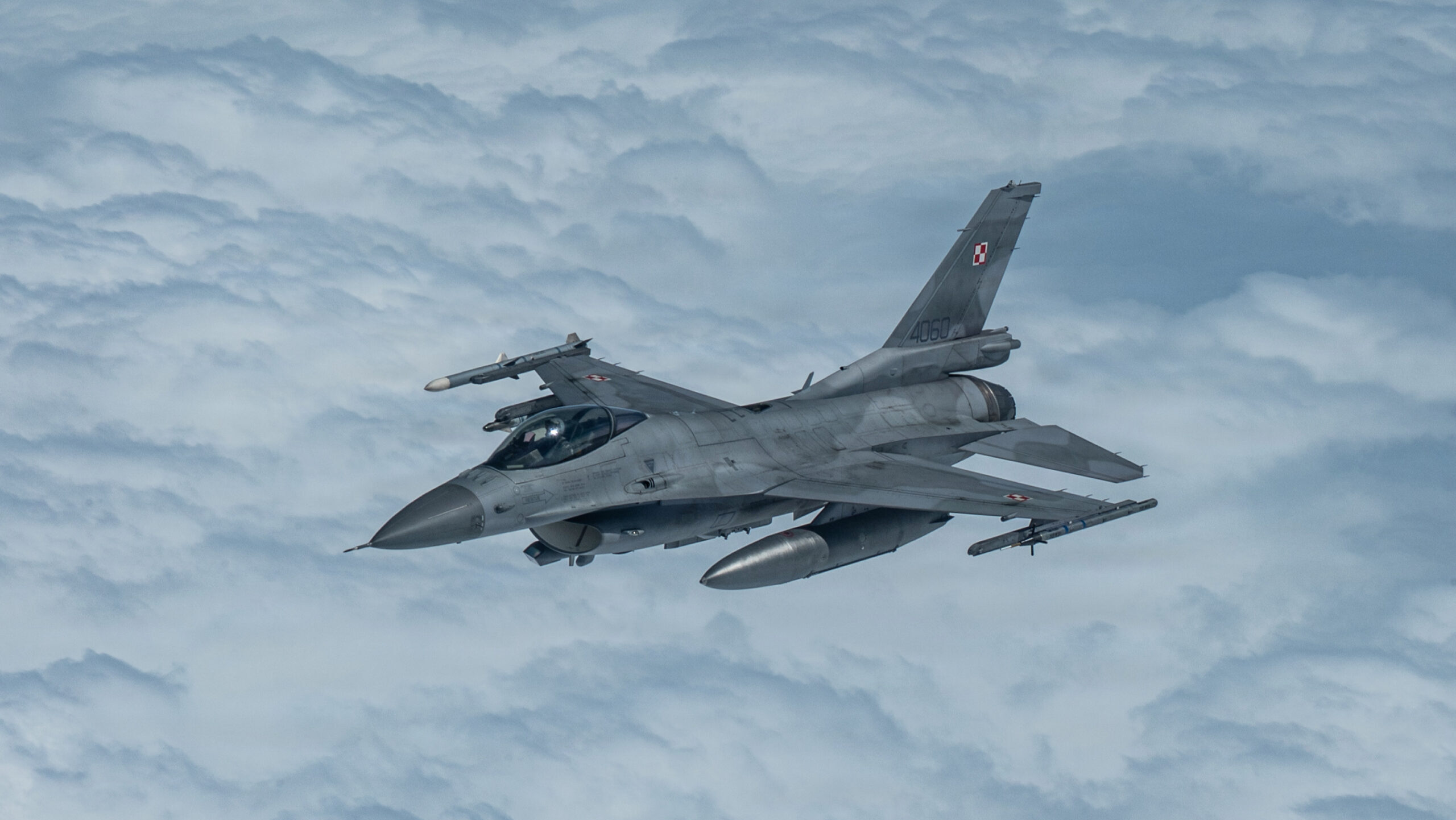
A Polish Air Force F-16C flies alongside a U.S. Air Force KC-135 Stratotanker assigned to the 100th Air Refueling Wing, during a refueling mission as part of Ramstein Flag 26 over Finland, June 12, 2026. (U.S. Air Force photo by Senior Airman Aidan Martínez Rosiere)
WARSAW — With Poland only partway through an air defense modernization effort, the Polish Air Force has been operating at the highest readiness on a nightly basis, which is putting heavy strain on personnel and equipment, according to Maj. Gen. Ireneusz Nowak, the operational commander for the Polish Armed Forces.
Nowak said 80 percent of his service’s attention is focused on air defense, with the ground and air components of Poland’s integrated air defenses still three to four years away.
“We are actually like maybe 30 percent advanced in that process. That means basically that we are procuring, we are acquiring new weapons systems and we are simply waiting for them to be implemented,” he said during a panel discussion at the Warsaw Security Forum.
In the meantime, the Air Force has changed how it operates in order to fill the gap. Starting Oct. 1, the service stopped following Visual Identification (VID) procedures in which a pilot confirms a target’s type, markings or nationality by sight before engaging.
Instead, they are now following Positive Identification (PI) procedures. That means that the pilot no longer needs to be close enough to see what the aircraft they are tracking is, and instead can engage based on factors such as radar data, information from other systems and intelligence, including information passed on by Ukraine.
“So now we are much more flexible, much more responsive,” Nowak, who is responsible for Polish airspace, said.
During the panel discussion, Nowak acknowledged that using fighter jets to shoot down cheap drones is a bad cost ratio for Poland, but said there simply isn’t any other option at the moment. “We need to develop massive, responsive weapons systems capable to counter-react the UAVs operations,” he said.
Lt. Gen. Rolf Folland, Norway’s Military Representative to NATO, agreed that the air superiority model of recent decades is under challenge, noting “We can’t just use all of our munitions in one blast. We have to repeat it over and over again.”
Poland should have some options, but systems that the country hoped to have ready now are still underway. Nowak pointed to the integration of Advanced Precision Kill Weapon System missiles on F-16s as a near-term solution, but said there is a hitch in getting those weapons in the field.
“It hasn’t happened yet, and we are trying to process it, but we [Polish Air Force] couldn’t get the fuses, which were utilized by the US Air Force, and were certified, because of business restrictions and limitations. So we are waiting for the new type of the fuse,” he concluded.
Nowak also mentioned the possibility of using the F/A-50GF aircraft to combat drones, which Defense Minister Władysław Kosiniak-Kamysz announced earlier this month has officially commenced combat duty. Nowak described the plane as very promising as a drone hunter and a very good tool against current threats which the Russian Federation presents, but said weapon integration challenges remain.
“So I must admit that this aircraft will be ready in maybe two years, fully operational and as a very good tool against current threats. But as always, it takes time, and the time is too long and that’s the part which frustrates me a lot,” he said.
Breaking Defense Video
Army doubles down on autonomy, stakes out Indo-Pacific role: AUSA Day 2
Telle talks ‘manufacturing rodeo,’ supply chain ‘weak links’: AUSA Day 1
New leaders, new drone command: What we expect from AUSA 2026
Unpacking Boeing’s F/A-XX win, plus a report from wartime Ukraine
How Hegseth envisions a new Autonomous Warfare Command
What Europe’s military air fleets will look like in 30 years
Riyadh gets closer to F-35s, Damascus presses sovereignty and an expert take on Iran
Drone-hunting on the border, plus turmoil at an Air Force think tank
The future of European airpower might be unmanned
The big news out of AFA, plus a guided tour of the show floor
2026年6月12日,在芬兰上空执行“拉姆施泰因旗帜26”演习期间的空中加油任务时,一架波兰空军的F-16C战斗机与一架隶属于美国空军第100空中加油联队的KC-135同温层加油机并排飞行。(美国空军高级飞行员艾丹·马丁内斯·罗西埃摄)
华沙——波兰武装部队作战司令伊雷纽什·诺瓦克少将表示,由于波兰的防空现代化工作仅完成了一部分,波兰空军每晚都处于最高战备状态,这给人员和装备带来了沉重的压力。
诺瓦克表示,他所在部门 80% 的精力都集中在防空上,波兰一体化防空系统的地面和空中组成部分还需要三到四年才能建成。
“实际上,我们在这个过程中可能已经完成了30%左右。这意味着我们基本上正在采购、获取新的武器系统,现在只是在等待它们投入使用,”他在华沙安全论坛的一个小组讨论会上说道。
与此同时,为了弥补这一缺口,空军改变了作战方式。从10月1日起,空军停止执行目视识别(VID)程序,即飞行员在交战前通过目视确认目标的类型、标志或国籍。
现在,他们采用的是正面识别(PI)程序。这意味着飞行员不再需要近距离观察目标飞机,而是可以根据雷达数据、其他系统信息和情报(包括乌克兰方面提供的信息)等因素进行交战。
“所以现在我们更加灵活,反应也更加迅速,”负责波兰空域的诺瓦克说。
在小组讨论中,诺瓦克承认,用战斗机击落廉价无人机对波兰来说性价比很低,但他表示目前别无选择。“我们需要研发大规模、反应迅速的武器系统,能够反制无人机的行动,”他说。
挪威驻北约军事代表罗尔夫·福兰德中将也认为,近几十年来奉行的空中优势模式正面临挑战,他指出:“我们不能一次性用完所有弹药。我们必须反复进行这样的打击。”
波兰应该有一些选择,但该国原本希望现在就能投入使用的系统仍在研发中。诺瓦克指出,将先进精确杀伤武器系统(APKWS)导弹集成到F-16战斗机上是一个近期可行的解决方案,但他表示,将这些武器投入实战还存在一些障碍。
“这件事还没发生,我们正在努力推进,但由于商业限制,我们(波兰空军)无法获得美国空军使用并已获得认证的引信。所以我们正在等待新型引信,”他总结道。
诺瓦克还提到了使用F/A-50GF战机对抗无人机的可能性。国防部长瓦迪斯瓦夫·科西尼亚克-卡梅什本月初宣布,该战机已正式投入作战使用。诺瓦克称,F/A-50GF作为无人机猎手非常有前景,是应对俄罗斯联邦当前威胁的有效工具,但他同时指出,武器整合方面仍存在挑战。
“所以我必须承认,这架飞机或许两年后就能准备就绪,全面投入使用,成为应对当前威胁的有力工具。但一如既往,这需要时间,而且时间太长了,这让我非常沮丧,”他说。
突破性防御视频
陆军加倍强调自主性,明确印太地区角色:AUSA第二天
特勒谈“制造业乱象”、供应链“薄弱环节”:AUSA第一天
新领导人,新无人机指挥部:我们对 AUSA 2026 的期待
深入剖析波音F/A-XX的中标,以及来自战时乌克兰的报道
赫格塞斯设想的新型自主作战指挥部
30年后欧洲军用空军机队会是什么样子
利雅得距离F-35战机更近一步,大马士革强调主权,以及专家对伊朗的看法
边境无人机猎杀行动,以及空军智库的动荡
欧洲空军的未来或许在于无人化。
AFA展会最新动态,以及展会现场导览。