Hegseth, service secretaries discuss ‘generational change’ of Autonomous Warfare Command赫格塞斯与各军种部长讨论自主作战司令部的“代际更替”
Each of the services will also stand up a component command, defense secretary said.
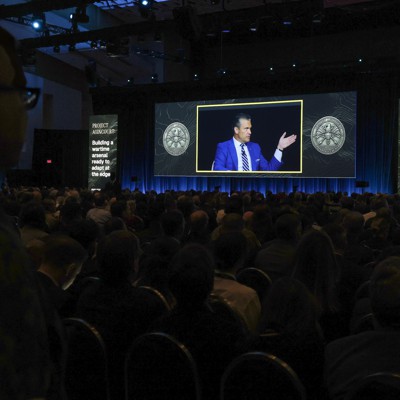
Defense Secretary Pete Hegseth speaks during the U.S. Army's 2026 annual meeting in Washington, D.C., on October 14, 2026. Kevin Dietsch/Getty Images
Each of the services will also stand up a component command, defense secretary said.
Meghann Myers and Patrick Tucker
Defense Secretary Pete Hegseth’s vision for the planned Autonomous Warfare Command over the next two years “is that we're still iterating, we're still adapting, we're still learning, and we're moving faster and faster because we're doing it. We understand how to do it better with each iteration.”
Hegseth sat down to discuss the Defense Department’s efforts to advance its autonomous capabilities with the service secretaries and the Pentagon’s top civilian for special operations during a panel Wednesday at AUSA’s annual meeting in Washington, D.C., but the discussion offered few details on what the forthcoming AUTOWARCOM, scheduled to activate by Oct. 1, 2027, will look like and how it will accomplish its mission.
The secretary, who has ordered cuts to and flag officer positions across the military services, was asked why a four-star combatant command is the correct vehicle to speed up acquisition and fielding of autonomous systems. He said that sometimes a general is the best person to get the job done.
“Let's put rank where we need it to ensure we can drive change quickly,” Hegseth said. “We're going to use rank to drive change with the right people in those positions, but not just legacy formations and commands which have gathered over time and haven't led to battlefield efforts.”
He did not say whether a search is on for commander candidates and what kind of experience he’s looking for.
The Army on Tuesday announced it would rename its Futures and Concepts Command , headed by Lt. Gen. Mac McCurry, to Futures and Autonomy Command, which will be the service’s component command nested under AUTOWARCOM.
The other services haven’t made any announcements about their own forthcoming autonomy commands. The Navy did not immediately respond to a query from Defense One on its plans. The Air Force referred questions to Hegseth’s office.
Much of the discussion focused on the services’ current use of unmanned platforms, as distinct from autonomous systems, which generally function without a human operator.
Hegseth said that AUTOWARCOM would deal not just with procurement, but also with training and doctrine around unmanned systems.
Two of the speakers mentioned an Army effort to open up its test ranges to private companies that make “drone, counter-drone, and long-ranges fires solutions.” Announced in August, the Army Permissive Test Range Expansion effort includes a website that promises a response within four weeks to companies that apply to use the ranges.
“Before, we kept these test ranges to ourselves for our own purposes. We were prioritizing and micromanaging the use of these ranges,” Acting Army Secretary Adam Telle said Wednesday. “To the degree that our bureaucracy is living in the way of our most innovative people from iterating quickly, it's a shame.”
The Army is also working to open “theater innovation labs” outside the United States, said Derrick Anderson, a ssistant defense secretary for Special Operations and Low-Intensity Conflict. Anderson said the labs, which are being launched in conjunction with U.S. Special Operations Command, meant that “operators sitting here stateside iterating on these autonomous systems” would have a “place to go and iterate” when they go abroad as well.
Anderson added that the Defense Autonomous Warfare Group run by the Defense Innovation Unit will be folded into SOCOM’s new Task Force Autonomous Warfare.
One day before Hegseth took the AUSA spotlight, Army officials had offered some insight into their plans for autonomous warfare on Tuesday, including “appropriate levels of human judgment,” Army Chief Technology Officer Alex Miller said during a panel.
“Things like counter-battery fire, things like air and missile defense, things that happen at a superhuman speed and scale—want to have humans on the loop for decisions, but then we cannot be limited by you know the 20 watts that have up here,” Miller said, pointing to his head. “If we are taking thousands of drones or hundreds of rounds, we can't put that on a human. We want to enable them to be a crew chief for superintelligence and autonomy.”
On Wednesday’s panel, Air Force Secretary Troy Meink said his service is experimenting with autonomous fighter aircraft at Creech Air Force Base in Nevada.
Last year, the Pentagon came under fire for its intentions around autonomous capabilities when AI company Anthropic , then a vendor to the Defense Department, protested the potential use of its models in support of lethal autonomous weapons and mass domestic surveillance.
Currently, artificial intelligence is used in collecting intelligence, identifying battlefield and data management. AUTOWARCOM would ostensibly be an entire combatant command built around autonomous platforms, but none of the senior officials on stage Wednesday identified any of the advancements the department hopes to make in their use.
“It will be a leader in the way we fight going forward, and I think we'll look back and say that was a no-brainer,” Hegseth said. “We should have done it 10 years earlier, but at least we did it.”
Lauren Williams contributed to this report.
Help us report on the future of national security. Contact Meghann Myers: mmyers@defenseone.com, meghannmyers.55 on Signal.
NEXT STORY: Army brings back ‘night court’ audit of programs, shifting more than $100M
2026年10月14日,美国国防部长皮特·赫格塞斯在华盛顿特区举行的美国陆军2026年度会议上发表讲话。图片来源:Kevin Dietsch/Getty Images
国防部长表示,各军种还将分别成立一个组成司令部。
梅根·迈尔斯和帕特里克·塔克
国防部长皮特·赫格塞斯对未来两年内计划成立的自主作战司令部的愿景是:“我们仍在迭代,仍在调整,仍在学习,而且我们进展得越来越快,因为我们一直在做。每一次迭代,我们都更了解如何做得更好。”
周三,在华盛顿特区举行的美国陆军协会年会上,赫格塞斯与各军种部长和五角大楼负责特种作战的最高文职官员坐下来,讨论了国防部为提升其自主能力所做的努力。但讨论并未提供太多关于即将于 2027 年 10 月 1 日启用的自动作战司令部(AUTOWARCOM)的具体细节,以及它将如何完成其任务。
这位部长下令削减各军种的高级军官职位,当被问及为何设立四星作战司令部是加快自主系统采购和部署的合适途径时,他表示,有时将军才是完成这项工作的最佳人选。
“我们要把军衔用在需要的地方,以确保能够迅速推动变革,”赫格塞斯说。“我们将利用军衔,让合适的人担任这些职位,从而推动变革,而不是仅仅沿用那些随着时间积累起来却未能带来战场成效的传统编制和指挥体系。”
他没有说明是否正在寻找指挥官候选人,也没有说明他希望候选人具备什么样的经验。
美国陆军周二宣布,将把由麦克·麦克库里中将领导的未来与概念司令部更名为未来与自主司令部,该司令部将成为美国陆军自主作战司令部下属的组成司令部。
其他军种尚未就各自即将成立的自主指挥部发布任何公告。海军方面没有立即回复Defense One关于其计划的问询。空军方面则将问题转给了赫格塞斯办公室。
讨论的重点大多集中在各军种目前对无人平台的使用上,这与通常无需人类操作员即可运行的自主系统有所不同。
赫格塞斯表示,AUTOWARCOM 不仅负责采购,还负责无人系统的培训和理论制定。
两位发言者提到陆军正在努力向生产“无人机、反无人机和远程火力解决方案”的私营公司开放其试验场。这项名为“陆军许可试验场扩建计划”的项目于8月宣布,其中包括一个网站,承诺在四周内回复申请使用试验场的公司。
“以前,我们把这些试验场留给自己使用。我们对这些试验场的使用进行了严格的优先级排序和微观管理,”代理陆军部长亚当·特勒周三表示。“如果我们的官僚作风阻碍了我们最具创新精神的人员快速迭代,那就太遗憾了。”
美国陆军也在努力在美国境外开设“战区创新实验室”,负责特种作战和低强度冲突的助理国防部长德里克·安德森表示。安德森说,这些实验室是与美国特种作战司令部联合启动的,这意味着“身处美国本土、不断改进这些自主系统的作战人员”在出国作战时,也将有一个“可以继续改进和完善的地方”。
安德森补充说,由国防创新部门运营的国防自主作战小组将并入特种作战司令部新成立的自主作战特遣队。
在赫格塞斯成为美国陆军协会焦点的前一天,陆军官员周二透露了一些关于自主战争计划的信息,其中包括“适当程度的人类判断”,陆军首席技术官亚历克斯·米勒在小组讨论中说道。
“像反炮兵火力、防空和导弹防御这类以超乎常人的速度和规模发生的事件——我们希望有人参与决策,但我们不能受限于我们头顶那区区20瓦的功率,”米勒指着自己的脑袋说道。“如果我们要操控成千上万架无人机或数百发炮弹,就不能把这些都交给一个人。我们希望他们能够成为超级智能和自主系统的指挥官。”
在周三的小组讨论会上,空军部长特洛伊·梅因克表示,空军正在内华达州克里奇空军基地试验自主战斗机。
去年,五角大楼因其在自主能力方面的意图而受到抨击,当时国防部的供应商人工智能公司 Anthropic 抗议其模型可能被用于支持致命的自主武器和大规模国内监控。
目前,人工智能已被应用于情报收集、战场识别和数据管理。AUTOWARCOM表面上是一个围绕自主平台构建的作战司令部,但周三在场的几位高级官员均未透露国防部希望在这些平台上取得哪些进展。
“这将引领我们未来的作战方式,我想我们以后回顾时会觉得这根本不用考虑,”赫格塞斯说。“我们本应该十年前就这么做,但至少我们做到了。”
劳伦·威廉姆斯对本报道亦有贡献。
请协助我们报道国家安全的未来发展趋势。请联系梅根·迈尔斯:邮箱 mmyers@defenseone.com,或通过 Signal 联系 meghannmyers.55。
下一篇报道:陆军恢复对各项计划进行“夜间法庭”审计,涉及超过1亿美元的资金。