As Wall Street banks finance and adopt AI, risks mount on both fronts随着华尔街银行对人工智能进行融资和应用,这两个方面的风险都在增加。
Oct 14 (Reuters) - Wall Street's biggest banks want to ride the AI wave without getting caught in its undertow, as the promise of a lucrative infrastructure boom collides with questions over returns and new security threats.
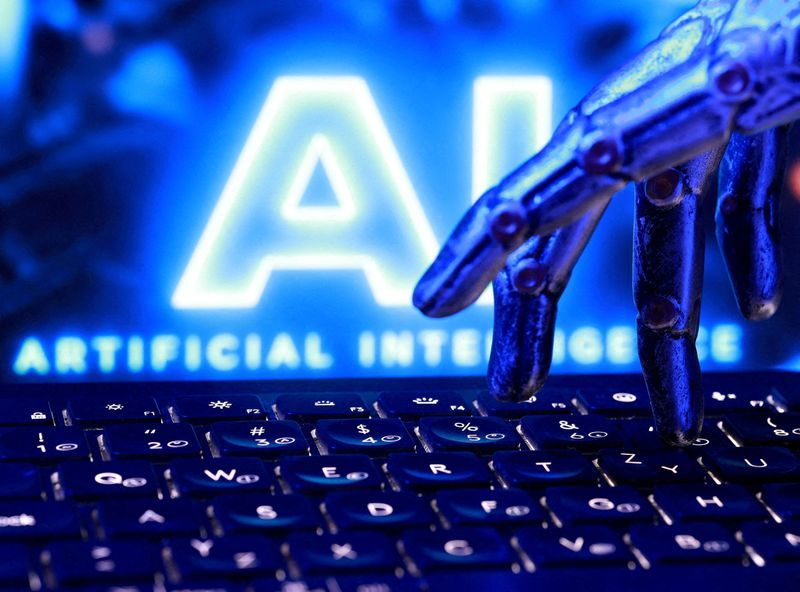
FILE PHOTO: "AI Artificial Intelligence" words, a keyboard and a robotics hand in this illustration taken, September 23, 2026. REUTERS/Dado Ruvic/Illustration/File Photo
Oct 14 (Reuters) - Wall Street's biggest banks want to ride the AI wave without getting caught in its undertow, as the promise of a lucrative infrastructure boom collides with questions over returns and new security threats.
Executives at the largest US banks this week discussed the risks of AI agents acting on customers' behalf and the uncertainty surrounding demand for the capital and computing power needed to fuel the technology's rapid growth.
"While we are proud of the privileged position we play in the AI investment cycle, no one knows how the demands for capital and compute will evolve as the broader AI ecosystem matures," Goldman CEO David Solomon said on a call with analysts.
"That will only become clearer as technology and markets continue to develop. This uncertainty reinforces the importance of remaining vigilant around the types of activity we finance and how we manage risk."
Citigroup CEO Jane Fraser does not believe that higher rates will slow down the investment in the AI infrastructure. "We're not seeing a slowdown in investment in the broader AI ecosystem. There's simply not enough compute," she said, referring to the processing power needed to develop and run AI models, supported by chips and data centers.
CAPITAL BEHIND THE GREAT AI BUILDOUT
The scale of investment in AI infrastructure is unprecedented. Big Tech has committed billions to building data centers, the backbone of the computing capacity needed to train and run generative AI models.
For Wall Street, the buildout offers a chance to finance one of the biggest investment cycles in decades.
Bank of America CEO Brian Moynihan said the enormous amount of AI capital investment is important for the lender's investment-grade debt and leveraged finance businesses.
Yet the financing opportunity hinges on several unknowns, from whether demand for computing power will keep pace with the industry's ambitious expansion plans to the returns data center projects can generate and the potential for local opposition.
"The AI investment cycle has become a complicated macroeconomic force in its own right," Wells Fargo CEO Charlie Scharf told analysts on a post-earnings call. He added that the buildout presents both opportunities and risks, given the significant leverage used to finance it and upward pressure on prices in some industries and supply chains.
"Having said this, the strength of the economy and the positive forces from these investments have thus far outweighed the potential downside," Scharf said.
Elevated interest rates that stay higher for longer, or rise further, could increase financing costs for data center projects, squeeze returns and make it more expensive for borrowers to service debt.
Morgan Stanley Chief Financial OfficerSharonYeshaya said in an interview with Reuters that the bank was "very discerning" about the types of risks it was taking. "What you worry about is that peers and other firms allow for a loosening of credit standards, and that's kind of what creates the issue. We're very focused on making sure that we're not involved in those types of transactions." The bank's CEO Ted Pick told analysts the involvement in AI financing is "existential" for Morgan Stanley.
Investors, too, are weighing the economic benefits of the AI boom against the risk of losses on loans to projects that fail to deliver expected returns.
"To the extent that the tech spend is helping drive growth in the overall economy, that is a positive and material to the banks. If the credit exposure is directly related to certain projects like speculative data-center builds, it could lead to issues down the road," said Macrae Sykes, portfolio manager at Gabelli Funds, which holds several bank stocks.
Other investors say that banks are better positioned to manage those risks than some fear, having tightened their risk management practices after the financial crisis.
Dave Ellison, portfolio manager at Hennessy Funds, said banks have not abandoned the lessons of the crisis and are being more careful than investors fear. They are facilitating AI-related financing, but often as arrangers that distribute risk.
RINGFENCING EMERGING AI RISKS
Beyond financing the buildout, banks are deploying AI in hopes of cutting costs and boosting productivity, but the financial payoff remains difficult to quantify.
"As important and dramatic and exciting as this theme is, it takes a long time to really do things that are visible at an institution of our size," JPMorgan CFO Jeremy Barnum said, adding that it is not a surprise that benefits are not yet observable in the bank's quarterly earnings.
Citi's Fraser said the bank is already seeing clear effects of the use of AI, such as developing products at lower cost and up to 40% faster. The use of coding tools has eased development and reduced tech vendor expenses by 30%, she said.
"We are seeing the financial benefits from AI and automation significantly outweigh the investments we've made year to date," Fraser said. The bank is using AI to reduce the volume of manual processes, as well as response time in client service.
Investors are betting on AI to deliver productivity gains across corporate America and valuations of US stocks leave little room for those gains to disappoint.
"If those gains in productivity and lower costs do not arrive by the end of next year, investors will begin to question the hype of AI," Brian Mulberry, chief market strategist at Zacks Investment Management, said.
At the same time, AI agents introduce new security challenges as they gain the ability to act autonomously. The technology is also adding to the threat posed by external cyber attackers.
JPMorgan CEO Jamie Dimon said that the lender is developing tools to navigate agentic AI risk.
(Reporting by Manya Saini in Bengaluru and Saeed Azhar and Tatiana Bautzer in New York; Editing by Aurora Ellis)
Thank you for your report!
NATO fund targets drone defence technologies as Ukraine reshapes priorities
Technology key to building future-ready road network, says Nanta
Crypto startup Alpaca targets prime brokerage technology market
资料图片:这张摄于2026年9月23日的插图显示了“AI 人工智能”字样、键盘和机械手。路透社/Dado Ruvic/插图/资料图片
10 月 14 日(路透社)——华尔街最大的几家银行希望搭上人工智能浪潮的顺风车,同时又不被其暗流吞噬。与此同时,利润丰厚的基建热潮与回报问题和新的安全威胁相互碰撞。
本周,美国最大几家银行的高管讨论了人工智能代理代表客户行事的风险,以及推动该技术快速增长所需的资金和计算能力的需求不确定性。
高盛首席执行官大卫·所罗门在与分析师的电话会议上表示:“虽然我们为自己在人工智能投资周期中扮演的特殊角色感到自豪,但随着更广泛的人工智能生态系统的成熟,没有人知道对资本和计算的需求将如何演变。”
“随着技术和市场的不断发展,这一点只会变得更加清晰。这种不确定性更加凸显了我们对所融资活动类型以及风险管理方式保持警惕的重要性。”
花旗集团首席执行官简·弗雷泽认为,利率上升不会减缓对人工智能基础设施的投资。“我们没有看到对整个人工智能生态系统的投资放缓。问题在于计算能力不足,”她说道,这里指的是开发和运行人工智能模型所需的处理能力,而这需要芯片和数据中心的支持。
推动人工智能大建设的资金
对人工智能基础设施的投资规模前所未有。大型科技公司已投入数十亿美元建设数据中心,这些数据中心是训练和运行生成式人工智能模型所需计算能力的支柱。
对于华尔街而言,此次扩建工程提供了一个机会,可以为几十年来最大的投资周期之一提供融资。
美国银行首席执行官布莱恩·莫伊尼汉表示,巨额人工智能资本投资对于该银行的投资级债务和杠杆融资业务至关重要。
然而,融资机会取决于几个未知因素,从计算能力的需求能否跟上该行业雄心勃勃的扩张计划,到数据中心项目能够产生的回报,以及当地可能出现的反对意见。
富国银行首席执行官查理·沙夫在财报电话会议上告诉分析师:“人工智能投资周期本身已成为一股复杂的宏观经济力量。”他补充说,鉴于用于融资的大量杠杆以及某些行业和供应链的价格上涨压力,人工智能的建设既带来了机遇也带来了风险。
“尽管如此,经济的强劲势头和这些投资带来的积极影响迄今为止已经超过了潜在的不利影响,”沙夫说。
高利率持续高位或进一步上涨,可能会增加数据中心项目的融资成本,挤压收益,并使借款人偿还债务的成本更高。
摩根士丹利首席财务官莎伦·耶沙亚在接受路透社采访时表示,该行对所承担的风险类型“非常谨慎”。“我们担心的是,同行和其他公司会放松信贷标准,这才是问题的根源。我们非常注重确保自己不参与这类交易。”该行首席执行官泰德·皮克告诉分析师,参与人工智能融资对摩根士丹利而言是“生死攸关”的。
投资者也在权衡人工智能热潮带来的经济效益与贷款项目未能实现预期回报而造成的损失风险。
“如果科技支出能够推动整体经济增长,这对银行来说是积极且重要的。但如果信贷风险敞口直接与某些项目相关,例如投机性数据中心建设,则可能导致未来出现问题,”持有多家银行股票的Gabelli Funds投资组合经理Macrae Sykes表示。
其他投资者则表示,银行在应对这些风险方面比一些人担心的要好,因为在金融危机之后,银行已经加强了风险管理措施。
轩尼诗基金的投资组合经理戴夫·埃里森表示,银行并未忘记危机中的教训,而且比投资者担心的更加谨慎。它们正在为人工智能相关的融资提供便利,但通常扮演的是风险分散的安排者角色。
隔离新兴人工智能风险
除了为建设提供资金外,银行还在部署人工智能,希望降低成本并提高生产力,但财务回报仍然难以量化。
摩根大通首席财务官杰里米·巴纳姆表示:“尽管这个主题非常重要、引人注目且令人兴奋,但对于我们这样规模的机构来说,真正取得可见的成效需要很长时间。”他还补充说,银行的季度收益尚未显现出效益,这并不令人意外。
花旗银行的弗雷泽表示,该行已经看到了人工智能应用带来的显著成效,例如产品开发成本更低,速度提升高达40%。她还表示,编码工具的使用简化了开发流程,并将技术供应商的费用降低了30%。
弗雷泽表示:“我们看到,人工智能和自动化带来的财务收益远远超过了我们今年迄今为止的投资。” 该银行正在利用人工智能来减少人工流程的数量,并缩短客户服务的响应时间。
投资者押注人工智能将提高美国企业的生产力,而美国股票的估值也使得这些收益几乎没有令人失望的空间。
Zacks投资管理公司首席市场策略师布莱恩·穆尔伯里表示:“如果到明年年底,生产力提高和成本降低的这些成果还没有实现,投资者就会开始质疑人工智能的热度。”
与此同时,人工智能代理在获得自主行动能力的同时,也带来了新的安全挑战。这项技术也加剧了外部网络攻击者构成的威胁。
摩根大通首席执行官杰米·戴蒙表示,该银行正在开发工具来应对人工智能代理风险。
(Manya Saini在班加罗尔报道,Saeed Azhar和Tatiana Bautzer在纽约报道;Aurora Ellis编辑)
感谢您的报告!
北约基金瞄准无人机防御技术,乌克兰调整优先事项
南塔表示,技术是构建面向未来的公路网络的关键。
加密货币初创公司Alpaca瞄准了主经纪商技术市场。