The Days Of Army Air Defense Systems Firing Just One Type Of Interceptor Are Ending陆军防空系统只发射一种拦截弹的时代即将结束。
The Army is pursuing an increasingly diverse array of new anti-air interceptors for use with existing launchers and other architectures.
新闻视频
By Joseph Trevithick
Published Oct 14, 2026 6:24 PM EDT
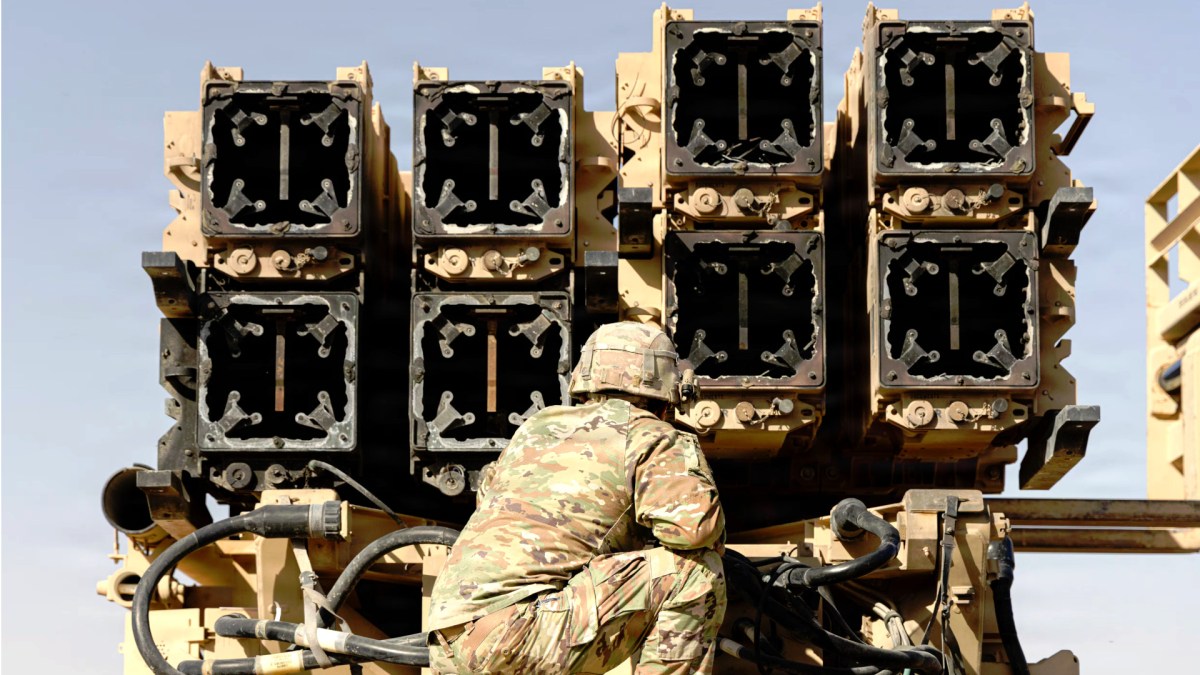
The U.S. Army now has at least five named programs seeking new anti-air interceptors of various tiers to collectively address everything from advanced hypersonic missiles to small weaponized drones . In the process, an important central theme is emerging: the service’s days of fielding air defense systems that can only use one type of interceptor look to be increasingly over. For the U.S. military, the impacts from the war with Iran have made clear that diversifying munitions stockpiles and supplier bases is no longer just valuable, it is critical.
Army Lt. Gen. Frank Lozano, the service’s Portfolio Acquisition Executive for Fires, highlighted this growing trend yesterday during a panel discussion at the Association of the U.S. Army’s (AUSA) main annual convention, at which TWZ has been in attendance.
Secretary Hegseth, second from the left, seen in front of a launcher for the Patriot surface-to-air missile system during a tour of Redstone Arsenal in Alabama earlier this year. Army Lt. Gen. Frank Lozano is seen at far right. DoW/USN Petty Officer 1st Class Alexander Kubitza
To provide some immediate context, with the exception of Patriot, the main ground-based air defense systems in Army inventory today are fielded with just one type of interceptor. In the case of Patriot, the service’s procurement of new interceptors had also been increasingly limited to just one type, the PAC-3 Missile Segment Enhancement (MSE). Production of the preceding PAC-3 Cost Reduction Initiative (CRI) missile ended in 2023. Just earlier this year, the Army placed its first order in decades for new PAC-2 Guidance Enhanced Missile-Tactical (GEM-T) missiles , an older interceptor design for Patriot that has remained in production primarily for U.S. allies and partners.
A graphic showing different interceptor load options for existing trailer-based Patriot launchers. Lockheed Martin
Separately, the Army is in the process of fielding Enduring Shield , a new middle-tier air defense system designed to handle multiple interceptor types. However, the service is currently only acquiring AIM-9X Sidewinders to load into them. We will come back to this later on.
An Enduring Shield launcher. USAF Pfc. Sang Woo Choi
“We have the capabilities we need to have to fight and win, but it’s our job to ensure that victory is achievable in the future inside of any dynamic environment scenario fight we might find ourselves in,” Lt. Gen. Lozano said yesterday. “So, it’s incumbent upon Mr. Ingraham [ Assistant Secretary of the Army for Acquisition, Logistics and Technology Brent Ingraham] and I to continue to be creative and looking at, well, should we buy GEM-Ts because they’re being produced?”
“GEM-Ts are a really good missile in the battlespace within they operate. I mean, they’re being employed today by air defense brigades around the world,” he continued. “So if we have the opportunity, it’s probably something we should take advantage of, and we’re looking at doing that.
“We’ve had a lot of discussions about even more interceptors. From a PAC-3 MSE perspective, our goal has always been to get to 2,000 [per year],” he added. “Why we’re running programs like LCI [Low Cost Interceptor], and NGSRI [Next-Generation Short-Range Interceptor], and NGCM [Next-Generation C-UAS Missile], and Second Interceptor, is because I think the easy button answer is just buy more of a great missile. We’re going to buy more [PAC-3 MSEs], but when we start talking about overall missile output, we start looking at numbers like is it 4,000, is it 6,000, is it 8,000, we’re looking at a diverse set of capabilities.”
The LCI program is seeking a lower-cost and lower-tier interceptor for Patriot with a unit price of no more than $1 million. PAC-3 MSE’s average unit cost has been around $4 million in recent years.
A PAC-3 MSE interceptor seen being launched. US military A Patriot launcher fires a newer PAC-3-series missile during a test. DoD
NGSRI is the Army’s program to find a replacement for the venerable Stinger . The new missiles have to be compatible with existing vehicle-based and man-portable launchers.
A US Army soldier fires a Stinger from a man-portable launcher during training. US Army
The Army is working to field a new counter-drone interceptor through NGCM. Those missiles will be integrated into launchers the service has now for the Coyote interceptor .
The Second Interceptor effort is for Enduring Shield, which is also known as the Indirect Fire Protection Capability Increment 2 (IFPC Inc 2). The main goal there is to provide increased capability against incoming cruise missiles compared to the AIM-9X.
There is also the Army’s Future Interceptor effort , which also came up separately at the panel yesterday, and is also for Patriot. Unlike LCI, the aim here is to acquire a new interceptor with improved capabilities against hypersonic missiles and other upper-tier threats.
Historically, Army programs like these would eventually result in the selection of a single winning missile design. Lozano’s remarks yesterday point to the service increasingly taking a very different approach.
On “second interceptor, obviously, we just moved into phase two of that program. We’ve got Lockheed Martin competing with Boeing, who was teamed with Anduril,” Lozano said. “But we wanted to turn up the heat on that program. I constantly get frustrated when a funding profile emerges over the FYDP [the Future Years Defense Program], and then magically we lay in a five-year program.”
At left, a model of the Boeing/Anduril offering for the Second Interceptor effort. At right, a rendering of Lockheed Martin’s proposed Second Interceptor. Jamie Hunter/Lockheed Martin
“I’m like, no, I actually need that capability now,” he continued. “So, have we thought maybe what if we ran a 24-month program or a 36-month program, right? And so, in that vein, what we have decided to do is, while those two companies continue to compete, we’re going to create a shoot-off opportunity in [the] fourth quarter [of Fiscal Year 20]27, and I want to run an in-parallel, what I call an in-stride competition.”
“We just held an industry day, and we basically just said, hey, if there’s any other company who didn’t make the first cut in the phase one, but, oh, by the way, who continued to invest in the IFPC Second Interceptor capability, we’d love for you to come out to the range,” he added. “We’ll give you range time, we’ll present targets, and we’ll allow you to recompete with an opportunity to get back into the program folder.”
The Army is doing the exact same thing with NGSRI , where Lockheed Martin and Raytheon have been competing face-to-face. That program is also now planning to hold a new shoot-off that will be open to other vendors in the fourth quarter of Fiscal Year 2027.
A picture showing a test of Lockheed Martin’s NGSRI entrant, called QuadStar. Lockheed Martin
Raytheon, which is also the prime contractor for Stinger, has previously released this image in relation to work on its NGSRI design. Raytheon
There are signs the Army is moving in a similar direction with NGCM, where it previously selected AeroVironment to supply its Freedom Eagle-1 (FE-1) interceptor . The service put out a request for information seeking new NGCM options in August, with a goal of holding an initial evaluation again in the fourth quarter of Fiscal Year 2027. A deeper operational assessment could then follow in Fiscal Year 2028.
To reiterate, on top of all this, the Army is also now pursuing at least two new interceptor options for Patriot.
“We have to address the threat, and we need to address the threat in a complementary way, meaning we need to fight on a cost curve that’s affordable for the U.S. Army to maintain and sustain that warfighting capability abroad,” Lozano stressed yesterday.
This gets to the crux of the matter. It is not at all a new observation that just having a stockpile of any particular munition on day one of a conflict is not enough, especially if the fight becomes drawn out. There needs to be sufficient depth to those stocks at the start and the ability to readily replenish them in line with expenditures. The war with Iran , compounded by other crises in the Middle East and the ongoing conflict in Ukraine , has made clear that these core truths apply to all armed forces, even the U.S. military.
Lower-cost munitions are part of the solution, but they also need to be producible at scale on reasonable timelines. The lead time for higher-end munitions today is often measured in months, if not years. Furthermore, being locked into a single vendor has been shown to not just be undesirable, but a potential national security risk in an actual conflict. Lozano’s remarks yesterday, and how the Army is now pursuing new anti-air interceptors, reflect larger trends, not just in the acquisition of larger volumes of munitions overall, but also from a broader array of total suppliers .
There has also a push across the U.S. military to bring in new and non-traditional firms , including in partnership with established prime contractors. An example of this is the Boeing/Anduril team-up for Second Interceptor. This was also underscored by new framework agreements the Pentagon announced back in May regarding the planned purchase of thousands of lower-cost cruise missiles.
The @DeptofWar has reached new framework agreements with a slate of disruptive new entrants to aggressively expand the United States military’s lethal cruise missile and hypersonic missile strike capabilities. Low-Cost Containerized Missiles (LCCM) Program: • Anduril •… pic.twitter.com/Fr2xAnBM7y — Department of War CTO (@DoWCTO) May 13, 2026
The @DeptofWar has reached new framework agreements with a slate of disruptive new entrants to aggressively expand the United States military’s lethal cruise missile and hypersonic missile strike capabilities. Low-Cost Containerized Missiles (LCCM) Program: • Anduril •… pic.twitter.com/Fr2xAnBM7y
With regard to the LCI program, specifically, Lozano highlighted an additional aspect of all of this yesterday.
LCI has “a unique twist to it because we’re looking for companies who have all-up rounds, but I’m also asking for companies to come in at the component level,” he explained. “We typically don’t do that, right? There’s a lot of risk in managing components and generating all-up round systems. But we’re also looking for weapon system integrators, because I want to be able to create two or three teams who can compete with the all-up round guys to see if we can generate some momentum behind the fact that we need to thicken our inventory with low-cost, affordable munitions.”
The U.S. Navy is now pursuing a roughly similar approach with its Naval Modular Missile (NMM) program. NMM envisions an entirely new family of sea-launched surface-to-air missiles that offer very different capabilities, but that all feature certain common components, as you can read more about here .
A graphic laying out the Navy’s vision for the different members of the NMM family, and shared components between them. USN
The Army is also eyeing a new family of launcher vehicles, as well as containerized options , all capable of firing various types of surface-to-air and surface-to-surface munitions. Autonomy is also an important aspect of what is aptly dubbed the Common Autonomous Multi-Domain Launcher (CAML) program .
It is also important to note here that the underlying aim is not to eliminate more exquisite munitions, or the capabilities that they offer, but to create a more affordable, complementary mix of options.
“What I would say is we’re solely focused on delivering on the programs we are executing now,” Lozano said in closing at the end of the panel yesterday. “We have to deliver, and if we deliver on that wide variety of capability, then we can increase and ramp that capacity. And that would be my wish list, that we have enough resources and we achieve programmatic success in the way that we’re planning to, so we can deliver in mass.”
All signs point to the diversity in munitions that Lozano is talking about here being particularly pronounced in future Army air defense capabilities full of systems firing multiple types of interceptors.
Contact the author: joe@twz.com
Comments couldn’t be loaded. Please refresh the page.
作者:约瑟夫·特雷维西克
发布于美国东部时间2026年10月14日下午6:24
美国陆军目前至少有五个项目正在寻求研发不同级别的新型防空拦截器,以应对从先进高超音速导弹到小型武装无人机等各种威胁。在此过程中,一个重要的核心主题正在浮现:陆军部署只能使用单一类型拦截器的防空系统的日子似乎正在逐渐结束。对于美军而言,与伊朗的战争已经清楚地表明,弹药储备和供应商来源的多样化不仅具有价值,而且至关重要。
陆军中将弗兰克·洛萨诺(Frank Lozano)是该军种火力采购组合执行官,他昨天在美国陆军协会(AUSA)年度大会的一个小组讨论中强调了这一日益增长的趋势,TWZ 也出席了此次大会。
今年早些时候,美国国防部长赫格塞斯(左二)在参观阿拉巴马州雷德斯通兵工厂期间,站在“爱国者”地对空导弹系统的发射装置前。陆军中将弗兰克·洛萨诺(最右侧)。美国海军一级军士长亚历山大·库比扎
为了便于理解,我们不妨先来看一下背景:除了“爱国者”导弹系统外,目前陆军装备的主要陆基防空系统都只配备一种拦截弹。就“爱国者”导弹系统而言,陆军采购新型拦截弹的渠道也日益局限于PAC-3导弹段增强型(MSE)。其前身PAC-3成本削减计划(CRI)导弹的生产已于2023年结束。就在今年年初,陆军下达了数十年来的首份PAC-2制导增强型战术导弹(GEM-T)订单。GEM-T是“爱国者”导弹系统较早设计的拦截弹,目前仍在生产,主要供应给美国的盟友和伙伴。
一张图表展示了现有拖车式“爱国者”导弹发射车的不同拦截弹装载方案。洛克希德·马丁公司
此外,陆军正在部署“持久盾牌”(Enduring Shield)系统,这是一种新型中级防空系统,旨在应对多种类型的拦截弹。然而,目前陆军仅采购AIM-9X“响尾蛇”导弹用于该系统。我们稍后会再讨论这个问题。
“持久之盾”发射器。美国空军一等兵崔相佑
洛萨诺中将昨天表示:“我们拥有作战和取胜所需的能力,但我们的职责是确保在未来任何可能遇到的动态环境和作战场景中都能取得胜利。因此,我和英格拉姆先生(陆军负责采购、后勤和技术的助理部长布伦特·英格拉姆)有责任继续发挥创造力,并考虑诸如‘我们是否应该购买GEM-T导弹系统,因为它们正在生产’之类的问题。”
“GEM-T导弹在其作战范围内是一种非常优秀的导弹。我的意思是,如今世界各地的防空部队都在使用它们,”他继续说道。“所以,如果我们有机会,我们或许应该抓住这个机会,而我们也正在考虑这样做。”
“我们已经就增加拦截弹数量进行了多次讨论。从PAC-3 MSE的角度来看,我们的目标始终是达到每年2000枚,”他补充道。“我们之所以要开展LCI(低成本拦截弹)、NGSRI(下一代短程拦截弹)、NGCM(下一代反无人机导弹)和第二种拦截弹等项目,是因为我认为最简单的办法就是购买更多性能优异的导弹。我们确实会购买更多PAC-3 MSE,但当我们开始讨论导弹总产量时,我们会考虑4000枚、6000枚还是8000枚这样的数字,我们需要考虑多种不同的能力。”
LCI项目正在为“爱国者”导弹系统寻求一种成本更低、性能更低的拦截器,单价不超过100万美元。近年来,PAC-3 MSE拦截器的平均单价约为400万美元。
图中可见一枚PAC-3 MSE拦截导弹正在发射。美国军方:爱国者导弹发射装置在测试中发射了一枚新型PAC-3系列导弹。(美国国防部)
NGSRI是陆军旨在寻找老旧“毒刺”导弹替代品的项目。新型导弹必须与现有的车载和便携式发射装置兼容。
一名美国陆军士兵在训练中用便携式发射器发射毒刺导弹。
陆军正致力于通过下一代反无人机导弹(NGCM)项目部署一种新型反无人机拦截器。这些导弹将集成到陆军目前用于“郊狼”(Coyote)拦截器的发射器中。
第二阶段拦截器研发工作是为“持久盾牌”(Enduring Shield)系统而开展的,该系统也被称为“间接火力防护能力提升2”(IFPC Inc 2)。其主要目标是提升拦截来袭巡航导弹的能力,使其优于AIM-9X导弹。
此外,陆军的“未来拦截器”项目也在昨天的小组讨论中单独提及,该项目同样针对“爱国者”导弹系统。与LCI项目不同,该项目的目标是研发一种新型拦截器,使其具备更强的拦截高超音速导弹和其他高端威胁的能力。
历史上,陆军此类项目最终都会选定一种中标导弹设计。洛萨诺昨天的讲话表明,陆军正日益采取截然不同的做法。
“关于第二款拦截机,显然,我们刚刚进入该项目的第二阶段。洛克希德·马丁公司正在与波音公司竞争,波音公司之前与安杜里尔公司合作,”洛萨诺说。“但我们希望加快该项目的进度。每当未来国防计划(FYDP)的资金方案出炉,然后我们又神奇地启动一个为期五年的项目时,我都会感到沮丧。”
左图为波音/安杜里尔公司为第二代拦截机项目提供的模型。右图为洛克希德·马丁公司提出的第二代拦截机效果图。图片来源:Jamie Hunter/洛克希德·马丁公司
“我的想法是,不,我现在就需要这种能力,”他继续说道。“所以,我们有没有想过,如果我们开展一个为期24个月或36个月的项目呢?因此,基于这个思路,我们决定,在这两家公司继续竞争的同时,我们将在2027财年第四季度创造一个加速发展的机会,我想开展一场并行的、我称之为‘步调一致’的竞争。”
“我们刚刚举办了一场行业日活动,我们基本上是说,嘿,如果还有其他公司在第一阶段筛选中落选,但顺便提一下,你们一直在投资IFPC第二拦截器项目,我们非常欢迎你们来靶场,”他补充道。“我们会提供靶场练习时间,展示目标,并让你们有机会重新参与竞争,重新回到项目名单中。”
陆军在下一代系统研发计划(NGSRI)中也采取了同样的做法,洛克希德·马丁公司和雷神公司一直在进行正面竞争。该计划目前也计划在2027财年第四季度举行新一轮的竞标,届时将向其他供应商开放。
图片展示了洛克希德·马丁公司参与下一代卫星研发计划(NGSRI)的QuadStar无人机的测试情况。洛克希德·马丁公司
雷神公司(同时也是“毒刺”导弹的主承包商)此前曾发布过这张图片,用于展示其新一代地面监视雷达(NGSRI)设计工作。雷神公司
有迹象表明,陆军在下一代巡航导弹(NGCM)领域正朝着类似的方向发展,此前陆军已选择AeroVironment公司为其提供“自由之鹰-1”(FE-1)拦截机。今年8月,陆军发布了一份信息征询书,寻求新的NGCM方案,目标是在2027财年第四季度再次进行初步评估。更深入的作战评估可能会在2028财年进行。
重申一下,除此之外,陆军目前还在为“爱国者”导弹系统寻求至少两种新的拦截器方案。
洛萨诺昨天强调:“我们必须应对这一威胁,而且我们需要以互补的方式来应对这一威胁,这意味着我们需要以美国陆军能够负担得起的成本曲线来维持和保持其在海外的作战能力。”
这直指问题的核心。在冲突爆发的第一天就拥有某种特定弹药的储备是不够的,尤其是在战争旷日持久的情况下,这并非什么新鲜事。这些储备必须在战争初期就具备足够的深度,并且能够根据实际消耗迅速补充。伊朗战争,加上中东其他危机以及持续不断的乌克兰冲突,都清楚地表明,这些核心真理适用于所有武装部队,甚至包括美军。
低成本弹药是解决方案的一部分,但它们也必须能够在合理的时间范围内大规模生产。如今,高端弹药的交付周期往往以月甚至年计算。此外,事实证明,被单一供应商锁定不仅不可取,而且在实际冲突中还可能构成国家安全风险。洛萨诺昨天的讲话,以及陆军目前正在研发新型防空拦截器的做法,反映了更大的趋势,不仅体现在弹药采购总量的增加,也体现在供应商范围的扩大。
美国军方也在大力推动引入新型和非传统公司,包括与老牌主承包商合作。波音公司与安杜里尔公司合作研发第二代拦截导弹就是一个例子。五角大楼五月份宣布的关于计划采购数千枚低成本巡航导弹的新框架协议也印证了这一点。
美国战争部已与一系列颠覆性的新进入者达成新的框架协议,旨在积极扩展美国军方致命巡航导弹和高超音速导弹的打击能力。低成本集装箱导弹(LCCM)项目:• Anduril •… pic.twitter.com/Fr2xAnBM7y — 美国战争部首席技术官 (@DoWCTO) 2026年5月13日
美国战争部已与一系列颠覆性的新进入者达成新的框架协议,旨在积极扩展美国军方致命巡航导弹和高超音速导弹的打击能力。低成本集装箱导弹(LCCM)项目:• Anduril •… pic.twitter.com/Fr2xAnBM7y
关于 LCI 项目,洛萨诺昨天特别强调了其中的另一个方面。
他解释说:“LCI项目有一个独特的特点,因为我们不仅寻找能够提供完整弹药系统的公司,还要求公司参与零部件层面的合作。我们通常不会这样做,对吧?管理零部件和开发完整弹药系统风险很大。但我们也在寻找武器系统集成商,因为我希望能够组建两到三支团队,与那些提供完整弹药系统的公司竞争,看看我们能否借此机会推动低成本、经济实惠的弹药库存扩充计划。”
美国海军目前正在推行类似的“海军模块化导弹”(NMM)计划。NMM计划旨在打造一个全新的海基地对空导弹系列,这些导弹性能各异,但都采用某些通用部件,详情请点击此处。
一张图表,阐述了海军对海军海事机械制造(NMM)系列不同成员及其共用部件的愿景。美国海军
陆军也在关注一系列新型发射车以及集装箱式发射方案,所有这些方案都能够发射各种类型的地对空和地对地弹药。自主性也是这项被恰当地称为“通用自主多域发射器”(CAML)计划的重要组成部分。
这里还需指出的是,其根本目的并非消除更精良的弹药或其所提供的能力,而是创造更经济实惠、互补的选择组合。
“我想说的是,我们目前只专注于推进正在执行的项目,”洛萨诺在昨天的小组讨论结束时总结道。“我们必须交付成果,如果我们能够交付各种能力,那么我们就可以扩大和提升产能。我的愿望是,我们拥有足够的资源,并且能够按照计划取得项目成功,这样我们才能大规模交付。”
种种迹象表明,洛萨诺在这里所说的弹药多样性在未来的陆军防空能力中将尤为突出,这些系统将发射多种类型的拦截弹。
联系作者:joe@twz.com
评论加载失败,请刷新页面。