White House Sinkhole Is A Reminder Of The Bunkers That Are Buried Beneath It白宫地陷提醒人们,它下面还埋着许多掩体。
Reporters gawking at the sinkhole on the White House lawn probably don't realize there is far more under there than just soaked dirt.
Updated Apr 29, 2019 2:34 PM EDT
A sinkhole has opened up along the North Lawn of the White House and the press and social media are having a field day with it. But the earthen anomaly can serve as a reminder that there is much more to the White House than what meets the eye. For seven and a half decades, a bunker has sat deep below the East Wing of the presidential estate. And no, it is not the famed Situation Room located in the basement of the West Wing. This is an entirely different and far more secure facility , and it in recent years it was likely augmented by a much more extravagant and modern complex buried deep beneath the western side of the North Lawn adjacent to the West Wing.
A labyrinth of passageways and rooms exists beneath 1600 Pennsylvania Avenue, the extent of which the public really doesn’t know. Much of this infrastructure was born of the atomic age when the White House was gutted and rebuilt under the Truman Administration between 1948 and 1952. This project included the establishment of the secretive secure facility we now know as the President’s Emergency Operations Center, or PEOC.
The White House seen totally gutted during the Truman renovation., National Archives
The facility actually dates back to World War II. At least a part of the space was originally built as a bunker for FDR, but with the Truman renovation, the bunker was expanded and drastically updated for a new era where atomic weapons and the fallout they produce posed massively greater dangers than traditional high-explosive bombs and other forms of attack.
Prior to 9/11, the facility existed in a form that was far from lavish and was highly limited in regards to how many occupants it could support within its hermetically sealed vault-like interior during a crisis. Lacking the convenience of the Situation Room, but offering far greater protection, the PEOC was there for the President and Vice President, their families, and only their closest aides to survive a surprise emergency.
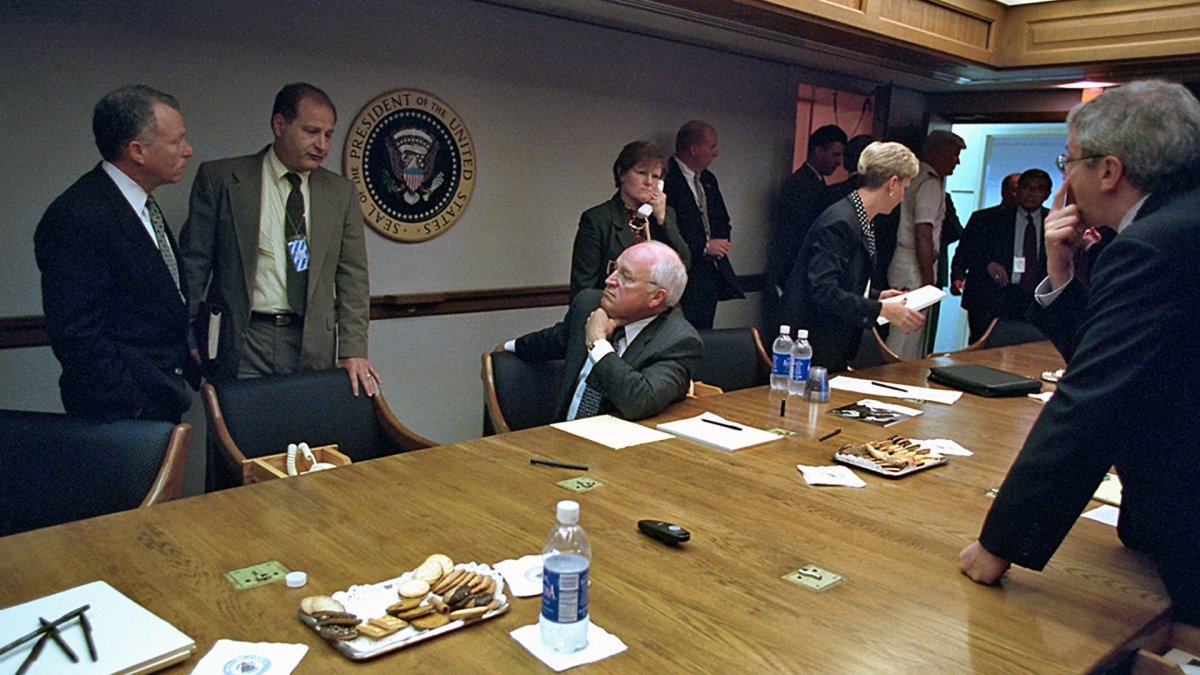
The sparse facility is described in Garrett Graff’s marvelous book Raven Rock (read our in-depth interview with Graff here ) as having a cot-lined hallway, a 600 square foot operations and communications room, a small briefing area, and a large command room dominated by some big-screen TVs and a conference table that can seat 16 people. When in use, a specialized U.S. Army engineering unit out of Fort Belvoir sits ready to dig out its occupants if need be.
In 2015, a series of photos that were taken throughout the day of Dick Cheney on 9/11 were released. They offer an incredible look at the mood and actions of the White House top staff on that day, and they are the first images released that show the PEOC. You can see more of them here .
U.S Government Image
U.S Government Photo
The Bush Administration cabinet, with the then FBI Director Mueller in the foreground, watch the President’s Oval Office address while still inside the safety of the PEOC’s vault-like walls., U.S Government Photo
During and immediately following the attacks on 9/11, Dick Cheney, various members of the Bush cabinet, First Lady Laura Bush, and eventually President Bush, huddled in the sparse bunker. In Laura Bush’s memoir Spoken From The Heart , she recounts being raced down to the dungeon-like facility on that fateful day, writing:
I was hustled inside and downstairs through a pair of big steel doors that closed behind me with a loud hiss, forming an airtight seal. I was now in one of the unfinished subterranean hallways underneath the White House, heading for the PEOC, the Presidential Emergency Operations Center, built for President Franklin Roosevelt during World War II. We walked along old tile floors with pipes hanging from the ceiling and all kinds of mechanical equipment… …I was ushered into the conference room adjacent to the PEOC’s nerve center. It’s a small room with a large table. National Security Advisor Condi Rice, Counselor to the President Karen Hughes, Deputy Chief of Staff Josh Bolten, and Dick and Lynne Cheney were already there, where they had been since the morning. Lynne, whose agents had brought her to the White House just after the first attack, came over and hugged me. Then she said quietly into my ear, “The plane that hit the Pentagon circled the White House first.”
I was hustled inside and downstairs through a pair of big steel doors that closed behind me with a loud hiss, forming an airtight seal. I was now in one of the unfinished subterranean hallways underneath the White House, heading for the PEOC, the Presidential Emergency Operations Center, built for President Franklin Roosevelt during World War II. We walked along old tile floors with pipes hanging from the ceiling and all kinds of mechanical equipment…
…I was ushered into the conference room adjacent to the PEOC’s nerve center. It’s a small room with a large table. National Security Advisor Condi Rice, Counselor to the President Karen Hughes, Deputy Chief of Staff Josh Bolten, and Dick and Lynne Cheney were already there, where they had been since the morning. Lynne, whose agents had brought her to the White House just after the first attack, came over and hugged me. Then she said quietly into my ear, “The plane that hit the Pentagon circled the White House first.”
The First Lady continues to describe being rushed down to the PEOC again later that evening:
We did finally climb into our own bed that night, exhausted and emotionally drained. Outside the doors of the residence, the Secret Service detail stood in their usual posts. I fell asleep, but it was a light, fitful rest, and I could feel George staring into the darkness beside me. Then I heard a man screaming as he ran, “Mr. President, Mr. President, you’ve got to get up. The White House is under attack.” We jumped up, and I grabbed a robe and stuck my feet into my slippers, but I didn’t stop to put in my contacts. George grabbed Barney; I grabbed Kitty. With Spot trailing behind, we started walking down to the PEOC. George had wanted to take the elevator, but the agents didn’t think it was safe, so we had to descend flight after flight of stairs, to the state floor, then the ground floor, and below, while I held George’s hand because I couldn’t see anything. My heart was pounding, and all I could do was count stairwell landings, trying to count off in my mind how many more floors we had to go. When we reached the PEOC, I saw the outline of a military sergeant unfolding the ancient hideaway bed and putting on some sheets. At that moment, another agent ran up to us and said, “Mr. President, it’s one of our own.” The plane was ours.
We did finally climb into our own bed that night, exhausted and emotionally drained. Outside the doors of the residence, the Secret Service detail stood in their usual posts. I fell asleep, but it was a light, fitful rest, and I could feel George staring into the darkness beside me. Then I heard a man screaming as he ran, “Mr. President, Mr. President, you’ve got to get up. The White House is under attack.”
We jumped up, and I grabbed a robe and stuck my feet into my slippers, but I didn’t stop to put in my contacts. George grabbed Barney; I grabbed Kitty. With Spot trailing behind, we started walking down to the PEOC. George had wanted to take the elevator, but the agents didn’t think it was safe, so we had to descend flight after flight of stairs, to the state floor, then the ground floor, and below, while I held George’s hand because I couldn’t see anything. My heart was pounding, and all I could do was count stairwell landings, trying to count off in my mind how many more floors we had to go. When we reached the PEOC, I saw the outline of a military sergeant unfolding the ancient hideaway bed and putting on some sheets.
At that moment, another agent ran up to us and said, “Mr. President, it’s one of our own.” The plane was ours.
What was discovered by Bush’s staff, and in particular Vice President Dick Cheney, was that the facility was alarming underprepared for dealing with a fast-moving crisis. Cheney couldn’t reach key personnel—there wasn’t even a line between the bunker and the nearby Situation Room. The TVs couldn’t video conference and provide audio from news networks at the same time. The facility didn’t even have the systems needed for the President or Vice President to address the nation. At one point, the CO2 was rising in the bunker because it was only built to handle a small number of people within its sealed environment.
In the end, command and control capabilities on that historic day were notoriously lacking. Essentially, it seemed as if the President and Vice President had the option of surviving in the cocooned facility or running the country, but not both.
With the specter of the 9/11 attacks looming large, the PEOC was drastically upgraded to be more capable of tying the President into their command and control network and the outside world. New communications systems and enhancements to environment systems were installed largely at the direction of the Vice President who had dealt with continuity of government planning over the vast majority of his career. It still wasn’t ideal, but the facility would at least hopefully be able to overcome some of the critical shortfalls experienced on 9/11.
Then, in 2010, part of the North Lawn adjacent to the West Wing of the White House was dug up and barriers were erected around the hole to hide part of a highly secretive a $375M construction project from the prying eyes of the very nearby media. The secrecy definitely brought on its own amount of media scrutiny , with stories popping up everywhere about how Obama was building a mysterious ‘super bunker’ under the White House lawn.
The largest construction project in over 60 years at the White House kicked off in 2010. The four-year, $376 million project is being supervised by the General Services Administration (GSA), which says the work is needed to upgrade underground utilities such as water and sewer lines and electrical conduits. By all indications, it went far beyond just a utility upgrade. , Kraft LLC/Corbis via Getty Images
Dubbed officially an air conditioning and mechanical systems upgrade, by almost all accounts part of the project included a new, massively expanded, PEOC—one replete with the latest communications, computer systems, and environmental technologies that could allow the President and their staff to operate unimpeded for extended periods of time during a crisis. In other words, we are likely talking about a fortified, deeply buried, five-story office building—an underground emergency White House if you will—that is in itself akin to a giant SCIF , which would also make it an ideal locale for holding highly sensitive meetings.
For years, steel beams and concrete disappeared into the chasm and an army of contractors worked away at what was literally a hole in the ground. But today, by looking at the area, you would have no clue what lies beneath.
The North Lawn of the White House just off the West Wing ripped up during the mysterious multi-year White House construction project. It was literally right in front of where the press post up on a daily basis., Google Earth
This new and improved facility could also seemingly offer the Secret Service more options when it comes to deciding where and when to move the President, Vice President, their families, and key members of their staffs, during a crisis. In the past, the decision would have to be made to move them to other continuity of government sites, like Camp David, Raven Rock, and Mount Weather, or shelter in place. With similar capabilities of those other sites now available on the White House grounds, the option of staying put is likely far more attractive for all but the direst of circumstances.
Considering how fast an attack or a major crisis could occur, it is questionable if there would be enough time for Marine One to launch from its alert site at Anacostia and make it to the White House and scurry the President off to a remote and highly secure location in time. With this in mind, a new and greatly enhanced PEOC certainly would seem to be long overdue. It’s also worth noting that an armada of other military helicopters is also on alert to move other administration officials off to secure locations scattered around the region, from the northern Allegheny Mountains own to the Carolinas.
It’s also worth noting that the sinkhole seems to exist along the perimeter of where the new construction took place in 2010-2012. But that doesn’t necessarily mean the two are directly related. Washington DC was fittingly built on a swamp remember and it has been a particularly wet stretch for the Capital. But it’s funny that such a small thing would grab so much attention from the press when there is likely a state of the art command center and continuity of government bunker right below their feet.
Contact the author: Tyler@thedrive.com
Comments couldn’t be loaded. Please refresh the page.
更新于美国东部时间2019年4月29日下午2:34
白宫北草坪出现了一个塌陷坑,媒体和社交媒体对此大肆报道。但这个地面异常现象也提醒我们,白宫远比表面看起来复杂得多。七十五年来,总统府东翼下方一直隐藏着一个掩体。而且,它并非位于西翼地下室的著名战情室。这是一个完全不同且安全得多的设施,近年来,在北草坪西侧、毗邻西翼的地下深处,很可能又增建了一个更加豪华现代化的建筑群。
宾夕法尼亚大道1600号下方隐藏着迷宫般的通道和房间,其规模之大鲜为人知。这其中许多基础设施都诞生于原子时代,当时在杜鲁门政府时期(1948年至1952年),白宫被彻底拆除重建。这项工程就包括建立我们现在所知的总统紧急行动中心(PEOC)——一个高度机密的安全设施。
杜鲁门翻修白宫期间,白宫内部几乎被完全掏空。(美国国家档案馆)
该设施实际上可以追溯到第二次世界大战时期。至少有一部分空间最初是为罗斯福总统建造的掩体,但随着杜鲁门总统的翻修,掩体得到了扩建和大幅升级,以适应原子武器及其产生的放射性尘埃比传统高爆炸弹和其他形式的袭击构成更大危险的新时代。
在9/11事件之前,总统紧急行动中心(PEOC)的设施远称不上豪华,而且在危机发生时,其密闭的保险库式内部空间所能容纳的人数也十分有限。虽然它不像战情室那样便利,但却能提供更强大的安全保障。PEOC的存在是为了确保总统、副总统及其家人和最亲密的助手在突发紧急情况下能够安全无虞。
加勒特·格拉夫在其精彩著作《渡鸦岩》(点击此处阅读我们对格拉夫的深度访谈)中对这座简陋的设施进行了描述:一条走廊两侧摆放着行军床,一个600平方英尺的作战和通信室,一个小型简报区,以及一个大型指挥室,指挥室内摆放着几台大屏幕电视和一张可容纳16人的会议桌。启用时,一支来自贝尔沃堡的美国陆军专业工程部队随时待命,准备在必要时将人员救出。
2015年,一组拍摄于9·11事件当天迪克·切尼的照片被公布。这些照片真实展现了白宫高层当天的情绪和行动,也是首次公开的白宫高层行动中心(PEOC)的照片。您可以在这里查看更多照片。
美国政府图片
美国政府照片
布什政府内阁成员,包括当时的联邦调查局局长穆勒在内,在总统紧急行动中心(PEOC)如同金库般的高墙内观看总统在椭圆形办公室的讲话。(美国政府照片)
在9·11袭击事件发生期间及之后,迪克·切尼、布什内阁的几位成员、第一夫人劳拉·布什,以及最终的布什总统,都躲进了那个简陋的地堡里。劳拉·布什在她的回忆录《发自肺腑》中,记述了在那场灾难发生当天,她被匆匆送往那个如同地牢般的设施的情景,并写道:
我被匆匆带进屋内,穿过两扇厚重的钢门下楼,门在我身后发出嘶嘶声砰然关上,形成一道密闭的屏障。现在,我身处白宫地下一条尚未完工的走廊,正前往总统紧急行动中心(PEOC)。这座中心是二战期间为富兰克林·罗斯福总统建造的。我们沿着老旧的瓷砖地面走着,天花板上垂挂着管道,各种机械设备林立……我被领进了PEOC指挥中心隔壁的会议室。那是个小房间,里面摆着一张大桌子。国家安全顾问康迪·赖斯、总统顾问凯伦·休斯、副幕僚长乔什·博尔顿以及迪克和琳恩·切尼夫妇已经在那里了,他们从早上就一直待在那里。琳恩的特工在第一次袭击发生后不久就把她带到了白宫,她走过来拥抱了我。然后,她在我耳边轻声说道:“撞击五角大楼的那架飞机先绕着白宫盘旋了一圈。”
我被匆匆带进屋内,穿过两扇厚重的钢门下楼,门在我身后发出嘶嘶声砰然关上,形成一道密闭的屏障。现在我身处白宫地下一条尚未完工的走廊,正前往总统紧急行动中心(PEOC),这座中心是二战期间为富兰克林·罗斯福总统建造的。我们沿着铺着老旧瓷砖的地面走着,天花板上垂挂着管道,还有各种各样的机械设备……
……我被领进了总统应急指挥中心(PEOC)指挥中心隔壁的会议室。那是个小房间,里面摆着一张大桌子。国家安全顾问康迪·赖斯、总统顾问凯伦·休斯、副幕僚长乔什·博尔顿以及迪克和琳恩·切尼夫妇都已经在那里了,他们从早上就一直待在那里。琳恩的特工在第一次袭击发生后不久就把她带到了白宫,她走过来拥抱了我。然后她在我耳边轻声说道:“撞击五角大楼的那架飞机先绕着白宫盘旋了一圈。”
第一夫人继续描述了当晚晚些时候她再次被紧急送往总统紧急行动中心(PEOC)的情况:
那天晚上,我们终于爬上了自己的床,筋疲力尽,心力交瘁。官邸门外,特勤局人员像往常一样站岗放哨。我睡着了,但睡得很浅,断断续续的,我能感觉到乔治正盯着身旁的黑暗。突然,我听到一个男人边跑边喊:“总统先生,总统先生,您得起来!白宫遭到袭击了!”我们跳了起来,我抓起一件睡袍,套上拖鞋,却忘了戴隐形眼镜。乔治抱起巴尼,我抱起凯蒂。斯波特跟在后面,我们开始往总统紧急行动中心走去。乔治想坐电梯,但特工们认为不安全,所以我们只好一层又一层地往下走,先到国宾层,再到一楼,最后到楼下。我紧紧地握着乔治的手,因为我什么也看不见。我心跳加速,只能不停地数着楼梯平台,在心里默默计算着还要爬多少层楼。到达总统紧急行动中心(PEOC)时,我看到一个军士长的身影,他正在展开那张古老的折叠床,铺上床单。就在这时,另一名特工跑过来对我们说:“总统先生,这是我们自己人。”飞机是我们的了。
那天晚上,我们终于爬上了自己的床,筋疲力尽,心力交瘁。官邸门外,特勤局人员像往常一样站岗放哨。我睡着了,但睡得很浅,断断续续的,我能感觉到乔治正凝视着身旁的黑暗。突然,我听到一个男人边跑边喊:“总统先生,总统先生,您必须起来!白宫遭到袭击了!”
我们跳了起来,我抓起一件睡袍,套上拖鞋,却忘了戴隐形眼镜。乔治抱起巴尼,我抱起凯蒂。斯波特跟在后面,我们开始往人事行动中心(PEOC)走去。乔治本来想坐电梯,但特工们觉得不安全,所以我们只好一层一层地往下走,先到州政府楼层,再到一楼,然后是更底层。我紧紧地抓着乔治的手,因为我什么也看不见。我的心怦怦直跳,只能数着楼梯平台,在心里默默计算还要走多少层。到了人事行动中心,我看到一个军士长的身影,他正在展开那张古老的折叠床,铺上床单。
就在这时,另一名特工跑过来对我们说:“总统先生,这是我们自己人。”飞机是我们的。
布什的幕僚,尤其是副总统迪克·切尼发现,这个设施应对瞬息万变的危机准备严重不足。切尼联系不上关键人员——掩体和附近的战情室之间甚至没有电话线。电视无法同时进行视频会议和播放新闻网络的音频。该设施甚至没有总统或副总统向全国发表讲话所需的系统。一度,掩体内的二氧化碳浓度上升,因为该掩体原本只设计容纳少量人员。
最终,在那历史性的一天,指挥控制能力严重不足。实际上,总统和副总统似乎只能在两个选择中做出抉择:要么待在封闭的设施里保命,要么治理国家,二者不可兼得。
由于9/11恐怖袭击的阴影挥之不去,总统紧急指挥中心(PEOC)进行了大幅升级,以更好地将总统与指挥控制网络和外部世界连接起来。新的通信系统和环境系统的改进主要是在副总统的指导下进行的,副总统在其职业生涯的大部分时间里都负责政府连续性计划。尽管升级后的设施仍不尽完美,但至少有望克服9/11事件中出现的一些关键缺陷。
随后,在2010年,白宫西翼旁北草坪的一部分被挖开,并在坑洞周围竖起围栏,以掩盖一项耗资3.75亿美元的高度机密建设项目,避免被附近的媒体窥探。这种保密措施无疑招致了媒体的密切关注,各种报道铺天盖地而来,声称奥巴马正在白宫草坪下建造一个神秘的“超级掩体”。
白宫六十多年来规模最大的建设项目于2010年启动。这项耗资3.76亿美元、为期四年的工程由美国总务管理局(GSA)负责监管,GSA表示,该项目旨在升级地下公用设施,例如供水管道、污水管道和电线管道。但种种迹象表明,其意义远不止于此。图片来源:Kraft LLC/Corbis via Getty Images
官方称之为空调和机械系统升级的项目,几乎所有人都表示,其内容包括新建一座规模庞大的总统紧急行动中心(PEOC),配备最新的通信、计算机系统和环境技术,确保总统及其工作人员在危机期间能够长时间不间断地运作。换句话说,我们很可能是在谈论一座加固的、深埋地下的五层办公楼——一个地下应急白宫——它本身就类似于一个巨大的保密信息隔离设施(SCIF),因此也是举行高度敏感会议的理想场所。
多年来,钢梁和混凝土消失在深渊之中,大批承包商在这个地面上轰隆隆地施工。但如今,从外观上看,你根本无法想象下面隐藏着什么。
白宫西翼旁的北草坪在神秘的多年白宫扩建工程中被夷为平地。它就位于媒体记者每天驻守的地点正前方。(谷歌地球)
这座全新升级的设施似乎还能为特勤局在危机期间决定总统、副总统、他们的家人以及重要幕僚的转移地点和时间方面提供更多选择。过去,他们必须决定是将他们转移到其他政府应急场所,例如戴维营、雷文岩和气象山,还是就地避难。如今,白宫也具备了类似场所的功能,因此,除了极少数极端情况外,就地避难无疑更具吸引力。
考虑到袭击或重大危机发生的速度之快,海军陆战队一号能否及时从阿纳科斯蒂亚的警戒基地起飞,抵达白宫并将总统迅速转移到偏远且高度安全的地点,令人质疑。鉴于此,新建并大幅升级总统紧急行动中心(PEOC)显然迫在眉睫。此外,值得注意的是,一支由其他军用直升机组成的机队也处于警戒状态,随时准备将其他政府官员转移到该地区各处的安全地点,从北部的阿勒格尼山脉一直延伸到卡罗来纳州。
值得注意的是,这个塌陷坑似乎位于2010年至2012年新建筑施工区域的边缘。但这并不一定意味着两者之间存在直接联系。别忘了,华盛顿特区建在一片沼泽地上,而且这片区域一直以来都比较潮湿。但令人啼笑皆非的是,这样一个小小的塌陷坑竟然会引起媒体如此大的关注,要知道,就在它脚下很可能就有一个最先进的指挥中心和政府运作的掩体。
联系作者:Tyler@thedrive.com
评论加载失败,请刷新页面。