Gen Zs say they are against fast fashion. So why are they still queueing for it?Z世代声称反对快时尚,那么他们为什么还在排队购买呢?
Gen Z shoppers in Singapore queue for fast fashion labels like Subdued, despite growing concern over sustainability. Read more at straitstimes.com.
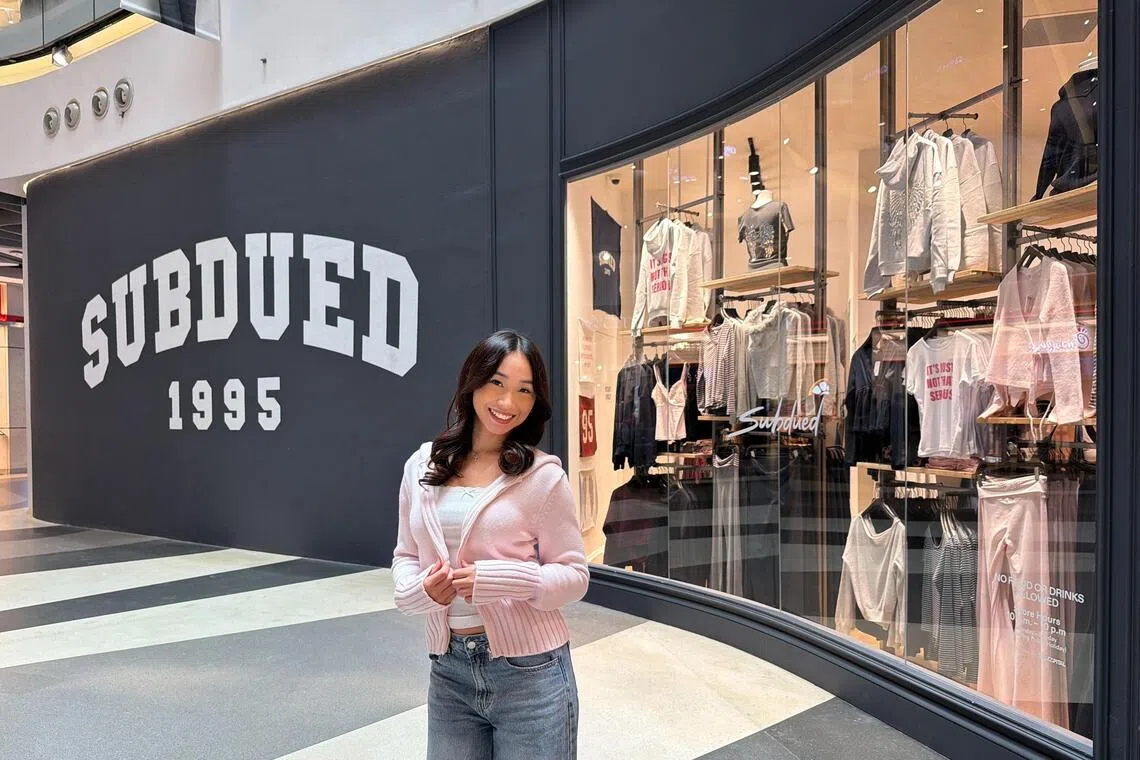
Content creator Sarah Lim, 20, outside Subdued's Bugis+ store in a pink knit jacket from the label, which she wears almost every day.
PHOTO: COURTESY OF SARAH LIM
Published Oct 15, 2026, 11:15 AM
Updated Oct 15, 2026, 03:58 PM
Young Singaporeans say they care about sustainability, but many still queue for fast, trendy fashion because of price, style and social buzz.
Subdued’s Singapore launch drew huge crowds, long queues and strong online attention, while the brand says it limits stock and rejects the fast fashion label.
Experts say the gap is driven by low budgets, social shopping and dopamine from buying, while thrift helps, but overconsumption and textile waste remain serious problems.
SINGAPORE – At about 9am on April 10, shoppers began gathering outside a new store in Wheelock Place. By the afternoon, a snaking queue of up to about 150 people stretched across two floors of the mall, and many waited about two hours to get in.
They were there for Subdued, an Italian label making its Singapore debut. The response was “exponentially much higher than what we initially thought”, says Vishesh Juneja, chief executive for Singapore and Malaysia at Gill Capital, which runs Subdued in the region.
In an interview with The Straits Times, he adds: “We were overwhelmed, to be honest.”
The 1,400 sq ft store drew about 6,000 visitors a day that weekend. “I had to personally cater for water and juices,” he recalls. “Within a week, we practically ran out of stock”.
Inside, the crush moved to the fitting rooms. “People wanted to take six to 12 pieces to try, and they were making live videos,” Juneja says. That online buzz, he adds, “contributed a lot to the next day’s queue”.
A second outlet opened at Bugis+ in September, drawing queues again, though not on the same scale. These days, the Wheelock store sees about 50,000 visitors a month.
When content creator Sarah Lim, 20, dropped by at about 3pm or 4pm one weekday, she waited behind six to eight people for a fitting room, many of them school students still in their uniforms.
The design practice student at Nanyang Academy of Fine Arts (NAFA), who has about 140,000 followers on TikTok, visited the store partly for the experience. “When I step into Subdued, I probably spend an hour plus just trying on all the clothes there,” she says.
Shoppers throng the Subdued clothing store at Wheelock Place on April 18. ST PHOTO: BRIAN TEO
Shoppers throng the Subdued clothing store at Wheelock Place on April 18.
Young Singaporeans have been known to say they care about the planet. Yet mass-market brands still top their shopping lists.
According to market research firm YouGov’s 2024 fashion rankings, Japanese retailer Uniqlo led desirability, with 51% of Singapore Gen Z respondents saying they would consider it the next time they shop for clothes. It was followed by Nike at 38%, adidas at 30%, H&M at 22% and Cotton On at 19%.
It is not that they do not care. In a survey of 1,500 Singaporeans released in February by insurer Singlife and the Sustainable and Green Finance Institute at the National University of Singapore, 60% of Gen Z respondents said they were fully or mostly aware of sustainable issues.
But they were less likely than older Singaporeans to act on it. About half said they recycle, compared with about 70% of Gen X and baby boomers. Across all ages, 65% said they prefer to buy from more sustainable companies, but only 38% were willing to pay more for sustainable products.
In Singapore, proof of demand is in the ever-evolving retail landscape.
Fellow Italian fast-fashion brand Brandy Melville briefly left Singapore in 2020, but returned in August 2024 with a bigger, two-storey store in Orchard Road. New Zealand label Glassons, whose Australian sales rose 29% in the past year, held its first pop-up here in May and now ships to Singapore through a dedicated online store.
Subdued is also expanding in the region, with Singapore setting the pace. “Singapore would lay down the trends first in the region, even today,” says Juneja, declining to reveal more details.
Sarah Lim in a grey zip-up hoodie with Subdued's angel-wing print, the label's bestseller in Singapore. PHOTO: COURTESY OF SARAH LIM
Sarah Lim in a grey zip-up hoodie with Subdued's angel-wing print, the label's bestseller in Singapore.
Lim does not see Subdued as fast fashion, since most pieces she buys cost $40 to $80. “I wouldn’t say they are so cheap that people can quickly buy a new one every single time something new and trendy comes into store,” she says.
She first heard of the brand in April when Subdued invited her to do a campaign and attend the media preview for its Wheelock Place opening. She has since become a fan of the brand, though she buys something only about once every month or two, spending about $70 of her own savings each time.
Rifah Tashfiah Mazumder, 23, who shops at Subdued, Brandy Melville and Glassons, does not shy away from calling them fast fashion. She says people her age buy them anyway because they are affordable.
“It doesn’t have to be Shein for it to be fast fashion. All of these big corporations are kind of fast fashion, realistically speaking,” says the content creator with 38,100 TikTok followers. “Obviously, it’s not very sustainable. But the reason a lot of people our age shop more from fast fashion is solely because of the cost.”
Rifah Tashfiah Mazumder in an outfit (left) from Brandy Melville, and her sporting a top (right) from Glassons. PHOTOS: COURTESY OF RIFAH TASHFIAH MAZUMDER
Rifah Tashfiah Mazumder in an outfit (left) from Brandy Melville, and her sporting a top (right) from Glassons.
PHOTOS: COURTESY OF RIFAH TASHFIAH MAZUMDER
Being Bengali, she feels guilty knowing that many fast-fashion garment workers come from Bangladesh and may not be working under optimal circumstances. “But it’s just not sustainable for me, especially at my current age, to spend a few hundred dollars on just one or two pieces of clothing. Maybe one day, when I have more money and financial stability, I’ll be able to shop from smaller brands.”
She buys new clothes every week or two, spending $200 to $300 a month, and up to $700 some months. She does not set a budget. “Money always comes back,” she says.
In the head, not the heart
Tracy Loh, senior lecturer of communication management at Singapore Management University’s Lee Kong Chian School of Business, calls this gap between what young shoppers say and what they buy the attitude-behaviour gap.
“Everybody knows about sustainability and how important it is, and they feel that it’s important, but then life happens,” she says.
Sustainable clothing also tends to cost more and is harder to find. “They take a longer time to develop and, more often than not, don’t look as good,” she adds.
When she asks her students what they consider when buying clothes or eyewear, the answer is “price, design, colours, speed”. “Sustainability is not in their top 10 (priorities),” she says.
For teenagers with limited pocket money, every dollar counts. “If we’re going to talk about $3 or $4, it might mean whether I can have my bubble tea today or not.”
Shopping is also a group activity. “When you go shopping for clothes, it’s an outing with your friends. It’s a chance to gather, to gossip. It’s a bonding experience as well,” she says. “Shopping is not a utilitarian experience. It’s a social experience.”
Queues add to the appeal. “Being in the queue and being one of the first makes for great TikTok material,” she says.
Cheap online buys add up too. Each click to checkout gives a dopamine hit, she says, and shoppers can rationalise each purchase. “It’s only $10. It’s only $20. I can afford it.”
But Loh says it is unfair to single out Gen Z. “Young people flocking to all these stores and buying fast fashion – this is not something that is unique to the current generation. Every generation has that,” she says. “When I was a teenager, there was the Forever 21 craze .
“It’s almost like a passage of life that you go through.”
Young people already know sustainability matters, she adds. “But it’s in the head, not in the heart.”
And there persists a more pressing priority: fitting in. Anthony Tan, associate dean of the School of Fashion Studies at NAFA, says brands like Subdued, Brandy Melville and Glassons sell “a lifestyle, identity and sense of belonging”.
“Young shoppers want brands that reflect their identity. Subdued’s effortless cool-girl aesthetic speaks directly to how young consumers want to present themselves,” he says. “Young people may want to dress like their peers or participate in a current aesthetic, even when doing so conflicts with their sustainability values.”
Social media raises the stakes. It “creates pressure to keep up, constantly exposing young consumers to new outfits, microtrends and ‘must-have’ items, and making repeated purchasing feel normal”, he says.
That is where fast fashion comes in. “Social media also increases the pressure to refresh outfits regularly, so lower-priced fashion becomes attractive because it allows consumers to experiment with different styles without a major financial commitment.”
Online, fans have chosen teams. “People are divided into Brandy baddies and Subdued angels,” says Lim, the content creator. “I would say I’m a Subdued angel kind of girl.”
The thrift alternative
Not all Gen Zs are cut from the same cloth. About 95% of 25-year-old Nguwar Myint’s wardrobe is second-hand.
About 95% of Nguwar Myint's wardrobe is second-hand, including this $19 top from Un.Wastelands and cargo pants from a vintage seller on Taobao. PHOTO: COURTESY OF NGUWAR MYINT
About 95% of Nguwar Myint's wardrobe is second-hand, including this $19 top from Un.Wastelands and cargo pants from a vintage seller on Taobao.
PHOTO: COURTESY OF NGUWAR MYINT
She started thrifting in 2020, after meeting a university friend with a distinctive style. “I loved how she used fashion as a form of self-expression,” she says.
That friend also taught her about thrifting’s environmental benefits and the importance of developing mindful consumption habits. “I primarily still do it for the ethical reasons,” Nguwar, a quality assurance engineer, says.
Her best finds include a 100% silk BCBG Max Azria lace top that cost $5 from Lucky Plaza, and a 2000s Fossil watch that cost $50 including repairs.
She buys new clothes only when she needs “a specific item that I cannot borrow from anyone or feasibly thrift in a short period of time”.
Nguwar Myint paid $5 for a 100% silk BCBG Max Azria lace top (left) at Lucky Plaza. Her 2000s Fossil stainless-steel watch (right), bought on Carousell, cost $50 including repairs. PHOTOS: COURTESY OF NGUWAR MYINT
Nguwar Myint paid $5 for a 100% silk BCBG Max Azria lace top (left) at Lucky Plaza. Her 2000s Fossil stainless-steel watch (right), bought on Carousell, cost $50 including repairs.
PHOTOS: COURTESY OF NGUWAR MYINT
Yet even thrifting cannot escape fast fashion, which Nguwar regularly spots on thrift store racks. She admits thrifting can also lead to overconsumption. “But I think the environmental impact is much more negligible compared with fast fashion.”
“Consumerism is part of the Singaporean identity,” she says. “Shopping is also a natural pastime, especially with the abundance of malls, which serve as a community hub in this humid climate.”
The appeal of physical stores is part of a wider trend a March 2026 Bloomberg report dubbed as “mallmaxxing”. Gen Z shoppers are increasingly treating malls as places to socialise in real life and take a break from the digital world, the report said.
Gill Capital’s Juneja sees the same pull. “Your friends can never be replaced by a chat online,” he says.
But he rejects the fast-fashion label for Subdued. “I wouldn’t call it fast fashion,” he says, adding that the brand limits stock to stay desirable. “Even if I know I can sell 500 pieces of angel wing hoodies, I would only order 100.”
An exclusive “Tropical Girl Singapore” T-shirt available for purchase only at Subdued's Bugis+ location. PHOTO: SUBDUED
An exclusive “Tropical Girl Singapore” T-shirt available for purchase only at Subdued's Bugis+ location.
The brand’s 2024 sustainability report, its first, paints a mixed picture. New designs are drawn up weekly and can go from idea to finished product in 60 days, but are first made in small test batches. Its unsold stock was below 8%, which the report describes as the industry’s standard threshold. Most of its clothes are made in Turkey (58%), with 37% made in Italy.
Still, sustainability rarely comes up in store.
When asked whether shoppers ask about it, he says: “My answer is no. Nobody asks us.”
Responsible shopping
All that shopping has to end up somewhere. Singapore generated 231,000 tonnes of textile and leather waste in 2025 but recycled just 3%, according to the National Environment Agency.
NAFA’s Tan suggests judging brands on a spectrum, by how fast and how much they produce.
Thrifting helps the environment because it extends the life of garments that already exist, Tan says. But it has its limits.
“Thrifting is not automatically sustainable. If consumers buy large quantities simply because the clothes are cheap, it can reproduce the same overconsumption habits associated with fast fashion.”
Instead, he suggests thinking in terms of cost per wear. “A $60 garment worn 30 times may offer better value than a $15 top worn twice.”
Rifah agrees that quitting fast fashion altogether is unlikely. “It’s not realistic for people our age to stop shopping fast fashion,” she says. “But we can learn to be more intentional.”
Get to know four labels young Singaporeans are flocking to:
Subdued’s second Singapore store at Bugis+. PHOTO: SUBDUED
Subdued’s second Singapore store at Bugis+.
Founded in Rome in the 1990s by Enrico Maria Sconciaforni and Alessandro Orsini, Subdued has targeted teenage girls from the start. It now has more than 130 stores worldwide, and its revenue rose 37.2% from 2023 to about €164 million (S$235 million) in 2024.
The label is known for laid-back, “cool girl” basics. Its angel-wing prints are its bestsellers in Singapore, alongside zip-up hoodies, crop tops and graphic tees in soft shades such as pearl grey, blue and white. New styles arrive almost every week, and the stores do not hold end-of-season sales.
In Singapore, it is run by Gill Capital, which says its customers are mainly aged 12 to 25.
Prices range from $15 for accessories to $129 for denim items such as jeans. The average item costs about $47, and most apparel comes in three sizes.
Info: B1-06 Wheelock Place, 501 Orchard Road, and 01-05 Bugis +, 201 Victoria Street
Italian entrepreneur Silvio Marsan and his son Stephan founded Brandy Melville in Italy in the early 1980s. The label became a teen phenomenon after opening its first US store in 2009 in Los Angeles’ Westwood , beside the University of California, Los Angeles campus .
Its California-inspired basics, such as tank tops, tees and sweatpants, are mostly made of cotton and largely sold in a single size, which the brand labels “one size fits most”. That sizing approach and the company’s culture were scrutinised in the 2024 HBO documentary Brandy Hellville & The Cult Of Fast Fashion.
The Brandy Melville store at Peranakan Place Complex. ST PHOTO: NG SOR LUAN
The Brandy Melville store at Peranakan Place Complex.
ST PHOTO: NG SOR LUAN
In Singapore, the brand closed its only outlet, at Ion Orchard, in 2020. It returned in August 2024 with a bigger two-storey boutique opposite somerset@313.
Prices range from about $25 to $45 for tops, and about $40 to $70 for bottoms.
Info: Peranakan Place Complex, 180 Orchard Road
New arrivals on Glassons’ Singapore online store, such as knit tops and cami tops, cost $29.99 each. PHOTO: GLASSONS
New arrivals on Glassons’ Singapore online store, such as knit tops and cami tops, cost $29.99 each.
Glassons began in 1918 as a mail-order clothing supplier in Christchurch, New Zealand. Today, its parent company, Hallenstein Glasson, runs about 130 stores across New Zealand and Australia. Sales at Glassons Australia rose 29% in its latest financial year, which ended in August 2026, helping lift group sales by 20%, Bloomberg reported.
The label is known for affordable, trend-led staples, from fitted basics and knits to denim and lace tops. Its store openings in Australia regularly draw crowds. In Sydney, hundreds of shoppers jostled at a recent opening of its Westfield Miranda store in August for giveaways promised to the first in line .
There is no permanent Singapore store yet. Its first local pop-up, Glassons Garden, was held at Maison Garden in Dempsey Hill in May 2026 to launch its Oasis Resort Collection.
Shoppers who registered online could try on its then-unreleased Oasis Resort Collection, with orders delivered to their homes after the event through Glassons’ Singapore online store. The pop-up doubled as a concept cafe, and guests received made-to-order florals, sodas and event-only shopping rewards.
Prices range from $9.99 for basic tops and singlets to $89.99 for tailored coats and jackets.
Info: Online at glassons.com/sg , with shipping to Singapore
Winning T-shirt designs from the November 2025 UTme! x ST180 Design Contest at Uniqlo at Orchard Central. ST PHOTO: NG SOR LUAN
Winning T-shirt designs from the November 2025 UTme! x ST180 Design Contest at Uniqlo at Orchard Central.
Owned by Japan’s Fast Retailing, Uniqlo needs no introduction. The brand opened its first store in Hiroshima in 1984. It arrived in Singapore in 2009 with a store at Tampines 1 and now has about 30 outlets islandwide.
Rather than chasing microtrends, it focuses on staples such as jeans, sweatpants and loungewear, and plans each season about a year ahead. Its AIRism line, made for hot weather, suits Singapore’s climate.
That everyday appeal resonates with the young. Uniqlo is Singapore Gen Z’s most-considered clothing brand, with 51% saying they would consider it the next time they shop for clothes, according to a YouGov survey.
Prices range from $4.90 for clearance tees to $249.40 for outerwear and select wool pieces.
Info: Outlets islandwide, including its global flagship store at Orchard Central, 181 Orchard Road
20岁的内容创作者Sarah Lim身穿Subdued品牌的粉色针织外套,站在Subdued位于Bugis+的门店外,她几乎每天都穿这件外套。
照片:由莎拉·林提供
发布于 2026 年 10 月 15 日上午 11:15
更新于2026年10月15日下午3:58
新加坡年轻人说他们关心可持续发展,但许多人仍然因为价格、款式和社交热度而排队购买快时尚产品。
Subdued 在新加坡的发布吸引了大量人群、排起了长队,并在网上引起了强烈的关注。该品牌表示,它会限制库存,并且拒绝快时尚标签。
专家表示,造成这种差距的原因是预算不足、社交购物以及购物带来的多巴胺,而节俭有所帮助,但过度消费和纺织品浪费仍然是严重的问题。
新加坡——4月10日上午9点左右,购物者开始聚集在威士马广场一家新店外。到了下午,一条蜿蜒的队伍横跨商场的两层楼,队伍长达约150人,许多人等待了近两个小时才得以进入。
他们到场是为了支持意大利品牌Subdued在新加坡的首次亮相。负责Subdued在该地区运营的Gill Capital新加坡和马来西亚首席执行官Vishesh Juneja表示,反响“远超我们最初的预期”。
他在接受《海峡时报》采访时补充道:“说实话,我们当时不知所措。”
这家1400平方英尺的商店那个周末每天吸引了约6000名顾客。“我不得不亲自准备水和果汁,”他回忆说,“不到一周,我们的库存就几乎售罄了。”
店内人潮涌向试衣间。“人们想拿六到十二件衣服试穿,还拍了直播视频,”朱内贾说道。他补充说,这种网络热潮“极大地促成了第二天的排队盛况”。
9月,第二家分店在武吉士+购物中心开业,同样吸引了不少顾客排队,但规模不及第一家。如今,会德丰店每月约有5万名顾客到访。
20岁的内容创作者Sarah Lim在一个工作日的下午3点或4点左右路过这里时,她在试衣间前排了六到八个人,其中许多人还是穿着校服的学生。
这位就读于南洋艺术学院(NAFA)设计专业的学生在TikTok上拥有约14万粉丝,她此次光顾Subdued的部分原因是为了体验。“每次走进Subdued,我大概都会花一个多小时试穿里面的衣服,”她说。
4月18日,顾客络绎不绝地涌入位于威士马坊的Subdued服装店。(海峡时报摄影:BRIAN TEO)
4月18日,购物者蜂拥至位于威乐坊的Subdued服装店。
新加坡年轻人一直声称他们关心地球,然而大众品牌仍然是他们购物清单上的首选。
根据市场调研公司YouGov发布的2024年时尚排行榜,日本零售商优衣库(Uniqlo)在新加坡Z世代受访者中人气最高,51%的受访者表示下次购买服装时会考虑优衣库。紧随其后的是耐克(Nike,38%)、阿迪达斯(adidas,30%)、H&M(22%)和Cotton On(19%)。
并非他们漠不关心。新加坡保险公司Singlife和新加坡国立大学可持续与绿色金融研究所2月份联合发布的一项针对1500名新加坡人的调查显示,60%的Z世代受访者表示他们完全或基本了解可持续发展问题。
但与年长的新加坡人相比,他们采取行动的可能性较低。约有一半的人表示会进行回收利用,而X世代和婴儿潮一代的这一比例约为70%。在所有年龄段中,65%的人表示他们更倾向于购买来自更具可持续发展理念的公司的产品,但只有38%的人愿意为可持续产品支付更高的价格。
在新加坡,不断变化的零售格局就是需求的证明。
意大利快时尚品牌 Brandy Melville 曾于 2020 年短暂撤出新加坡市场,但于 2024 年 8 月重返新加坡,并在乌节路开设了一家更大的两层门店。新西兰品牌 Glassons 去年在澳大利亚的销售额增长了 29%,今年 5 月在新加坡开设了首家快闪店,现在通过其专属线上商店向新加坡发货。
低调的风格也在该地区蔓延,新加坡引领潮流。“即使在今天,新加坡仍然会率先引领该地区的潮流,”Juneja说道,但他拒绝透露更多细节。
Sarah Lim身穿Subdued品牌的灰色拉链连帽衫,上面印有天使翅膀图案,这是该品牌在新加坡的畅销款。图片:由Sarah Lim提供
Sarah Lim 身穿 Subdued 品牌的灰色拉链连帽衫,上面印有该品牌的“天使翅膀”图案,这是该品牌在新加坡的畅销款。
林女士并不认为Subdued是快时尚品牌,因为她买的大部分单品价格都在40到80美元之间。“我不会说它们便宜到人们每次店里有新款流行单品就立刻买一件,”她说。
她四月份第一次听说这个品牌,当时Subdued邀请她参与一个宣传活动,并出席其在威士洛克广场的开业媒体预览会。从那以后,她就成了这个品牌的粉丝,不过她大约每隔一两个月才买一次东西,每次都要花掉自己70美元左右的积蓄。
23岁的里法·塔什菲亚·马祖姆德经常光顾Subdued、Brandy Melville和Glassons等品牌,她毫不避讳地称这些品牌为快时尚。她说,像她这个年纪的人还是会买,因为它们价格实惠。
“快时尚并不一定非得是Shein这样的品牌。说实话,所有这些大公司都算是快时尚,”这位拥有3.81万TikTok粉丝的内容创作者说道。“显然,这种模式并不可持续。但我们这个年龄段的很多人之所以更倾向于购买快时尚产品,仅仅是因为价格便宜。”
里法·塔什菲亚·马祖姆德身着 Brandy Melville 的服装(左图),以及 Glassons 的上衣(右图)。图片由里法·塔什菲亚·马祖姆德提供。
Rifah Tashfiah Mazumder 身穿 Brandy Melville 的服装(左图),以及她穿着 Glassons 的上衣(右图)。
照片:由 RIFAH TASHFIAH MAZUMDER 提供
身为孟加拉人,她深感愧疚,因为她知道许多快时尚服装工人来自孟加拉国,而且他们的工作环境可能并不理想。“但对我来说,尤其是我现在这个年纪,花几百美元只买一两件衣服实在是不划算。也许有一天,等我经济条件更好了,就能买一些小众品牌的衣服了。”
她每隔一两周就买新衣服,每月花费200到300美元,有时甚至高达700美元。她不制定预算。“钱总会回来的,”她说。
在头脑中,而不是在心中
新加坡管理大学李光前商学院传播管理高级讲师 Tracy Loh 将年轻购物者所说与所购之间的这种差距称为态度-行为差距。
“每个人都知道可持续发展的重要性,也觉得它很重要,但生活总会发生各种各样的事情,”她说。
可持续服装往往价格更高,也更难买到。“它们的研发周期更长,而且通常来说,外观也不如其他服装好看,”她补充道。
当她问学生们在购买衣服或眼镜时会考虑哪些因素时,答案是“价格、设计、颜色、速度”。她说:“可持续性并不在他们的前十名考虑因素之列。”
对于零花钱有限的青少年来说,每一分钱都很重要。“如果要说3美元或4美元,那可能就意味着我今天能不能喝到我的珍珠奶茶了。”
购物也是一种群体活动。“和朋友们一起去买衣服,就像是一次外出聚会。这是一个聚会、聊天、增进感情的机会,”她说。“购物不是一种实用行为,而是一种社交行为。”
排队也增添了吸引力。“排队,而且是第一批拿到手的人,这绝对是拍TikTok视频的好素材,”她说。
网上低价购物累积起来也是一笔不小的开支。她说,每次点击结账都会带来多巴胺的刺激,而且购物者会为每次购买找各种理由。“才10美元,才20美元,我买得起。”
但罗女士认为单独指责Z世代是不公平的。“年轻人涌入各种商店购买快时尚产品——这并非当代年轻人独有的现象。每一代人都有这种情况,”她说。“我十几岁的时候,Forever 21也风靡一时。”
“这就像人生中要经历的一个阶段。”
她补充说,年轻人已经知道可持续发展的重要性。“但这只是停留在头脑层面,而不是内心层面。”
还有一个更为紧迫的问题:融入群体。南洋艺术学院时装研究学院副院长安东尼·谭表示,像Subdued、Brandy Melville和Glassons这样的品牌销售的是“一种生活方式、身份认同和归属感”。
“年轻消费者想要的是能体现他们个性的品牌。Subdued轻松随性的酷女孩美学,恰好契合了年轻消费者想要展现自我的方式,”他说道。“年轻人可能想要穿得像同龄人一样,或者追随当下的潮流,即使这样做与他们的可持续发展价值观相冲突。”
他说,社交媒体提高了竞争门槛。它“制造了跟上潮流的压力,不断向年轻消费者展示新的服装、微趋势和‘必备’单品,使重复购买成为一种常态”。
这就是快时尚的用武之地。“社交媒体也加剧了人们定期更新服装的压力,因此价格较低的时尚产品就变得很有吸引力,因为它让消费者能够在无需投入大量资金的情况下尝试不同的风格。”
在网上,粉丝们已经分成了不同的阵营。“人们分成了‘布兰迪坏女孩’和‘低调天使’两派,”内容创作者林说道。“我觉得我属于‘低调天使’这一派。”
节俭的替代方案
并非所有Z世代都千篇一律。25岁的恩古瓦尔·敏特衣橱里大约95%的衣服都是二手货。
Nguwar Myint 的衣橱里大约 95% 的衣服都是二手货,包括这件来自 Un.Wastelands 的 19 美元上衣和从淘宝古着店买来的工装裤。图片:Nguwar Myint 提供
Nguwar Myint 的衣橱里大约 95% 的衣服都是二手的,包括这件来自 Un.Wastelands 的 19 美元上衣和这条来自淘宝上复古卖家的工装裤。
照片:由 NGUWAR MYINT 提供
2020年,她结识了一位风格独特的大学朋友后,开始逛二手店。“我喜欢她把时尚作为一种自我表达方式,”她说。
那位朋友还教会了她购买旧货对环境的好处,以及培养理性消费习惯的重要性。“我主要还是出于道德原因才这样做,”身为质量保证工程师的恩古瓦尔说道。
她淘到的最棒的东西包括一件来自 Lucky Plaza 的 5 美元的 100% 真丝 BCBG Max Azria 蕾丝上衣,以及一块 2000 年代的 Fossil 手表,包括维修费在内共花了 50 美元。
她只有在需要“一件我无法在短时间内从任何人那里借到或在二手店买到的特定物品”时才会购买新衣服。
Nguwar Myint在Lucky Plaza花了5美元买了一件BCBG Max Azria的100%真丝蕾丝上衣(左图)。她那块2000年代的Fossil不锈钢手表(右图)是从Carousell上买的,包括维修费在内一共花了50美元。图片由Nguwar Myint提供
Nguwar Myint在Lucky Plaza花了5美元买了一件100%真丝的BCBG Max Azria蕾丝上衣(左图)。她那块2000年代的Fossil不锈钢手表(右图)是从Carousell上买的,包括维修费在内一共花了50美元。
照片由 NGUWAR MYINT 提供
然而,即使是逛旧货店也无法摆脱快时尚的影响,恩古瓦尔经常在旧货店的货架上看到快时尚的身影。她承认,逛旧货店也可能导致过度消费。“但我认为,与快时尚相比,它对环境的影响要小得多。”
“消费主义是新加坡人身份认同的一部分,”她说。“购物也是一种自然的消遣方式,尤其是在购物中心林立的地区,购物中心在这种潮湿的气候下更成为了社区中心。”
实体店的吸引力是彭博社2026年3月一份报告所称的“购物中心盛行”(mallmaxxing)这一更广泛趋势的一部分。报告指出,Z世代消费者越来越将购物中心视为现实生活中社交和远离数字世界的场所。
Gill Capital 的 Juneja 也看到了同样的趋势。“网上聊天永远无法取代朋友之间的真情实感,”他说。
但他并不认同Subdued是快时尚品牌。“我不会称之为快时尚,”他说道,并补充说,为了保持品牌的吸引力,他们会限制库存。“即使我知道我能卖出500件天使翅膀连帽衫,我也只会订购100件。”
这款独家“热带女孩新加坡”T恤仅在Subdued位于Bugis+的门店有售。图片:SUBDUED
独家“Tropical Girl Singapore”T恤,仅在Subdued的Bugis+门店有售。
该品牌的首份2024年可持续发展报告描绘了一幅喜忧参半的景象。新设计每周都会推出,从构思到成品只需60天,但会先进行小批量试生产。其未售库存低于8%,报告称这是行业标准阈值。该品牌的大部分服装产自土耳其(58%),37%产自意大利。
然而,可持续性在商店里却很少被提及。
当被问及是否有顾客询问此事时,他回答说:“我的回答是没有。没有人问过我们。”
负责任的购物
所有这些购物最终都必须有个去处。据新加坡国家环境局预测,到2025年,新加坡将产生23.1万吨纺织品和皮革废料,但回收率仅为3%。
NAFA 的 Tan 建议从生产速度和产量两个方面来评判品牌。
谭女士表示,购买旧货有助于保护环境,因为它延长了现有衣物的使用寿命。但它也有局限性。
“购买二手商品并不必然意味着可持续发展。如果消费者仅仅因为衣服便宜就大量购买,就会重蹈快时尚带来的过度消费覆辙。”
他建议,应该从每次穿着的成本来考虑。“一件价值 60 美元的衣服,如果穿 30 次,可能比一件价值 15 美元的上衣只穿两次更划算。”
里法也认为完全放弃快时尚不太可能。“对我们这个年纪的人来说,停止购买快时尚产品是不现实的,”她说。“但我们可以学会更有意识地选择。”
了解一下新加坡年轻人正在追捧的四个品牌:
Subdued在新加坡武吉士+开设的第二家门店。图片:SUBDUED
Subdued 在新加坡 Bugis+ 的第二家门店。
Subdued由Enrico Maria Sconciaforni和Alessandro Orsini于20世纪90年代在罗马创立,从一开始就瞄准了十几岁的女孩群体。如今,它在全球拥有超过130家门店,其收入从2023年的37.2%增长到2024年的约1.64亿欧元(2.35亿新元)。
这个品牌以休闲随性、酷女孩风格的基础款单品而闻名。天使翅膀印花是其在新加坡的畅销款,此外还有拉链连帽衫、露脐上衣和印花T恤,颜色以珍珠灰、蓝色和白色等柔和色调为主。几乎每周都有新款上架,而且门店不进行季末促销。
在新加坡,该公司由 Gill Capital 运营,该公司表示其客户主要年龄在 12 至 25 岁之间。
价格从15美元的配饰到129美元的牛仔服(例如牛仔裤)不等。平均每件商品价格约为47美元,大多数服装都有三种尺码。
地址:乌节路501号威士隆广场B1-06,以及维多利亚街201号武吉士+购物中心01-05
意大利企业家西尔维奥·马尔桑和他的儿子斯蒂芬于 20 世纪 80 年代初在意大利创立了 Brandy Melville 品牌。该品牌于 2009 年在洛杉矶西木区(加州大学洛杉矶分校校园旁)开设了第一家美国门店,之后迅速成为青少年现象。
其加州风格的基本款单品,例如背心、T恤和运动裤,大多采用棉质面料,并且大多只出售一个尺码,该品牌称之为“均码适合大多数人”。这种尺码理念和公司文化在2024年HBO纪录片《布兰迪·赫尔维尔与快时尚的狂热》中受到了深入剖析。
位于土生华人广场的 Brandy Melville 专卖店。照片由 NG SOR LUAN 拍摄。
位于土生华人广场的 Brandy Melville 专卖店。
圣徒照片:吴索銮
在新加坡,该品牌于 2020 年关闭了位于 Ion Orchard 的唯一一家门店。2024 年 8 月,该品牌在 Somerset@313 对面开设了一家更大的两层精品店。
上衣价格约为 25 美元至 45 美元,裤子价格约为 40 美元至 70 美元。
信息:土生华人坊,乌节路180号
Glassons新加坡线上商店的新款针织衫和吊带背心等单品,每件售价29.99新元。图片:GLASSONS
Glassons 新加坡网上商店的新品,如针织上衣和吊带背心,每件售价 29.99 美元。
Glassons于1918年在新西兰基督城成立,最初是一家邮购服装供应商。如今,其母公司Hallenstein Glasson在新西兰和澳大利亚经营着约130家门店。据彭博社报道,Glassons澳大利亚公司在截至2026年8月的最新财年销售额增长了29%,带动集团整体销售额增长了20%。
该品牌以价格亲民、引领潮流的经典单品而闻名,从修身基础款和针织衫到牛仔和蕾丝上衣,应有尽有。其在澳大利亚的门店开业总是吸引大量顾客。在悉尼,8 月份其位于 Westfield Miranda 的新店开业时,数百名顾客为了获得承诺赠送给前几位顾客的赠品而争相排队。
目前在新加坡还没有永久门店。其首家本地快闪店 Glassons Garden 于 2026 年 5 月在登布西山 Maison Garden 举办,旨在推出其 Oasis 度假系列。
在线注册的顾客可以试穿当时尚未发布的绿洲度假系列,活动结束后,顾客可通过Glassons新加坡线上商店订购商品并送货上门。这家快闪店同时也是一家概念咖啡馆,顾客可享用定制鲜花、苏打水以及活动专属购物奖励。
价格从基本款上衣和背心的 9.99 美元到定制外套和夹克的 89.99 美元不等。
详情:请访问 glassons.com/sg 在线购买,可运送至新加坡
2025年11月UTme! x ST180设计大赛获奖T恤设计作品,优衣库(Orchard Central店)现场拍摄。ST摄影:吴淑銮
2025 年 11 月 UTme! x ST180 设计大赛在乌节中央城优衣库举办的获奖 T 恤设计。
优衣库隶属于日本迅销集团,无需过多介绍。该品牌于1984年在广岛开设了第一家门店。2009年,优衣库进军新加坡市场,在淡滨尼1号开设了首家门店,如今在全岛拥有约30家分店。
它不追逐微潮流,而是专注于牛仔裤、运动裤和家居服等经典单品,并提前一年左右规划每个季度的服装。其专为炎热天气设计的AIRism系列,非常适合新加坡的气候。
这种日常吸引力引起了年轻人的共鸣。优衣库是新加坡Z世代最常考虑的服装品牌,YouGov的一项调查显示,51%的受访者表示下次买衣服时会考虑优衣库。
价格从清仓T恤的4.90美元到外套和部分羊毛制品的249.40美元不等。
信息:全岛各门店,包括位于乌节路181号Orchard Central的全球旗舰店