Latvian official warns Russia ‘tempted to test’ European readiness, sounds alarm over border issues拉脱维亚官员警告称,俄罗斯“企图试探”欧洲的应对能力,并对边境问题发出警报。
Airis Rikveilis, the state secretary at Latvia’s Ministry of Defense, told Breaking Defense the military and border guards are working jointly to stem the tide of illegal entries, including via tunnels.
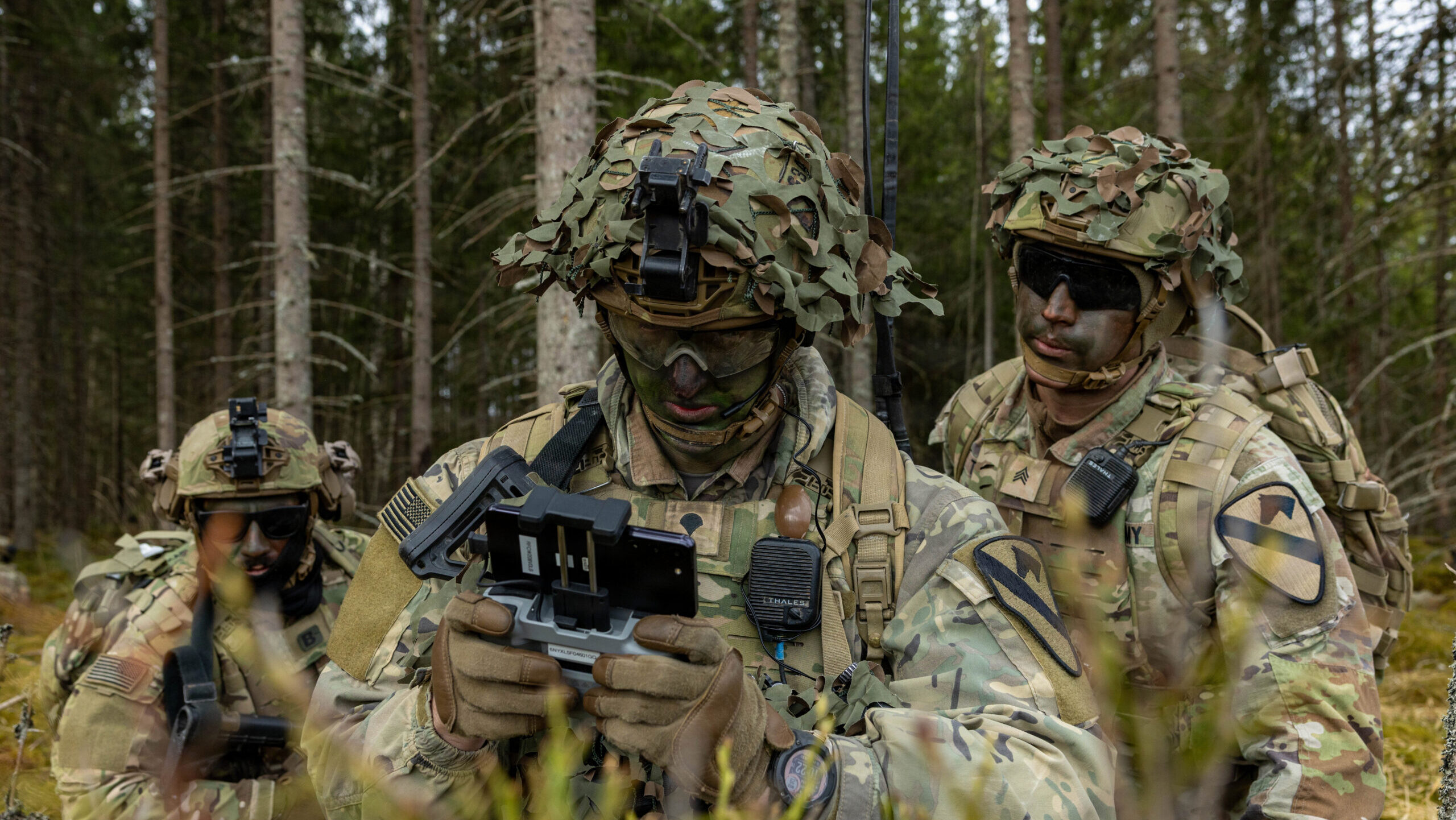
US soldiers participate in an exercise involving a Titan V3 counter-unmanned aircraft system that detects and jams enemy drones in Selija, Latvia, April 29, 2026. (US Army photo by Spc. Gabriel Martinez)
WASHINGTON — While Latvia assesses that a Russian large-scale attack on a NATO member-state like the one seen in Ukraine in 2022 is highly unlikely, the Baltic nation is worried Moscow could launch smaller-scale operations to test Europe’s reaction, a senior Latvian Ministry of Defense official said today.
The country is not evaluating any single attack scenario Russia could attempt, but rather considering the many ways Moscow could target Latvia, Airis Rikveilis, the state secretary at Latvia’s Ministry of Defense, told Breaking Defense.
“I don’t think one can surprise an average Latvian with what Russians are capable of — from our perspective, nothing, literally nothing, they are capable of can make my people overly surprised in terms of what they are trying to achieve,” said Rikveilis, who spoke on the sidelines of the AUSA conference here.
Rikveilis said the main reason they view such a large-scale assault as largely impossible to replicate is that Russia currently lacks the credible, significant military forces required for such an operation.
“What is possible and we think [is] that certainly the Russians would be tempted to test the readiness [of countries] on a smaller-scale,” he said.
Rikveilis is not the first European official to warn that Russia may test the resolve of Europe or the NATO military alliance. Moscow, for its part, has dismissed the suggestion that it’s a threat.
Rikveilis appeared to link the threat to Riga’s growing troubles with illegal migration. The Baltic state shares an approximately 276 kilometers (171 miles) border with Russia and roughly 161 kilometers (100 miles) one with Russian ally Belarus.
MQ-9B and Gambit Series: Advancing European Defense Capabilities
GA-ASI will build Gambit aircraft in Europe, partnered with European-based companies, with airframes available for international procurement starting in 2027.
According to Rikveilis, there have been nearly 12,000 cases overall of illegal attempts to penetrate into Latvian territory, where, in a small number of instances, the culprits intended to cross the border via underground tunnels.
“What concerns us is the profile of that intruder, if I might say, or illegal migrant, which is mostly young males in the conscription age — nothing to do in my analysis with a specific need to seek refuge,” Rikveilis said.
Regarding the use of tunnels, the Warsaw-based television channel Belsat reported in September that the first case of illegal border crossing in Latvia occurred on Aug. 10, when authorities found 15 individuals who had crossed from Belarus. A few days later, authorities reportedly discovered a second tunnel, through which 28 people crossed from Belarus again. That same day, the Latvian State Border Guard also reported 109 attempts to cross the border from Belarus.
To address this issue, Rikveilis explained that the country has been running a national operation involving the border guard and military, which cooperate in part on search capabilities.
So far, Rikveilis said they have concluded that the approach these people have adopted is “organized, orchestrated and professionally led,” and that the tunnels are not simple dug-outs but were done in “quite a professional job,” he said.
Breaking Defense Video
Hegseth talks autonomy at AUSA, a key show focus
Army doubles down on autonomy, stakes out Indo-Pacific role: AUSA Day 2
Telle talks ‘manufacturing rodeo,’ supply chain ‘weak links’: AUSA Day 1
New leaders, new drone command: What we expect from AUSA 2026
Unpacking Boeing’s F/A-XX win, plus a report from wartime Ukraine
How Hegseth envisions a new Autonomous Warfare Command
What Europe’s military air fleets will look like in 30 years
Riyadh gets closer to F-35s, Damascus presses sovereignty and an expert take on Iran
Drone-hunting on the border, plus turmoil at an Air Force think tank
The future of European airpower might be unmanned
2026年4月29日,在拉脱维亚塞利亚,美军士兵参加了一项演习,演习中使用了泰坦V3反无人机系统,该系统能够探测并干扰敌方无人机。(美国陆军下士加布里埃尔·马丁内斯摄)
华盛顿——拉脱维亚国防部一位高级官员今天表示,虽然拉脱维亚评估认为俄罗斯对北约成员国发动类似2022年乌克兰战争那样的大规模袭击的可能性极低,但这个波罗的海国家担心莫斯科可能会发动小规模行动来试探欧洲的反应。
拉脱维亚国防部国务秘书艾里斯·里克维利斯告诉《防务新闻》,该国并未评估俄罗斯可能采取的任何单一攻击方案,而是考虑莫斯科可能以多种方式攻击拉脱维亚。
“我认为,俄罗斯人的能力不会让一个普通的拉脱维亚人感到惊讶——从我们的角度来看,他们所能做到的任何事情,真的任何事情,都不会让我的人民对他们试图取得的成就感到过于惊讶,”里克维利斯在AUSA会议间隙说道。
里克维利斯表示,他们认为如此大规模的袭击在很大程度上不可能复制的主要原因是,俄罗斯目前缺乏开展此类行动所需的可靠、强大的军事力量。
他说:“有可能的是,我们认为俄罗斯肯定会想方设法在小范围内测试各国的准备情况。”
里克维利斯并非首位警告俄罗斯可能试探欧洲或北约军事联盟决心的欧洲官员。而莫斯科方面则驳斥了俄罗斯构成威胁的说法。
里克维利斯似乎将这一威胁与里加日益严重的非法移民问题联系起来。这个波罗的海国家与俄罗斯接壤,边界线长约276公里(171英里),与俄罗斯的盟友白俄罗斯接壤,边界线长约161公里(100英里)。
MQ-9B 和 Gambit 系列:提升欧洲国防能力
通用航空飞机公司(GA-ASI)将与欧洲公司合作,在欧洲生产 Gambit 飞机,从 2027 年开始,飞机机身将面向国际市场进行采购。
据 Rikveilis 称,非法入侵拉脱维亚领土的案件总数已接近 12,000 起,其中少数案件中,犯罪分子企图通过地下隧道越境。
“我们关注的是这些入侵者(如果我可以用这个词的话)或非法移民的特征,他们大多是处于征兵年龄的年轻男性——在我看来,这与寻求庇护的具体需求无关,”里克维利斯说。
关于使用隧道的情况,总部位于华沙的贝尔萨特电视台(Belsat)9月份报道称,拉脱维亚首例非法越境事件发生在8月10日,当时当局查获了15名从白俄罗斯越境的人员。几天后,据报道,当局发现了第二条隧道,又有28人通过该隧道再次从白俄罗斯越境。同一天,拉脱维亚国家边防局也报告了109起试图从白俄罗斯越境的事件。
为了解决这个问题,里克维利斯解释说,该国一直在开展一项全国性行动,边防部队和军队在其中部分合作,共同开展搜查工作。
里克维利斯表示,到目前为止,他们已经得出结论,这些人采取的方法是“有组织、有计划、有专业领导的”,而且这些隧道不是简单的挖掘,而是“相当专业的工程”。
突破性防御视频
Hegseth 在 AUSA 大会上谈到了自主性,这是本次大会的一个重点议题。
陆军加倍强调自主性,明确印太地区角色:AUSA第二天
特勒谈“制造业乱象”、供应链“薄弱环节”:AUSA第一天
新领导人,新无人机指挥部:我们对 AUSA 2026 的期待
深入剖析波音F/A-XX的中标,以及来自战时乌克兰的报道
赫格塞斯设想的新型自主作战指挥部
30年后欧洲军用空军机队会是什么样子
利雅得距离F-35战机更近一步,大马士革强调主权,以及专家对伊朗的看法
边境无人机猎杀行动,以及空军智库的动荡
欧洲空军的未来或许在于无人化。