First C-130J For Navy’s New E-130J Phoenix II Ballistic Submarine Communications Fleet Delivered首架C-130J交付海军新型E-130J“凤凰II”弹道导弹潜艇通信舰队
The E-130J will be taking over the Take Charge And Move Out mission from the jet-powered E-6B Mercury. The E-130J will be taking over the Take Charge And Move Out mission from the jet-powered E-6B Mercury.
Published Oct 16, 2026 11:52 AM EDT
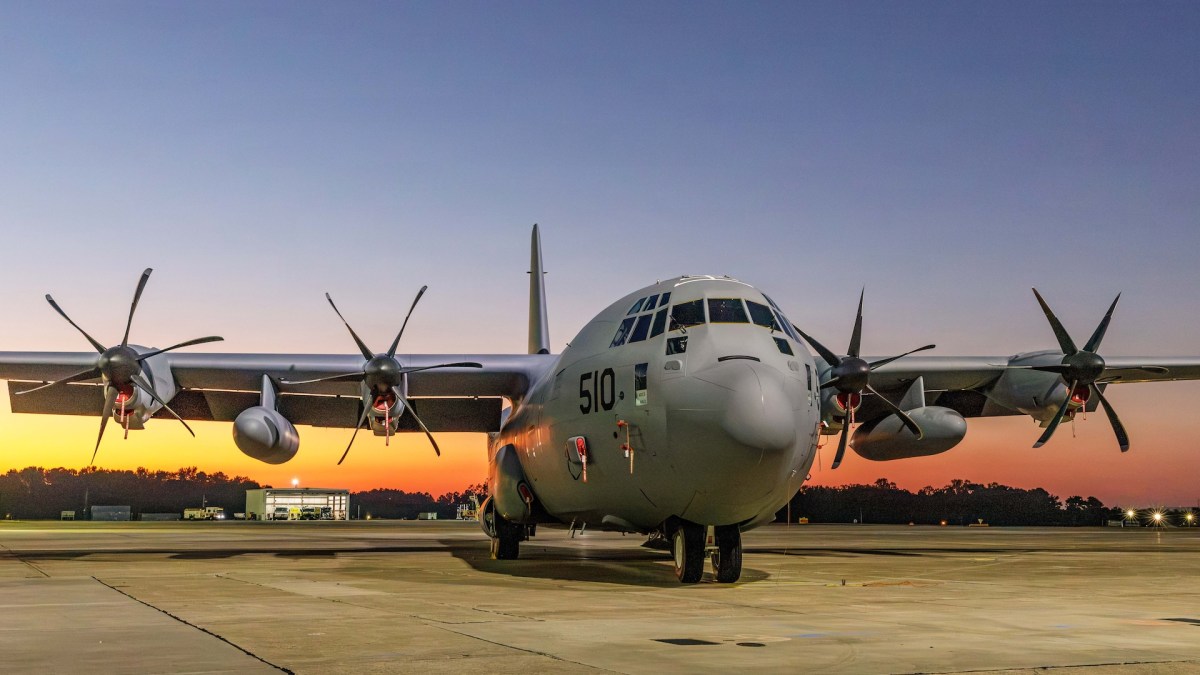
Photo courtesy of Lockheed Martin by Damien A. Guarnieri
The U.S. Navy has taken delivery of the first C-130J-30 Hercules airframe destined to become an E-130J Phoenix II , the service’s next-generation aircraft for maintaining communications with its nuclear ballistic submarines. The aircraft will now undergo extensive mission-systems integration before it can begin testing for the Take Charge and Move Out (TACAMO) mission.
The @USNavy 's future TACAMO aircraft is here. 🇺🇸 The C-130J-30 Super Hercules keeps strategic command and control connected when it matters most. Four engines. Long endurance. Proven reliability. pic.twitter.com/huX0qlzKkm — Lockheed Martin (@LockheedMartin) October 16, 2026
The @USNavy 's future TACAMO aircraft is here. 🇺🇸 The C-130J-30 Super Hercules keeps strategic command and control connected when it matters most. Four engines. Long endurance. Proven reliability. pic.twitter.com/huX0qlzKkm
Lockheed Martin handed over the newly built aircraft at its facility in Marietta, Georgia, on October 15. The delivery marks the start of the transition from the Navy’s aging E-6B Mercury fleet to the turboprop-powered E-130J, which is intended to provide a survivable communications link between national leadership and U.S. Navy nuclear ballistic missile submarines , including the ability to send them orders to launch strikes while they are submerged .
An E-6B Mercury assigned to the Strategic Communications Wing 1 at Tinker Air Force Base approaches a tanker during an aerial refueling mission over Oregon, Feb. 28, 2025. U.S. Air Force photo by Airman 1st Class Megan Delaine
“Today’s delivery from the historic Marietta line represents far more than a new airframe; it marks the foundation of our future strategic deterrence posture,” Capt. Roger Davis, program manager for the Navy’s Airborne Strategic Command, Control, and Communications program office (PMA-271), said in a statement.
“Through our close partnership with Lockheed Martin and our industry team, we are ensuring our nation maintains an unshakeable communications lifeline to our ballistic missile submarine fleet.”
Capt. Roger Davis, left, Airborne Strategic Command, Control and Communications program manager (PMA-271), presents a ceremonial key to Capt. David Gardner, commodore of Strategic Communications Wing 1 (SCW 1), during the C-130J-30 delivery ceremony Oct. 15, 2026 in Marietta, Georgia. Photo courtesy of Lockheed Martin by Thinh D. Nguyen
The aircraft is the first of three C-130J-30s initially procured by the Navy in September 2024. It will be transferred to Northrop Grumman, the E-130J program’s prime contractor and mission-systems integrator, for conversion. Collins Aerospace is providing the very low frequency (VLF) communications system, a key component of the TACAMO mission.
TACAMO aircraft provide a means for the president, secretary of defense, and U.S. Strategic Command to communicate with nuclear forces, including submarines submerged at sea. The mission is designed to preserve the ability to transmit emergency action messages even if conventional communications infrastructure is disrupted or destroyed.
The E-6B accomplishes this in part through a long, trailing wire antenna that enables VLF transmissions to submerged submarines. The E-130J will receive a comparable system as part of its conversion.
Hardening against the effects of electromagnetic pulse (EMP), which occurs during the detonation of nuclear warheads , is another key requirement for these planes.
The first C-130J-30 being built by Lockheed Martin Corp. for the E-130J program. Photo by David L. Key, Lockheed Martin
The Navy plans to acquire 31 E-130Js , nearly doubling the 16 E-6Bs currently in service. That total includes six developmental aircraft and 25 production examples, although it remains unclear how many of the developmental aircraft will ultimately be available for operational use.
The larger planned fleet should provide additional aircraft to support training, maintenance, and operational demands. However, the transition also brings technical challenges. The Government Accountability Office has previously warned that integrating the specialized mission equipment into the smaller C-130J-30 airframe could affect operational availability and create additional engineering and manufacturing difficulties.
Rendering of the future E-130J aircraft. Courtesy of Northrop Grumman Corp.
In the past, TWZ has discussed the potential operational readiness and other trade-offs that could come from selecting a C-130-based platform to replace the E-6B in the TACAMO role. As we wrote previously :
“It’s certainly worth pointing out that the E-6Bs, conversions of what were some of the last and most modern 707 airliners built, were larger and higher performance platforms than the EC-130Qs. The C-130J-30 is certainly a more capable aircraft than the C-130H on which the EC-130Q was based, but it won’t have the base speed and altitude capabilities of an airliner-sized multi-engine jet. Compared to the Mercuries, any TACAMO-configured C-130J-30 would not be able to get on station as quickly, or fly as high, limiting its ability to get above bad weather or establish a better line of sight for its communications systems.”
“At the same time, as the Navy itself has noted, the C-130J-30 platform does immediately open up the ability to use a larger number of air bases, airports, and airfields, including austere ones that the E-6B cannot operate from. This could be very useful in a contingency scenario where an opponent may have destroyed or otherwise rendered unusable many well-established bases, as well as larger secondary dispersal sites, which include large commercial airports. Being able to fly from smaller, tertiary locations could help to ensure that the TACAMO mission continues without significant disruption under such circumstances. This is also true during peacetime, as targeting the TACAMOs on the ground would be much harder if they could easily operate from and sit alert at a much larger number of airports.”
“A C-130J-30 configured for the TACAMO mission would certainly have a mid-air refueling capability, and the Hercules is already a platform that has demonstrated the ability to loiter over particular areas for long periods of time. Unlike the Boeing 707, the C-130J is still in production, as well, meaning that TACAMO aircraft based on this plane would be inherently easier to maintain and support logistically, and may also be easier to convert to this specialized configuration to begin with. As time goes on, the J looks set to increasingly become the default base C-130 model across the U.S. military, as well. Compared to the long out-of-production 707-based E-6, support for the C-130J is already distributed across the U.S. and beyond. Training C-130J crews is even an easier proposition.”
The E-130J also represents a return to the Hercules family for the Navy’s TACAMO mission. The EC-130Q performed the role from 1963 to 1993, before the E-6A Mercury took over. The E-6B subsequently added an airborne command post mission known as Looking Glass , supporting U.S. strategic forces beyond the submarine communications role .
The US Navy operated a fleet of EC-130Q TACAMO aircraft like the one seen here before the arrival of the E-6As. U.S. Navy
The Navy’s current plan is for the E-130J to assume the TACAMO mission, while the Air Force pursues a separate effort to replace the Looking Glass airborne command post capability.
Following its delivery, the first E-130J airframe will enter mission-systems modification, ground testing, and developmental flight testing. The aircraft is not yet an operational TACAMO platform, and further integration and testing will be required before the Navy can begin fielding the new fleet.
The transition is intended to preserve one of the most critical links in the U.S. nuclear command, control, and communications architecture as the E-6B fleet becomes increasingly difficult to sustain.
Contact the author: thomas@thewarzone.com
Comments couldn’t be loaded. Please refresh the page.
发布于美国东部时间2026年10月16日上午11:52
照片由达米安·A·瓜尔涅里拍摄,洛克希德·马丁公司提供。
美国海军已接收首架C-130J-30“大力神”运输机机身,该机将改装为E-130J“凤凰II”预警机,这是美国海军用于与核动力弹道潜艇保持通信的下一代预警机。该机在开始执行“接管行动”(TACAMO)任务测试之前,将进行全面的任务系统集成。
美国海军的未来TACAMO飞机来了!🇺🇸 C-130J-30“超级大力神”运输机在最关键的时刻确保战略指挥与控制的畅通无阻。四台发动机,超长续航,久经考验的可靠性。pic.twitter.com/huX0qlzKkm — 洛克希德·马丁公司 (@LockheedMartin) 2026年10月16日
美国海军的未来战术空中机动与控制(TACAMO)飞机来了!🇺🇸 C-130J-30“超级大力神”运输机在最关键的时刻确保战略指挥与控制的畅通无阻。四台发动机,超长续航,久经考验的可靠性。pic.twitter.com/huX0qlzKkm
10 月 15 日,洛克希德·马丁公司在其位于佐治亚州玛丽埃塔的工厂交付了这架新制造的飞机。此次交付标志着海军从老旧的 E-6B 水星预警机队过渡到涡轮螺旋桨动力 E-130J 预警机队的开始。E-130J 旨在为国家领导层和美国海军核动力弹道导弹潜艇之间提供可靠的通信链路,包括在潜艇潜航时向其发送攻击命令的能力。
2025年2月28日,一架隶属于廷克空军基地第一战略通信联队的E-6B“水星”预警机在俄勒冈州上空执行空中加油任务时接近一架加油机。美国空军一等兵梅根·德莱恩摄
“今天从历史悠久的马里埃塔生产线交付的这架飞机,其意义远不止是一架新的机身;它标志着我们未来战略威慑态势的基础,”海军空中战略指挥、控制和通信项目办公室 (PMA-271) 项目经理罗杰·戴维斯上校在一份声明中表示。
“通过与洛克希德·马丁公司和我们行业团队的紧密合作,我们正在确保我国与弹道导弹潜艇舰队之间保持不可动摇的通信生命线。”
2026年10月15日,在佐治亚州玛丽埃塔举行的C-130J-30交付仪式上,机载战略指挥、控制和通信项目经理(PMA-271)罗杰·戴维斯上尉(左)向战略通信联队1(SCW 1)准将大卫·加德纳上尉赠送了一把象征性的钥匙。照片由Thinh D. Nguyen拍摄,洛克希德·马丁公司提供。
这架飞机是海军于2024年9月首批采购的三架C-130J-30中的第一架。它将被移交给E-130J项目的主承包商和任务系统集成商诺斯罗普·格鲁曼公司进行改装。柯林斯宇航公司将提供甚低频(VLF)通信系统,这是TACAMO任务的关键组成部分。
战术空中机动指挥所(TACAMO)飞机为总统、国防部长和美国战略司令部提供了一种与核力量(包括水下潜艇)进行通信的手段。该任务旨在确保即使常规通信基础设施中断或被摧毁,也能保持传递紧急行动信息的能力。
E-6B 的部分功能是通过一根长长的拖曳式天线实现的,该天线能够向水下潜艇进行甚低频 (VLF) 通信。E-130J 在改装过程中也将配备类似的系统。
抵御核弹头爆炸时产生的电磁脉冲 (EMP) 的影响是这些飞机的另一项关键要求。
洛克希德·马丁公司为E-130J项目建造的首架C-130J-30运输机。照片由洛克希德·马丁公司的David L. Key拍摄。
美国海军计划采购31架E-130J预警机,几乎是目前服役的16架E-6B预警机的两倍。这其中包括6架研发型飞机和25架生产型飞机,但目前尚不清楚最终有多少架研发型飞机能够投入作战使用。
计划中的更大规模机队将提供更多飞机,以满足训练、维护和作战需求。然而,这一转变也带来了技术挑战。美国政府问责局此前曾警告,将专用任务设备集成到较小的C-130J-30机身上可能会影响作战可用性,并造成额外的工程和制造难题。
未来E-130J飞机的效果图。图片由诺斯罗普·格鲁曼公司提供。
过去,TWZ曾讨论过选择基于C-130的平台来取代E-6B担任TACAMO角色可能带来的潜在作战准备情况和其他权衡取舍。正如我们之前所写:
值得一提的是,E-6B是由当时建造的最后一批也是最先进的707客机改装而来,其尺寸和性能都比EC-130Q更大。C-130J-30的性能当然比EC-130Q所基于的C-130H更强,但它的基本速度和飞行高度无法与客机级别的多引擎喷气式飞机相提并论。与水星系列飞机相比,任何采用TACAMO配置的C-130J-30都无法快速到达指定位置,也无法飞得更高,这限制了它飞越恶劣天气或为其通信系统建立更佳视线的能力。
“与此同时,正如海军自身所指出的,C-130J-30平台确实能够立即使用更多空军基地、机场和简易机场,包括E-6B无法起降的简陋设施。这在敌方可能摧毁或以其他方式使许多成熟的基地以及包括大型商业机场在内的大型备用分散地点无法使用的突发情况下非常有用。能够从较小的、次要的地点起飞有助于确保战术空中机动作战(TACAMO)任务在类似情况下继续进行,而不会受到重大干扰。在和平时期也是如此,因为如果TACAMO能够轻松地从更多机场起降并保持警戒状态,那么地面攻击将更加困难。”
“一架配置用于战术空中机动支援(TACAMO)任务的C-130J-30肯定具备空中加油能力,而且大力神运输机本身就已展现出在特定区域上空长时间盘旋的能力。与波音707不同,C-130J目前仍在生产,这意味着基于该机型的TACAMO飞机在维护和后勤保障方面必然更加便捷,而且可能也更容易改装成这种特殊配置。随着时间的推移,C-130J有望逐渐成为美军的C-130标准机型。与早已停产的基于波音707的E-6相比,C-130J的后勤保障已经覆盖美国乃至全球。C-130J机组人员的培训也更加容易。”
E-130J 也标志着大力神系列飞机重返海军的战术空中指挥所(TACAMO)任务。EC-130Q 从 1963 年到 1993 年执行过这项任务,之后被 E-6A 水星预警机取代。E-6B 随后增加了一项名为“镜中世界”(Looking Glass)的空中指挥所任务,为美国战略部队提供除潜艇通信之外的支援。
在E-6A到来之前,美国海军曾运营过一支EC-130Q TACAMO飞机机队,就像图中这架一样。
海军目前的计划是让 E-130J 承担 TACAMO 任务,而空军则另辟蹊径,寻求取代 Looking Glass 空中指挥所的能力。
首架E-130J飞机交付后,将进行任务系统改装、地面测试和研发飞行测试。该机目前还不是作战型TACAMO平台,海军在开始部署新机队之前,还需要进行进一步的集成和测试。
此次过渡旨在维护美国核指挥、控制和通信架构中最关键的环节之一,因为 E-6B 机队的维护变得越来越困难。
联系作者:thomas@thewarzone.com
评论加载失败,请刷新页面。