Zone 5 ‘found a spot’ in drone interceptor market with new Eclipse: CEOZone 5凭借新款Eclipse在无人机拦截器市场“找到了立足之地”:首席执行官
CEO Thomas Akers told Breaking Defense that the company’s recent acquisition by Norwegian defense firm Kongsberg offers “an immediate step change” for the startup firm, whose portfolio now spans from a reusable drone interceptor to a low-cost cruise missile.
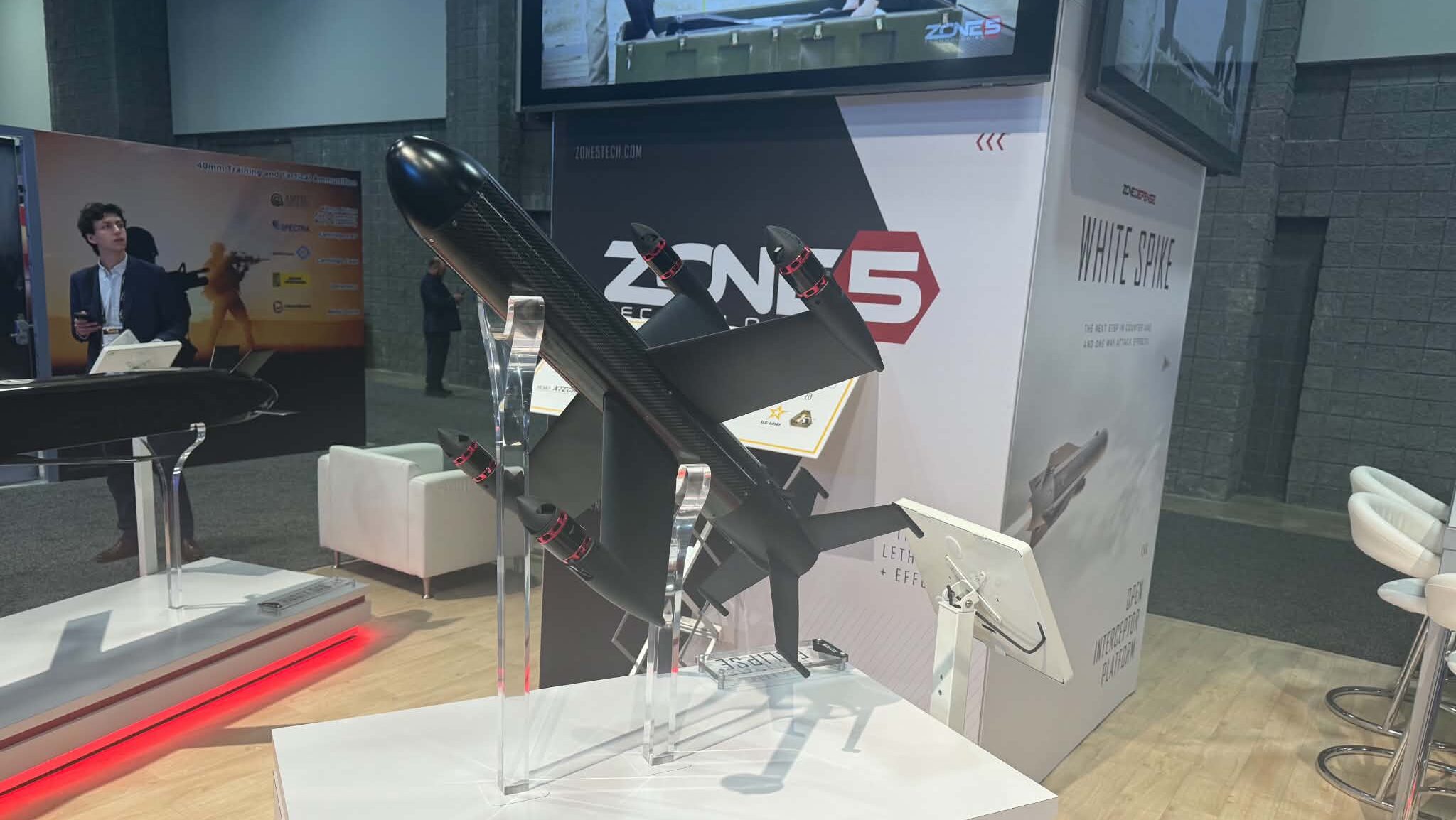
A model of Zone 5's Eclipse drone interceptor on display at the 2026 AUSA conference. (Michael Marrow/Breaking Defense)
WASHINGTON — Defense startup Zone 5 is joining the rush for counter-drone tech, debuting a new interceptor dubbed the “Eclipse” that the company says can combat high-speed, unmanned threats.
Still in development but shown publicly for the first time at the Association of the United States Army conference here, the Eclipse offers a lower-cost, reusable option to take down high-speed drones, Zone 5 CEO Thomas Akers told Breaking Defense.
Arguing that the market is “coalescing” around smaller interceptors that are in turn challenged by more capable drones, Akers said his firm “found a spot” for a larger interceptor with modular payloads.
Larger doesn’t mean too large — an Eclipse model on display at Zone 5’s booth measured 39 in. long and 32 in. wide. But according to Akers, the platform can sport a high-powered microwave that can zap a drone’s electronics, or can carry a kinetic payload to knock one out of the sky. A company fact sheet said the Eclipse can take off and land vertically, achieve speeds of over 200 knots (230 miles per hour) and reach over 30 miles.
Akers said he expects Eclipse to be in development for roughly another six months before entering production, and is initially aimed at the American market. He said the company is aiming to build hundreds of copies a month but declined to comment on an expected price tag, pointing to various potential payloads that influence a final cost.
Akers explained that the Eclipse helps round out Zone 5’s offerings for layered defenses, from a drone-mounted firearm featured on the firm’s Paladin system to its White Spike anti-air missile. Zone 5’s burgeoning portfolio, which includes a cruise missile dubbed Rusty Dagger exported to Ukraine and on order for the Pentagon , likely helped attract the attention of the Norwegian defense firm Kongsberg, which completed an acquisition of Zone 5 earlier this year.
The Kongsberg acquisition “bring[s] kind of an immediate step change” regarding Zone 5’s access to international resources, Akers said. While Zone 5 still operates separately from Kongsberg in the United States, “globally, we present one unified front under the Kongsberg brand.”
The company’s new Norwegian ownership also “gives us access to a larger portfolio of vendors” that can help expand supply chains beyond the US, Akers added. Looking ahead, he said that the firm is going to remain focused on producing low-cost cruise missiles and technologies that can defeat Group 1-4 drones. A key goal is producing thousands of missiles annually, he said, along with leveraging Kongsberg resources to iterate on Zone 5’s products to increase lethality and survivability.
Alongside recent agreements like a Navy program for maritime strike and a Pentagon-wide effort for containerized munitions , one big opportunity for Zone 5, the Air Force’s Family of Affordable Mass Missiles (FAMM) program, is just over the horizon. In the coming years the service plans to acquire tens of thousands of FAMM missiles using multi-year deals, drawing from a pool of vendors including Zone 5, Anduril and CoAspire.
But after using dollars from the One Big Beautiful Bill to kickstart procurement in fiscal 2026, the Air Force once again banked on reconciliation to deliver funds for buying FAMM in FY27 — a prospect dimmed by doubts over another reconciliation bill.
“If multi-year doesn’t happen the way that it’s scheduled to, that sends a clear signal to industry,” Akers said, adding that a shortfall of appropriations means “you’re going to have, definitely, a recoil, and it’s going to be felt beyond just FAMM.”
在2026年美国陆军协会(AUSA)年会上展出的Zone 5公司“日蚀”(Eclipse)无人机拦截器的模型。(Michael Marrow/Breaking Defense)
华盛顿——国防初创公司 Zone 5 加入了反无人机技术的竞争,推出了一款名为“Eclipse”的新型拦截器,该公司称该拦截器可以对抗高速无人威胁。
Zone 5 首席执行官 Thomas Akers 告诉 Breaking Defense,Eclipse 仍在研发中,但首次在美国陆军协会会议上公开亮相,它提供了一种成本更低、可重复使用的方案来击落高速无人机。
阿克斯认为,市场正在围绕小型拦截器“凝聚”,而小型拦截器又受到功能更强大的无人机的挑战。他表示,他的公司“找到了”一款具有模块化有效载荷的大型拦截器的市场空间。
尺寸更大并不意味着过大——在Zone 5展位上展出的Eclipse模型长39英寸,宽32英寸。但据Akers介绍,该平台可以搭载高功率微波炉,摧毁无人机的电子设备,或者携带动能有效载荷将其击落。公司资料显示,Eclipse可以垂直起降,速度超过200节(230英里/小时),航程超过30英里。
阿克斯表示,Eclipse预计还需要大约六个月的研发时间才能投入生产,初期目标市场是美国。他表示,公司计划每月生产数百台,但拒绝透露预计售价,并指出最终价格会受到多种潜在有效载荷的影响。
阿克斯解释说,Eclipse系统完善了Zone 5公司的多层次防御产品线,该公司产品线还包括Paladin系统上的无人机搭载武器和White Spike防空导弹。Zone 5公司不断增长的产品组合,包括出口到乌克兰并已获得五角大楼订单的名为Rusty Dagger的巡航导弹,很可能是吸引挪威国防公司康斯伯格(Kongsberg)注意的原因之一。康斯伯格于今年早些时候完成了对Zone 5的收购。
阿克斯表示,收购康斯伯格“立即给Zone 5获取国际资源带来了质的飞跃”。虽然Zone 5在美国仍然独立于康斯伯格运营,但“在全球范围内,我们以康斯伯格品牌统一行动”。
阿克斯补充说,公司新的挪威所有权也“让我们能够接触到更广泛的供应商”,这有助于将供应链扩展到美国以外。展望未来,他表示,公司将继续专注于生产低成本巡航导弹和能够对抗1-4类无人机的技术。他指出,一个关键目标是每年生产数千枚导弹,同时利用康斯伯格的资源对Zone 5的产品进行迭代改进,以提高杀伤力和生存能力。
除了近期达成的海军海上打击项目和五角大楼范围内的集装箱式弹药项目等协议外,空军“经济型大规模导弹系列”(FAMM)项目——Zone 5——也即将迎来一个重大机遇。未来几年,空军计划通过多年期合同采购数万枚FAMM导弹,供应商包括Zone 5、Anduril和CoAspire等。
但是,在利用“一项伟大的法案”中的资金启动 2026 财年的采购工作后,空军再次依靠预算协调来获得 2027 财年购买 FAMM 的资金——但由于对另一项预算协调法案的疑虑,这一前景变得黯淡。
“如果多年计划不能按计划进行,这将向业界发出一个明确的信号,”阿克斯说,并补充说,拨款不足意味着“肯定会产生反弹,而且这种反弹的影响将远远超出FAMM。”