The lack of a shared lexicon is undermining responsible AI-military integration缺乏共享词汇正在削弱人工智能与军事领域负责任的融合。
We need a common way to talk about military AI—across services, agencies, and indeed, the world.
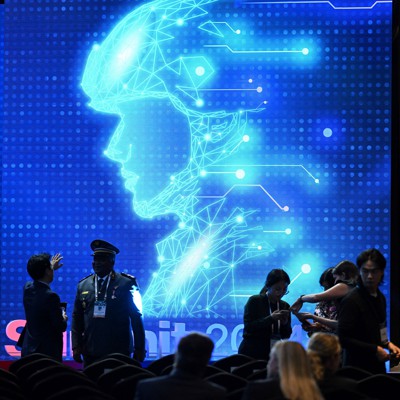
Participants chat at the closing session of the Responsible AI in the Military Domain (REAIM) summit in Seoul on September 10, 2024. JUNG YEON-JE/AFP via Getty Images
We need a common way to talk about military AI—across services, agencies, and indeed, the world.
Jason Warner and Sofia Romansky
Today’s headlines are full of killer robots and doomsayers, but the most urgent risk in military AI is more mundane: the people shaping it share neither a common lexicon nor common data.
The problem is not a lack of discussion. The authors have taken part in many global deliberations, both as conveners and as private-sector representatives, and we can report: If the world is to forge responsible governance of AI in the military domain, it will need shared definitions and a way to fuse relevant developments and decisions into something approximating “ground truth.”
The players in AI-military integration come from every realm: governments, militaries, the private sector, academia, the legal system, civil society, human rights, technology, journalism, and more. In multilateral negotiations and colloquial parlance, they speak varied languages—literally and topically. They are guided by varied incentives: some are eagerly pursuing AI-military integration, while others are trying to regulate it. A word like “autonomy” means something different to a general, an engineer, a lawyer, and a human rights advocate, not to mention the nuances born of the 200 or so countries they call home.
The staggering breadth of these players, combined with the wide range of AI applications, means that data about their actions is scattered. It can be found in government contract announcements, legislation, news coverage, court documents, patent applications, and beyond, in nearly every global language. This has made it impossible to track and compare developments within and across countries.
Without common language and common data, humanitarian organizations often talk past supply-chain experts. Tech executives fail to communicate effectively with academic researchers. Efforts to develop responsible AI-military integration cannot move ahead.
This is not a new concern. In 2024, the Responsible AI in the Military Domain Summit, or REAIM—the preeminent forum for global discussions of the topic— urged stakeholders to begin “fostering a common understanding of…capabilities and limitations [of AI-military integration], and a shared understanding of the possible applications…and their potential impacts, including both benefits and risks.” The same year, the United Nations Institute for Disarmament Research Roundtable for AI, Security, and Ethics identified six priority areas for governance, including: “Building a shared and solid knowledge base on AI in the military domain, developed through cross-regional, inter-disciplinary and multi-stakeholder input.” And last year’s report by the Global Commission REAIM urged states to “maintain international repositories of best practices, including AI concepts and definitions, AI capabilities in specific contexts of application…and military AI policies” to support national and international regulatory efforts.
One effort to bridge the data gap is the AI-Military Integration Database , operated by AIMID, a private company whose CEO is one of the authors. The database does a daily scan for news and information about AI-military integration in more than 20 languages—news reports, company announcements, academic articles, legislation, contracts, think tank reports, and more. The result is an ever-growing knowledge graph: a structured, footnoted map of actors, technologies, events and the relationships between them. This makes it possible to see which countries are doing what, with what technologies, from what companies, and for what use cases. In short, AIMID aims to deliver a single, verifiable picture of global AI-military integration, a data-driven “ground truth.”
Among other benefits, the database aims to help allies and partners pool knowledge about testing, evaluation, verification, and validation—supporting innovation and interoperability while avoiding the costly duplication of technical efforts. It might also help reduce tension between global rivals by providing empirical reference points, reducing dangerous interstate misperceptions, and ensuring that states’ security policies are anchored in evidence rather than ambiguity. For anyone concerned with responsible AI-military development—governments, businesses, NGOs, academics, or average citizens—AIMID serves as a unique resource,
But more than merely recognizing that data fragmentation is hindering responsible military-AI progress, defense leaders around the world should next fund and adopt the tools necessary to fully understand the data and intelligence-gathering side of this new ecosystem. Indeed, while organizations like AIMID cannot fully solve the fundamental problem of data fragmentation, they represent some of the best resources available.
This commentary is published in coordination with the 2026 Global Security Forum , of which Defense One is a media partner.
Dr. Jason Warner is the CEO of the AI-Military Integration Database (AIMID). He holds a Ph.D. from Harvard University.
Sofia Romansky is a Strategic Analyst at The Hague Centre for Strategic Studies (HCSS) and Subject Matter Expert for the NATO Defence Education Enhancement Program (DEEP). She previously served as the Project Coordinator of the Global Commission on Responsible Artificial Intelligence in the Military Domain (GC REAIM).
NEXT STORY: The most important alliances will lead to critical minerals
2024年9月10日,在首尔举行的“负责任的军事领域人工智能”(REAIM)峰会闭幕式上,与会者正在交谈。图片来源:JUNG YEON-JE/AFP via Getty Images
我们需要一种通用的方式来谈论军事人工智能——无论是在各个军种、机构,还是在全世界范围内。
杰森·华纳和索菲娅·罗曼斯基
如今的新闻头条充斥着杀手机器人和末日预言,但军事人工智能领域最紧迫的风险却更为平凡:塑造人工智能的人们既没有共同的词汇,也没有共同的数据。
问题不在于缺乏讨论。作者曾多次参与全球性磋商,既作为召集人,也作为私营部门代表,我们可以得出结论:如果世界要在军事领域构建负责任的人工智能治理体系,就需要达成共识,找到一种方法,将相关的发展和决策融合起来,形成接近“事实真相”的理论框架。
人工智能与军事融合的参与者来自各个领域:政府、军队、私营部门、学术界、法律体系、公民社会、人权组织、科技界、新闻界等等。在多边谈判和日常交流中,他们的语言——无论是字面意义还是具体内容——都各不相同。他们的动机也各不相同:有些人热衷于推进人工智能与军事融合,而另一些人则试图对其进行监管。“自主性”一词对于将军、工程师、律师和人权倡导者来说意义各不相同,更不用说他们所居住的约200个国家所带来的细微差别了。
这些参与者的数量之多令人咋舌,再加上人工智能应用的广泛性,意味着有关其行为的数据十分分散。这些数据散见于政府合同公告、立法、新闻报道、法庭文件、专利申请等各种渠道,几乎涵盖所有国际语言。这使得追踪和比较各国国内及各国之间的发展动态变得几乎不可能。
缺乏通用语言和通用数据,人道主义组织往往无法与供应链专家有效沟通。科技高管也难以与学术研究人员进行有效交流。负责任的AI与军事融合项目也无法推进。
这并非一个新问题。2024年,负责任的军事领域人工智能峰会(REAIM)——该议题全球讨论的首要论坛——敦促各利益攸关方开始“促进对人工智能与军事融合的能力和局限性的共同理解,以及对可能的应用及其潜在影响(包括益处和风险)的共同理解”。同年,联合国裁军研究所人工智能、安全与伦理圆桌会议确定了六个优先治理领域,其中包括:“通过跨区域、跨学科和多方利益攸关方的参与,构建一个关于军事领域人工智能的共享且坚实的知识库”。去年,全球REAIM委员会的报告敦促各国“维护国际最佳实践库,包括人工智能概念和定义、特定应用背景下的人工智能能力……以及军事人工智能政策”,以支持国家和国际监管工作。
为了弥合数据鸿沟,人工智能军事一体化数据库(AI-Military Integration Database)应运而生。该数据库由AIMID运营,AIMID是一家私营公司,其首席执行官也是该数据库的作者之一。该数据库每日扫描20多种语言的人工智能军事一体化相关新闻和信息,包括新闻报道、公司公告、学术文章、立法、合同、智库报告等等。最终形成一个不断增长的知识图谱:一个结构化的、带有脚注的地图,涵盖了参与者、技术、事件及其相互关系。这使得人们能够了解哪些国家正在做什么,使用了哪些技术,这些技术来自哪些公司,以及这些技术应用于哪些场景。简而言之,AIMID的目标是提供一个单一的、可验证的全球人工智能军事一体化图景,一个数据驱动的“真实情况”。
该数据库旨在帮助盟友和合作伙伴共享测试、评估、验证和确认方面的知识,从而支持创新和互操作性,同时避免技术工作的重复投入和高昂成本。此外,它还有助于通过提供经验参考点、减少危险的国家间误解以及确保各国安全政策以证据而非模糊性为基础,来缓解全球竞争对手之间的紧张关系。对于任何关注负责任的人工智能军事发展的人士——无论是政府、企业、非政府组织、学术界还是普通公民——AIMID 都是一项独特的资源。
但世界各国国防领导人不仅应该认识到数据碎片化阻碍了负责任的军事人工智能发展,更应该资助并采用必要的工具,以全面了解这一新生态系统中的数据和情报收集方面。事实上,虽然像AIMID这样的组织无法彻底解决数据碎片化的根本问题,但它们代表了目前可用的最佳资源之一。
本文评论与 2026 年全球安全论坛联合发布,Defense One 是该论坛的媒体合作伙伴。
杰森·华纳博士是人工智能军事集成数据库(AIMID)的首席执行官。他拥有哈佛大学的博士学位。
索菲娅·罗曼斯基是海牙战略研究中心(HCSS)的战略分析师,也是北约国防教育强化计划(DEEP)的专家。她此前曾担任全球军事领域负责任人工智能委员会(GC REAIM)的项目协调员。
下一篇报道:最重要的联盟将带来关键矿产资源