The real job of the Army’s new ‘robotics technicians’ is constant adaptation陆军新“机器人技术人员”的真正工作是不断适应
The age of battlefield autonomy demands more than just drone pilots and mechanics, Special Forces’ training chief says.
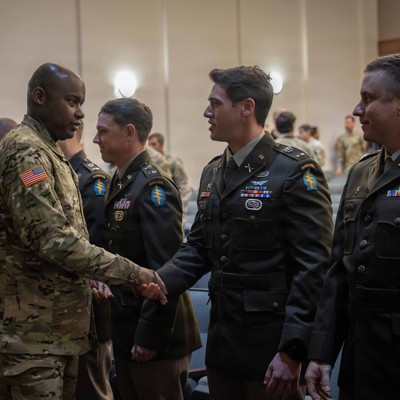
Lt. Gen. Steven M. Marks, Vice Commander of U.S. Special Operations Command, meets with the first 390A warrant officers at the U.S. Army John F. Kennedy Special Warfare Center and School on Fort Bragg, N.C., on Oct. 2, 2026. U.S. Army / Maj. George Wasickanin
The age of battlefield autonomy demands more than just drone pilots and mechanics, Special Forces’ training chief says.
Training & Simulation
You likely have a picture of the future of drone-assisted warfare: a soldier in a trench or a bunker, eyes enveloped in a virtual reality headset, hands clasping a controller, attention on targets below the drone he steers. But the reality of robot-assisted soldiering has already moved elsewhere, according to the military leaders who are training elite forces for future conflict.
On Oct. 2, 10 warrant officers became the Army’s first robotics technicians under the new 390A military occupational specialty. On Tuesday, Maj. Gen. Jason Slider, who commands the U.S. Army John F. Kennedy Special Warfare Center and School at Fort Bragg, described how their jobs will go far beyond remotely piloting or maintaining a drone or ground robot.
“It's important that it's not a pilot. We're not building a pilot. What we're building is a soldier that can adapt a piece of robotic kit to the mission, to the enemy, to the terrain,” Slider said at a Defense One event on the sidelines of the AUSA annual conference.
He described this as one of the most important lessons to emerge from Ukraine in terms of designing doctrine and training for the age of battlefield autonomy.
“We looked at the Nagorno-Karabakh , at Ukraine, and we're studying the ongoing conflicts in the Middle East,” he said. Militaries that “solely focus on pilots quickly lose the advantage to an adversary or an enemy force that can adapt that piece of tech to the mission.”
Adaptation was key to Azerbaijan's 2020 victory over Armenia in Nagorno-Karabakh. A 2021 report from the Center for Army Lessons Learned describes an Azerbaijani tactic in which “remotely piloted Soviet-era AN-2 biplanes flew at low altitudes as decoys to force the Armenians to respond against the perceived threat,” a use of robotics to surprise and confuse the enemy, not just drop bombs on them.
The United States used a similar tactic in the Middle East at the outset of Operation Epic Fury earlier this year, swarming Iranian forces with cheap drones modeled after the Shahed drones that Iran was using against U.S. forces. Both cases show the importance of deploying robotics, autonomy, and semiautonomy in ways the enemy had not yet predicted.
Chief Warrant Officer 5 Michael Updike, one of the architects of the 390A program, said at the Defense One event that the robotics technician military specialty will include aspects of intelligence analysis, command and control, communications, software development under extremely difficult and disconnected conditions, and even acquisition.
“What it encompasses is different pillars of not only software engineering and mechanical engineering but your data science, understanding research and development,” Updike said. “They have to do all that innovation in the field without…large-language models that are connected to the internet.”
The job will also entail rapidly inventing new capabilities on the ground, much as Ukrainian forces have done, and working with contractors who can do so as well.
During the first phase of the 19-week 390A training course, a group of students improved hardware and software to allow drones under electromagnetic attack to communicate with one another in a mesh network.
“They took a high-definition, $1,000 camera, put it on this quadcopter. They were being jammed in frequencies but they were using a mesh network. So, even though one node was taken out, they had multiple nodes where they could still have communications with the quadcopter or the unmanned drone to be able to still accomplish that mission,” Updike said.
To teach the skills of constant adaptation, Slider said, much of the course is designed to “drive failure” and force reconsideration. That’s something that the course architects themselves had to do when f, the students began, in Slider’s words, “outpacing the curriculum” four weeks in. They were too good at drone warfare, which meant that the course wasn’t hard enough. So Slider worked with academics, sources, and international partners to make the course more difficult, adding additional weeks of training.
“The problems that they were able to solve during the culminating exercise were much closer to the need that the operational force was communicating to us,” the general said.
The 390A program won’t be limited to Fort Bragg. This week, acting Army Secretary Adam Telle said, “Traditionally, historically, those types of [military occupational specialty] might live at — with the special forces and never be proliferated throughout the Army.”
Telle said that his office was working with the office responsible for special operations and low-intensity conflict to expand the specialty but did not provide further details.
NEXT STORY: Hegseth, service secretaries discuss ‘generational change’ of Autonomous Warfare Command
2026年10月2日,美国特种作战司令部副司令史蒂文·M·马克斯中将在北卡罗来纳州布拉格堡的美国陆军约翰·F·肯尼迪特种作战中心暨学校会见了首批390A准尉。(美国陆军/乔治·瓦西卡宁少校摄)
特种部队训练主管表示,战场自主化时代需要的不仅仅是无人机飞行员和机械师。
训练与模拟
你或许对未来无人机辅助作战的画面有所设想:一名士兵身处战壕或掩体中,双眼被虚拟现实头盔包裹,双手紧握控制器,目光紧盯着下方由他操控的无人机所瞄准的目标。但据那些正在为未来冲突训练精锐部队的军事领导人称,机器人辅助作战的现实已经发生了变化。
10月2日,10名准尉成为陆军首批390A军事职业专长下的机器人技术员。周二,驻布拉格堡的美国陆军约翰·F·肯尼迪特种作战中心和学校指挥官杰森·斯莱德少将阐述了他们的工作内容远不止远程操控或维护无人机或地面机器人。
“重要的是,它不是一架试验机。我们不是在制造一架试验机。我们是在制造一名士兵,他可以根据任务、敌人和地形调整机器人装备,”斯莱德在AUSA年会期间的Defense One活动上说道。
他认为这是乌克兰战争中最重要的教训之一,它有助于为战场自主时代设计理论和训练。
他说:“我们研究了纳戈尔诺-卡拉巴赫和乌克兰局势,目前还在研究中东地区的持续冲突。” 他还表示,如果军队“仅仅关注飞行员,很快就会因为对手或敌军能够根据任务调整技术而失去优势”。
适应性是阿塞拜疆在2020年纳戈尔诺-卡拉巴赫战役中战胜亚美尼亚的关键。美国陆军经验教训中心2021年的一份报告描述了阿塞拜疆的一种战术,即“使用苏联时代的AN-2遥控双翼飞机低空飞行作为诱饵,迫使亚美尼亚人对感知到的威胁做出反应”,这种利用机器人技术出其不意地迷惑敌人,而不仅仅是投掷炸弹。
今年早些时候,美国在中东地区发起“史诗狂怒行动”(Operation Epic Fury)之初,就采用了类似的战术,用仿照伊朗用来攻击美军的“沙赫德”(Shahed)无人机的廉价无人机对伊朗军队进行围攻。这两个案例都表明,以敌人始料未及的方式部署机器人、自主和半自主技术至关重要。
390A 项目的设计者之一,五级准尉迈克尔·厄普代克在国防一号活动上表示,机器人技术员这一军事专业将包括情报分析、指挥与控制、通信、在极其困难和孤立的条件下进行软件开发,甚至包括采购等方面的知识。
“它涵盖了软件工程、机械工程、数据科学、理解研发等各个方面,”厄普代克说。“他们必须在没有……连接到互联网的大型语言模型的情况下,在这个领域进行所有这些创新。”
这项工作还包括像乌克兰军队那样,迅速在实地创造新的能力,并与能够做到这一点的承包商合作。
在为期 19 周的 390A 培训课程的第一阶段,一组学员改进了硬件和软件,使遭受电磁攻击的无人机能够在网状网络中相互通信。
“他们把一台价值1000美元的高清摄像头装在了这架四轴飞行器上。虽然他们的通信频率受到了干扰,但他们使用的是网状网络。所以,即使一个节点被干扰,他们还有其他节点可以与四轴飞行器或无人机保持通信,从而完成任务,”厄普代克说。
斯莱德说,为了培养学员不断适应变化的能力,课程设计很大程度上旨在“制造失败”,迫使他们重新思考。课程设计者们自己也不得不这样做,因为在课程开始四周后,学员们就开始“超越课程进度”,用斯莱德的话说,他们在无人机作战方面表现得过于出色,这意味着课程难度不够。于是,斯莱德与学术界人士、相关资源和国际合作伙伴共同努力,增加了课程难度,延长了训练时间。
这位将军说:“他们在最终演习中能够解决的问题,与作战部队向我们传达的需求更加接近。”
390A计划并不局限于布拉格堡。本周,代理陆军部长亚当·特勒表示:“传统上,从历史上看,这类[军事职业专长]可能只存在于特种部队中,而不会在陆军中推广。”
特勒表示,他的办公室正在与负责特种作战和低强度冲突的办公室合作,以扩大这一专业领域,但没有提供更多细节。
下一篇报道:赫格塞斯与各军种部长讨论自主作战司令部的“代际更迭”