US withdrawal won’t end the region’s ISIS dilemma美国撤军并不能结束该地区的ISIS困境。
Iraq, Syria, and their regional partners must cooperate to replace what U.S. troops once provided.
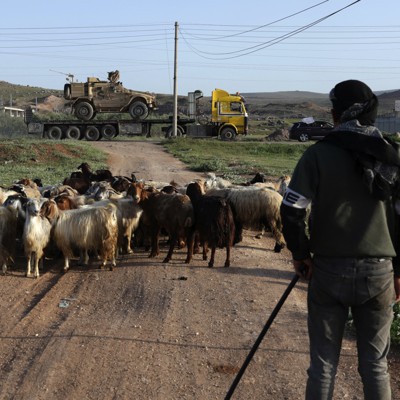
A Syrian shepherd watches as U.S. military equipment is hauled away from a base in Syria on April 16, 2026. Bakr ALkasem / AFP via Getty Images
Iraq, Syria, and their regional partners must cooperate to replace what U.S. troops once provided.
Caroline D. Rose and Julie Chernov Hwang
The U.S. military recently completed its withdrawals from Iraq and Syria, ending a decade of leadership in the counterterrorism fight against the Islamic State in the Levant. The gradual drawdown was meant to avoid a sudden vacuum that proxy militias, malign regional actors, terrorist organizations, and great-power rivals could fill, as happened in Iraq and Afghanistan. Yet ISIS, while greatly reduced, persists in Iraq and Syria, which must now build a sustained regional counterterrorism effort to prevent the group’s resurgence.
The absence of an American footprint in the two countries reduces cost and risks to personnel, but it also diminishes visibility into ISIS networks, undermines security relationships, and eliminates a forward position from which Washington could detect and disrupt terrorist threats before they affect U.S. interests and foreign partners.
While ISIS has mounted fewer attacks in Iraq and Syria since 2025, this is evidence not of diminished capacity but of strategic recalibration . In Syria, ISIS has been busy diversifying its targets and methods. In June alone, ISIS attacked oil tankers, commercial trucks, security checkpoints, military regional headquarters, political figures, judges, and buses ferrying personnel from the Ministry of Defense. In July, a bomb killed 10 people at a Damascus café frequented by officials working in the Justice Palace. Two more bombs exploded during President Macron of France’s first state visit, killing 10 and 18 people near the Four Seasons Hotel and Ministry of Tourism respectively.
Counterterrorism infrastructure, never perfect to begin with, can erode quickly after American forces leave. This has been seen in the dissolution of the Counter-ISIS mission and the emptying of ISIS detention camps like Al Hol and Al Roj. It has also been seen in the region’s prisons. As ISIS has lost operational capacity and territory, the group has turned to prison breaks as a strategic imperative, undertaking campaigns like the “Breaking the Walls” Campaign of 2012-13 in Iraq to replenish its ranks.
The threat is acute in Iraq, which took in 5,700 ISIS-affiliated prisoners—not only Iraqis and Syrians, but residents of 61 other countries—after the SDF’s January collapse in northeast Syria. It put them in prisons that were already overcrowded and under-resourced, and accepted responsibility for their detention, interrogation, and trial. The U.S. presence had helped encourage the humane treatment of prisoners and fair trials for those charged with terror crimes, reducing ISIS’ ability to use the prisons for recruiting, networking and organizing. Now, the troops have departed amid real concerns about backsliding.
In Syria, concerns remain about whether Syrian forces can integrate effectively and quickly to sustain ISIS’ defeat, in the face of recent incidents like ISIS infiltration into the Syrian Army and recent high-profile plots and attacks beyond ISIS’ traditional area of operations. Syrian prisons have also been targeted for breakouts, including ISIS’ 2022 attack on Al Sinaa prison and a January attempt at the Shaddadi detention facility .
Throughout the fight against terrorist organizations in Iraq and Syria, American personnel provided intelligence, surveillance, reconnaissance, airpower, special operations capacity, logistics, and local partnerships to local forces. This allowed the U.S. and its partners to monitor and disrupt groups like the Islamic State and defeat its territorial caliphate, while also giving Washington on-the-ground insight into terrorist organizations’ rapidly evolving tactics, as well as local political and security dynamics.
Absent these resources, it is likely the number and severity of ISIS plots and attacks will increase. Washington, its partners, and the Iraqi and Syrian governments must find creative ways to fill the security gaps. Syrian and Iraqi neighbors—Jordan, Türkiye, Lebanon, and other regional players—must begin forging close relationships with Damascus and Baghdad. Without these relationships, the region risks losing years of counterterrorism progress—and the U.S. may be forced to intercede once again.
This commentary is published in coordination with the 2026 Global Security Forum , of which Defense One is a media partner.
Caroline D. Rose is a Senior Director at the New York City-based Soufan Center, a nonpartisan research institution, where she conducts research on the crime-terror nexus, security, counterterrorism, and U.S. defense policy with a focus on Iraq and Syria. She is a Senior Nonresident Fellow at both the New Lines Institute and Orion Policy Institute, both where she writes about trends in terrorism and geopolitics.
Dr. Julie Chernov Hwang is an Associate Professor of Political Science and International Relations at Goucher College. She is a Senior Research Fellow at the Soufan Center & a Harry Frank Guggenheim Distinguished Scholar with over a decade researching terrorist behavior, notably social networks, radicalization, commitment, role assignment, disengagement, rehabilitation, reintegration, repatriation, and deradicalization.
NEXT STORY: The lack of a shared lexicon is undermining responsible AI-military integration
2026年4月16日,一名叙利亚牧羊人目睹美军装备从叙利亚的一个基地被运走。图片来源:Bakr ALkasem / AFP via Getty Images
伊拉克、叙利亚及其地区伙伴必须合作,以取代美军曾经提供的作用。
卡罗琳·D·罗斯和朱莉·切尔诺夫·黄
美国军方近期完成了从伊拉克和叙利亚的撤军,结束了其在黎凡特地区打击伊斯兰国的十年领导地位。逐步撤军旨在避免出现权力真空,以免像在伊拉克和阿富汗那样,被代理民兵、恶意地区势力、恐怖组织和大国对手填补。然而,尽管伊斯兰国势力已大幅削弱,但它仍然在伊拉克和叙利亚顽强存在,两国现在必须建立持续的区域反恐力量,以防止该组织死灰复燃。
美国在这两个国家没有驻军,虽然降低了人员成本和风险,但也降低了对ISIS网络的可见性,破坏了安全关系,并消除了华盛顿可以在恐怖主义威胁影响美国利益和外国伙伴之前发现和阻止它们的前沿阵地。
虽然自2025年以来,ISIS在伊拉克和叙利亚发动的袭击有所减少,但这并非表明其能力下降,而是战略调整的结果。在叙利亚,ISIS一直在积极拓展其袭击目标和手段。仅在6月份,ISIS就袭击了油罐车、货车、安全检查站、军事区域总部、政治人物、法官以及国防部人员的巴士。7月份,大马士革一家常有司法宫官员光顾的咖啡馆发生爆炸,造成10人死亡。法国总统马克龙首次对叙利亚进行国事访问期间,又有两枚炸弹爆炸,分别在四季酒店和旅游部附近造成10人和18人死亡。
反恐基础设施原本就不完善,美军撤离后更是迅速瓦解。打击“伊斯兰国”行动的解散以及“伊斯兰国”拘留营(如霍尔和罗杰)的清空,都印证了这一点。该地区的监狱也出现了类似的衰落。随着“伊斯兰国”行动能力和地盘的丧失,该组织将越狱视为一项战略要务,并开展了诸如2012-2013年在伊拉克发起的“破墙行动”等行动,以补充其人员。
在叙利亚东北部叙利亚民主力量(SDF)于1月份溃败后,伊拉克接收了5700名与“伊斯兰国”(ISIS)有关联的囚犯,其中不仅包括伊拉克人和叙利亚人,还有来自其他61个国家的居民。伊拉克将他们关押在原本就人满为患、资源匮乏的监狱中,并承担了拘留、审讯和审判的责任。美军的存在曾有助于促使伊拉克方面人道对待囚犯,并确保对被控犯有恐怖罪行的人进行公正审判,从而削弱了“伊斯兰国”利用监狱进行招募、联络和组织的能力。如今,在人们对局势可能出现倒退的担忧日益加剧的情况下,美军已经撤离。
在叙利亚,人们仍然担忧叙利亚军队能否有效且迅速地整合力量,以巩固对“伊斯兰国”的打击成果。近期发生的事件,例如“伊斯兰国”渗透叙利亚军队,以及在“伊斯兰国”传统活动区域之外策划和实施的高调袭击,都加剧了这种担忧。此外,叙利亚监狱也成为越狱事件的目标,包括“伊斯兰国”2022年对锡纳监狱的袭击,以及今年1月对沙达迪拘留中心的未遂袭击。
在伊拉克和叙利亚打击恐怖组织的整个过程中,美军人员向当地部队提供了情报、监视、侦察、空中力量、特种作战能力、后勤保障和本地合作伙伴关系。这使得美国及其伙伴能够监控和打击“伊斯兰国”等组织,并最终摧毁其建立的“哈里发国”,同时也让华盛顿能够深入了解恐怖组织快速演变的战术以及当地的政治和安全动态。
如果缺乏这些资源,ISIS的阴谋和袭击的数量和严重程度可能会增加。华盛顿及其伙伴以及伊拉克和叙利亚政府必须找到创造性的方法来填补安全缺口。叙利亚和伊拉克的邻国——约旦、土耳其、黎巴嫩和其他地区国家——必须开始与大马士革和巴格达建立密切关系。如果没有这些关系,该地区多年来在反恐方面取得的进展可能会付诸东流,美国或许将被迫再次进行干预。
本文评论与 2026 年全球安全论坛联合发布,Defense One 是该论坛的媒体合作伙伴。
卡罗琳·D·罗斯是位于纽约市的苏凡中心(一家无党派研究机构)的高级主任,她在该中心从事犯罪与恐怖主义关系、安全、反恐和美国国防政策方面的研究,重点关注伊拉克和叙利亚问题。她同时也是新线研究所和猎户座政策研究所的高级非常驻研究员,在这两个机构撰写有关恐怖主义和地缘政治趋势的文章。
朱莉·切尔诺夫·黄博士是古彻学院政治学和国际关系专业的副教授。她是苏凡中心的高级研究员,也是哈里·弗兰克·古根海姆杰出学者,十多年来一直致力于恐怖主义行为的研究,尤其关注社交网络、激进化、承诺、角色分配、脱离、改造、重返社会、遣返和去激进化。
下一篇报道:缺乏共享词汇正在破坏负责任的人工智能与军事融合。