F-22 Pilot Controls FQ-44 Fighter Drone From The Cockpit For The First TimeF-22飞行员首次从座舱内操控FQ-44战斗无人机
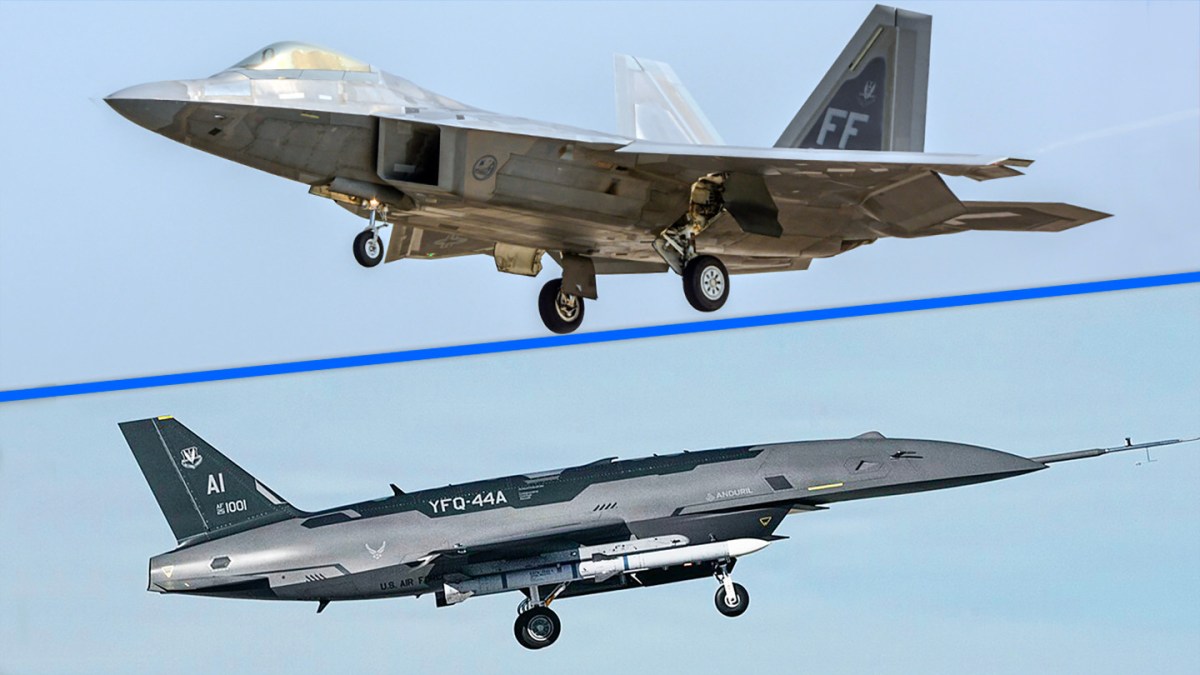
This is a key milestone as F-22s will be the Air Force's first aerial 'quarterbacks' for Collaborative Combat Aircraft drones.
By Joseph Trevithick
Published Oct 16, 2026 5:25 PM EDT
A pilot flying an F-22 Raptor fighter has issued commands to a YFQ-44A Fury Collaborative Combat Aircraft (CCA) drone in a first-of-its-kind test. This is an important development for the U.S. Air Force’s CCA program, as its F-22s are set to be the first aerial ‘quarterbacks’ for these uncrewed aircraft once they enter operational service.
The Air Force and Anduril, Fury’s prime contractor, announced the “airborne tactical-control demonstration” today, but it occurred sometime earlier this month. An Anduril spokesperson confirmed directly to TWZ that this was a first for an F-22 and a pre-production YFQ-44A. Last month, the company disclosed tests involving Fury flying in formation with F-35 fighters , but stressed that the latter were not yet issuing commands to the former in mid-air. A Fury drone also launched an AIM-120 Advanced Medium-Range Air-to-Air Missile (AMRAAM) for the first time earlier this year.
A stock picture of a pre-production YFQ-44A Fury CCA drone. USAF
The Air Force has orders in now for production of FQ-44As, as well as General Atomics’ FQ-42A Vengeance drones , under the first phase, or Increment 1, of its CCA program. The service is still planning to acquire additional CCAs, which could be of entirely different types, through a follow-on Increment 2 . The goal now is to have a fleet of at least 500 CCAs, in total, by 2032 . The recent test is part of efforts to lay the groundwork for an initial tranche of CCAs to start entering operational service around the end of the decade.
“During the demonstration, an F-22 pilot served as an airborne ‘quarterback,’ issuing high-level tactical directives to a single YFQ-44A,” according to a press release from the Air Force . “The aircraft’s onboard autonomy software interpreted and executed those directives in real time, conducting dynamic flight maneuvers and simulated combat tasks.”
A stock picture of an F-22 Raptor test jet. USAF
“The event brought together personnel from the 412th Test Wing, 422nd Test and Evaluation Squadron, 309th Software Engineering Group, Experimental Operations Unit, F-22 System Program Office and the CCA Software Autonomy and Teaming Branch,” according to the Air Force release.
The Experimental Operations Unit (EOU) mentioned here is based at Nellis Air Force Base in Nevada and has been leading efforts to pave the way for future Air Force CCA operations.
The “Fury and an F-22 both took off [from] Edwards AFB [Air Force Base in California] and joined up midair,” according to a separate release from Anduril. “While in flight, the Raptor pilot sent an updated mission plan to Fury using a tactical data link, commanding Fury through operationally-relevant maneuvers from the cockpit of the crewed quarterback.”
Neither the Air Force nor Anduril provided further details on how the F-22 was configured for this test. Past Air Force budget documents have mentioned the need to integrate “tablets, cables, and associated materials” onto the Raptor for this purpose. A single Raptor is also expected to be able to manage multiple CCA drones simultaneously.
The Raptor’s prime contractor, Lockheed Martin, has certainly been working with the Air Force to develop the relevant control architectures and user interfaces for that fighter, as well as the F-35. In terms of in-cockpit user interfaces for controlling drones, known work to date has centered largely on the use of touchscreen tablet-like devices , but this is understood to just be a starting point. Though tablet-based interfaces are a workable option, questions and criticisms about increased workload , especially for pilots in single-seat fighters, have been raised in the past.
A view of a “battle manager” in the back seat of an L-39 light jet using a tablet-like device during a past test of capabilities to control drones in mid-air conducted by Lockheed Martin’s Skunk Works. Lockheed Martin
It is also worth noting here that General Atomics announced a similar demonstration involving a Raptor and an MQ-20 Avenger back in November 2025. General Atomics has been using the MQ-20 as a CCA surrogate in various types of testing . What the plan might be now to demonstrate the F-22’s ability to control an FQ-42A in flight is unclear. General Atomics has previously released a picture of a Vengeance drone flying in formation with, though not being directly controlled by, Air Force fighters.
A General Atomics Vengeance drone, at right, in flight together with an F-35A Joint Strike Fighter and an F-15E Strike Eagle. General Atomics
In addition, Fury and Vengeance are set to make their debut in a large-scale exercise before the end of the year. Bringing the CCAs to the next iteration of Exercise Emerald Flag will give the Air Force further opportunity to test them in a more operationally relevant context alongside crewed fighters.
“We have not yet done a LFE [large-force employment exercise] with these [CCAs], for real. The first one is going to be Emerald Flag. That’s in December,” Lt. Col. Lyndon “OTTO” Bartlett, the EOU’s Director of Operations, said during a panel at the Air & Space Forces Association’s (AFA) 2026 Air, Space & Cyber Conference in September, at which TWZ was in attendance. “That’ll be our first tip [sic] dip of the toe in an actual force integration.”
The EOU, working together with other Air Force elements and industry partners, still has to answer a host of other outstanding questions unrelated to tactical operations. CCAs will be deployed, launched, recovered, supported, and otherwise operated in ways that are distinct from their crewed counterparts, and for which new policies and procedures will need to be developed. Just making sure human pilots have trust in their uncrewed wingmen operating as expected will be critical, underscoring the specific importance of the demonstration disclosed today. All of this applies equally to the U.S. Marine Corps and U.S. Navy CCA programs , which are being run in very close coordination with the Air Force’s efforts.
When it comes to the recent test involving the F-22 and the YFQ-44A, “this achievement demonstrates what is possible when we are aligned with industry on a shared imperative: delivering capability to the warfighter at unprecedented speed,” Secretary of the Air Force Troy Meink said in a statement today. “We are driving urgency into every part of acquisition from rapid integration and flight learning to disciplined assessment, so we can turn promising technology into combat capability at the pace the threat demands.”
A graphic showing the FQ-42 and FQ-44 designs together. USAF
“This flight shows the power of crewed-uncrewed teaming and the advantage it provides our warfighters,” Air Force Chief of Staff Gen. Ken Wilsbach also said. “We must test often, learn fast, and give commanders what they need, when they need it.”
“The U.S. Air Force’s CCA program is the fastest moving, most mature CCA program anywhere in the world, and will be the first to field operational aircraft,” Mark Shushnar, Anduril’s Vice President of Autonomous Airpower, said as well. “Getting there demands that Anduril and the U.S. Air Force work together to prove out the capability, define the operational procedures, and build trust between operators and their semi-autonomous wingmen.”
With all this in mind, an F-22 issuing orders to a YFQ-44A in mid-air is an important new sign of what is on the horizon for the U.S. Air Force, though there is still work to be done.
Contact the author: joe@twz.com
Comments couldn’t be loaded. Please refresh the page.
作者:约瑟夫·特雷维西克
发布于美国东部时间2026年10月16日下午5:25
一名驾驶F-22“猛禽”战斗机的飞行员在一次史无前例的测试中,向一架YFQ-44A“狂怒”协同作战飞机(CCA)无人机发出了指令。这对美国空军的CCA项目来说是一项重要的进展,因为一旦这些无人机投入作战使用,F-22战斗机将成为它们的首批空中“指挥中心”。
美国空军和“狂怒”无人机的主承包商安杜里尔公司今天宣布了“空中战术控制演示”,但实际上演示发生在本月初。安杜里尔公司的一位发言人直接向TWZ证实,这是F-22战斗机和YFQ-44A预生产型无人机的首次此类演示。上个月,该公司披露了“狂怒”无人机与F-35战斗机编队飞行的测试,但强调后者尚未在空中向前者发出指令。今年早些时候,“狂怒”无人机还首次发射了一枚AIM-120先进中程空空导弹(AMRAAM)。
一张YFQ-44A“狂怒”CCA无人机的预生产型示意图。美国空军
美国空军目前已订购FQ-44A和通用原子公司的FQ-42A“复仇”无人机,这是其CCA项目第一阶段(或称“增量1”)的订单。空军仍计划通过后续的“增量2”采购更多CCA,这些CCA可能采用完全不同的型号。目前的目标是到2032年拥有至少500架CCA。最近的测试是为首批CCA于本十年末开始服役奠定基础的工作之一。
根据美国空军发布的新闻稿,“在演示过程中,一名F-22飞行员扮演空中‘四分卫’的角色,向一架YFQ-44A无人机下达高级战术指令。该无人机的机载自主软件实时解读并执行这些指令,进行动态飞行机动并模拟作战任务。”
一张F-22猛禽战斗机测试机的库存照片。美国空军
据空军发布的消息称,“此次活动汇集了来自第412测试联队、第422测试评估中队、第309软件工程大队、实验运行部队、F-22系统项目办公室以及CCA软件自主与协作部门的人员。”
这里提到的实验行动单位 (EOU) 位于内华达州的内利斯空军基地,一直致力于为未来的空军 CCA 行动铺平道路。
根据安杜里尔公司发布的另一份声明,“‘狂怒’战斗机和一架F-22战斗机均从加利福尼亚州的爱德华兹空军基地起飞,并在空中会合。” “飞行过程中,‘猛禽’战斗机的飞行员通过战术数据链向‘狂怒’战斗机发送了更新后的任务计划,并在‘狂怒’战斗机的座舱内指挥其执行作战相关的机动动作。”
空军和安杜里尔公司均未提供关于F-22此次测试具体配置的更多细节。此前空军预算文件曾提及,为此需要将“平板电脑、线缆及相关设备”集成到猛禽战机上。预计一架猛禽战机还能同时操控多架CCA无人机。
猛禽战斗机的主承包商洛克希德·马丁公司一直在与美国空军合作,为该型战斗机以及F-35战斗机开发相关的控制架构和用户界面。就用于控制无人机的座舱用户界面而言,目前已知的研究主要集中在使用类似平板电脑的触摸屏设备上,但这仅仅是一个起点。虽然基于平板电脑的界面是一个可行的选择,但过去也曾有人提出质疑和批评,认为这会增加飞行员的工作负荷,尤其是对于单座战斗机飞行员而言。
照片显示,在洛克希德·马丁公司臭鼬工厂进行的一次空中无人机控制能力测试中,一名“作战管理人员”坐在L-39轻型喷气式飞机的后座上,使用类似平板电脑的设备。
值得注意的是,通用原子公司早在2025年11月就宣布了一项类似的演示计划,涉及猛禽战斗机和MQ-20复仇者无人机。通用原子公司一直在各种测试中使用MQ-20作为CCA(协同作战能力)的替代机型。目前尚不清楚该公司计划如何演示F-22战斗机在飞行中控制FQ-42A无人机的能力。通用原子公司此前曾发布过一张照片,照片中一架复仇者无人机与美国空军战斗机编队飞行,但并非由战斗机直接控制。
图中右侧为通用原子公司生产的“复仇者”无人机,与一架F-35A联合攻击战斗机和一架F-15E“攻击鹰”战斗机一同飞行。通用原子公司
此外,“狂怒”和“复仇”两款无人机将于年底前在一次大规模演习中首次亮相。将这两款无人机引入下一届“翡翠旗”演习,将使空军有机会在更具实战相关性的环境中,与有人驾驶战斗机一同测试它们的性能。
“我们还没有真正与这些联合作战能力(CCA)进行过大规模兵力部署演习(LFE)。第一次演习将是‘翡翠旗’,定于12月举行。”欧洲联合作战中心(EOU)作战主任林登·“奥托”·巴特利特中校在9月份举行的空军与太空部队协会(AFA)2026年空天网络大会的一个小组讨论会上说道,TWZ也出席了此次会议。“这将是我们首次试探性地进行实际的兵力整合。”
空军作战单位(EOU)正与其他空军部门和行业伙伴合作,继续解答一系列与战术行动无关的悬而未决的问题。无人驾驶飞机(CCA)的部署、发射、回收、保障和其他操作方式都与有人驾驶飞机截然不同,因此需要制定新的政策和程序。确保飞行员对无人僚机按预期运行充满信心至关重要,这也凸显了今天公布的演示的重要性。所有这些同样适用于美国海军陆战队和海军的无人驾驶飞机项目,这些项目正与空军的工作密切协调开展。
空军部长特洛伊·梅因克今天在一份声明中表示,就最近F-22战机与YFQ-44A导弹的联合测试而言,“这一成果表明,当我们与业界在共同目标上保持一致时,就能取得怎样的成就:以前所未有的速度向作战人员交付作战能力。我们正在加快采购流程的各个环节,从快速集成和飞行学习到严谨的评估,以便我们能够以应对威胁所需的速度,将前景广阔的技术转化为作战能力。”
一张图表展示了FQ-42和FQ-44的设计方案。美国空军
“这次飞行展现了有人/无人协同作战的强大威力,以及它为我们的作战人员带来的优势,”空军参谋长肯·威尔斯巴赫将军也表示。“我们必须经常进行测试,快速学习,并在指挥官需要的时候提供他们所需的一切。”
“美国空军的CCA项目是全球发展最快、最成熟的CCA项目,并将率先部署作战飞机,”安杜里尔公司自主空中力量副总裁马克·舒什纳尔表示。“要实现这一目标,安杜里尔公司和美国空军需要携手合作,验证其能力,制定操作程序,并在操作人员和他们的半自主僚机之间建立信任。”
考虑到所有这些因素,F-22 在空中向 YFQ-44A 下达指令,是美国空军未来发展方向的一个重要新标志,尽管仍有许多工作要做。
联系作者:joe@twz.com
评论加载失败,请刷新页面。