Opting out of the education arms race – these parents don’t sweat about grades选择退出教育军备竞赛——这些家长并不为孩子的成绩担忧。
These parents are choosing what matters most to them – keeping their children happy and not pressuring them to excel academically. Read more at straitstimes.com.
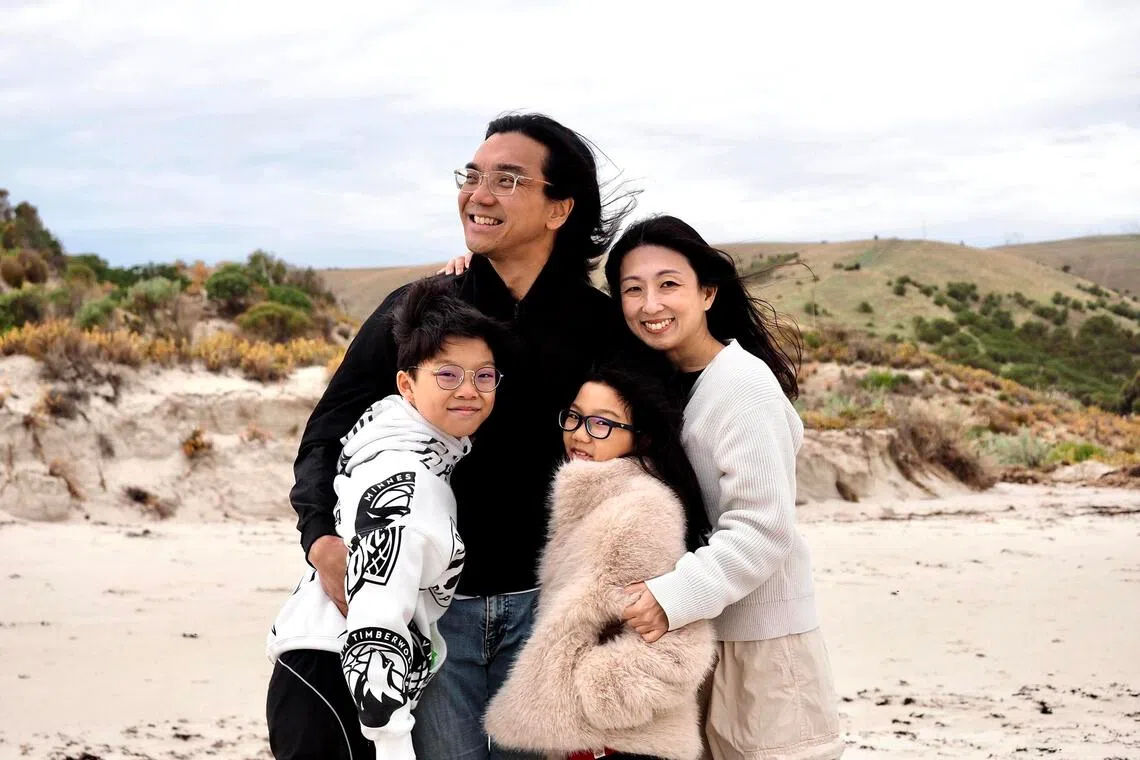
Mother of two Liang May, with her husband, Meyer Yang, son, Ewan Yang, and daughter, Jing Faye Yang, in Australia during the June 2025 school holidays.
PHOTO: COURTESY OF LIANG MAY
Vanessa Paige Chelvan
Published Oct 17, 2026, 12:00 PM
Updated Oct 17, 2026, 12:00 PM
SINGAPORE – Liang May took her son for a staycation at a hotel during his study break before sitting the PSLE in 2024.
They went rock climbing, played games at an arcade and visited cafes for meals, while weaving study time in between these activities.
“It made him feel more relaxed. He was feeling the stress of PSLE, so this actually helped him,” said the 44-year-old homemaker.
In the lead-up to the examination, Liang said her friends confiscated their children’s devices or limited their play time. But she did the opposite. In fact, she increased her son’s gaming time and ensured there was a good balance between his studies and personal time.
“I consciously told myself not to be reeled into that pressure… He’s the one sitting the PSLE, and he’s the one feeling most of the pressure,” said Liang , adding that she worried her son would not be able to put in effort into studying when he was required to, if he was not rested enough .
This was not the first time Liang’s approach to her two children’s education seemed unusual to her friends and family.
Although her son had the chance to enrol at an earlier phase in her husband’s alma mater, a prestigious boys’ primary school, she decided to place him in a neighbourhood school near their home instead.
“I wanted my children to grow up meeting kids from different backgrounds, to gain a wider view of the world… And they thrived at Pei Tong Primary School where they were able to find long-lasting friendships, and had caring teachers,” she said.
Liang also learnt to relax about her children’s development from experience.
She recalled worrying when her daughter was in Primary 2, and struggled to recite the alphabet. But instead of sending her for tuition, Liang continued reading to her and taking her to the library, trusting that she would learn at her own pace.
Today, her daughter represents her primary school in a creative writing competition.
“I realised then that self-discovery is more powerful than force-feeding,” she said.
Choosing a different path
In a society where families usually go to great lengths to give their children the best chance of academic success, some parents in Singapore, like Liang, are opting for a different path.
This means not succumbing to the peer pressure to enrol their kids into tuition and various enrichment programmes , to give them an edge over others or boost academic excellence .
While acknowledging the ever-present pressures from the education system here, these parents are making deliberate choices to channel their efforts and resources into what matters most to them – keeping their children happy and not pressuring them to excel academically.
A 2026 study by the Institute of Policy Studies (IPS) found that most parents of primary school children in Singapore increasingly value holistic or broader development.
At the same time, more parents indicate feeling stressed and anxious about their children’s futures and whether they will fall behind in the long run, compared with 2016, when the study was last done.
And although they view the education system here as among the best in the world, more than two-thirds of them say it still causes their children unnecessary stress.
Still, there are some parents The Straits Times spoke to who said they do not want to be caught up in the competitive aspects of the education system. These include strategising ways to enter popular primary schools or focusing their energies on direct school admission (DSA), through sports and the arts, to get into top secondary schools.
A parent and pre-school administrative executive, who wanted to be known as Tang, said she did not set grade targets for her children to achieve. Instead, she was more concerned about whether they understood what they were learning and put in reasonable effort into their studies.
“ Their childhood doesn’t have to be optimised every minute… They need to grow in a way that makes sense for them,” she said.
Her son, who is now in Secondary 4, had gained entry to the School of Science and Technology via DSA route after taking written tests and completing science challenges. Her 11-year-old daughter will sit the PSLE in 2027.
“Instead of gunning for one (particular secondary) school, we will be practical and choose a school based on her results and CCA preference,” said Tang, adding that she does not believe that entering a top school is the only route to a successful future.
Jason Tan, a professor at the National Institute of Education, said there is a lack of rigorous local longitudinal research that examines the strength of the proposition that studying in the so-called good schools increases one’s success later in life.
He added that questions still remain about how much of the perceived success of students from top schools is driven by school programmes or by students’ pre- existing advantages.
Lesser focus on academic excellence
For some parents, investing in their children’s future means focusing less on academic results and more on developing life skills, pursuing interests and building resilience.
Former secondary school teacher Jasmine Sia, 41, takes a different approach with each of her four children, aged eight to 15, depending on their strengths and abilities.
“It’s not possible to hold the same academic standard for all kids, as each child is different,” said Sia, who is now a private tutor.
She is also selective about enrichment classes . Rather than sending them for tuition in every weaker subject, she prioritises activities that could become lifelong hobbies.
Her eldest child takes piano lessons, her second attends wushu classes, her third learns robotics and her youngest plays soccer.
Instead of signing up her daughters for enrichment classes, marketing manager Yong Qiao Qing, 39, involves them in her online business Little Warriors, which makes protective clothes for children with sensitive skin.
She and the two girls, aged six and 10, would brainstorm ideas and create social media content, as well as help set up booths and interact with customers.
“They pick up financial skills and entrepreneurship (and) learn how to speak to customers and how to present ideas through social media content creation,” said Yong.
“These are skills you can’t teach in schools and through preparing for exams,” she said.
Single mother-of-two, Shoba Agnetha Seetaram, 46, prioritises her two children’s well-being, their ability to be independent, and their character and values, over their academic achievement.
Mother-of-two Shoba Agnetha Seetaram at the Singapore Oceanarium with her 17-year-old daughter and 12-year-old son. PHOTO: COURTESY OF SHOBA AGNETHA SEETARAM
Mother-of-two Shoba Agnetha Seetaram at the Singapore Oceanarium with her 17-year-old daughter and 12-year-old son.
PHOTO: COURTESY OF SHOBA AGNETHA SEETARAM
Her 16-year-old daughter’s social anxiety began when the girl was in Primary 5 during the Covid-19 pandemic, and resulted in physical symptoms like severe headaches, hospitalisations, and difficulty attending school.
When she moved to secondary school, she received psychological and psychiatric support from KK Women’s and Children’s Hospital, and started on anxiety medication in June 2026. She is currently repeating Secondary 3, after missing most of her Secondary 2 and 3 classes the last two years.
Instead of allowing academic pressure to further threaten her daughter’s mental health, Shoba, an early childhood teacher, prioritised the girl’s emotional stability .
“ I’m more focused on who they are growing up to be, whether they are good people,” she said .
While some parents consciously resist the academic pressure on their children, they harbour doubts whether they are doing enough for their children.
Marketing consultant Vanessa Ng, 38, who has two children aged four and one, said: “When I’m surrounded by conversations (about school registration strategies) , there is a part of me that wonders if I’m being too relaxed, or if I’m doing enough for my children.”
For now, she has resisted packing her older son’s schedule with enrichment classes, limiting him to no more than one class per term, usually in creative or language-based activities.
“ I don’t want a disappointing (academic) result to become a judgment about who they are. I just hope I can stand by this when my children are old enough to be within the system,” said Ng, acknowledging that her views may change once her son enters primary school, particularly if she sees him falling behind his peers.
“It’s very easy to say you’re not concerned about school prestige until you’re actually faced with the possibility that your child might miss out.
“That’s the uncomfortable part of the system. I can see the logic that drives parents to do more .”
Elisha Tushara is a correspondent at The Straits Times, specialising in Singapore’s education landscape.
Vanessa Paige Chelvan is an education correspondent at The Straits Times. She also writes the occasional commentary on parenthood, work and family life.
梁梅(音译),两个孩子的母亲,与丈夫杨迈尔(音译)、儿子杨伊万(音译)和女儿杨晶菲(音译)在澳大利亚度过 2025 年 6 月的学校假期。
照片:由梁梅提供
凡妮莎·佩奇·切尔万
发布于2026年10月17日下午12:00
更新于2026年10月17日中午12:00
新加坡——梁梅在儿子参加2024年小学离校考试(PSLE)前的学习假期,带他去酒店度假。
他们去攀岩,在游戏厅玩游戏,去咖啡馆吃饭,并在这些活动之间穿插学习时间。
“这让他感觉更放松了。他当时正承受着小六会考的压力,所以这确实对他有所帮助,”这位44岁的家庭主妇说道。
梁女士说,考试前,她的朋友们要么没收了孩子的电子设备,要么限制了他们的游戏时间。但她却反其道而行之。事实上,她增加了儿子的游戏时间,并确保他的学习和娱乐时间保持平衡。
“我刻意告诉自己不要被那种压力所影响……是他要参加小学离校考试,也是他承受着最大的压力,”梁女士说,她还补充道,她担心如果儿子休息不够,就无法在需要的时候努力学习。
这并非梁女士第一次在两个孩子的教育问题上,其做法在亲朋好友看来显得不同寻常。
尽管她的儿子有机会提前进入她丈夫的母校——一所著名的男子小学——就读,但她决定让他去家附近的一所社区学校。
“我希望我的孩子在成长过程中能结识来自不同背景的孩子,从而获得更广阔的世界观……他们在培童小学茁壮成长,在那里他们找到了长久的友谊,也遇到了关心他们的老师,”她说。
梁女士也从自身经历中学会了放松心态,不再为孩子的成长而担忧。
她回忆起女儿小学二年级时,背诵字母表很吃力,当时她很担心。但梁女士并没有送女儿去补习,而是继续给她读书,带她去图书馆,相信她会按照自己的节奏学习。
今天,她的女儿代表她的小学参加创意写作比赛。
“我当时意识到,自我发现比强迫灌输更有力量,”她说。
选择一条不同的道路
在新加坡,许多家庭为了让孩子获得最好的学业成功机会,不惜一切代价,但有些家长,比如梁先生,却选择了一条不同的道路。
这意味着不要屈服于同辈压力,让孩子参加补习班和各种课外活动,以使孩子比其他人更有优势或提高学业成绩。
尽管这些家长意识到来自本地教育体系的压力始终存在,但他们仍然有意识地选择将精力和资源投入到对他们来说最重要的事情上——让孩子快乐,而不是强迫他们在学业上出类拔萃。
新加坡政策研究所 (IPS) 2026 年的一项研究发现,新加坡大多数小学生家长越来越重视全面或更广泛的发展。
与此同时,与 2016 年上次进行这项研究时相比,更多的家长表示对孩子的未来感到压力和焦虑,担心他们从长远来看是否会落后。
尽管他们认为这里的教育体系是世界上最好的体系之一,但超过三分之二的人表示,它仍然给他们的孩子带来了不必要的压力。
不过,《海峡时报》采访的一些家长表示,他们不想卷入教育体系的竞争之中。这些家长包括想方设法进入热门小学,或者将精力集中在通过体育和艺术等途径进入顶尖中学的直接入学计划(DSA)上。
一位化名唐的家长兼幼儿园行政人员表示,她没有为孩子设定成绩目标。相反,她更关心孩子是否理解所学内容,以及是否在学习上投入了合理的努力。
“他们的童年不需要每分每秒都过得尽善尽美……他们需要以适合自己的方式成长,”她说。
她的儿子目前就读中学四年级,通过笔试和完成科学挑战赛,经由直接入学计划(DSA)进入了科技学校。她11岁的女儿将于2027年参加小学离校考试(PSLE)。
唐女士说:“我们不会一味追求某一所(特定的)中学,而是会务实地根据她的成绩和课外活动偏好来选择学校。”她还补充说,她不认为进入顶尖学校是通往成功未来的唯一途径。
国立教育学院教授 Jason Tan 表示,目前缺乏严谨的本地纵向研究来检验“在所谓的好学校学习会增加一个人日后成功的可能性”这一论断的力度。
他还补充说,人们仍然需要质疑,顶尖学校学生的成功究竟有多少是学校课程带来的,又有多少是学生自身已有的优势带来的。
对学术成就的重视程度较低
对于一些父母来说,投资孩子的未来意味着减少对学业成绩的关注,更多地关注培养生活技能、追求兴趣和增强韧性。
41岁的前中学教师Jasmine Sia,根据她四个孩子(年龄在8岁到15岁之间)的优势和能力,对他们采取不同的教育方法。
“不可能对所有孩子都采用相同的学术标准,因为每个孩子都是不同的,”现在是一名私人教师的西亚说道。
她对课外辅导班也有选择性。她不会让孩子在所有薄弱科目上都去补习,而是优先考虑那些可能发展成终身爱好的活动。
她的大儿子学钢琴,二儿子上武术课,三儿子学机器人,小儿子踢足球。
39岁的市场经理杨乔卿没有让女儿们参加各种课外活动,而是让她们参与到自己的线上生意“小勇士”中来,这家公司生产专为敏感肌肤儿童设计的防护服。
她和另外两个女孩(分别6岁和10岁)会一起集思广益,创作社交媒体内容,还会帮忙搭建展位,与顾客互动。
Yong说:“他们学习金融技能和创业知识,学习如何与客户沟通,以及如何通过社交媒体内容创作来展示想法。”
“这些技能是你在学校里教不了的,也不是通过准备考试就能学到的,”她说。
46 岁的单身母亲 Shoba Agnetha Seetaram 育有两个孩子,她将两个孩子的福祉、独立能力、品格和价值观置于学业成就之上。
育有两个孩子的肖巴·阿格内塔·西塔拉姆(Shoba Agnetha Seetaram)带着她17岁的女儿和12岁的儿子在新加坡海洋馆游玩。照片由肖巴·阿格内塔·西塔拉姆提供。
育有两个孩子的 Shoba Agnetha Seetaram 带着她 17 岁的女儿和 12 岁的儿子在新加坡海洋馆。
照片:由 SHOBA AGNETHA SEETARAM 提供
她16岁的女儿在新冠疫情期间读小学五年级时开始出现社交焦虑,并导致了严重的头痛、住院治疗和上学困难等身体症状。
她升入中学后,在竹脚妇幼医院接受了心理和精神方面的支持,并于2026年6月开始服用抗焦虑药物。由于过去两年缺席了大部分中二和中三的课程,她目前正在重读中三。
身为幼儿教师的肖巴没有让学业压力进一步威胁女儿的心理健康,而是优先考虑了女儿的情绪稳定。
“我更关注他们长大后会成为什么样的人,他们是否是好人,”她说。
虽然有些家长有意识地抵制给孩子施加的学业压力,但他们内心深处仍然怀疑自己是否为孩子做得足够多。
38 岁的市场营销顾问 Vanessa Ng 有两个孩子,分别四岁和一岁。她说:“当我被(关于入学注册策略的)谈话包围时,我的一部分会想,我是不是太放松了,或者我是否为我的孩子做得足够多。”
目前,她一直避免让大儿子参加过多的课外辅导班,而是限制他每学期最多只上一门课,通常是一些创意或语言类的活动。
“我不希望令人失望的(学业)成绩成为评判他们人格的标准。我只希望当我的孩子长大成人,能够适应教育体系时,我还能坚持现在的立场,”吴女士说道。她也承认,一旦儿子进入小学,尤其是当她看到儿子落后于同龄人时,她的观点可能会改变。
“说自己不在乎学校名声很容易,但只有真正面临孩子可能因此错失良机的可能性时,你才会明白其中的利害关系。”
“这就是这个体系令人不舒服的地方。我能理解促使父母承担更多责任的逻辑。”
Elisha Tushara 是《海峡时报》的记者,专门报道新加坡的教育领域。
Vanessa Paige Chelvan是《海峡时报》的教育记者。她偶尔也会撰写一些关于育儿、工作和家庭生活的评论文章。