Macron, Merz vow closer defense ties in reboot of French-German couple马克龙和默茨誓言加强法德关系,重启法德关系
The countries will establish a Franco-German defense and security council to tackle common threats.
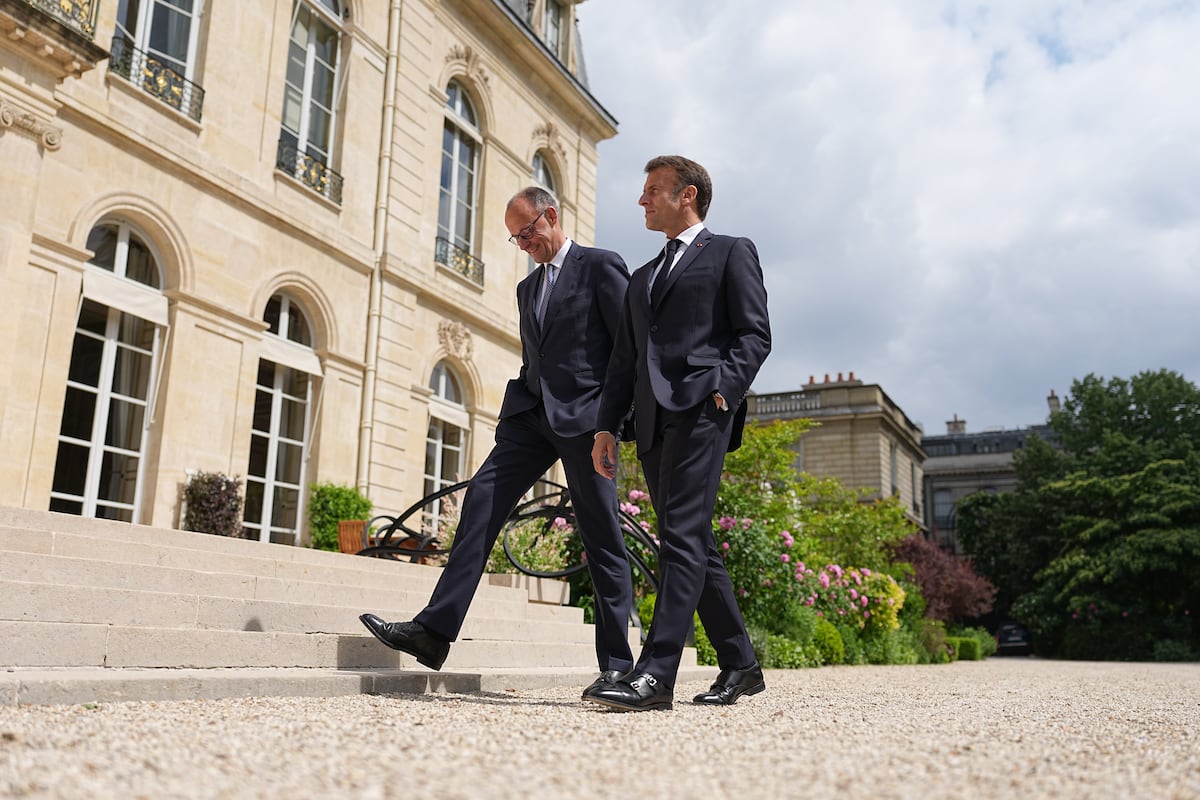
PARIS — German Chancellor Friedrich Merz traveled to Paris on his first foreign trip as head of government to meet with French President Emmanuel Macron, with the two leaders promising closer defense ties and a reboot of the French-German alliance that has been a driver of European cooperation.
The two countries will accelerate French-German programs to develop capacities that go beyond current programs for next-generation tanks , fighter jets and long-range missiles , Macron said at a press conference here on Wednesday, without providing details.
The countries will also establish a Franco-German defense and security council that will meet regularly to provide “operational responses to our common strategic challenges,” Macron said.
“In the future, we want to use this council to coordinate our support for Ukraine even better, to coordinate our national defense planning and procurement projects even more closely, and to provide new answers to strategic questions of security and defense policy,” Merz said.
Macron said the first responsibility of France and Germany is security in Europe, “and this requires above all our resolute support for Ukraine in the face of Russian aggression.” The countries must continue to respond to Russia’s systemic threat to European security by upping defense investment, the French president said.
Merz called for further increased defense spending in all European Union member states.
“This is the only way we can gradually close our military capability gaps and continue to provide comprehensive support to Ukraine,” he said.
Macron said France and Germany will have to enact the plan by the European Commission to fund priority capability needs and “invest heavily in our European defense industrial and technological base.” The countries will coordinate work on updating their national strategic reviews and share analyses, according to Macron.
“Finally, we will establish a Franco-German defense innovation program to enable the breakthrough innovations needed for tomorrow’s warfare,” Macron said.
Merz said he and Macron agreed on an “a Franco-German new start for Europe,” giving new impetus to the French-German friendship and deepening cooperation at all levels. “Europe must become more competitive, and to do so, it must become more united,” Merz said.
France and Germany will further develop format such as the E3 informal security conoperation with the U.K., as well as the Weimar Triangle alliance with Poland, according to the chancellor.
“We will take joint measures to further expand Europe’s security and defense capabilities and to further strengthen the European pillar within NATO,” Merz said. “This also includes bilateral defense cooperation, which we will deepen and accelerate, as well as cooperation with our European partners.”
Macron said strengthening the European pillar of NATO doesn’t call into question the historical alliances, but is about Europeans assuming more responsibility for themselves.
“In this context, it is entirely natural that all issues should be discussed, including that of nuclear deterrence, with our histories, our specific characteristics and, in France’s case, our status as a state with independent and autonomous capabilities and different components,” Macron said.
Merz said there’s a fundamental need to discuss with France and the U.K. “how we can continue to provide such a deterrent response together in the future,” adding that would be “expressly” intended as a supplement to agreements with the U.S. on nuclear deterrence within NATO.
French and German government leaders, foreign ministers and defense ministers will discuss the nuclear deterrent and other issues in coming weeks and months, according to Merz.
“This is first and foremost a discussion that we will hold together because we want to know what we can do together to strengthen our defense efforts,” the chancellor said, again emphasizing the goal is “expressly not a substitute for the nuclear guarantee” provided by the United States.
The French president said France and Germany will continue to work with the U.S. and willing nations on a ceasefire in Ukraine and to create conditions for just and lasting peace “based on robust security guarantees.” France is “coordinating very closely” with Merz and his teams on the issue, Macron said.
Merz said he‘s planning to visit Ukraine in the coming weeks, with discussions on the details of the visit currently taking place.
The chancellor said that until a lasting ceasefire and an agreement can be reached, the countries can’t provide information on the scope of the security guarantees for Ukraine, “because we simply do not yet know the conditions.”
He said the war in Ukraine cannot be ended without further political and military engagement by the United States.
“We are prepared to do our part on the European side,” Merz said. “But we also know that we still need the Americans. We want the Americans to stay on board, to continue to fulfill their responsibilities within NATO, but also toward Ukraine.”
Macron said he approves of Merz’s desire to recreate “strategic ambiguity” regarding aid provided to Ukraine, including Taurus missiles.
“We would be crazy to give out categories of weapons, delivery dates, and models at every press conference, because the Russian army may be listening to the answers to your questions and sometimes to your questions as well,” Macron said.
Merz, who had floated the idea of giving Taurus long-range cruise missiles to Ukraine in past months, was noncommittal on the issue in his first German TV interview as chancellor on Tuesday, the day he was sworn in.
Asked about prospective Taurus deliveries, he said only that Ukraine would be able to rely on him and Germany. His predecessor, Olaf Scholz believed giving Taurus to Ukraine would be impossible as a stand-alone weapon, pulling German military-support elements into the fight directly.
Macron and Merz published a joint op-ed in conservative-leaning French daily Le Figaro on their plan to reboot French-German cooperation, with a goal of making Europe more sovereign and to promote its interests.
As European countries spend on their defense capabilities, France and Germany will promote a European preference, the leaders said. Europe has to reduce its strategic dependencies as well as the number of defense systems, creating standardization and interoperability, according the president and the chancellor.
Rudy Ruitenberg is a Europe correspondent for Defense News. He started his career at Bloomberg News and has experience reporting on technology, commodity markets and politics.
巴黎——德国总理弗里德里希·默茨作为政府首脑首次出访巴黎,与法国总统埃马纽埃尔·马克龙会面。两位领导人承诺加强防务关系,并重启法德联盟,该联盟一直是欧洲合作的驱动力。
马克龙周三在新闻发布会上表示,两国将加快法德合作项目,以发展超越当前下一代坦克、战斗机和远程导弹项目的能力,但他没有提供细节。
马克龙表示,两国还将成立法德防务安全委员会,定期举行会议,以“应对我们共同的战略挑战”。
梅尔茨表示:“未来,我们希望利用这个委员会更好地协调我们对乌克兰的支持,更紧密地协调我们的国防规划和采购项目,并为安全和国防政策的战略问题提供新的答案。”
马克龙表示,法国和德国的首要责任是维护欧洲安全,“这首先要求我们坚决支持乌克兰,对抗俄罗斯的侵略。”这位法国总统还表示,两国必须继续加大国防投入,以应对俄罗斯对欧洲安全的系统性威胁。
默茨呼吁欧盟所有成员国进一步增加国防开支。
他说:“这是我们逐步缩小军事能力差距并继续向乌克兰提供全面支持的唯一途径。”
马克龙表示,法国和德国必须落实欧盟委员会的计划,为优先能力需求提供资金,并“大力投资欧洲国防工业和技术基础”。马克龙还表示,两国将协调更新各自的国家战略评估,并分享分析结果。
“最后,我们将建立一个法德国防创新计划,以实现未来战争所需的突破性创新,”马克龙说。
梅尔茨表示,他和马克龙就“法德携手开启欧洲新篇章”达成共识,这将为法德友谊注入新的活力,并深化各层面的合作。梅尔茨说:“欧洲必须变得更具竞争力,而要做到这一点,欧洲必须更加团结。”
据总理称,法国和德国将进一步发展与英国的E3非正式安全合作模式,以及与波兰的魏玛三角联盟等合作模式。
梅尔茨表示:“我们将采取联合措施,进一步提升欧洲的安全和防务能力,并进一步加强北约内部的欧洲支柱。这其中也包括我们将深化和加快的双边防务合作,以及与欧洲伙伴的合作。”
马克龙表示,加强北约的欧洲支柱并非质疑历史上的联盟,而是欧洲人要承担更多自身责任。
“在这种背景下,所有问题都应该进行讨论,包括核威慑问题,这完全是自然而然的,这其中既要考虑我们的历史,也要考虑我们的具体特点,就法国而言,还要考虑我们作为一个拥有独立自主能力和不同组成部分的国家的地位,”马克龙说。
梅尔茨表示,有必要与法国和英国讨论“未来如何继续共同提供这种威慑反应”,并补充说,这将“明确”作为对北约内部与美国达成的核威慑协议的补充。
据梅尔茨称,法国和德国政府领导人、外交部长和国防部长将在未来几周和几个月内讨论核威慑和其他问题。
“首先,我们将共同进行这次讨论,因为我们想知道我们可以共同做些什么来加强我们的国防努力,”总理说道,并再次强调,这一目标“绝非取代美国提供的核保证”。
法国总统表示,法国和德国将继续与美国及其他有意愿的国家合作,推动乌克兰停火,并“在强有力的安全保障基础上”创造公正持久和平的条件。马克龙说,法国正就此问题与默茨及其团队“密切协调”。
梅尔茨表示,他计划在未来几周内访问乌克兰,目前正在讨论访问的细节。
总理表示,在达成持久停火和协议之前,各国无法提供有关乌克兰安全保障范围的信息,“因为我们根本还不知道具体情况”。
他表示,如果没有美国进一步的政治和军事介入,乌克兰战争就无法结束。
梅尔茨说:“我们准备在欧洲方面尽我们的一份力。但我们也知道,我们仍然需要美国。我们希望美国继续参与,继续履行其在北约内部以及对乌克兰的责任。”
马克龙表示,他赞同默茨希望在向乌克兰提供的援助(包括金牛座导弹)方面重新营造“战略模糊性”。
马克龙说:“如果我们每次新闻发布会都公布武器种类、交付日期和型号,那就太疯狂了,因为俄罗斯军方可能正在监听你们问题的答案,有时甚至也会监听你们的问题。”
在过去的几个月里,默茨曾提出向乌克兰提供金牛座远程巡航导弹的想法。但在周二,也就是他宣誓就职当天,作为德国总理的默茨首次接受德国电视采访时,他对这个问题没有明确表态。
当被问及未来是否会交付“金牛座”导弹时,他只表示乌克兰可以依靠他和德国。他的前任奥拉夫·朔尔茨则认为,单独向乌克兰提供“金牛座”导弹是不可能的,因为这会将德国的军事支援力量直接卷入战斗。
马克龙和梅尔茨在倾向保守派的法国日报《费加罗报》上联合发表了一篇评论文章,阐述了他们重启法德合作的计划,目标是让欧洲更加自主,并促进欧洲的利益。
两国领导人表示,随着欧洲各国加大国防投入,法德两国将倡导欧洲优先战略。他们指出,欧洲必须减少战略依赖和国防系统数量,实现标准化和互操作性。
鲁迪·鲁伊滕贝格是《防务新闻》的欧洲记者。他的职业生涯始于彭博新闻社,拥有报道科技、大宗商品市场和政治方面的经验。