Where Are The Aircraft Carriers?: October 17, 2026航空母舰在哪里?:2026年10月17日
USS Theodore Roosevelt arrives in Japan ahead of exercise Keen Sword, while the U.S. once again positions two aircraft carriers in the Middle East.
新闻视频
Published Oct 17, 2026 2:35 PM EDT
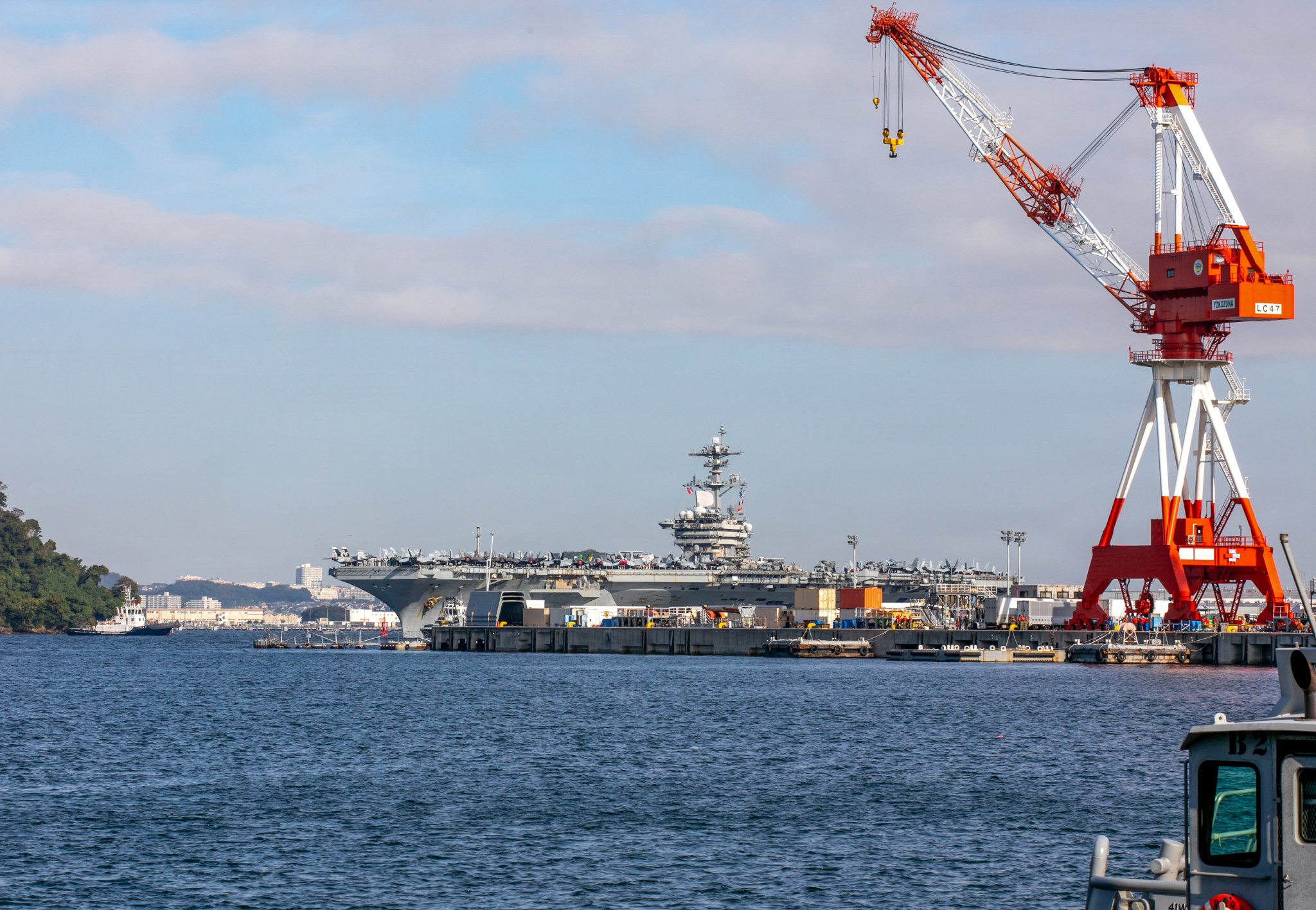
With a flight deck packed with carrier-based aircraft, including stealthy fifth-generation F-35Cs, the USS Theodore Roosevelt pulled into Yokosuka, Japan, on Friday. Roosevelt is the first non-resident U.S. carrier to visit the key naval port, strategically located on the east side of Japan, in more than four years. Yokosuka is home to USS George Washington and America’s only forward-based carrier strike group.
The Roosevelt , which serves as the flagship of Carrier Strike Group (CSG) 9, escorted by guided-missile cruiser USS Chosin and destroyer USS Decatur , completed the journey from San Diego in 19 days − maneuvering around a typhoon in the Western Pacific − and will participate in the upcoming combined exercise Keen Sword 27. Meanwhile, the USS George H.W. Bush departed Thailand after a five-day port call and returned to the Middle East, and the USS Abraham Lincoln arrived home after a nearly eleven-month combat deployment.
Here’s TWZ’s weekly carrier tracker monitoring America’s flattop fleet, including deployed CSGs and Amphibious Ready Groups (ARGs), using publicly available open-source information. Check out last week’s report here .
Theodore Roosevelt Docks In Yokosuka, Japan; First Visiting Carrier In Four Years
Roosevelt and Chosin chopped into the U.S. 7th Fleet-Pacific Command (PACOM) area of responsibility (AOR) and arrived at Commander, Fleet Activities Yokosuka on the morning of October 16. The CSG will spend a few days in port before beginning participation in exercise Keen Sword, a “premier joint-bilateral field training exercise designed to increase readiness and interoperability between the Japan Self-Defense Forces and U.S. military forces,” according to the 7th Fleet press release . The brief visit allows the crew to complete maintenance, resupply, and disembark for liberty before resuming routine operations.
“Our crew is honored to visit Yokosuka and experience the rich culture and hospitality of Japan,” the commanding officer of Roosevelt , Capt. Will Mathis, said in the release. “Port visits like this are vital for crew morale and mission readiness, allowing our Sailors to rest, recharge, and prepare to operate seamlessly alongside our allies during exercise Keen Sword.”
Roosevelt arrives in Yokosuka, Japan. U.S. Navy photo
Roosevelt moors at Commander, Fleet Activities Yokosuka. U.S. Navy photo
The five-ship CSG, the composition of which a Navy official confirmed to TWZ , is currently operating on a disaggregated basis − a common practice employed by strike groups with multiple ongoing missions. The duo that departed the U.S. at the end of September linked up with another element of the group, Pearl Harbor-based guided missile destroyer USS Decatur , as they were steaming westbound past the Hawaiian Islands, based on public Automatic Identification System (AIS) data. Decatur arrived in Yokosuka the day after Roosevelt but was not mentioned in the press release.
USS Carl M. Levin , also stationed in Hawaii, was the first ship from the group to deploy, according to DVIDS, the military’s content-sharing platform. Levin departed on September 9 and is operating at an undisclosed location. USS Paul Hamilton , the final ship assigned to CSG 9 to deploy, left San Diego on October 10 after onloading ammo at Bravo Pier and moored at Joint Base Pearl Harbor-Hickam on October 15, AIS data shows. Henry J. Kaiser class fleet replenishment oiler USNS Tippecanoe supported the group’s transit across the Pacific, conducting multiple replenishments-at-sea (RAS), and recently entered the East Sea/Sea of Japan via the Tsugaru Strait before going dark on AIS.
Chosin alongside Roosevelt. Navy photo
Decatur and Roosevelt at RIMPAC. Navy photo
Tippecanoe conducts a RAS. Navy photo
Multiple reports indicated that medium unmanned surface vessel (MUSV) Seahawk (2) deployed with the group, which would represent a significant operational achievement and the first time a drone boat was assigned to a CSG, but the MUSV quietly slipped out of Point Loma on October 8, more than ten days after Roosevelt . Seahawk reappeared on AIS and docked in Hawaii for a couple days before continuing its journey westbound in the Pacific on October 16. If Seahawk is assigned to CSG 9, it is currently disaggregated, and whether it will join Roosevelt to participate in exercise Keen Sword 27 is unknown.
Acting Secretary of the Navy Hung Cao seemingly confirmed the deployment, saying during a panel at the Association of the United States Army (AUSA) convention that “the Teddy Roosevelt carrier strike group just deployed on October 8 with a medium sized unmanned surface vessel. This is the first carrier strike group to ever deploy with a large size unmanned surface vessel.” However, Roosevelt was more than halfway to Japan on the date referenced. “This is a force multiplier, imagine having more guns out there,” he added.
MUSV Seahawk leaving Point Loma in August. U.S. Navy photo
Seahawk’s transit out of San Diego. Source: MarineTraffic/KPLER
TWZ reached out to the Secretary’s office for clarification and to confirm the deployment but did not receive a response. “ Seahawk’s operations represent continued progress in the Navy’s efforts to integrate unmanned systems into Fleet operations. As with any emerging capability, we continue to learn, adapt, and refine how these systems are employed,” a Navy official told us.
Abraham Lincoln’s Homecoming
Surrounded by small boats, with hundreds of spectators lining the channel in San Diego Bay and thousands more watching online, the USS Abraham Lincoln arrived home from a historic ten-and-a-half-month combat deployment. The flagship of CSG 3 and her crew of more than 5,000 Sailors and Marines served as the tip of the spear in the war against the Iranian regime, first during Operation Epic Fury and then the subsequent blockades , and set a new record for the most consecutive days at sea without a port call.
USS Abraham Lincoln pulls into San Diego Bay. U.S. Navy photo
Lincoln pulled into Naval Air Station North Island and moored at Berth Lima on October 8, 321 days after casting off on November 21, 2025. Sailors in dress whites manned the rails as the carrier transited the bay, escorted on both sides by small boats and jet skis flying American flags, while family and friends eagerly waited pierside for their return. The video below, shared by the Pentagon, captures the moment.
Family and friends welcome the crew of the USS Abraham Lincoln home. Pentagon video.
Lincoln now lays claim to the second-longest deployment in the modern carrier era, falling just five days short of the 326-day post-Vietnam record held by the USS Gerald R. Ford . The flattop traveled over 93,000 nautical miles during the cruise − more than four trips around the Earth, a post by the public affairs officer highlighted − and conducted 72 replenishments-at-sea, received 20-plus million gallons of aviation fuel, and flew more than 14,000 sorties that totaled 28,500 flight hours, a press release from the Navy highlighted.
The release confirmed for the first time that Lincoln broke the previous record of 206 days set by USS Dwight D. Eisenhower during the COVID pandemic for days spent underway between port visits, as TWZ first reported . “The ship’s 208 uninterrupted days at sea between Guam and Oman, and its 286 consecutive days at sea between departing San Diego and arriving in Thailand, are record-breaking marks for modern aircraft carriers.”
Lincoln’s cruise took her through both U.S. 7th Fleet and U.S. 5th Fleet AORs. During Operation Epic Fury, which began on February 28 and lasted almost 40 days, Lincoln took up station in the northern Arabian Sea as Commander, Task Force (CTF) 50 and pressured Iran’s southern flank. When major combat operations wound down, the carrier and her air wing patrolled and enforced the blockade line during both rounds that followed.
Carrier Air Wing (CVW) 9, the “Navy’s premier next-generation air wing that served as the primary offensive power” for CSG 3, flew 14,037 sorties − including 4,000 combat missions − and dropped more than 1.37 million pounds of ordnance on thousands of targets while employing 1,499 precision weapons. “This concentrated firepower significantly degraded Iranian Navy capabilities,” a separate statement noted.
“The rapid mobilization and combat execution of CVW-9 during Operation Epic Fury demonstrated the unmatched flexibility of a U.S. Navy carrier strike group,” Capt. J.W. Stigi, commander of CVW-9, said in the statement. “Pairing fifth-generation F-35C stealth and sensor fusion with fourth-generation workhorse strike and electronic attack platforms, Team Shogun destroyed Iran’s conventional Navy and secured vital maritime chokepoints in support of our commander’s objectives.”
Kill marks painted on the island superstructure show CSG 3 destroyed 106 one-way attack drones fired by the Islamic Revolutionary Guard Corps (IRGC), 34 Iranian Navy and IRGC ships, 23 inbound cruise missiles, and 10 enemy submarines. The strike group dropped 1,463 air-to-ground munitions in total, a Sailor explaining the marks said in a video on social media.
George H.W. Bush Leaves Thailand And Returns To The Middle East
The USS George H.W. Bush and her destroyer escort, USS Delbert D. Black , departed Phuket, Thailand, on October 9 after a five-day liberty visit. “Nearly 5,000 Sailors from across the strike group experienced the sights and sounds Thailand has to offer, deepening their understanding of the Thai people and strengthening interpersonal bonds,” according to a press release .
George H.W. Bush departs Phuket, Thailand, on October 9, 2026. U.S. Navy photo
“The Sailors and I had an amazing time in this beautiful country, and I sincerely thank the people of Thailand for their incredible welcome,” Capt. Justin T. Issler, the commanding officer of George H.W. Bush, said about the stop. “This port visit to Phuket was a tremendous opportunity for the crew. We are grateful to our Thai allies for hosting us, and we look forward to continuing our mission here in 7th Fleet, alongside Thailand and our other regional allies and partners.”
USS George H.W. Bush arrives in Thailand. U.S. Navy photo
USS George H.W. Bush anchors in Phuket. U.S. Navy photo
Bush dropped anchor approximately two nautical miles south of Ao Makham Deep Sea Port on October 4 after 187 consecutive days at sea. After leaving Phuket, the carrier stopped broadcasting AIS while steaming due south at 10 knots. Imagery on DVIDS confirms that the CSG returned to the Middle East and operating in the U.S. 5th Fleet AOR to “support maritime security and stability,” joining the George Washington CSG once again as the second strike group in the region.
Destroyer USS Mason , which deployed as the integrated air and missile defense (IAMD) commander for the CSG but has disaggregated at times, arrived in Singapore on October 5, likely for a port call. The Arleigh Burke class destroyer departed on October 9 and was last tracked heading northwestbound in the Malacca Strait, likely to rejoin the CSG. The other two destroyers assigned to the CSG, USS Ross and USS Donald Cook , remained in 5th Fleet during the visit.
F-35C Lightning II Operates from A Ford Class Carrier For The First Time
Marking a major milestone, an F-35C Lightning II Joint Strike Fighter made the first arrested landing aboard a Gerald R. Ford class carrier, the Navy’s newest and most advanced class of aircraft carriers that are being built to replace the aging Nimitz fleet. The trap was made by Lt. Cmdr. Robert Mason with the “Salty Dogs” of Air Test and Evaluation Squadron (VX) 23 aboard the future USS John F. Kennedy in the Western Atlantic on October 13. The first catapult launch followed the next day, pictures on DVIDS showed.
F-35Cs approach for first landing aboard PCU John F. Kennedy. U.S. Navy video
VX-23, based out of Naval Air Station Patuxent River in Maryland, is part of the Naval Air Warfare Center Aircraft Division and was putting Kennedy through the ongoing Aircraft Compatibility Testing to assess the “operational capabilities of the ship’s aircraft launch and recovery equipment.” A team from the Patuxent River-based F-35 Integrated Test Force, detached to the ship, conducted the evaluation using a specially instrumented example of the jet. One of the two pictured was externally equipped with an inert Joint Direct Attack Munition (JDAM) bomb.
VX-23 F-35Cs flying over and on the flight deck of PCU John F. Kennedy. U.S. Navy photos
The Navy took preliminary acceptance of Kennedy , which is still considered a Pre-Commissioning Unit, on September 29. This process allows the service to conduct at-sea testing and build underway proficiency while the shipbuilder, Huntington Ingalls Industries, completes final system checks ahead of expected delivery in spring 2027. Kennedy got underway on October 13 and returned to her homeport of Naval Station Norfolk three days later.
The lead ship of the class, the USS Gerald R. Ford , does not currently embark F-35Cs and will need upgrades to field the Navy’s most advanced jet. Back in 2019, TWZ warned that the stealth jet wouldn’t fly from the troubled class for years. Because of this, Congress required that Kennedy be equipped to embark F-35Cs, which led to additional delays for the Navy’s next carrier.
Big Deck Fleet At A Glance
Overall, three U.S. carriers are deployed, three are working up in various states of readiness, three are in maintenance availabilities, one is post-deployment, one is being used primarily for training before deactivation next year, and another will be delivered in 2027. Two amphibious ready groups are deployed, one is forward-deployed, three are working up or in port, and three are in maintenance.
Note: Positions are general approximations. Non-deployed LHA/LHD amphibious warships are not shown.
Contact the author: ian@twz.com or @ianellisjones
Comments couldn’t be loaded. Please refresh the page.
发布于美国东部时间2026年10月17日下午2:35
周五,满载舰载机(包括隐形第五代F-35C战斗机)的“西奥多·罗斯福”号航空母舰驶入日本横须贺港。这是四年多来首艘访问这座位于日本东部战略要地的美国非驻港航母。横须贺港也是“乔治·华盛顿”号航空母舰和美国唯一前沿部署航母打击群的母港。
作为第9航母打击群(CSG 9)旗舰的“罗斯福”号航母,在导弹巡洋舰“乔辛”号和驱逐舰“迪凯特”号的护航下,历时19天完成了从圣地亚哥出发的航程——期间绕过了西太平洋的台风——并将参加即将举行的“利剑27”联合演习。与此同时,“乔治·H·W·布什”号航空母舰在泰国进行了为期五天的港口访问后离开,返回中东;“亚伯拉罕·林肯”号航空母舰在完成了近11个月的作战部署后返回母港。
以下是TWZ每周发布的航母追踪报告,监测美国航母舰队,包括已部署的航母打击群和两栖戒备群,数据来源于公开的开源信息。点击此处查看上周报告。
“西奥多·罗斯福”号航母停靠日本横须贺港;四年来首艘到访的航母
“罗斯福”号和“长津”号航母进入美国第七舰队太平洋司令部责任区,于10月16日上午抵达横须贺舰队基地。根据第七舰队新闻稿,“罗斯福”号航母战斗群将在港口停留数日,之后将参加“利剑”联合军演。“利剑”是“旨在提升日本自卫队和美国军队战备水平和协同作战能力的顶级双边联合实战训练演习”。此次短暂访问期间,舰员将完成维护、补给,并在返回基地执行日常任务前下船休假。
“我们全体官兵很荣幸能够访问横须贺,体验日本丰富的文化和热情好客,”罗斯福号航母舰长威尔·马蒂斯上校在新闻稿中表示。“像这样的港口访问对于提升官兵士气和任务准备至关重要,它能让我们的水兵得到休息、恢复精力,并为在‘利剑’联合演习中与盟友无缝协作做好准备。”
罗斯福抵达日本横须贺。美国海军照片
罗斯福号停泊在横须贺舰队活动司令部。美国海军照片
据海军官员向TWZ证实,这支由五艘舰艇组成的航母打击群目前正以分散部署的方式行动——这是执行多项任务的打击群的常用做法。根据公开的自动识别系统(AIS)数据,9月底离开美国的两艘舰艇在驶过夏威夷群岛西行时,与该打击群的另一艘舰艇——驻扎在珍珠港的导弹驱逐舰“迪凯特”号会合。“迪凯特”号在“罗斯福”号抵达横须贺的第二天抵达,但新闻稿中并未提及。
根据军方内容共享平台DVIDS的数据,驻扎在夏威夷的“卡尔·M·莱文”号驱逐舰是该航母战斗群中首艘部署的舰艇。“莱文”号于9月9日启航,目前在未公开的地点执行任务。“保罗·汉密尔顿”号驱逐舰是第9航母战斗群最后一艘部署的舰艇,根据AIS数据显示,该舰于10月10日在圣地亚哥布拉沃码头装载弹药后离开圣地亚哥,并于10月15日停靠在珍珠港-希卡姆联合基地。“亨利·J·凯泽”级舰队补给油船“蒂珀卡努”号为该航母战斗群的太平洋航行提供了支持,进行了多次海上补给作业,并于近期经津轻海峡进入东海/日本海,之后在AIS上停止了通信。
长津湖畔罗斯福。海军照片
迪凯特号和罗斯福号在环太平洋军演中。海军照片
蒂珀卡努号进行 RAS 作业。海军照片
多份报告显示,中型无人水面舰艇(MUSV)“海鹰”(2)号已随该编队部署,这将代表一项重大的作战成就,也是无人艇首次被分配到航母打击群(CSG)。然而,这艘MUSV在“罗斯福”号航母部署十多天后,于10月8日悄然离开洛马角。“海鹰”号随后在AIS上重新出现,并在夏威夷停靠数日,之后于10月16日继续向西驶入太平洋。如果“海鹰”号确实被分配到第9航母打击群(CSG 9),那么它目前处于分散状态,是否会与“罗斯福”号一同参加“利剑27”演习尚不得而知。
美国海军代理部长洪曹似乎证实了此次部署。他在美国陆军协会(AUSA)年会的一个小组讨论会上表示:“‘罗斯福’号航母打击群于10月8日部署了一艘中型无人水面舰艇。这是航母打击群首次部署大型无人水面舰艇。” 然而,在洪曹提及的日期,罗斯福号航母已经航行了超过一半的航程到达日本。“这是一种力量倍增器,想象一下,如果有更多的火炮部署在海上会是什么效果,”他补充道。
8月,MUSV“海鹰”号离开洛马角。美国海军照片
海鹰号从圣地亚哥起飞。来源:MarineTraffic/KPLER
TWZ联系了海军部长办公室,希望澄清并确认此次部署,但未收到回复。一位海军官员告诉我们:“海鹰无人机的行动代表着海军在将无人系统融入舰队作战方面取得的持续进展。与任何新兴能力一样,我们将继续学习、调整和改进这些系统的运用方式。”
亚伯拉罕·林肯的返乡
在圣地亚哥湾航道两旁数百名观众和数千名在线观众的簇拥下,美国海军“亚伯拉罕·林肯”号航空母舰结束了长达十个半月的历史性作战部署,凯旋归来。作为第三航母打击群的旗舰,这艘航母及其五千多名水兵和海军陆战队员在对伊朗政权的战争中扮演了先锋角色,先是在“史诗狂怒行动”中,随后又参与了对伊朗的封锁行动,并创造了连续海上航行时间最长且未靠港的新纪录。
“亚伯拉罕·林肯”号航空母舰驶入圣地亚哥湾。(美国海军照片)
2025年11月21日启航321天后,林肯号于10月8日驶入北岛海军航空站,停靠在利马泊位。身着白色制服的水兵在航母驶过海湾时列队守卫,两侧是悬挂着美国国旗的小艇和水上摩托艇护航,家人和朋友在码头上翘首期盼着他们的归来。以下视频由五角大楼分享,记录了这一时刻。
家人和朋友迎接“亚伯拉罕·林肯”号航空母舰的官兵凯旋。五角大楼视频。
“林肯”号航母目前保持着现代航母时代第二长的部署纪录,仅比“杰拉尔德·R·福特”号航母在越战后保持的326天纪录少了5天。据公共事务官员发布的消息,这艘航母在巡航期间航行了超过93000海里——相当于绕地球四圈多——并进行了72次海上补给,补充了超过2000万加仑的航空燃油,执行了超过14000架次的飞行任务,总飞行时间达28500小时。海军的新闻稿也强调了这一点。
此次发布的消息首次证实,“林肯”号航母打破了此前由“艾森豪威尔”号航母在新冠疫情期间创下的206天的海上航行纪录,该纪录是现代航母在两次港口访问之间连续航行天数最长的一次,正如TWZ网站此前报道的那样。“该舰在关岛和阿曼之间连续航行208天,以及从圣地亚哥出发到抵达泰国之间连续航行286天,均创下了现代航母的航行纪录。”
林肯号航母的巡航路线途经美国第七舰队和第五舰队的责任区。在2月28日开始、持续近40天的“史诗狂怒行动”期间,林肯号作为第50特遣部队(CTF 50)的指挥官,在阿拉伯海北部部署,并对伊朗南部侧翼施加压力。主要作战行动结束后,该航母及其舰载机联队在随后的两轮行动中巡逻并执行了封锁线任务。
第9舰载航空联队(CVW 9)是“海军首屈一指的新一代航空联队,也是第3航母战斗群的主要进攻力量”,共执行了14037架次飞行任务,其中包括4000次作战任务,并使用1499枚精确制导武器,向数千个目标投掷了超过137万磅的弹药。“这种集中火力显著削弱了伊朗海军的能力,”另一份声明指出。
“在‘史诗狂怒’行动中,CVW-9航母打击群的快速动员和作战执行展现了美国海军航母打击群无与伦比的灵活性,”CVW-9指挥官JW·斯蒂吉上校在声明中表示。“‘将军’团队将第五代F-35C隐形战机和传感器融合技术与第四代主力打击和电子攻击平台相结合,摧毁了伊朗常规海军,并夺取了关键的海上咽喉要道,从而支持了指挥官的目标。”
舰岛上层建筑上绘制的击杀标记显示,第3战斗群摧毁了106架伊朗伊斯兰革命卫队(IRGC)发射的单向攻击无人机、34艘伊朗海军和革命卫队舰艇、23枚来袭巡航导弹以及10艘敌方潜艇。一名水兵在社交媒体上发布的视频中解释这些标记时说,该打击群共投掷了1463枚空对地弹药。
老布什离开泰国,返回中东。
“乔治·H·W·布什”号航空母舰及其护航驱逐舰“德尔伯特·D·布莱克”号于10月9日结束为期五天的休假访问,离开泰国普吉岛。新闻稿称:“来自打击群的近5000名水兵体验了泰国的风土人情,加深了对泰国人民的了解,并加强了彼此之间的联系。”
2026年10月9日,乔治·H·W·布什离开泰国普吉岛。(美国海军照片)
“我和水兵们在这个美丽的国家度过了美好的时光,我衷心感谢泰国人民的热情款待,”乔治·H·W·布什号航母舰长贾斯汀·T·伊斯勒上校在谈到此次停靠时说道。“此次普吉岛港口访问对全体舰员来说是一次绝佳的机会。我们感谢泰国盟友的热情接待,并期待继续在第七舰队执行任务,与泰国以及其他地区盟友和伙伴并肩作战。”
“乔治·H·W·布什”号航空母舰抵达泰国。(美国海军照片)
“乔治·H·W·布什”号航空母舰停泊在普吉岛。美国海军照片
10月4日,在连续航行187天后,“布什”号航母在阿奥马克汉深水港以南约两海里处抛锚。离开普吉岛后,该航母以10节航速向正南航行,并停止了AIS广播。DVIDS上的图像证实,该航母打击群已返回中东,并在美国第五舰队责任区内执行任务,以“维护海上安全与稳定”,再次与“乔治·华盛顿”号航母打击群会合,成为该地区的第二个打击群。
驱逐舰“梅森”号(USS Mason)作为航母打击群(CSG)的综合防空反导(IAMD)指挥舰部署,但有时会脱离该打击群执行任务。该舰于10月5日抵达新加坡,很可能是进行港口访问。这艘阿利·伯克级驱逐舰于10月9日离开新加坡,最后一次被追踪到是在马六甲海峡向西北方向航行,很可能是重新加入航母打击群。另外两艘隶属于航母打击群的驱逐舰“罗斯”号(USS Ross)和“唐纳德·库克”号(USS Donald Cook)在访问期间留在第五舰队。
F-35C“闪电II”战斗机首次从福特级航母上起飞
一架F-35C“闪电II”联合攻击战斗机完成了首次在“杰拉尔德·R·福特”级航母上的拦阻着陆,这标志着一个重要的里程碑。“杰拉尔德·R·福特”级航母是美国海军最新、最先进的航母,正在建造中以取代老旧的“尼米兹”级航母舰队。此次拦阻着陆由隶属于第23空中测试与评估中队(VX-23)“咸狗”中队的罗伯特·梅森中校于10月13日在西大西洋的“约翰·F·肯尼迪”号航母上完成。DVIDS网站上的图片显示,第二天就进行了首次弹射起飞。
F-35C战机接近约翰·F·肯尼迪号货轮进行首次着陆。美国海军视频
驻扎在马里兰州帕图克森特河海军航空站的VX-23中队隶属于海军航空作战中心飞机部,当时正在对“肯尼迪”号航母进行持续的飞机兼容性测试,以评估“舰载机起降设备的作战能力”。一支来自帕图克森特河海军航空站的F-35综合测试部队的团队被派往该舰,使用一架经过特殊改装的F-35战机进行评估。图中两架战机中的一架外部挂载了一枚惰性联合直接攻击弹药(JDAM)炸弹。
VX-23中队的F-35C战斗机飞越“约翰·F·肯尼迪”号巡洋舰的飞行甲板。美国海军照片
海军于9月29日对“肯尼迪”号进行了初步验收,该舰目前仍被视为预备役舰艇。这一程序允许海军进行海上测试并提升航行能力,同时造船商亨廷顿·英格尔斯工业公司完成最终系统检查,预计将于2027年春季交付。“肯尼迪”号于10月13日下水,三天后返回其母港诺福克海军基地。
该级航母的首舰“杰拉尔德·R·福特”号目前无法搭载F-35C战机,需要进行升级才能部署海军最先进的战机。早在2019年,TWZ就曾警告称,这款隐形战机在未来几年内都无法从这艘问题重重的航母上起飞。正因如此,国会要求“肯尼迪”号航母具备搭载F-35C战机的能力,这也导致海军下一艘航母的建造计划进一步延期。
大型甲板舰队概览
总体而言,美国目前部署了三艘航母,三艘正在进行不同程度的战备训练,三艘正在进行维护保养,一艘已完成部署,一艘主要用于训练,将于明年退役,另一艘将于2027年交付。此外,美国还部署了两个两栖戒备群,一个已前沿部署,三个正在进行训练或在港口,三个正在进行维护保养。
注:位置均为大致估计。未部署的LHA/LHD两栖攻击舰未显示。
联系作者:ian@twz.com 或 @ianellisjones
评论加载失败,请刷新页面。