Take A Rare Look Inside Russia’s Doomsday Ballistic Missile Warning System罕见一窥俄罗斯末日弹道导弹预警系统内部运作
As Russia’s early warning network marks 50 years of service, one of its satellite control centers opened its doors.
新闻视频
Updated Feb 16, 2021 2:24 PM EST
The Russian Ministry of Defense posted a video to its various social media channels yesterday showing some of the inside workings of one of the country’s early warning facilities that watch for incoming ballistic missiles. The video appears to show the Serpukhov-15 satellite control center in Kaluga Oblast, around 90 miles southwest of Moscow, which was at the center of one of the Cold War’s most hair-raising incidents.
The video was posted online as Russia’s early warning network, designed to protect against ballistic missile attacks , celebrated its 50th anniversary. The organization that operates these systems, commonly referred to by its Russian acronym SPRN, marked the occasion in an appropriate style. The footage shows that it even apparently simulated an incoming intercontinental ballistic missile (ICBM) attack from the United States.
Operators at work within the early warning station, apparently Serpukhov-15., Youtube Screencap
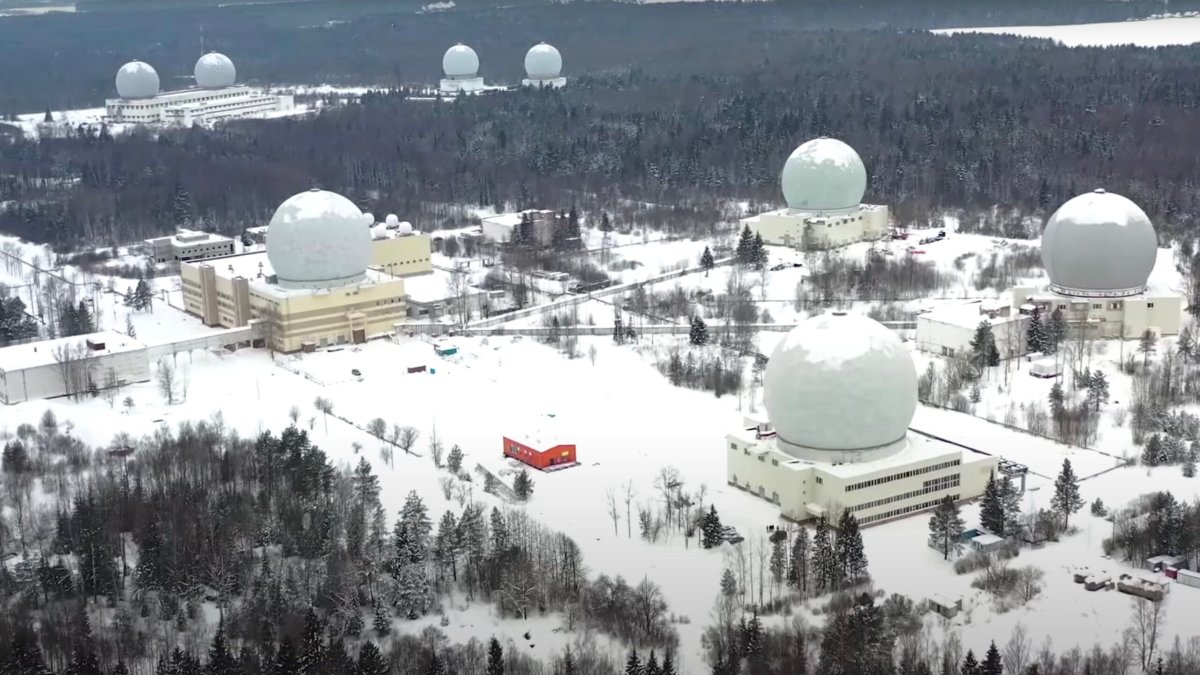
We also see the exterior of the sprawling facility, with its characteristic array of eight antennas under enormous geodesic domes. There is a brief view inside one of these radomes, revealing the rotating antenna itself, used for communication with early warning satellites.
The video in question, seen below, shows critical information flash up onto a screen before the operators within the facility swing into action to start categorizing the object and confirming whether or not the launch is real. This is followed by a clip showing what appears to be an automatically generated map with the projected path of, in this case, the simulated missile as it hurtles toward Russian territory.
According to the analysis of Dmitry Stefanovich, a Research Fellow at the Center for International Security, IMEMO RAS , the simulated attack sequence shown in the footage is based on a single ICBM being launched from the missile fields associated with F. E. Warren Air Force Base in Wyoming. This base is home to the U.S. Air Force’s 90th Missile Wing, which is equipped with LGM-30G Minuteman III ICBMs.
The job of the SPRN is not only to monitor for possible ICBM attacks but could help support a so-called “launch-on-warning” posture, wherein a nuclear retaliatory strike is initiated immediately when a likely threat is detected, rather than waiting for detonation to occur on Russian soil to conclusively confirm a suspect attack is real. There has been a debate over the years about whether or not the Kremlin actually has such a policy in place.
The network would also be used to detect targets that Russia’s A-135 anti-ballistic missile system — known to NATO as the ABM-4 Gorgon — could then attempt to intercept. That system is designed to protect the Russian capital Moscow and its surrounding areas.
The Missile Attack Warning System or Sistema preduprezhdeniya o raketnom napadenii (SPRN) became operational in what was then the Soviet Union on February 15, 1971. At that time, it consisted of a pair of Dnestr-M space surveillance and early warning radars located at Olenegorsk and Skrunda, plus a command post in Solnechnogorsk, located outside Moscow.
As the space portion of the Russian early-warning system, the SPRN is the first echelon of this network, intended to detect the launch of an ICBM, while the second echelon consists of radars for over-the-horizon detection of ballistic missiles once they are on their flight paths. When ICBMs are launched, they create a telltale plume that can be observed by infrared sensors onboard satellites, at an altitude of around 25,000 miles above the surface of the Earth.
A similar system exists in the United States, where Lockheed Martin is building three new missile warning satellites as part of the U.S. Air Force’s Next-Generation Overhead Persistent Infrared program, also called Next-Gen OPIR. This is part of a wider plan for an array of new space-based sensors to help guard against both advanced ballistic missiles and emerging hypersonic threats .
A satellite image of the Serpukhov-15 satellite control center, as seen in the video., GOOGLE EARTH
Once a satellite detects a launch, and its direction, this information is relayed to a ground control center where its reliability is assessed, followed by the automated warning: “Attention. Launch. First echelon.” At the same time, an alert signal is issued to the domestic missile defense system.
“The early warning system was one of the first systems to perform the tasks of detecting possible attacks of ballistic missiles in a fully automatic mode,” the Russian Ministry of Defense explains. “During its years of duty, it went through several stages of modernization. This included more powerful radar stations and a space echelon, including special spacecraft and ground control centers.”
Serpukhov-15 is one of two such centers, with a corresponding eastern satellite control center located near Komsomolsk-on-Amur in the Russian Far East. Between them, they receive information in real-time from early-warning satellites. The data is processed at the two centers and then transmitted to the command center at Solnechnogorsk.
New Oko early-warning satellites began to be launched in 1972 and the initial constellation was commissioned into service in 1982. The last of these satellites was reportedly launched in 2010 and, since 2015, the more capable EKS Kupol satellites have begun to replace them. The Serpukhov-15 site, specifically, has continued to be upgraded, as well.
It’s also interesting to note that Serpukhov-15 was also at the center of an incident in 1983 that apparently almost led to World War III. On September 26 of that year, a serious malfunction led to this satellite control center erroneously alerting officials to a launch of five Minuteman ICBMs in the United States. Lieutenant Colonel Stanislav Petrov , the officer on duty at the time, is credited with discounting the reports — which were not backed up by early warning radar — and preventing a potential nuclear conflict.
Many years later, after the fall of the Soviet Union, another incident saw a fire break out at Serpukhov-15, on May 10, 2001. “The fire destroyed one of the buildings and cables at the Serpukhov-15 control station, which led to a loss of communication with all four satellites in orbit,” according to an account by Pavel Podvig, an independent analyst who runs the Russian Nuclear Forces research project. As a result of the fire, control over all four of the station’s satellites was lost, although the center was back online by August 20 the same year.
The Russian Ministry of Defense announced that the country’s missile attack warning systems detected more than 90 launches of foreign and domestic ballistic missiles and space rockets last year. Since the SPRN was introduced, the system has detected more than 2,000 launches of foreign and domestic ballistic missiles and approximately 1,000 launches of space rockets.
The SPRN may not attract as much attention as the country’s ICBM forces , missile defenses , or anti-satellite systems , but it is a fundamental component of Russia’s strategic defenses. While the arsenals of strategic offensive weapons in Russia and the United States may be greatly reduced compared to their 1983 levels , they are still capable of catastrophic destruction, and infrastructure like Serpukhov-15 will continue to play a vital role in providing early warning of a ballistic missile attack.
Contact the author: thomas@thedrive.com
Comments couldn’t be loaded. Please refresh the page.
更新于美国东部时间2021年2月16日下午2:24
俄罗斯国防部昨日在其多个社交媒体平台上发布了一段视频,展示了该国一处用于监测来袭弹道导弹的早期预警设施的内部运作情况。视频似乎拍摄于位于莫斯科西南约90英里(145公里)的卡卢加州谢尔普霍夫-15卫星控制中心,该中心曾是冷战时期最惊心动魄的事件之一的中心。
这段视频发布于俄罗斯早期预警网络(旨在防御弹道导弹袭击)成立50周年之际。负责运营该系统的机构(通常以其俄语缩写SPRN为人所知)以恰当的方式庆祝了这一盛事。视频显示,该系统甚至模拟了来自美国的洲际弹道导弹(ICBM)来袭。
显然是谢尔普霍夫-15号预警站内的操作员正在工作。(YouTube截图)
我们还能看到这座庞大设施的外观,其标志性的八个天线阵列位于巨大的测地线穹顶之下。镜头短暂地切换到其中一个天线穹顶内部,可以看到用于与预警卫星通信的旋转天线。
下方视频显示,关键信息闪现在屏幕上,随后设施内的操作人员迅速行动,开始对该物体进行分类,并确认发射是否真实。紧接着的片段显示了一张看似自动生成的地图,地图上标出了模拟导弹飞向俄罗斯领土的预计路径。
根据俄罗斯科学院国际安全研究中心(IMEMO RAS)研究员德米特里·斯特凡诺维奇的分析,视频中显示的模拟攻击序列是基于从怀俄明州沃伦空军基地导弹发射场发射一枚洲际弹道导弹。该基地驻扎着美国空军第90导弹联队,该联队装备有LGM-30G“民兵III”型洲际弹道导弹。
俄罗斯战略核研究中心(SPRN)的职责不仅在于监测可能的洲际弹道导弹袭击,还能支持所谓的“预警发射”态势,即一旦探测到潜在威胁,便立即启动核报复打击,而不是等到俄罗斯本土发生核爆炸才最终确认疑似袭击的真实性。多年来,克里姆林宫是否真的实施了这样的政策一直存在争议。
该网络还将用于探测目标,以便俄罗斯的A-135反弹道导弹系统(北约代号ABM-4“戈尔贡”)能够尝试拦截。该系统旨在保护俄罗斯首都莫斯科及其周边地区。
导弹攻击预警系统(Sistema preduprezhdeniya o raketnom napadenii,简称 SPRN)于 1971 年 2 月 15 日在当时的苏联投入使用。当时,该系统由位于奥列涅戈尔斯克和斯克伦达的两部“德涅斯特-M”空间监视和预警雷达,以及位于莫斯科郊外索尔涅奇诺戈尔斯克的指挥所组成。
作为俄罗斯早期预警系统的空间部分,SPRN是该网络的第一层级,旨在探测洲际弹道导弹的发射;第二层级则由用于超视距探测弹道导弹飞行轨迹的雷达组成。洲际弹道导弹发射时会产生明显的尾焰,卫星上的红外传感器可以在地球表面上方约25000英里(约40000公里)的高度观测到该尾焰。
美国也存在类似的系统。洛克希德·马丁公司正在为美国空军的“下一代高空持续红外”(Next-Generation Overload Persistent Infrared,简称Next-Gen OPIR)项目建造三颗新型导弹预警卫星。这是更广泛的天基传感器计划的一部分,旨在防御先进弹道导弹和新兴的高超音速威胁。
视频中显示的谢尔普霍夫-15卫星控制中心的卫星图像。(谷歌地球)
一旦卫星探测到发射及其方向,该信息就会被传递到地面控制中心,由地面控制中心评估其可靠性,随后发出自动警告:“注意。发射。第一梯队。”与此同时,国内导弹防御系统也会收到警报信号。
俄罗斯国防部解释说:“这套预警系统是最早能够全自动探测弹道导弹袭击的系统之一。在服役期间,它经历了多次现代化改造,包括建设更强大的雷达站和空间梯队,其中包括专用航天器和地面控制中心。”
谢尔普霍夫-15是两个此类中心之一,另一个对应的东部卫星控制中心位于俄罗斯远东地区的阿穆尔河畔共青城附近。这两个中心实时接收来自预警卫星的信息。数据在两个中心进行处理后,传输到位于索尔涅奇诺戈尔斯克的指挥中心。
新型Oko预警卫星于1972年开始发射,首批卫星于1982年投入使用。据报道,最后一颗Oko卫星于2010年发射,自2015年起,性能更强大的EKS Kupol卫星开始逐步取代它们。此外,谢尔普霍夫-15卫星发射场也一直在进行升级改造。
值得注意的是,谢尔普霍夫-15卫星在1983年也曾卷入一起几乎引发第三次世界大战的事件。当年9月26日,该卫星发生严重故障,导致其控制中心错误地向美国官员发出警报,称美国发射了五枚民兵洲际弹道导弹。当时值班的斯坦尼斯拉夫·彼得罗夫中校驳回了这些报告(这些报告并未得到预警雷达的证实),从而避免了一场潜在的核冲突。
多年后,苏联解体后,2001年5月10日,谢尔普霍夫-15卫星再次发生火灾。据俄罗斯核力量研究项目负责人、独立分析师帕维尔·波德维格(Pavel Podvig)所述,“火灾摧毁了谢尔普霍夫-15控制站的一栋建筑和电缆,导致与所有四颗在轨卫星失去通信。” 火灾导致该站四颗卫星的控制权丧失,但该中心于同年8月20日恢复运行。
俄罗斯国防部宣布,该国导弹袭击预警系统去年探测到90多次国内外弹道导弹和航天火箭发射。自SPRN系统投入使用以来,该系统已探测到2000多次国内外弹道导弹发射和约1000次航天火箭发射。
虽然战略导弹防御系统(SPRN)可能不像俄罗斯的洲际弹道导弹部队、导弹防御系统或反卫星系统那样引人注目,但它却是俄罗斯战略防御体系的重要组成部分。尽管俄罗斯和美国的战略进攻性武器库与1983年的水平相比已大幅缩减,但它们仍然具有毁灭性的破坏力,而像“谢尔普霍夫-15”这样的基础设施将继续在弹道导弹袭击预警方面发挥至关重要的作用。
联系作者:thomas@thedrive.com
评论加载失败,请刷新页面。