Paris defense show may be last chance to buy before war, CEO says首席执行官称,巴黎防务展可能是战前最后一次采购机会。
Surging defense spending means Eurosatory is bigger than ever this year, with the number of exhibitors rising 30% to more than 2,600, per the organizer.
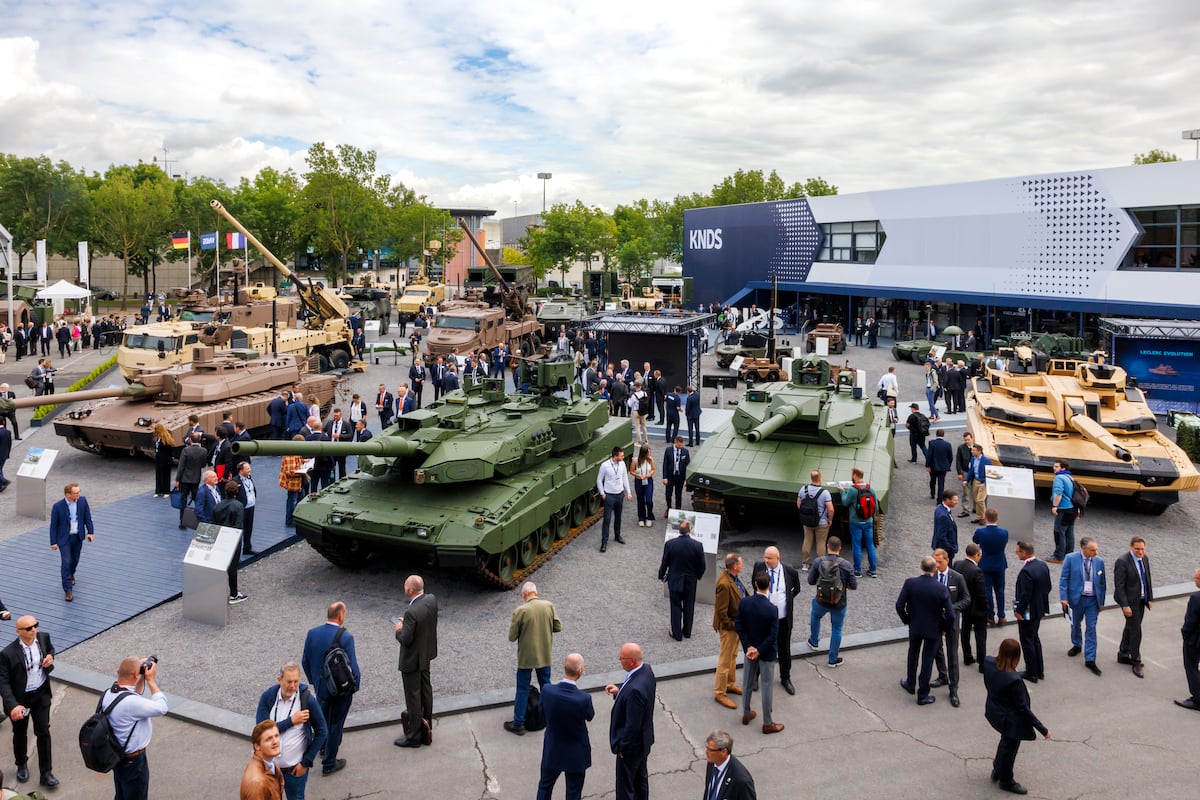
PARIS — This year’s Eurosatory defense show near Paris may be the last chance for European countries to shop for weapons that will still be delivered in time for a possible conflict with Russia, according to the retired French general who heads the company running the event.
With some military experts warning Europe risks a direct confrontation with Russia in the next two years, defense equipment still in development would arrive too late to make a difference at the outbreak of a conflict, said Charles Beaudouin, the CEO of Coges Events, which organizes the show, the largest of its kind by the number of exhibitors.
“It’s the show of the rising perils, to use a term that isn’t too warlike, but it’s clearly a show that is preparing for war,” Beaudouin told Defense News. “The show is the last chance to buy off-the-shelf equipment to be delivered for the war.”
Several European intelligence services have warned Russia could challenge NATO by 2030, with European Commissioner for Defence Andrius Kubilius last November saying the country “ can be ready to test ” the alliance within two to four years. German Lt. Gen. Alexander Sollfrank told Reuters in November that Russia could launch a “small-scale attack” against NATO territory at any time.
If Europe goes to war in the next two years, it will be with what it either possesses already or can acquire in the coming year, according to Beaudouin, the former head of the French army’s equipment office.
“We no longer have time to develop new systems,” the retired general said, arguing that equipment still in development “will arrive too late” should Europe face a military conflict in the next few years. He said the urgency means that wherever European options are not available “we have to go with an American, Korean, Indian or other off-the-shelf solution.”
Surging defense investment means Eurosatory is bigger than ever this year, with the number of exhibitors rising 30% to more than 2,600, and 80% of the defense firms at the show from European NATO countries. While French exhibitors typically make up more than a third of the show, there will be around 180 U.S. companies and some 220 German companies this year, Beaudouin said.
One of the main themes of Eurosatory 2026 will be new weapons on offer, including drones with longer ranges and greater payloads as well as new proposals for ground-launched, long-range missiles. With concerns about long-range missile threats, including from Iran, the show will also feature countermeasures such as a Thales system similar to Israel’s Iron Dome, Beaudouin said.
Charles Beaudouin is CEO of COGES Events, the organizer of Eurosatory. (Coges Events photo)
“Europe, like the United States, will have to equip itself with broad missile defense, including of course hypersonic missile interceptors,” Beaudouin said.
He cited MBDA as one of the exhibitors working on hypersonic technology, while for the missile threat, both the French-Italian SAMP/T air-defense system and the U.S. Patriot system will be on display at the show.
Israel’s presence will be restricted to defensive arms following a French government decision, with firms only able to exhibit air-defense systems, including those against drones and ballistic missiles, the general said. “So there will indeed be Israeli companies at the show, showcasing areas where they excel and for which there is very strong demand from all nations.”
The drone segment at this year’s edition will feature more autonomous systems, particularly in aerial and maritime drones, according to Beaudouin. He said much of the European and U.S. offerings remain focused on “large, very expensive platforms” whereas the experience from Ukraine shows drones are lost very quickly, with that country instead focusing on “extremely basic” platforms.
Beaudouin said that with 80 Ukrainian companies present at this year’s Eurosatory, compared to ten in 2024, “we can be sure we have the full range of state-of-the-art Ukrainian solutions.” The Ukrainian firms will include Fire Point, displaying its Flamingo cruise missile and long-range drones that are hitting Russia, while drone swarms will be another theme, he said.
“Those are capabilities that Europeans don’t have and that they need to buy off the shelf right away,” Beaudouin said. “We need to focus more on emulating the Ukrainians than on developing our own solutions, given how far behind we are compared to them.”
Ukrainian drones are on display at the Eurosatory trade show near Paris on June 17, 2024. (Photo by Patrick Robert/Getty Images)
After Eurosatory 2024 saw the widespread appearance of armed drones, this year’s defining feature will be AI-enabled autonomy, according to the CEO. “We’re accepting the idea that we’re moving more and more toward autonomous weapon systems, we have fewer ethical concerns on the subject, we’re driven by the need to be effective.”
French general staff visiting Eurosatory will be interested in seeing how Ukraine manages to keep costs in check, with unsophisticated, mass-produced weapons that can strike at a distance, according to Beaudouin. He said the question for companies such as Thales and MBDA is how they can offer systems that are efficient, but with fewer bells and whistles.
This year’s show features a surge in the number of drone and counter-drone manufacturers, including companies offering drones “that look pretty rough, they’re really rugged,” but which are expendable and have ranges of 300 or 600 kilometers.
For intelligence, surveillance and reconnaissance drones, the trend is for systems that are “much more rugged” than platforms such as Safran’s Patroller or General Atomics’s MQ-9 Reaper, which “work very well in a permissive environment” but don’t survive in contested airspace, he said.
Eurosatory will feature counter-drone radars that can track hundreds of targets simultaneously, using AI to process the data and pick out targets, “with systems where automation is increasingly taking precedence over human intervention because we don’t have time to react.”
The show will also feature “significantly more” proposals for ammunition and weapons manufacturing lines than in 2024, according to Beaudouin.
Europe faces challenges to scale up production, which is why Volkswagen attending Eurosatory for the first time this year is “very interesting,” because the company can bring automotive-industry practices into defense manufacturing, the general said.
A major trend at Eurosatory 2026 will be what Beaudouin called “the militarization of deep tech,” with disruptive innovation entering the military domain, ranging from artificial intelligence and cloud computing to nanotechnology and quantum technology, as well as the emergence of a private space-flight industry, or new space, with micro-satellites and reusable launchers.
The show will feature AI-based solutions for decision making “throughout the military chain of command, from the four-star general all the way down to the soldier,” Beaudouin said. Technology on show at Eurosatory will include deployable data centers in containers, the first offers for quantum sensors, as well as micro satellites and reusable space launchers.
The show will see more robust and cheaper systems, with Ukraine’s experience highlighting the lack of operational availability of complex systems such as the Panzerhaubitze 2000 self-propelled howitzer and Leopard tanks, even if manufacturers will continue to showcase their bespoke high-end systems, according to Beaudouin.
Eurosatory also speaks to how Europe’s defense industry remains fragmented, with at least twenty to thirty armored-vehicle manufacturers at the show, according to Beaudouin.
One novelty this year will be a section dedicated to banks and investors with 15 exhibitors, which the general called a first for a defense trade show.
“The days when banks didn’t want to finance defense are over,” Beaudouin said. “We’ve realized that there are democracies in danger and autocracies that are dangerous, and banks are beginning to understand they must support this effort.”
Rudy Ruitenberg is a Europe correspondent for Defense News. He started his career at Bloomberg News and has experience reporting on technology, commodity markets and politics.
巴黎——据负责举办此次展会的法国退役将军称,今年在巴黎附近举行的欧洲防务展可能是欧洲各国购买武器的最后机会,这些武器仍能及时交付,以应对可能发生的与俄罗斯的冲突。
一些军事专家警告说,未来两年欧洲可能面临与俄罗斯直接对抗的风险,而仍在研发中的国防装备在冲突爆发时将为时已晚,无法起到作用。Coges Events 的首席执行官 Charles Beaudouin 表示,该公司组织了此次展会,该展会是同类展会中参展商数量最多的。
“用一个不那么好战的词来形容,这场展会展现了日益严峻的形势,但它显然是在为战争做准备,”博杜安告诉《防务新闻》。“这场展会是购买现成装备投入战争的最后机会。”
多个欧洲情报机构警告称,俄罗斯可能在2030年前挑战北约。欧盟防务委员安德留斯·库比柳斯去年11月表示,俄罗斯“可能在两到四年内做好试探”北约的准备。德国陆军中将亚历山大·索尔弗兰克去年11月告诉路透社,俄罗斯随时可能对北约领土发动“小规模袭击”。
法国陆军装备办公室前负责人博杜安表示,如果欧洲在未来两年内卷入战争,那将依靠它已经拥有的或在未来一年内能够获得的装备。
这位退役将军表示:“我们已经没有时间研发新系统了。”他认为,如果欧洲在未来几年内面临军事冲突,仍在研发中的装备“到货太晚了”。他指出,形势紧迫,这意味着凡是欧洲方案不可行的地方,“我们都只能采用美国、韩国、印度或其他国家的现成解决方案”。
国防投资的激增意味着今年的欧洲防务展规模空前,参展商数量增长了30%,超过2600家,其中80%的参展国防企业来自欧洲北约国家。博杜安表示,虽然法国参展商通常占展会的三分之一以上,但今年将有约180家美国公司和约220家德国公司参展。
2026年欧洲防务展的主要议题之一是展示新型武器,包括航程更远、有效载荷更大的无人机,以及新型陆基远程导弹方案。博杜安表示,鉴于人们对包括伊朗在内的远程导弹威胁的担忧,此次展会还将展出一些反制措施,例如泰雷兹公司开发的类似于以色列“铁穹”系统的武器系统。
查尔斯·博杜安是COGES Events的首席执行官,该公司是Eurosatory的组织方。(COGES Events供图)
博杜安说:“欧洲和美国一样,都必须配备全面的导弹防御系统,当然也包括高超音速导弹拦截器。”
他提到 MBDA 是从事高超音速技术研究的参展商之一,而对于导弹威胁,法国-意大利联合研制的 SAMP/T 防空系统和美国的“爱国者”系统都将在展会上展出。
根据法国政府的决定,以色列参展范围将仅限于防御性武器,参展企业只能展示防空系统,包括反无人机和反弹道导弹系统。这位将军表示:“因此,展会上确实会有以色列公司参展,展示他们擅长的领域,以及各国都非常需要的领域。”
据博杜安称,今年的无人机展区将重点展示更多自主系统,尤其是在空中和海上无人机领域。他表示,目前欧美的大部分产品仍然侧重于“大型、昂贵的平台”,而乌克兰的经验表明,无人机很容易丢失,因此该国更注重“极其基础”的平台。
博杜安表示,今年有80家乌克兰公司参加欧洲防务展,而2024年只有10家,“我们可以肯定,届时我们将看到全系列最先进的乌克兰解决方案。” 他说,参展的乌克兰公司包括Fire Point,该公司将展示其“火烈鸟”巡航导弹和正在打击俄罗斯的远程无人机,而无人机群也将是另一个主题。
博杜安说:“这些是欧洲人所不具备的能力,他们需要立即购买现成的解决方案。鉴于我们与乌克兰人之间的差距,我们应该更多地关注如何效仿他们,而不是开发我们自己的解决方案。”
2024年6月17日,乌克兰无人机在巴黎附近的欧洲防务展上展出。(图片来源:Patrick Robert/Getty Images)
据首席执行官称,继2024年欧洲防务展上武装无人机广泛亮相之后,今年的展会亮点将是人工智能赋能的自主系统。“我们接受这样一个理念:我们正越来越多地转向自主武器系统,我们在这方面的伦理顾虑也越来越少,我们追求的是实效。”
据博杜安称,即将访问欧洲防务展的法国总参谋部将关注乌克兰如何利用简单、批量生产的远程打击武器来控制成本。他表示,对于泰雷兹和MBDA等公司而言,关键在于如何提供高效但功能较少的武器系统。
今年的展会上,无人机和反无人机制造商的数量激增,其中包括一些公司提供的无人机“看起来很粗糙,非常坚固耐用”,但这些无人机属于消耗品,飞行范围为 300 或 600 公里。
他说,对于情报、监视和侦察无人机而言,目前的趋势是采用比赛峰集团的“巡逻者”或通用原子公司的MQ-9“死神”等平台“更加坚固耐用”的系统,这些平台“在宽松的环境下运行良好”,但在有争议的空域中无法生存。
欧洲防务展将展出反无人机雷达,该雷达可以同时跟踪数百个目标,利用人工智能处理数据并挑选目标,“这些系统越来越重视自动化,而不是人为干预,因为我们没有时间做出反应。”
据博杜安称,与 2024 年相比,本次展会还将展出“数量显著更多”的弹药和武器生产线提案。
这位将军表示,欧洲在扩大生产规模方面面临挑战,因此大众汽车今年首次参加欧洲防务展“非常有趣”,因为该公司可以将汽车行业的经验引入国防制造领域。
2026 年欧洲防务展 (Eurosatory 2026) 的一个主要趋势将是博杜安所说的“深度技术的军事化”,颠覆性创新将进入军事领域,涵盖人工智能和云计算、纳米技术和量子技术,以及私人太空飞行产业或新太空的出现,包括微型卫星和可重复使用的运载火箭。
博杜安表示,此次展会将重点展示基于人工智能的决策解决方案,“涵盖整个军事指挥链,从四星上将到普通士兵”。欧洲防务展将展出的技术包括集装箱式可部署数据中心、首批量子传感器产品、微型卫星和可重复使用航天器。
据博杜安称,此次展会将展出更坚固、更便宜的系统,乌克兰的经验表明,像 Panzerhaubitze 2000 自行榴弹炮和豹式坦克这样的复杂系统缺乏可操作性,即使制造商将继续展示其定制的高端系统。
据博杜安称,欧洲防务展也反映出欧洲国防工业仍然处于分散状态,展会上至少有二三十家装甲车制造商。
今年的一大亮点是设立了一个专门面向银行和投资者的展区,共有 15 家参展商,这位将军称之为国防贸易展的首创。
博杜安说:“银行不愿为国防提供融资的日子已经结束了。我们已经意识到,有些民主政体正处于危险之中,有些专制政体本身就很危险,银行也开始明白它们必须支持这项事业。”
鲁迪·鲁伊滕贝格是《防务新闻》的欧洲记者。他的职业生涯始于彭博新闻社,拥有报道科技、大宗商品市场和政治方面的经验。